
The Maguiresbridge Interstadial31667 BCE
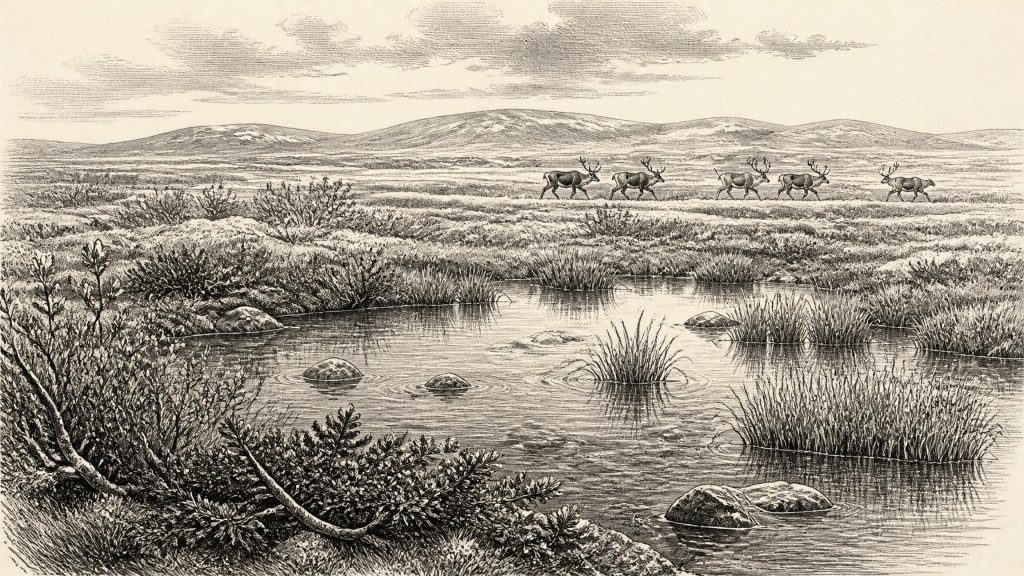
At approximately 31,667 BCE, Ireland lay in the climatically unstable Late Pleistocene, not a historical year with identifiable communities. Freshwater deposits beneath later glacial till at Derryvree, County Fermanagh, and Greenagho indicate ice-free local basins supporting tundra-steppe vegetation, pools, sedges, mosses, dwarf willow and juniper. Cave remains at Castlepook, County Cork, demonstrate varied cold-climate fauna, including reindeer, mammoth, giant deer and predators, though not all were contemporary. A possibly stone-cut reindeer femur may indicate brief Upper Palaeolithic human activity, but remains disputed and proves neither settlement nor hunting. Expanding ice buried, disturbed and erased evidence before the Last Glacial Maximum.
Dateline
Modern calendar-year precision is not available for Ireland in 31,667 BCE. This label is a retrospective convenience, applied tens of millennia before calendars, writing, named communities or political institutions existed on the island. In archaeological terms it lies approximately 33,600 calendar years before 1950, within the Late Pleistocene and broadly within Marine Isotope Stage 3, an exceptionally changeable portion of the last Ice Age. The responsible historical frame is therefore not a supposed event in one year, but a calibrated span of centuries and millennia around it.
For this point in time, the best Irish evidence comes not from settlements or artefacts left in the open, but from deposits protected beneath later glacial sediments and from animal bones in limestone caves. They show that parts of Ireland could support cold-adapted plants and mammals before the island was overwhelmed by the last great expansion of the British–Irish Ice Sheet. They do not provide a continuous narrative, nor do they prove that people lived permanently in Ireland. Their importance lies precisely in the fragments: silts, pollen, seeds, mosses, bones, cave passages and a debated mark on a reindeer femur.
A Date Range Rather Than a Year
The closest securely dated environmental archive is at Derryvree, near Maguiresbridge in County Fermanagh. Road works in 1969 exposed freshwater silts and fine sands trapped between two tills within a drumlin. The organic deposit produced a conventional radiocarbon age of about 30,500 years BP. Calibration has placed it broadly between about 36,900 and 31,700 calibrated years BP. Thus 31,667 BCE falls near the younger end of a wide range relevant to this buried landscape, not at a pinpoint that can be matched to a season, a generation or an individual occurrence.
Another Fermanagh deposit, at Greenagho near Belcoo, has produced organic material dated broadly to about 37,200–35,700 calibrated years BP. Together, the sites demonstrate that north-central Ireland was not continuously entombed beneath ice during this earlier phase of the last glaciation. Yet neither is a complete national climate record. Derryvree and Greenagho preserve local conditions in particular basins; Ireland’s coasts, uplands and western districts could have experienced rather different conditions. Their chronology also carries the uncertainties normal for radiocarbon ages approaching its practical limits.
Fresh Water Under Future Ice
Derryvree is striking because the freshwater sediments were later overridden and buried by ice-derived material. At the time represented by the silts, however, there was standing or slow-moving fresh water in a lowland hollow, with sediment accumulating amid a cold, open landscape. Fossil plant remains and pollen indicate tundra or tundra-steppe conditions rather than forest. Sedges, grasses and herbs were important. Mosses, including cold-tolerant species, help to describe wet ground around pools and marshes. Bogbean and water-milfoil attest freshwater habitats, while dwarf willow and scattered juniper point to low woody vegetation in sheltered places.
This was not a familiar modern Irish countryside transported into the Ice Age. Trees were absent or extremely sparse, and exposed ground would have been shaped by frost, wind and seasonal thaw. Permafrost or strongly periglacial conditions are consistent with the wider evidence, although their local intensity cannot be reconstructed day by day. In summer, shallow water, wet sedge margins and flowering herbs could have made selected hollows comparatively productive. In winter, the same country was a far more severe place: open, treeless and vulnerable to bitter winds.
Animals on an Open Plain
The cave record of southern Ireland supplies the animal dimension. Castlepook Cave near Doneraile, County Cork, has yielded remains attributed to a varied Late Pleistocene fauna: reindeer, woolly mammoth, giant deer, brown bear, wolf, fox, Arctic fox, spotted hyaena and lemmings. Not all the bones belong to one moment. Cave sediments were disturbed in antiquarian excavations, material was deposited over long intervals, and carnivores could carry carcass parts into dens. The collection therefore cannot be treated as a census of animals seen together in 31,667 BCE.
Nevertheless, improved radiocarbon dating has reinforced the broad conclusion that several large mammals reached or survived in southern Ireland during Marine Isotope Stage 3, before the Last Glacial Maximum. Reindeer especially fit the open, cold vegetation suggested in Fermanagh. Mammoths and giant deer indicate that, at least intermittently, the island formed part of a wider north-west European ecological zone capable of sustaining very large grazers and browsers. Predators such as wolf and hyaena remind us that carcasses, rather than human hunters, may account for much of what entered cave chambers.
The landscape was changing rapidly on geological timescales. Research on the last British–Irish Ice Sheet indicates that its growth and maximum were asynchronous across Britain and Ireland. Some Irish areas remained ice-free until around 34,000 years ago, while ice expanded elsewhere or later. By the global Last Glacial Maximum, conventionally placed around 26,000–20,000 calibrated years BP, much or all of Ireland was subject to extensive ice cover. The Derryvree freshwater world belonged to the unstable lead-up to that transformation, when habitable ground still existed but its long-term security was diminishing.
The Castlepook Human Question
The most provocative evidence relevant to this era is a reindeer femur from Castlepook. It has been presented by zooarchaeologist Ruth Carden as bearing a deep incision made with a sharp stone edge while the bone was fresh, and it has been publicly dated to about 31,000 BC. If that interpretation is confirmed, it would represent evidence that Upper Palaeolithic people butchered a reindeer in Ireland far earlier than the island’s formerly accepted record of human activity.
That conclusion needs careful wording. The bone is evidence for an animal of great age; the identification of the incision as a human tool mark is a separate taphonomic interpretation. No associated stone toolkit, hearth, dwelling floor, human skeleton or securely excavated butchery site has yet established a permanent human population at Castlepook. Nor can the cave prove that the animal was killed there. A plausible reconstruction is that hunters processed a carcass somewhere in the surrounding landscape and that scavengers later transported discarded remains into the cave. But this remains a hypothesis, not a recovered scene.
The wider European setting makes a short-lived visit conceivable. Upper Palaeolithic hunter-gatherers were living in parts of Britain and continental Europe, using stone tools and pursuing large game. Lower sea levels reshaped the seas around north-west Europe, but the exact nature, timing and usefulness of routes between Ireland, Britain and the continent remain contested. One should not imagine a simple permanent land bridge or a straightforward migration corridor. A human presence in Ireland at this date, if the Castlepook mark proves anthropogenic, may have been brief, mobile and archaeologically almost invisible.
No States, No Diplomacy
There is no evidence for political affairs in the later historical sense: no chiefs known by name, territories, law, diplomacy, tribute, warfare, monuments or collective institutions can be assigned to Ireland at this time. Even the existence of a resident human group is unproven. It would be misleading to invent clans, rituals or rival hunting territories from a single marked bone and a scattered faunal collection. Conflict can be discussed only at the ecological scale: animals competed for food and shelter, predators hunted prey, and any people who entered this landscape faced serious risks from weather, isolation and carnivores.
Similarly, nothing direct can be said about religion, language, stories, music, art or formal learning in Ireland around this date. Upper Palaeolithic communities elsewhere in Europe possessed rich social and symbolic practices, but that continental evidence cannot simply be projected across the Irish Sea. If people did reach Ireland, they surely brought knowledge: routes, seasonal animal behaviour, stone-working skills, fire-making and the practical co-operation required for hunting and survival. Such knowledge is an inference from human lifeways elsewhere, not an Irish archaeological fact.
Economy Without Markets
There was no economy of farms, coinage, towns or long-distance trade documented in Ireland. The only economically relevant possibility is mobile hunting and scavenging. Reindeer would have supplied meat, fat, hide, sinew, antler and bone; large mammals could yield substantial returns but also required planning, tools and social co-operation to exploit safely. Yet no Irish stone tools of this age have been recovered to demonstrate that such work occurred on a regular basis. The Castlepook femur can at most suggest one episode of carcass processing.
The strongest story for 31,667 BCE is consequently environmental. Ireland was not yet the green, wooded island familiar from later prehistory. In and around Fermanagh, freshwater basins lay amid open tundra vegetation; in southern limestone country, caves accumulated traces of cold-climate animals and carnivores. Ice was a growing presence in the wider region, although its timing and extent varied. This was a landscape capable of supporting life, perhaps occasionally including visiting humans, but one about to be profoundly altered by advancing ice.
What the Evidence Can Bear
For Ireland around 31,667 BCE, evidence and interpretation must remain distinct. The evidence includes freshwater sediments beneath till at Derryvree, dated organic deposits at Fermanagh sites, cold-climate plant fossils, and Pleistocene animal remains from caves including Castlepook. Interpretation connects them into a picture of open, periglacial habitats and a shifting pre-maximum glacial landscape. The possibility of human butchery at Castlepook is important, but remains more fragile than the environmental record.
That restraint does not make the period empty. It reveals an Ireland whose history was written in ecological opportunity and climatic instability: sedges growing at a pool edge, reindeer moving across exposed country, carnivores using caves, and glaciers preparing to erase or bury much of the surface record. The Maguiresbridge deposits preserve an unusually vivid window onto that lost world. They also explain why certainty is scarce. The later ice sheet did not merely reshape the island; it removed, mixed and sealed much of the evidence by which its earliest possible inhabitants might otherwise be known.
Primary Sources
- A Middle Midlandian Freshwater Series at Derryvree, Maguiresbridge, County Fermanagh, Northern Ireland
- Middle Midlandian Interstadial Deposits at Greenagho, Near Belcoo, County Fermanagh, Northern Ireland
- Trimlines, Blockfields and the Vertical Extent of the Last Ice Sheet in Southern Ireland
- Growth and Retreat of the Last British–Irish Ice Sheet, 31,000 to 15,000 Years Ago: the BRITICE-CHRONO Reconstruction
- A Reconsideration of the Radiocarbon Dating of the Marine Isotope Stage 3 Fauna from Southern Ireland
- The Irish Quaternary Fauna Project
- Phylogeographic, Ancient DNA, Fossil and Morphometric Analyses Reveal Ancient and Modern Introductions of a Large Mammal: the Complex Case of Red Deer (Cervus elaphus) in Ireland
- First Evidence of a Late Upper Palaeolithic Human Presence in Ireland
- Revisiting Alice and Gwendoline Cave, Co. Clare: New Light on the 1902 Excavations
- New Insights on the Fauna of Ireland's Younger Dryas and Early Holocene from Alice & Gwendoline Cave
- Castlepook Cave, Co. Cork, 2022: 32564
- Heritage Artefacts of County Cork
- Palaeoecology
- Figure 6.—The Subdivision of the Quaternary Period in Ireland
- ESCR Site Summary: Late Pleistocene Vegetation in Northern Ireland
- Aghnadarragh
- The Problem of a Late Quaternary Landbridge Between Britain and Ireland
- The Island of Ireland: Drowning the Myth of an Irish Land-Bridge?
- Anthropogenic Changes to the Holocene Nitrogen Cycle in Ireland
- The Colonization of Ireland: A Human Ecology Perspective
- Pleistocene Vertebrates in the British Isles
- Irish Quaternary Association: Outreach and Education Resources
- Geology: Educational Resources