
Mammoth Cave’s Unsettled Signal31605 BCE
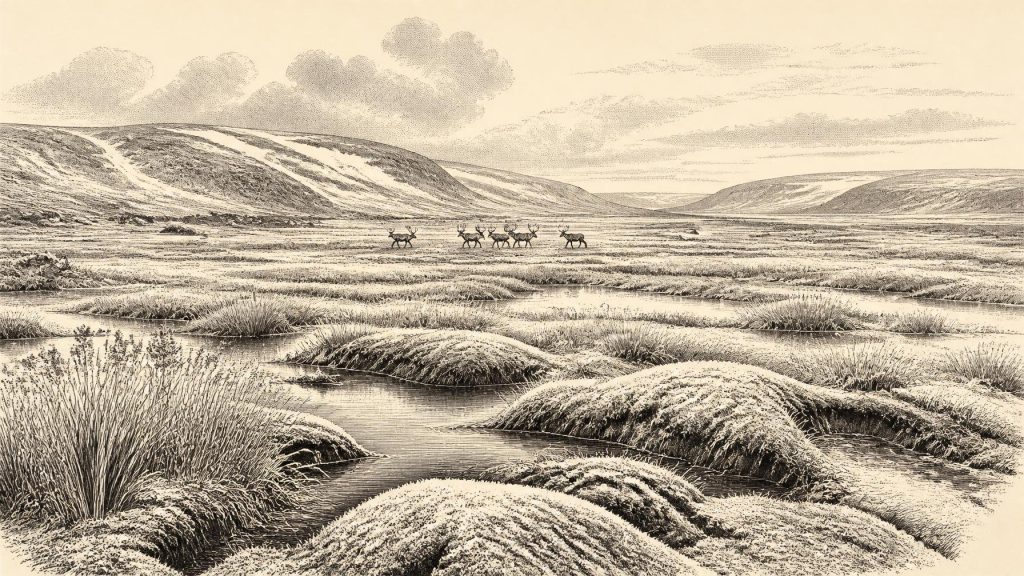
Around 31,605 BCE, Ireland had no inhabitants or calendar, and evidence permits only broad reconstruction. During climatically unstable Marine Isotope Stage 3, expanding ice, lower sea levels and altered coastlines created cold, open, regionally variable environments. Derryvree sediments in Fermanagh preserve tundra-like wetland vegetation between glacial deposits. Castlepook Cave in Cork contains MIS 3 fauna, including mammoth, reindeer and predators, accumulated over long periods. A reported cut-marked reindeer femur, dated about 33,000 years ago, may indicate human carcass processing, but insecure context prevents proof of settlement. Later glaciation destroyed much evidence; surviving fragments demonstrate environmental change and plausible human visits.
Dateline
Modern calendar-year precision is not available for Ireland in 31,605 BCE. The label is a useful point on a modern timeline, not the anniversary of a known event: there was no written calendar, no named community and no historical record from the island. In the conventional archaeological notation of years before AD 1950, it falls roughly 33,554 years before present, within Marine Isotope Stage 3 (MIS 3), a long and climatically variable part of the Last Glacial period. At this depth of time, evidence is dated as ranges, probabilities and broad phases. The question is therefore not what happened in one Irish year, but what the surviving deposits responsibly allow us to say about Ireland around the middle 30,000s calibrated years ago.
A Landscape Before Maximum Ice
The great ice-sheet maximum lay ahead, rather than being a single condition already fixed across the island. The British–Irish Ice Sheet grew rapidly during the later part of MIS 3 and reached its greatest overall area much later, around 26,000 years ago. Its margins did not advance everywhere at once. Accordingly, it is misleading to picture all Ireland in 31,605 BCE as buried beneath an unbroken ice cap, but equally misleading to imagine a mild green island. This was an unstable cold-world setting in which glaciers, periglacial ground and open habitats could all matter, varying by region and changing over generations beyond the resolution of the evidence.
Ireland’s physical geography was also unlike that of today. Global sea level was lower during the glacial period, and the shelves, coastlines and routes between Ireland, Britain and continental Europe were altered. Yet the precise nature of access at any given moment remains uncertain. It cannot responsibly be claimed that people simply walked to County Cork on a demonstrated land bridge, nor that they necessarily crossed open sea by boat. The relevant evidence is geological and palaeogeographical, not a mapped route used by a documented party of travellers. What can be said is that animal populations did reach Ireland during portions of MIS 3, showing that the island was not an ecological void.
Derryvree’s Buried Wetland
One of the most revealing Irish environmental records comes not from a cave but from sediments at Derryvree, near Maguiresbridge in County Fermanagh. There, freshwater silts and sands containing organic material were preserved between two tills, the sediments laid down by glaciers. The enclosing tills show that the site experienced ice before and after the wetland interval; the intervening layers preserve a landscape that later glaciation sealed from view. A radiocarbon determination of about 30,500 ± 1,100 radiocarbon years BP has been calibrated broadly to a span that includes the mid-30,000s to low-30,000s calendar years BP. It illuminates the period around this article’s date, but cannot identify conditions in 31,605 BCE itself.
Pollen, plant remains, mosses and insects from this kind of archive point to open, treeless vegetation: cold-tolerant herbs, sedges, dwarf shrubs and wet-ground communities rather than closed woodland. The word “tundra” is useful if understood as a broad ecological comparison, not as proof that every hill and valley looked identical. Parts of the terrain likely included damp, peaty margins, shallow water and mineral ground exposed to frost action. Such places could provide plant food for herbivores and seasonal feeding grounds, while remaining harsh environments for large mammals and any humans who entered them. The archaeological importance of Derryvree is that it supplies direct Irish evidence for habitat rather than relying wholly on analogies from Britain or mainland Europe.
Castlepook’s Animal Archive
In north County Cork, Castlepook Cave near Doneraile—historically called Mammoth Cave—provides the outstanding faunal archive for this broad pre-maximum interval. Excavations in the early twentieth century recovered a substantial collection that includes remains attributed to woolly mammoth, reindeer, giant deer, brown bear, wolf, Arctic fox, hare, lemmings and spotted hyaena. The list is impressive, but it must not be turned into a single illustrated procession through the cave entrance. Bones accumulated over time, and species did not necessarily coexist at Castlepook on the same day, in the same season or even in the same millennium. Revised radiocarbon work has shown that some southern Irish cave fauna belongs in MIS 3, while also indicating that giant deer and spotted hyaena may have disappeared locally before about 40,000 calibrated years BP.
The most secure conclusion is that parts of Ireland supported a shifting cold-stage fauna between roughly 45,000 and 20,000 years ago. Reindeer are especially significant to a date such as this one because they are animals of open northern environments and because their bones could have represented a valuable resource to predators, scavengers and people. Mammoth and giant deer evoke a large-bodied fauna, but their presence does not demonstrate systematic human hunting. Spotted hyaena is an equally important corrective to romantic scenes of human mastery: caves could be carnivore dens, traps, shelters, drainage channels and bone repositories. Tooth marks, transport by scavengers, weathering, collapse and water movement can all shape an assemblage before archaeologists ever see it.
The Reindeer Femur Question
Castlepook matters to Irish human history because a reindeer femur from the old collection has been publicly reported as dating to about 33,000 years ago and as carrying a deep mark interpreted as fresh-bone butchery with a sharp stone tool. If that diagnosis and association are confirmed through full scholarly publication and further work, it would be extraordinarily early evidence that Upper Palaeolithic people handled a reindeer carcass in Ireland. It would fit the wider fact that Homo sapiens lived elsewhere in north-west Europe during MIS 3. But it would still be evidence of an action on an animal, not automatically of a settlement, population or homeland.
Caution is essential because Castlepook’s principal bone collection came from excavations undertaken before modern standards of stratigraphic recording, systematic sieving and contamination control. The date of a bone measures the death of that animal within a statistical range; it does not alone date every nearby specimen, the mark upon it, or the time when it entered the cave. Nor does one possible cut mark establish whether a person killed the reindeer, found a carcass, removed a limited portion of meat or tendon, or processed it elsewhere before a carnivore carried the bone underground. Fresh excavation at Castlepook has sought surviving undisturbed deposits precisely because firmer associations—tools, hearths, charcoal, more modified bone or occupation surfaces—would transform the strength of the case.
For now, the reindeer femur should be described as a potentially crucial indication of brief human activity around this broad period, not as proof of continuous habitation. That restraint also explains why the National Museum of Ireland’s general public account still states that clear Palaeolithic human presence has not yet been demonstrated. It reflects a properly high evidential threshold: a securely excavated assemblage is stronger than a remarkable but contextually difficult specimen. The later cut-marked bear bone from Alice and Gwendoline Cave in County Clare remains the better established evidence for Upper Palaeolithic activity, though it is many millennia younger than the date considered here.
Life, If Visitors Were Present
There is no basis for writing political history for Ireland at this date. No rulers, polities, territorial boundaries, diplomacy, warfare, law or collective institutions can be identified. Likewise, there is no Irish evidence for farming, herding, metalworking, monuments, formal burial, cave art, literacy, ritual sites or long-distance trade in 31,605 BCE. Terms such as “Irish”, “Gaelic” or “Celtic” would be deeply anachronistic if applied to any people who may have visited the island.
If humans did reach the Cork landscape, the reasonable inference is of mobile hunter-gatherers operating in very small groups and making decisions around weather, animal movement, shelter and fuel. Their practical knowledge may have included stone-tool use, carcass processing and the navigation of cold open country. Those are possibilities supported by the proposed modified femur and by the wider Upper Palaeolithic context, not documented facts about a Castlepook camp. No Irish dwelling, hearth, tool kit, ornament or human bone of this age permits a reconstruction of clothing, language, family organisation, beliefs or artistic practice. European examples can suggest what was possible; they cannot supply missing Irish evidence.
The same distinction governs economy and exchange. A reindeer carcass, if processed by people, would have yielded meat, fat, hide, sinew and bone, but there is no evidence that these materials entered an organised Irish economy or exchange network. Hunting itself need not have been a local undertaking: visitors might have ranged from a wider population based beyond Ireland. Equally, the bone could ultimately prove to bear non-human damage. The most responsible account preserves both possibilities rather than choosing a dramatic narrative prematurely.
A Record of Change, Not a Founding Year
The central development around 31,605 BCE was environmental vulnerability. Ireland was part of a north-west European world in which climate oscillated, ice was expanding and habitats could be fragmented or erased. Subsequent glaciation stripped landscapes and disturbed or buried earlier evidence, helping to explain why the island’s Palaeolithic record is so slight. Caves and rare sub-till wetlands are therefore disproportionately important: they are not a full national archive but fragments that survived an exceptional process of destruction.
For this point in deep time, Ireland offers no year-by-year chronicle. It offers a cold wetland beneath Fermanagh till, a cave-bone archive in the Awbeg valley, and one debated reindeer femur that may eventually alter the story of first human visits. Those traces establish a landscape inhabited by animals and undergoing profound climatic change. They make a short human presence plausible enough to investigate seriously, but they do not yet reveal a permanent community. That uncertainty is not a failure of the record; it is the most important historical fact the record provides.
Primary Sources
- A reconsideration of the radiocarbon dating of the Marine Isotope Stage 3 fauna from southern Ireland
- The Irish Quaternary Fauna Project
- New insights on the fauna of Ireland's Younger Dryas and Early Holocene from Alice & Gwendoline Cave
- Growth and retreat of the last British–Irish Ice Sheet, 31,000 to 15,000 years ago: the BRITICE-CHRONO reconstruction
- Late Pleistocene chronostratigraphy and ice sheet limits, southern Ireland
- The IntCal20 Northern Hemisphere Radiocarbon Age Calibration Curve (0–55 cal kBP)
- Quaternary deposits and glacial stratigraphy in Ireland
- Extent and deglacial chronology of the last British–Irish Ice Sheet: implications of exposure dating using cosmogenic isotopes
- Trimlines, blockfields and the vertical extent of the last ice sheet in southern Ireland
- Timing and pace of ice-sheet withdrawal across the marine–terrestrial transition west of Ireland during the last glaciation
- The deglaciation of the western sector of the Irish Ice Sheet from the inner continental shelf to its terrestrial margin
- Lateglacial vegetation and environment in Ireland: First results from four western sites
- Advances in Irish Quaternary Studies
- Regional Pleistocene Geology
- The Quaternary of South Fermanagh
- Spotted Hyena Skull
- Prehistoric Details: Mell Flint Flake
- 2022:564 – Castlepook Cave, Castlepook South, Cork
- Archaeological Heritage of County Cork
- The IntCal20 Northern Hemisphere Radiocarbon Age Calibration Curve (0–55 cal kBP) PDF