
The Castlepook Butchery Debate31577 BCE
At the modern filing date of 31,577 BCE, Ireland was a climatically unstable Ice-Age landscape, not a documented society. Derryvree, County Fermanagh, preserves evidence of a treeless, cold wetland existing between glacial advances, though its dated range cannot describe a single year. Castlepook Cave, County Cork, contains MIS 3 animal remains, including mammoth, reindeer, giant deer, hyaena and wolf, but its mixed cave deposits do not represent one community. A cut-marked reindeer femur, dated around 33,000 years ago, may indicate human butchery. It supports possible brief visits by hunter-gatherers, not continuous settlement, institutions or cultural traditions with certainty in Ireland.
Dateline
Modern calendar precision cannot be carried back to 31,577 BCE. No one in Ireland recorded a year, season or event at this depth of time, and the surviving evidence cannot distinguish one calendar year from the next. The date is best treated as a modern filing point: approximately 33,526 calendar years before AD 1950 (cal BP), within the later part of Marine Isotope Stage 3, a climatically unsettled phase of the last Ice Age. The most responsible history of Ireland at this point is therefore a history of dated ranges, fossil deposits and geological traces—not a narrative of named people or year-specific happenings.
An Island Before the Ice Maximum
Around this broad horizon, Ireland had not yet reached the fullest extent of the last British–Irish Ice Sheet. That later maximum belongs principally to the period after about 26,000 cal BP, while evidence from southern Ireland shows that the major glacigenic deposits there were laid down after roughly 24,000 cal BP. The island’s landscapes were nevertheless part of a cold North Atlantic world in which temperature, sea level, rainfall, vegetation and ice margins changed sharply over long periods and sometimes abruptly over shorter ones.
It would be misleading to picture a single uniform Ireland. Some ground may have supported open, cold-climate habitats while high ground, northern districts and areas close to expanding ice were more severely affected. Rivers carried seasonal meltwater; frozen or repeatedly thawing soil shaped slopes and valley floors; winds redistributed fine sediment. Lower global sea levels altered the surrounding shelf seas and exposed land now underwater, but they do not license a simple image of a permanent dry-land bridge to Britain or continental Europe. Routes into and out of Ireland depended upon shifting coastlines, sea passages, ice, weather and the ecology of the intervening terrain.
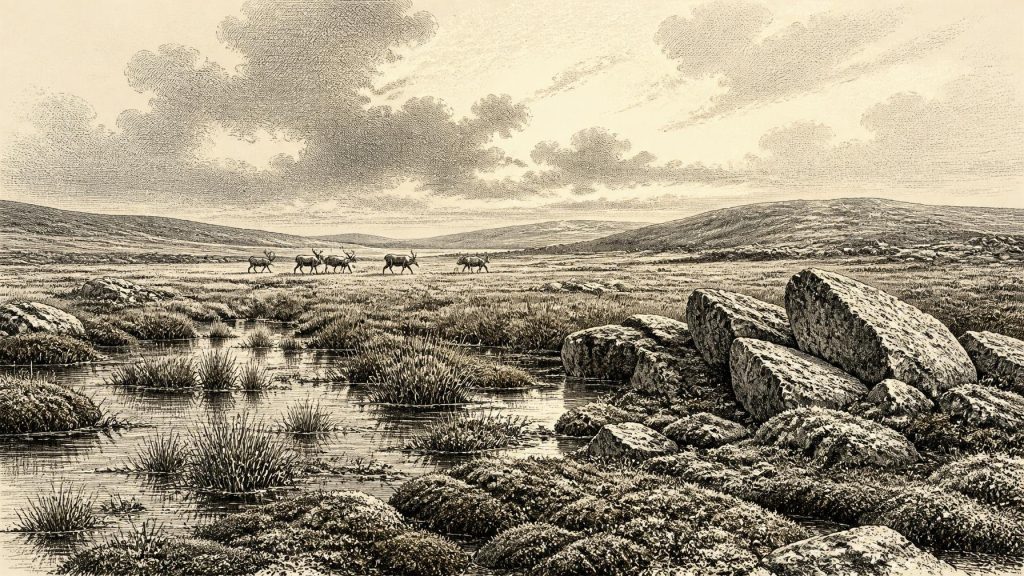
Nor was this the familiar green island of later millennia. There were no oak woods, hazel scrub, enclosed fields, pasture farms or permanent villages. The available evidence instead points towards a sparse, highly seasonal mosaic of open ground, wet hollows, pools, sedge-rich vegetation and cold-adapted plants. It was a potentially habitable landscape in places, but one in which shelter, food and reliable movement would have been difficult and changeable.
Derryvree’s Buried Wetland
The clearest Irish environmental record relevant to this date comes from Derryvree near Maguiresbridge in County Fermanagh. Roadworks exposed organic freshwater silts and fine sands caught between two layers of glacial till within a drumlin. Till is sediment deposited by glacier ice. The sequence is valuable precisely because it preserves an interval when vegetation and freshwater existed at the site before a later ice advance buried and reshaped it.
Organic material from Derryvree produced a radiocarbon determination of about 30,500 ± 1,100 radiocarbon years BP. Raw radiocarbon years are not calendar years: atmospheric carbon-14 has varied through time, and results must be calibrated against independently dated records. Published calibration places the Derryvree material broadly between about 36,900 and 31,700 cal BP. Thus 31,577 BCE lies close to, but just beyond, the younger edge of this wide calibrated range. It remains relevant as the nearest securely dated Irish environmental window, but it must not be represented as a weather report for the exact numbered year.
Pollen, plant macrofossils, mosses and insect evidence from the deposit indicate a treeless tundra or muskeg environment. Sedges, mosses, bogbean and lesser clubmoss are among the informative traces. These do not recreate a picturesque continuous meadow. They suggest wet, peaty ground with shallow freshwater, low vegetation and a short growing season, set within a periglacial regime. The word “periglacial” describes terrain affected by intense freezing and thawing near glaciers or ice sheets; it does not mean that Derryvree itself lay beneath ice when the sediments accumulated.
This northern record is especially important because it counters two opposite simplifications. Ireland was not necessarily sealed beneath unbroken ice throughout the whole late Ice Age, but neither was it a mild refuge resembling the modern countryside. At Derryvree, life persisted in a cold wetland landscape between glacial episodes. The evidence demonstrates ecological opportunity, not comfort or permanence.
Castlepook’s Animal Archive
In southern Ireland, Castlepook Cave near Doneraile, County Cork, provides the principal animal archive for the wider period. Excavations there, undertaken largely in the early twentieth century, recovered remains of woolly mammoth, giant deer, reindeer, brown bear, wolf, Arctic fox, mountain hare, lemmings and spotted hyaena. The National Museum of Ireland holds important material from the cave, and the Irish Quaternary Fauna Project has transformed understanding of its chronology by applying improved accelerator radiocarbon methods to old collections.
The fauna demonstrates that, at different times during Marine Isotope Stage 3, Ireland formed part of a wider north-west European cold-stage ecological zone. Reindeer and lemmings are consistent with open, cold country; mammoth and giant deer imply extensive forage somewhere in the accessible landscape; hyaenas, wolves and bears reveal a food web containing large scavengers and predators. Yet the list is not a census from one afternoon beside the Awbeg valley. Individual animals may have lived centuries or millennia apart, and different species need not have shared precisely the same local habitat.
Caves are complicated archives. Animals may die inside them, fall into fissures, be carried in by water, or be dragged in by carnivores. Hyaenas are especially significant because dens can accumulate bones from prey and carrion collected elsewhere. Early excavations also lacked the stratigraphic recording expected today, while later disturbance by water and sediment could further mix materials. Direct dates establish the age of particular bones more firmly than the date of a single undisturbed occupation layer.
Recent redating has shown that several earlier measurements from Castlepook were thousands of radiocarbon years too young. This revision places important portions of the faunal collection securely within MIS 3 and indicates that some species, including spotted hyaena and giant deer, may have disappeared locally before the Last Glacial Maximum. The lesson is both exciting and cautionary: the Irish Ice-Age record is richer than once thought, but its chronology has been revised through laboratory work and remains open to further refinement.
A Mark on a Reindeer Bone
The most consequential question for human history concerns a reindeer femur from Castlepook. The bone has been dated to around 33,000 years ago and bears a deep mark interpreted by zooarchaeologist Ruth Carden as having been made by a sharp stone implement on fresh bone. If that interpretation is sustained, it is evidence that people processed a reindeer in Ireland during the Upper Palaeolithic—far earlier than the previously secure evidence for human activity on the island.
The distinction between observation and interpretation matters. The direct date applies to the animal’s death, while the identification of the incision as a human-made cut or chop mark depends upon expert analysis of its form and context. Even if human modification is accepted, the find does not establish where the animal was killed, whether it was hunted or scavenged, what part of the carcass was removed, or whether the cave was visited by people. County Cork heritage material reasonably suggests that a butchered carcass may have been taken into the cave later by scavengers.
There is, as yet, no securely associated hearth, stone-tool assemblage, dwelling surface, burial or repeated occupation sequence of this age in Ireland. It follows that settled population, family size, language, political organisation and social identity cannot responsibly be reconstructed for 31,577 BCE. Brief visits by mobile hunter-gatherers are possible, and the marked femur may preserve one such encounter; continuous human residence is not demonstrated. Nor can Irish evidence identify a particular European cultural group, despite the flourishing diversity of Upper Palaeolithic societies elsewhere in Europe.
No Politics, But Real Constraints
There is no evidence for political institutions, leaders, diplomacy, territorial states or organised warfare in Ireland at this date. Even the presence of people remains tentative. It would be anachronistic to populate the island with tribes, nations or later ethnic labels. If small groups did cross into Ireland, their immediate concerns would have been practical: moving through unfamiliar country, finding shelter and fuel, obtaining meat and fat, processing hides and bone, avoiding predators, and judging rapidly changing weather.
For the same reason, religion, art, formal learning and trade cannot be described as Irish institutions in this year. A stone-marked bone does not reveal ceremonies or beliefs; animal remains do not prove exchange networks. Wider European comparison can show that Upper Palaeolithic people elsewhere possessed sophisticated technologies, social relationships and symbolic cultures, but comparison is not evidence that those practices occurred in Ireland. The island’s record offers no known cave art, portable art, grave, house or tool kit from this horizon.
What can be said is more modest, but historically important. Ireland was an intermittently accessible, ecologically varied northern landscape before the great ice expansion. Its cold wetlands supported specialised plant communities; its open terrain at times sustained large herbivores and formidable carnivores; and a single modified reindeer bone raises the possibility of a much deeper human story than older textbooks allowed. Around 31,577 BCE, Ireland was not yet a country of recorded communities. It was a changing Ice-Age environment whose buried silts and cave bones preserve fragments of lives, journeys and encounters that cannot be reduced to one year.
Primary Sources
- A Reconsideration of the Radiocarbon Dating of the Marine Isotope Stage 3 Fauna from Southern Ireland
- The Irish Quaternary Fauna Project
- Late Pleistocene Chronostratigraphy and Ice Sheet Limits, Southern Ireland
- Maximum Extent and Dynamic Behaviour of the Last British–Irish Ice Sheet West of Ireland
- Dimensions and Chronology of the Last Ice Sheet in Western Ireland
- Deglaciation Chronology of the Donegal Ice Centre, North-West Ireland
- Extent and Retreat History of the Barra Fan Ice Stream Offshore Western Scotland and Northern Ireland During the Last Glaciation
- The IntCal20 Northern Hemisphere Radiocarbon Age Calibration Curve (0–55 cal kBP)
- Advances in Irish Quaternary Studies
- Figure 6.— The Subdivision of the Quaternary Period in Ireland
- Quaternary Site Descriptions
- Spotted Hyena Skull
- Heritage Artefacts of County Cork
- 32564: Castlepook Cave, Castlepook, Doneraile, Cork
- BSBI: Menyanthes trifoliata
- BSBI: Selaginella selaginoides
- Soils of County Waterford
- Episodic Speleothem Deposition Tracks the Terrestrial Impact of Millennial-Scale Climate Change During Marine Isotope Stage 3
- Ice Sheet Limits and Chronostratigraphy in the Southern Sector of the Last Irish Ice Sheet
- Quaternary Geology of Ireland