Derryvree’s Treeless Muskeg31557 BCE
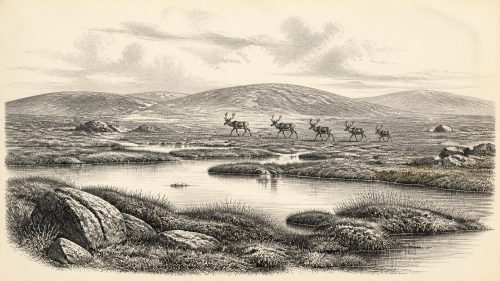
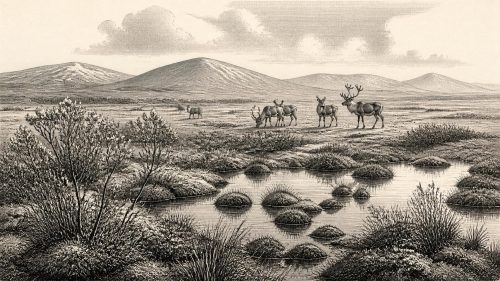
Around 31,557 BCE, Ireland lay within the unstable later Pleistocene climate of Marine Isotope Stage 3, not a documented historical era. At Derryvree, County Fermanagh, freshwater sediments between tills reveal a locally ice-free, treeless muskeg of mosses, sedges and cold-adapted plants during an interval between glacier advances. Castlepook Cave, County Cork, preserves evidence of diverse fauna, including mammoth, reindeer, giant deer, predators and scavengers, indicating open steppe-tundra habitats at different times. A possibly tool-marked reindeer femur may suggest brief human activity, but lacks associated archaeology. Environmental change, animal movements and uncertain human presence define this remote period in Irish prehistory.

Dateline
31,557 BCE is not a date at which Irish history can be narrated year by year. It is a modern calendar label projected onto a time nearly 33,500 calendar years before 1950, the conventional reference point for radiocarbon dating. No written record, annual sequence, named community or securely dated Irish event reaches this far back. The responsible frame is therefore the later part of the Pleistocene, broadly Marine Isotope Stage 3, and the evidence consists of cave bones, buried sediments, pollen and plant remains, glacial landforms, and scientific dates with substantial margins of uncertainty.
That caution matters especially here. A radiocarbon determination is not a calendar date, and calibrated ranges at this depth of time remain broad. IntCal20, the principal Northern Hemisphere calibration curve, is built from several natural archives and explicitly incorporates uncertainties in both radiocarbon and calendar ages. Around 31,557 BCE, it is more accurate to speak of a changing phase within later MIS 3 than of a particular season or episode.
A Landscape Between Ice Advances
Ireland at this point was not the green, wooded island of later prehistory. It lay within the unstable climatic world that preceded the fullest Late Pleistocene ice expansion. The Last Glacial Maximum is generally placed later, roughly 26,500–19,000 years ago, but the growth of the British–Irish Ice Sheet was neither simple nor simultaneous. Different Irish sectors advanced, stagnated and retreated at different times. Reconstructions based on hundreds of dates show maximum extents ranging broadly from about 30,000 to 22,000 years ago across the wider ice sheet system; the later Irish maximum is especially well evidenced offshore and in the south and west.
The key Irish warning against any island-wide reconstruction comes from Derryvree, near Maguiresbridge in County Fermanagh. A road cutting through a drumlin exposed silts and fine sands containing freshwater organic material between two distinct tills. In plain terms, glacier ice had deposited one layer of till, an interval of non-glacial freshwater and wetland sediment followed, and a later ice advance sealed that record beneath another till. The original study obtained a radiocarbon determination of 30,500 ± 1,100 radiocarbon years BP from the organic deposits. This is evidence that this part of Fermanagh was ice-free during a cold-stage interval; it is not proof that the whole island was simultaneously free of ice.
Modern calibration places the Derryvree determination across a wide span in the later Pleistocene, broad enough to overlap the notional date considered here. It cannot locate 31,557 BCE within a particular layer, much less identify a day in the life of the wetland. Yet it provides an exceptionally useful local anchor: northern Ireland could contain open, waterlogged ground between glacial advances. The drumlin that now dominates the setting is itself part of the later story of ice movement and deposition.
Fermanagh’s Cold Wetland
Derryvree’s plant remains give the clearest picture of a living Irish environment close to this broad horizon. The assemblage has been described as treeless muskeg: a cold, saturated landscape of mosses, sedges and shallow freshwater rather than forest. Fossil evidence includes bogbean (Menyanthes trifoliata) and mountain avens (Dryas octopetala), plants strongly associated with cool conditions and open ground. Such species do not provide a photograph of the entire island, but together with the sedimentology they support the interpretation of periglacial wetland, with seasonal thaw water, exposed mineral ground and a low, sparse vegetation cover.
This was a climate of abrupt North Atlantic shifts, not an unchanging “Ice Age”. Greenland ice-core records show repeated sharp transitions between colder stadials and comparatively milder interstadials during the last glacial period. Ireland’s weather was governed by that wider North Atlantic system, although its local expression depended on elevation, exposure, ice margins and drainage. The evidence permits a landscape of severe winters, short growing seasons and cold-adapted plant communities. It does not justify assigning an exact temperature, annual snowfall total or weather event to this particular numbered year.
The Doneraile Fauna
In north County Cork, Castlepook Cave—also known as Mammoth Cave or Doneraile Cave—offers a different window. Its old collections contain remains of mammoth, giant deer, reindeer, brown bear, wolf, Arctic fox, lemmings and spotted hyena. The variety demonstrates that, at different points during the Pleistocene, Ireland supported or received a remarkably rich cold-climate mammal fauna. It also points towards open grassland, herb-rich steppe-tundra and broken rocky refuges rather than closed woodland. The National Museum of Ireland notes that spotted hyena and other mammals are thought to have migrated from Britain to Ireland during the approximate 45,000–30,000-year interval.
There is, however, a vital complication. Castlepook is not a sealed camp floor. Much of its fauna was recovered in antiquarian excavations, and cave deposits have been affected by carnivore activity, sediment movement and earlier collecting practices. The Irish Quaternary Fauna Project used accelerator mass spectrometry to show that specimens in Irish cave collections could belong to very different periods. A later reassessment of Castlepook’s MIS 3 fauna, using improved preparation and dating, shifted some animal ages thousands of radiocarbon years older than earlier results. Therefore mammoth, hyena and reindeer remains establish a long-lived faunal history, not a single community all present together in 31,557 BCE.
For all that, Castlepook is directly relevant to this date. A conventional radiocarbon result on a mammoth femur from the cave was 33,500 ± 1,200 BP, while revised work has shown that several Castlepook animals belonged deep within MIS 3. The cave demonstrates that southern Ireland was periodically habitable for large grazers and their predators before the later ice maximum. Reindeer and mammoth also imply wider ecological connections beyond the modern coastline, although the exact routes used by animals remain uncertain. Lower sea levels exposed substantial shelf landscapes around north-west Europe, but research on Irish relative sea level cautions against assuming one simple, permanent dry land bridge between Ireland and Britain.
The Human Question
A single Castlepook reindeer femur makes this period unusually important. County Cork heritage material presents it as a Palaeolithic bone of about 31,000 BCE, with a deep mark interpreted by zoologist Ruth Carden as having been made by a sharp stone tool while the bone was fresh. If that interpretation is confirmed, it is evidence that Upper Palaeolithic people processed a reindeer in Ireland or handled its carcass shortly after death. It would greatly extend the island’s human archaeological record.
But the distinction between evidence and interpretation must remain firm. The dated object is animal bone, not a human skeleton; the incision is a proposed butchery mark, not a stone tool; and the find lacks a securely associated hearth, occupation surface, tool assemblage, dwelling, burial or art. The bone cannot identify the people involved, their language, the duration of a visit, the place of the kill, or whether they returned. Nor does it demonstrate a resident population. The most securely dated published proxy for human activity in Ireland remains much later: a cut-marked brown-bear patella from Alice and Gwendoline Cave in County Clare, dating to the terminal Pleistocene. The National Museum of Ireland consequently still describes Palaeolithic human presence as unclear in its public overview.
What Society Cannot Yet Be Seen
Nothing in the Irish record at this horizon supports claims about chiefs, political territories, warfare, diplomacy, religious rites, formal learning or trade. Such categories belong to human societies, and the evidence for a society in Ireland remains at most a possible, fleeting signal. It would be equally unsafe to import the well-known caves, art or stone industries of continental Europe directly into Ireland. Upper Palaeolithic people elsewhere undoubtedly possessed sophisticated skills and social worlds, but Ireland has not yet yielded the associated material that would let historians describe their local equivalents.
The same restraint applies to economy and settlement. There was no farming, stock-keeping or metalworking: those are far later developments. If people did reach Ireland, the reindeer femur suggests an opportunistic hunter-gatherer engagement with large game. Yet one marked bone cannot establish a hunting strategy, seasonal round or exchange network. A cave containing carnivore-accumulated bones may record hyenas and wolves carrying prey more clearly than it records human provisioning. The absence of a camp is not proof that no camp ever existed—later glaciation and erosion destroyed or buried much evidence—but loss cannot substitute for archaeological discovery.
An Island of Intervals
The strongest history of Ireland around 31,557 BCE is thus environmental and regional. In Fermanagh, freshwater sediments and cold-adapted plants show an ice-free wetland interval trapped between ice advances. In north Cork, cave fauna show that large mammals and formidable carnivores used an open, cold landscape during the wider MIS 3 period. Across Ireland, the approach to the Last Glacial Maximum was reshaping drainage, coastlines, habitats and the chances of animal or human movement.
The scored reindeer femur at Castlepook is a compelling possibility, not a licence for certainty. It asks whether people briefly reached the far north-western edge of Upper Palaeolithic Europe before ice expansion made much of Ireland inhospitable. Derryvree supplies the environmental context; Castlepook supplies the fauna and the question. Neither allows a year-specific event. Together they show why this remote date belongs in Irish history: not as the beginning of a documented nation, but as a narrow and scientifically contested window onto landscapes, animals and perhaps human visitors before the ice altered the island again.
Primary Sources
- A Middle Midlandian Freshwater Series at Derryvree, Maguiresbridge, County Fermanagh, Northern Ireland
- The IntCal20 Northern Hemisphere Radiocarbon Age Calibration Curve (0–55 cal kBP)
- A Stratigraphic Framework for Abrupt Climatic Changes During the Last Glacial Period Based on Three Synchronized Greenland Ice-Core Records
- High-Resolution Record of Northern Hemisphere Climate Extending into the Last Interglacial Period
- The Irish Quaternary Fauna Project
- A Reconsideration of the Radiocarbon Dating of the Marine Isotope Stage 3 Fauna from Southern Ireland
- Occurrence of Mammalia Relicts at Site Castlepook Cave
- Spotted Hyena Skull
- Heritage Artefacts of County Cork
- Prehistoric Details
- Quaternary Site Descriptions
- Figure 6—The Subdivision of the Quaternary Period in Ireland
- The Island of Ireland: Drowning the Myth of an Irish Land-Bridge?
- Ireland: Submerged Prehistoric Sites and Landscapes
- Growth and Retreat of the Last British–Irish Ice Sheet, 31,000 to 15,000 Years Ago: the BRITICE-CHRONO Reconstruction
- Timing and Pace of Ice-Sheet Withdrawal Across the Marine–Terrestrial Transition West of Ireland During the Last Glaciation
- Late Pleistocene Chronostratigraphy and Ice Sheet Limits, Southern Ireland
- Last Glacial Maximum Cirque Glaciation in Ireland and Implications for Reconstructions of the Irish Ice Sheet
- Dimensions and Chronology of the Last Ice Sheet in Western Ireland
- First Evidence of a Late Upper Palaeolithic Human Presence in Ireland
- Revisiting Alice and Gwendoline Cave, Co. Clare: New Light on the 1902 Excavations
- New Insights on the Fauna of Ireland's Younger Dryas and Early Holocene from Alice & Gwendoline Cave
- The Mesolithic in Ireland: When Was It?
- Radiocarbon Dates for Ireland