
Water-Milfoil Beneath Maguiresbridge31556 BCE
31,556 BCE is best understood as part of Ireland’s climatically unstable Middle Midlandian, not a recorded year. At Derryvree, County Fermanagh, organic sediments dated broadly to this period preserve evidence of a cold, treeless tundra wetland between glacial advances, containing aquatic plants, mosses, insects and hardy herbs. Castlepook Cave, County Cork, preserves a complex, long-accumulated fauna including reindeer, mammoth, giant deer, bears and hyenas. A marked reindeer bone may indicate human butchery, but remains disputed and cannot prove settlement. Ireland’s surviving evidence reveals changing ice, water, vegetation and animal communities, while offering no secure account of peoples, institutions or events.
Dateline
31,556 BCE is a modern chronological label, not a year that anyone in Ireland could have named, recorded or commemorated. No calendar, writing system, settlement chronicle or securely dated human artefact permits history at annual resolution this far back. The most responsible approach is therefore to place the number within a much broader Late Pleistocene interval. In radiocarbon terms, it lies within the long, climatically unstable middle part of the last Ice Age, generally called the Middle Midlandian in Ireland and Marine Isotope Stage 3 internationally. For Ireland, the evidence is environmental first: sediments, pollen, plant remains, insects, animal bones, cave deposits and traces of moving ice.
A Date Within a Range
Scientific dates of this antiquity are ranges, not timestamps. Radiocarbon ages measure the remaining carbon-14 in once-living material and must be calibrated because atmospheric carbon-14 has varied over time. The most relevant Irish determination is BIRM-166, taken from organic mud at Derryvree near Maguiresbridge in County Fermanagh. It produced a conventional result of about 30,500 radiocarbon years before present, with a large uncertainty. Modern calibration places its likely age broadly between about 36,900 and 31,700 calibrated years before present, approximately 34,950 to 29,750 BCE. Thus 31,556 BCE falls within the wide span associated with the deposit, but cannot be assigned to a particular season, layer, plant or event.
This distinction matters. Derryvree does not show what happened everywhere in Ireland in one numbered year. Nor does it demonstrate an unbroken habitable landscape across the island. It records one exceptionally valuable local sequence: a freshwater and wet-ground environment that existed after an earlier ice advance had laid down till, and before a later advance sealed the deposits under more glacial sediment. Its importance lies precisely in that sequence. It demonstrates major environmental change, with ice, water, vegetation and frost-dominated terrain succeeding one another over long periods.
A Wetland in Cold Country
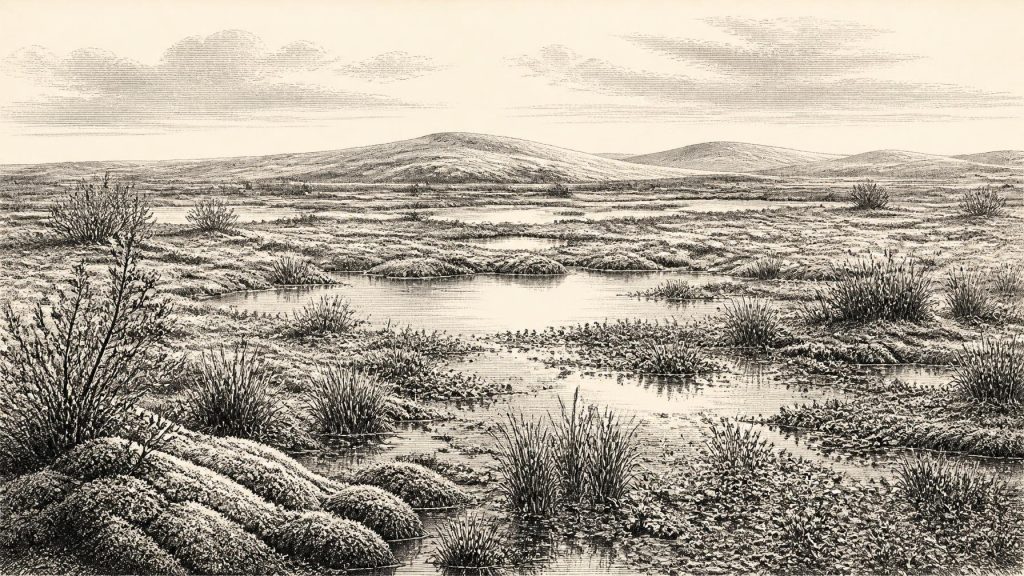
Road works in 1969 cut through a drumlin at Derryvree, exposing silts and fine sands rich enough to preserve biological evidence. The organic layers produced poorly preserved herb pollen, moss macrofossils and insect remains. They also contained evidence for plants including bogbean, alternate water-milfoil, mountain avens, dwarf willow and lesser clubmoss. These are not a catalogue of a lush forest. They point instead to a cold, largely treeless, open landscape in which wet hollows and shallow freshwater pools supported specialised vegetation. Grasses, sedges, mosses and hardy herbs could occupy ground that was often waterlogged, frozen or exposed to strong winds.
Researchers have compared this setting with muskeg: peaty, moss-rich wetland broken by shallow pools and plant-filled margins. Such a comparison is an interpretation drawn from the combined plant and insect record, rather than a direct view of the ancient surface. Even so, it conveys an essential truth. Ireland was not uniformly buried beneath permanent ice throughout this phase of the last Ice Age. At least at Derryvree, freshwater accumulated and a functioning tundra wetland existed during an interval between glaciations. Winters were probably severe, growing seasons short, and dry ground patchy; but the locality was ecologically alive.
Ice Was Advancing Unevenly
The wider setting was one of profound instability. The British–Irish Ice Sheet did not simply appear at its later maximum in a single advance. Geological and modelling work indicates a complicated history of ice growth, retreat and renewed expansion around Ireland and its surrounding seas. Derryvree supplies evidence for pre-Last Glacial Maximum ice-free conditions in the north-western part of the island, while other evidence indicates that ice was becoming an increasingly important force in the region. The best-established maximum extent of the last ice sheet came substantially later, around 27,000 to 23,000 years before present in many reconstructions, though different sectors reached their maxima at different times.
For people living today, drumlins can seem like permanent elements of the Irish countryside. At Derryvree, however, the drumlin preserved a story of destruction as well as survival. A lower till represented an earlier glacier; then water and plants occupied the area; finally an upper till buried the wetland record. Later ice reshaped much of Ireland and removed or disturbed older deposits. That destructive history helps explain why the evidence for this period is sparse. The absence of camps, hearths or tools may reflect genuine human absence, but it also reflects the poor survival prospects of exposed Ice Age landscapes beneath later ice and meltwater.
Castlepook’s Animal Archive
In County Cork, Castlepook Cave near Doneraile provides the strongest Irish evidence for the animal world of the broader period. Also known as Mammoth Cave, it is a limestone maze of narrow galleries and chambers, some named by earlier investigators Hyenahall, Elephant Hall and the Gallery of Aged Carnivores. Excavations begun in the early twentieth century recovered more than two thousand bones, teeth and other remains. The cave is Ireland’s richest known repository of vertebrate material dating to the time leading towards the Last Glacial Maximum.
The cave’s fauna includes reindeer, woolly mammoth, giant deer, brown bear and spotted hyena; later or differently dated material includes wolf, Arctic fox, collared lemming and Norwegian lemming. This is powerful evidence that Ireland could at times support a far richer Pleistocene mammal community than the island’s later history might suggest. It must not, however, be turned into a single picturesque scene. Castlepook accumulated remains over a very long interval, with individual dated bones spanning roughly 45,700 to 19,950 years before present. Water movement, carnivore activity, nineteenth- and twentieth-century excavation, and later disturbance all complicate associations between finds.
Radiocarbon redating has made this complication more important, not less. Work published in 2020 showed that some earlier Irish cave-bone dates were too young, and that certain Castlepook mammals belonged much earlier in Marine Isotope Stage 3 than formerly believed. Giant deer and spotted hyena may have disappeared locally before about 40,000 calibrated years ago. The resulting picture is one of shifting animal communities, not a fixed fauna. A mammoth bone, a reindeer bone and a hyena skull from the same cave need not prove that all three animals occupied the same valley in the same generation.
The Reindeer Femur Question
Castlepook is also central to the question of whether people reached Ireland during this remote phase. A reindeer femur fragment from the cave has been reported as about 33,000 years old and as carrying a deep mark interpreted as having been made on fresh bone with a sharp stone tool during butchery. County Cork heritage material has presented this as potential evidence for Stone Age hunters in Ireland around 31,000 BCE. If the interpretation is upheld, it would be an extraordinary indication that one or more Upper Palaeolithic people processed a reindeer in Ireland far earlier than the long-established post-glacial record.
Yet the proper conclusion remains cautious. The age is a date for the animal bone, expressed through radiocarbon measurement and calibration; it is not an exact date for the incision. Identifying a mark as a human-made cut or chop is a separate taphonomic judgement, requiring comparison with damage caused by carnivores, trampling, sediment movement, excavation and natural breakage. More importantly, a modified bone would record an encounter or episode of carcass processing, not automatically a resident population. Castlepook has not yielded a securely associated dwelling floor, hearth, stone-tool assemblage, burial, food store or repeated butchery area of this age.
What Cannot Be Written
Accordingly, there is no responsible basis for naming an Irish people, tribe, ruler or language in 31,556 BCE. There is no evidence for political institutions, territorial boundaries, diplomacy, warfare, religious monuments, formal learning or artistic tradition on the island at this date. Nor can cave fauna be borrowed from continental Europe to fill those silences. Upper Palaeolithic communities elsewhere in Europe certainly possessed sophisticated technologies, social relations and symbolic cultures, but Ireland’s evidence cannot demonstrate that such communities were established here. The possible reindeer butchery trace should enlarge the question, not settle it.
If people did briefly enter Ireland during this broader interval, the practical economy most plausibly indicated by the femur would have involved mobile hunting, scavenging or carcass processing. Reindeer would have offered meat, fat, marrow, hide, sinew and bone, but none of those uses can be confirmed at Castlepook beyond the contested mark. There is equally no direct evidence of trade or seafaring. Mammals evidently reached Ireland during favourable phases, but the exact routes, frequency of crossings and relationship between land, sea and ice remain subjects for geological reconstruction rather than settled narrative.
An Environmental History
The most secure history for this date is therefore a history without conventional historical actors. In Fermanagh, an open cold wetland supported mosses, sedges, aquatic plants and insects between phases of glaciation. In southern Ireland, cave deposits preserve evidence that large herbivores and formidable carnivores occurred across a broad part of Marine Isotope Stage 3. Around the island, ice margins and sea levels were changing, while later glacial expansion would erase much of what had existed. These regional differences are significant: ‘Ireland’ was not one uniform environment, and the surviving records are scattered fragments rather than a complete map.
31,556 BCE should therefore be understood as a point within a calibrated archaeological and environmental horizon, not as a date of a known event. Derryvree offers the clearest local glimpse: cold freshwater, treeless tundra vegetation and periglacial wet ground beneath the future drumlin landscape. Castlepook offers a complementary but more complicated glimpse of Ice Age animals, and perhaps a fleeting human action. Together they show an Ireland that was harsh, changeable and biologically connected to a wider north-west European world, while still withholding the names and stories that later history makes familiar.
Primary Sources
- A Middle Midlandian Freshwater Series at Derryvree, Maguiresbridge, County Fermanagh, Northern Ireland
- Palaeoecology: The Middle Midlandian Palaeoenvironment of South Fermanagh
- Figure 6: The Subdivision of the Quaternary Period in Ireland
- Early Midlandian–Middle Midlandian, Pleistocene, Northern Ireland
- Quaternary Deposits and Glacial Stratigraphy in Ireland
- A Reconsideration of the Radiocarbon Dating of the Marine Isotope Stage 3 Fauna from Southern Ireland
- The Irish Quaternary Fauna Project
- Pleistocene Vertebrates in the British Isles
- The Exploration of Castlepook Cave, County Cork, Being the Third Report from the Committee Appointed to Explore Irish Caves
- The Exploration of Castlepook Cave, Co. Cork. With 3 Plates
- Castlepook Cave County Geological Site Report
- Spotted Hyena Skull
- 2022:564 – Castlepook Cave, Castlepook South, Cork
- Heritage Artefacts of County Cork
- New Insights on the Fauna of Ireland’s Younger Dryas and Early Holocene from Alice & Gwendoline Cave
- Growth and Retreat of the Last British–Irish Ice Sheet, 31,000 to 15,000 Years Ago: The BRITICE-CHRONO Reconstruction
- Deglaciation Chronology of the Donegal Ice Centre, North-West Ireland
- Dimensions and Chronology of the Last Ice Sheet in Western Ireland
- The Timing and Magnitude of the British–Irish Ice Sheet Between Marine Isotope Stages 5d and 2
- Exploring Controls of the Early and Stepped Deglaciation on the Western Margin of the British-Irish Ice Sheet
- The Evolution of the Terrestrial-Terminating Irish Sea Glacier During the Last Glaciation
- The IntCal20 Northern Hemisphere Radiocarbon Age Calibration Curve (0–55 cal kBP)
- The Problem of a Late Quaternary Landbridge Between Britain and Ireland
- The Mesolithic in Ireland: When Was It?
- Occurrence of Mammalia Relicts at Site Castlepook Cave
- BSBI: Menyanthes trifoliata in Fermanagh
- BSBI: Myriophyllum alterniflorum in Fermanagh
- BSBI: Dryas octopetala in Fermanagh