Steppe Passage31458 BCE
31,458 BCE is a chronological label, not evidence for a dateable Irish event. During MIS 3, Ireland experienced unstable cold conditions, fluctuating ice margins, sea levels and habitats. Deposits at Fermanagh preserve non-glacial wetlands, while Castlepook Cave near Doneraile yielded mammoth, reindeer, horse, giant deer, carnivores and fauna, indicating steppe-tundra and wetlands during favourable intervals. Changing geography permitted animal dispersal from north-west Europe, though no permanent land bridge can be assumed. No secure human settlement exists. A possibly modified reindeer bone may indicate brief Upper Palaeolithic activity, but disturbed deposits and uncertain dating prevent conclusions. Predating Irish politics and writing.
Dateline
The label “31,458 BCE” is useful for arranging a modern timeline, but it cannot identify an Irish event in a particular year. There was no calendar, writing, named community or securely dated settlement on the island from which annual history can be made. Mechanically converted, the label falls about 33,407 years before AD 1950, or roughly 33.4 thousand calendar years ago. That is not the same thing as a radiocarbon age of 33,400 BP: radiocarbon measurements must be calibrated, and their probability ranges can be broad at this depth of time. The responsible subject, therefore, is Ireland during the middle part of the Late Pleistocene, within Marine Isotope Stage 3 (MIS 3), rather than a supposed occurrence on one day or in one year.
A Landscape in an Unstable Cold Age
Ireland lay in the long descent towards the Last Glacial Maximum, when the British–Irish Ice Sheet reached its greatest late-glacial extent around 27,000 years ago. Around the notional date represented here, conditions were cold but were not simply a single, unchanging “Ice Age”. Greenland ice-core sequences show that the North Atlantic climate repeatedly swung between relatively milder interstadials and severe stadials. Translating those abrupt Greenland signals exactly into a particular Irish valley is difficult. The best conclusion is that Ireland’s climate, ice margins, sea level and habitats were all capable of changing markedly over generations or centuries, far more quickly than an annual label implies.
Older schemes of Irish Quaternary history gave names such as the Derryvree cold stage to deposits thought to belong broadly near 30,000 radiocarbon years ago. Such names remain useful as the history of investigation, but they should not be treated as precise island-wide climate episodes. Deposits beneath and between tills, especially at Derryvree and Maguiresbridge in Fermanagh, preserve waterlogged plant remains and freshwater sediments that demonstrate that local non-glacial environments existed during parts of the last cold cycle. Their age models and correlation with wider North Atlantic events remain matters for geological interpretation, not a dateable Irish annal.
The ice-sheet picture is similarly regional and contested. Recent syntheses indicate that the British–Irish Ice Sheet had already experienced growth and retreat during MIS 3, while evidence from southern Ireland points to glacial influence before the later maximum. Yet an ice margin is not a simple national boundary. At one time it could have filled uplands or marine basins while exposed terrain, lakes, rivers and cave entrances survived elsewhere; at another, advancing ice could erase or bury much of that evidence. It is consequently unsafe to state that all Ireland was either continuously ice-covered or continuously open at 31,458 BCE.
Open Country at Castlepook
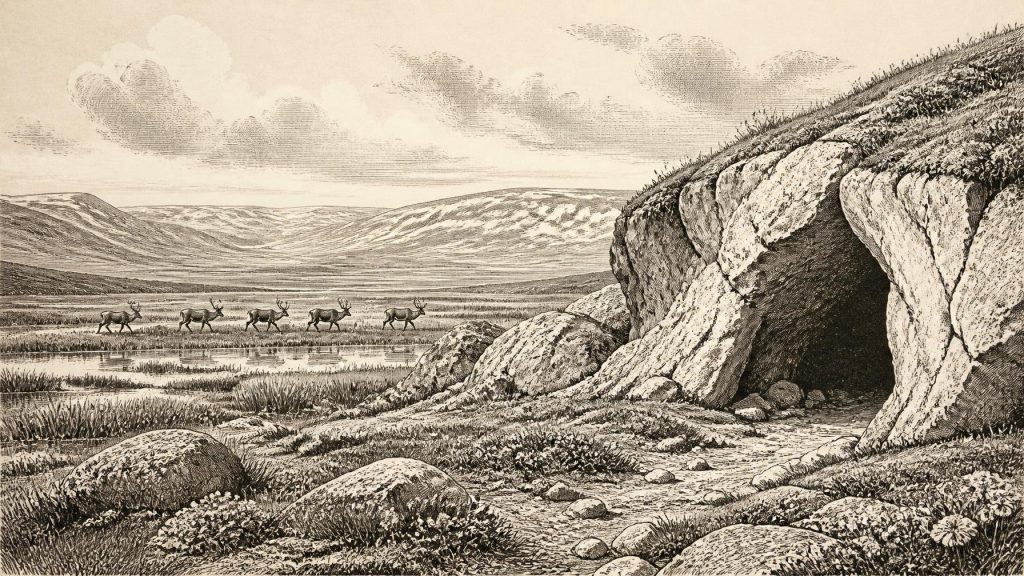
The strongest direct window on a broadly comparable Irish world comes from Castlepook Cave, also called Mammoth Cave, near Doneraile in north County Cork. Its limestone passages, excavated principally in the early twentieth century, yielded one of Ireland’s richest Pleistocene mammal assemblages. The National Museum of Ireland holds material from the Royal Irish Academy’s cave work, including spotted-hyena remains. Castlepook has produced evidence for animals associated with open, cold landscapes: reindeer, woolly mammoth, wild horse, giant deer, brown bear, wolf, Arctic fox, lemmings and spotted hyena. Not every species necessarily lived together, and not every bone belongs to one phase; that caveat is central to understanding the site.
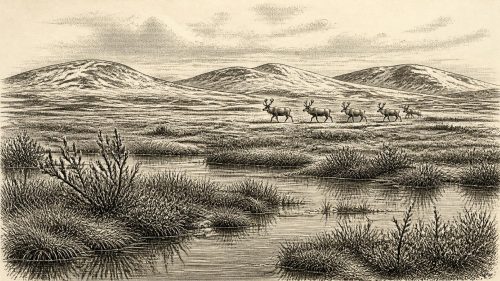
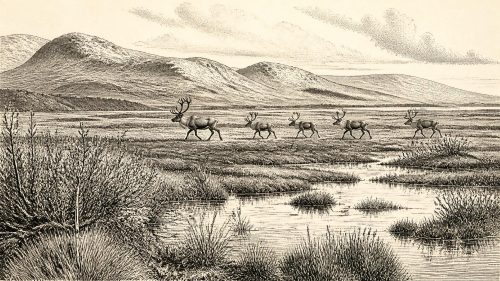
Nevertheless, the assemblage decisively overturns any image of a uniformly empty frozen island. During suitable intervals, parts of southern Ireland supported a productive patchwork of grassland, herb-rich steppe-tundra, sparsely vegetated ground, wetlands and sheltered limestone country. Reindeer and horse would have exploited open forage; mammoths required extensive plant resources; giant deer occupied varied environments; and carnivores followed prey or scavenged carcasses. Caves could serve as dens, traps, shelters or places into which water and sediment carried bones. A concentration of fossils is therefore evidence for animal movement and deposition, not a ready-made picture of a single living herd at the cave mouth.
Plant evidence helps make this scene more precise without making it cosy. Interstadial freshwater deposits in Ireland have yielded remains of sedges, mosses, dwarf shrubs and cold-tolerant herbs, including bogbean, water-milfoil, mountain-avens and fringed sandwort in different deposits and contexts. Such finds indicate pools, marshy margins and tundra-like vegetation rather than continuous woodland. Trees, if present locally during milder phases, were limited; this was not the later oak-and-hazel Ireland familiar from the Holocene. Strong winds, seasonally frozen ground, thin soils and short growing seasons would have shaped both plant cover and animal routes.
Routes Across the Western Peninsula
Ireland’s fauna raises a geographical question. Reindeer, hyenas and mammoths did not arrive by magic. Sea level was lower globally than it is today, but the Irish Sea region was also deformed by the weight and changing position of ice. The resulting coastlines, channels and possible terrestrial passages were complex and changed through time. It is reasonable to infer that animal dispersal was possible during some MIS 3 windows, whether across exposed terrain, narrowed marine gaps, ice-adjacent corridors or combinations of these. It is not responsible to draw a single permanent land bridge, nor to assume that a route available to an animal at one date was open to people at another.
In this sense, Ireland was part of a wider north-west European ecological zone even when its geography was distinctive. Britain and the continental shelf contained Upper Palaeolithic populations, and mainland Europe supported several traditions of Homo sapiens hunter-gatherers. But proximity does not prove an Irish crossing. The Irish fossil record records animals much more clearly than it records humans, partly because caves preserve bone better than camps on exposed ground and partly because later ice and sea-level change have removed or submerged landscapes where people might have stopped.
The Human Question
No accepted settlement, hearth, stone-tool assemblage, dwelling, burial or artwork establishes a human community in Ireland at approximately 33.4 thousand calendar years ago. That absence should be stated plainly. It means there is no evidence from which to describe Irish political affairs, diplomacy, tribal territories, language, ritual practice, teaching or trade at this time. Nor is there evidence for farming, domesticated animals, metalworking, monuments, permanent villages or a population descended continuously into later Irish prehistory.
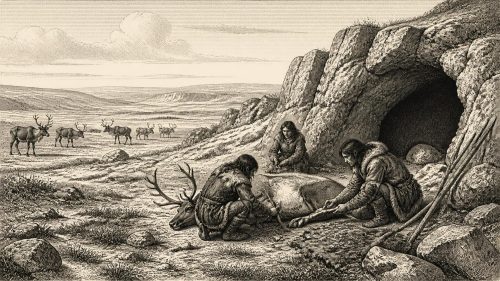
Castlepook nonetheless makes the question more interesting. A reindeer femur from the cave has a linear surface modification that has been interpreted as a cut or chopping mark made with a sharp stone edge while the bone was fresh. Earlier reporting linked a radiocarbon determination of about 33,400 ± 1,200 radiocarbon years BP to this striking possibility, inviting claims for a very early human presence. But the bone’s dating history and the mark’s cause are separate problems. Improved collagen preparation and redating have shown that several earlier dates from southern Irish caves were substantially too young. Cave deposits were disturbed by natural processes and by early excavation, and a single modified bone does not demonstrate a camp, a population or an enduring occupation.
The fairest interpretation is therefore conditional. If the mark is anthropogenic and genuinely contemporary with the animal, it could represent a brief episode in which Upper Palaeolithic people acquired or processed reindeer in southern Ireland. Such people would have been mobile foragers, not settlers in any later agricultural sense. Their everyday economy would probably have combined large-game acquisition with smaller animals, plant foods and opportunistic scavenging, as circumstances allowed; their possessions would have been portable tools of stone, bone, wood and hide. Yet those are informed comparisons from Upper Palaeolithic Europe, not discoveries from Ireland. The available Irish evidence cannot tell us whether any visitors crossed once, seasonally, repeatedly, or not at all.
Animals, Not Polities
Conflict and diplomacy are likewise beyond recovery. Spotted hyenas, wolves and humans, if humans were present, may all have competed for carcasses and shelter; that is an ecological possibility, not evidence for a specific encounter. A reindeer limb bone could have been moved by a carnivore, water, sediment or people. Its story is valuable precisely because it is incomplete: it obliges archaeologists to distinguish a directly observed incision, a dated specimen, a deposit’s complicated history and a larger claim about colonisation.
Religion, culture and learning leave no secure Irish trace for this interval. There are no cave paintings, engraved objects or formal burials from which beliefs can be reconstructed. It would be wrong, however, to regard the period as culturally blank simply because Ireland provides no record. Human groups elsewhere in Europe possessed sophisticated stone technologies, ornaments, image-making traditions and social knowledge. Whether any such traditions ever reached Ireland around this time is unknown. The archaeological silence is a statement about surviving evidence, not a verdict on the capacities of people who may have passed through the region.
A Deep-Time Threshold
For Ireland around 31,458 BCE, the central historical development is environmental opportunity constrained by severe instability. In favourable episodes, open habitats sustained a remarkable large-mammal community in a western fringe of Europe. In harsher episodes, ice, cold and changing sea routes fragmented that world. Castlepook and the buried wetlands of Fermanagh preserve fragments of it: bones, seeds, mosses, silts and tills rather than chronicles.
That evidence also sets the proper scale of the human question. Ireland may have been visited by Upper Palaeolithic foragers during the wider MIS 3 period, but a secure year-specific occupation cannot be claimed. The best documented history for this notional year is thus one of reindeer paths, mammoth-range country, carnivore dens, shallow cold-water basins and an advancing, retreating ice-sheet system. It is a landscape before Irish politics and written memory, but not before history in the deeper archaeological sense.
Source References
Hover over a number to see the source. Select it to open the source.

- [1] A Reconsideration of the Radiocarbon Dating of the Marine Isotope Stage 3 Fauna from Southern Ireland
- [2] The Irish Quaternary Fauna Project
- [3] Spotted Hyena Skull
- [4] Castlepook Caves: County Geological Site Report
- [5] 2022:564 - Castlepook Cave, Castlepook South, Cork
- [6] Heritage Artefacts of County Cork
- [7] Late Pleistocene Chronostratigraphy and Ice Sheet Limits, Southern Ireland
- [8] Reconstructing the Last Irish Ice Sheet 2: A Geomorphologically-Driven Model of Ice Sheet Growth, Retreat and Dynamics
- [9] Pattern and Timing of Retreat of the Last British-Irish Ice Sheet
- [10] Ice Sheet Extension to the Celtic Sea Shelf Edge at the Last Glacial Maximum
- [11] Dimensions and Chronology of the Last Ice Sheet in Western Ireland
- [12] The Timing and Magnitude of the British–Irish Ice Sheet Between Marine Isotope Stages 5d and 2
- [13] Character of Advance and Retreat of the Southwest Sector of the British-Irish Ice Sheet During the Last Glaciation
- [14] Oscillating Retreat of the Last British-Irish Ice Sheet on the Continental Shelf Offshore Galway Bay, Western Ireland
- [15] The IntCal20 Northern Hemisphere Radiocarbon Age Calibration Curve (0–55 cal kBP)
- [16] A Stratigraphic Framework for Abrupt Climatic Changes During the Last Glacial Period Based on Three Synchronized Greenland Ice-Core Records
- [17] The Colonization of Ireland: A Human Ecology Perspective
- [18] First Evidence of a Late Upper Palaeolithic Human Presence in Ireland
- [19] New Insights on the Fauna of Ireland’s Younger Dryas and Early Holocene from Alice & Gwendoline Cave
- [20] Dating Constraints on the Last British-Irish Ice Sheet: A Map and Database
Primary Sources
- A Reconsideration of the Radiocarbon Dating of the Marine Isotope Stage 3 Fauna from Southern Ireland
- The Irish Quaternary Fauna Project
- Spotted Hyena Skull
- Castlepook Caves: County Geological Site Report
- 2022:564 – Castlepook Cave, Castlepook South, Cork
- Heritage Artefacts of County Cork
- Late Pleistocene Chronostratigraphy and Ice Sheet Limits, Southern Ireland
- Reconstructing the Last Irish Ice Sheet 2: A Geomorphologically-Driven Model of Ice Sheet Growth, Retreat and Dynamics
- Pattern and Timing of Retreat of the Last British-Irish Ice Sheet
- Ice Sheet Extension to the Celtic Sea Shelf Edge at the Last Glacial Maximum
- Dimensions and Chronology of the Last Ice Sheet in Western Ireland
- The Timing and Magnitude of the British–Irish Ice Sheet Between Marine Isotope Stages 5d and 2
- Character of Advance and Retreat of the Southwest Sector of the British-Irish Ice Sheet During the Last Glaciation
- Oscillating Retreat of the Last British-Irish Ice Sheet on the Continental Shelf Offshore Galway Bay, Western Ireland
- The IntCal20 Northern Hemisphere Radiocarbon Age Calibration Curve (0–55 cal kBP)
- A Stratigraphic Framework for Abrupt Climatic Changes During the Last Glacial Period Based on Three Synchronized Greenland Ice-Core Records
- The Colonization of Ireland: A Human Ecology Perspective
- First Evidence of a Late Upper Palaeolithic Human Presence in Ireland
- New Insights on the Fauna of Ireland’s Younger Dryas and Early Holocene from Alice & Gwendoline Cave
- Dating Constraints on the Last British-Irish Ice Sheet: A Map and Database