Mammoth Mixture31459 BCE
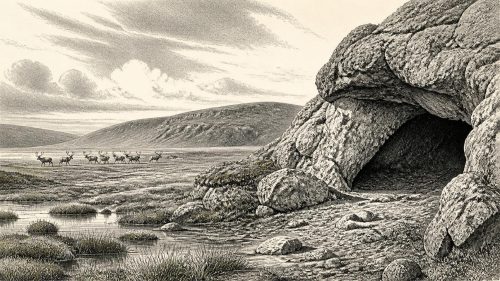
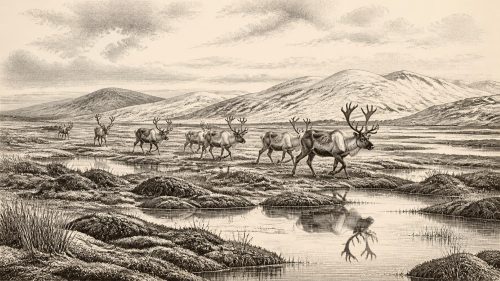
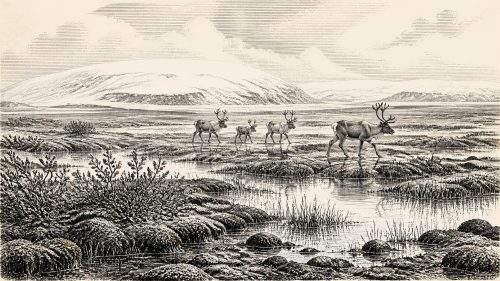
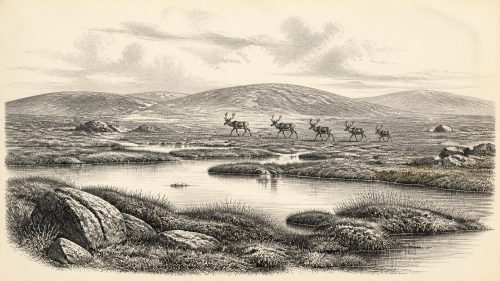
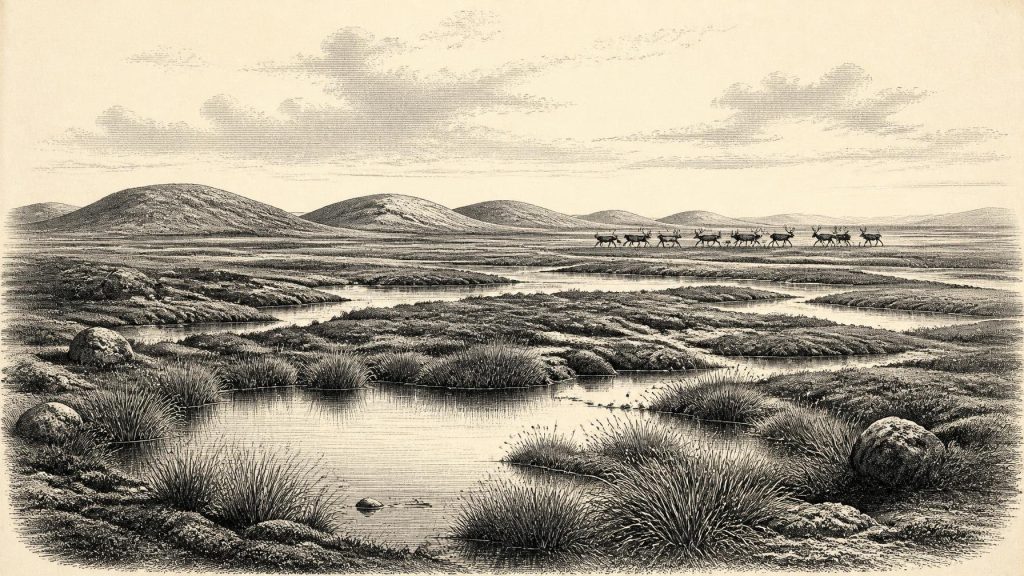
Around 31,459 BCE, Ireland was in the climatically unstable Late Pleistocene, not uniformly ice-covered. At Derryvree, County Fermanagh, a freshwater organic layer later buried by glacial till records mossy, sedgy tundra-steppe wetlands during a broad interval spanning the notional date. Castlepook Cave, County Cork, yielded reindeer, mammoth, giant deer, horse, carnivores and lemmings, demonstrating cold open habitats and intermittent animal access before major ice expansion. Cave deposits accumulated over time, however, so they cannot define a single community. A cut-marked reindeer femur may indicate human carcass processing, but lacks contextual evidence. No settlement, culture or political history can be inferred.
Dateline
A Date Without a Year
31,459 BCE is a modern chronological label, not a year that could have been recognised in prehistoric Ireland. No calendar, written record, named ruler or dated event exists for the island at this depth of time. Converted only as a convenient point on the archaeological timescale, it lies roughly 33,400 calendar years before the conventional “present” of AD 1950, in the Late Pleistocene and Marine Isotope Stage 3 (MIS 3). That apparent precision is misleading. Radiocarbon measurements must be calibrated against changing atmospheric carbon levels, and their results are expressed as probability ranges rather than single certainties. The responsible question is therefore not what happened in Ireland in one particular year, but what securely dated deposits and animal remains can tell us about the island during the broad interval surrounding it.
The answer is necessarily fragmentary. Later glaciers eroded, buried and rearranged much of Ireland’s older ground surface. Acid soils also destroy bone and organic material outside exceptional settings. The surviving evidence comes chiefly from two very different kinds of archive: a buried freshwater deposit at Derryvree near Maguiresbridge in County Fermanagh, and Pleistocene animal remains from Castlepook Cave near Doneraile in north County Cork. Neither is a historical narrative. Together, however, they show that parts of Ireland supported cold-climate landscapes and a varied large-mammal fauna before the much more extensive glaciation that followed.
Fermanagh’s Buried Wetland
The closest Irish environmental evidence is the organic layer found within a drumlin at Derryvree. Roadworks in 1969 exposed silts and fine sands lying between two thick sheets of glacial till. The deposit produced a conventional radiocarbon age of 30,500 years BP, with a substantial error margin. Modern calibration has placed it broadly between about 36,900 and 31,700 calibrated years BP. The notional date considered here falls within that wide span, but it cannot be placed at a particular level in the deposit or assigned to a particular season, generation or century.
What the Derryvree material does demonstrate is especially valuable: before the upper till was laid down, there was standing or slow-moving freshwater in this part of Fermanagh. Plant macrofossils, pollen, insects and other remains indicate an open tundra or tundra-steppe setting, not woodland. Mosses and sedges grew around pools rich in decaying vegetation, while cold-adapted plants included species associated with exposed, treeless ground. The investigators described a muskeg-like wetland: a waterlogged, organic landscape with shallow pools amid mossy and sedgy vegetation. It was a hard environment, shaped by severe winters, frost and periglacial processes, yet it was not a featureless frozen waste.
This local wetland should not be mistaken for a map of the entire island. Ireland’s terrain, elevation, drainage and proximity to marine ice margins would have produced marked regional contrasts. Nevertheless, Derryvree proves that an ice-free freshwater habitat existed in at least one northern district during part of this broad interval. It also shows why simplistic images of an Ireland permanently sealed beneath ice are inaccurate. The Late Pleistocene was climatically unstable. Colder phases and relatively milder interstadials succeeded one another, sometimes rapidly in geological terms. Speleothem records from Crag Cave in County Kerry independently show episodes of calcite growth during MIS 3; because such growth requires liquid water, they point to repeated intervals when conditions were less continuously frozen than in the harshest glacial phases.
Ice Was Advancing, Not Yet Everywhere
At this time Ireland stood within the long approach to the Last Glacial Maximum, not at its best-established maximum extent. Reconstructions of the British–Irish Ice Sheet show major growth and changing ice margins across these islands after roughly 31,000 years ago, while the fullest later expansion occurred substantially afterwards. The exact timing varied by sector: ice sheets do not advance as a single, even wall. The Derryvree sequence is important precisely because its freshwater layer was later overridden and enclosed by glacial deposits. It preserves evidence of an earlier habitable opening that subsequent ice partly erased.
Sea level was lower than today, and the geography of the Irish Sea region differed greatly from the modern map. Yet lower sea level alone does not prove that a dependable dry route connected Ireland to Britain or continental Europe. Ice, changing shorelines, rivers, estuaries and marine channels all mattered, while the evidence for particular routes remains incomplete. Animals clearly reached Ireland during favourable phases, but whether they crossed exposed terrain, narrow water barriers, seasonal ice or combinations of these cannot always be resolved. For people, whose evidence is far rarer, the uncertainty is greater still.
The Awbeg Fauna
Castlepook Cave, in the Awbeg Valley beneath the Ballyhoura Hills, is Ireland’s most important southern archive for pre-Last Glacial Maximum vertebrates. Excavations and collecting campaigns in the early twentieth century recovered bones from a remarkable range of animals. The wider Castlepook assemblage includes reindeer, woolly mammoth, giant deer, brown bear, spotted hyaena, wolf, Arctic fox, wild horse and lemmings. It establishes beyond doubt that Ireland was reached by animals characteristic of cold, open north-west European environments.
But the cave collection cannot be read as a single living community seen on one day. Its deposits accumulated over a long period; bones could have been brought in by predators, scavengers, water or sediment movement; and early excavation methods did not provide the contextual detail expected today. Spotted hyaena is particularly significant. Its presence shows that large social carnivores entered Ireland, and it raises an important caution: caves could be dens and bone accumulators rather than places where an animal died or was eaten by people. Improved radiocarbon pretreatment has also shown that some older dates on Irish cave bones were too young. Re-dating at Castlepook pushed several specimens thousands of radiocarbon years further back, strengthening the case for MIS 3 fauna but also underlining the need to reassess inherited chronologies.
The fauna supports a picture of open country capable of sustaining grazing and browsing herbivores, together with predators and scavengers. Reindeer are especially relevant because they commonly move across broad seasonal ranges and can prosper in sparse northern landscapes. Mammoth and horse point towards extensive open habitats, while small mammals such as lemmings provide sensitive evidence of cold conditions. Even so, no one bone proves that every listed species lived together, nor does it settle their population sizes, migration routes or the duration of their Irish presence.
A Possible Human Trace
One Castlepook object gives this period an exceptional, but carefully limited, human significance: a reindeer femur bearing a deep linear mark interpreted by zooarchaeologist Ruth Carden as having been made on fresh bone with a sharp stone tool. County Cork heritage material has presented the bone as dating to about 31,000 BC and as possible evidence that Palaeolithic hunters processed reindeer in the Doneraile area. If that interpretation is sustained, it would extend evidence for human activity in Ireland far beyond the better-established terminal Pleistocene record.
The word if is essential. The bone dates the death of the animal, not necessarily the instant when it was marked. It came from an old cave collection rather than a modernly excavated occupation surface. No securely associated stone-tool assemblage, hearth, shelter floor, human remains or repeated butchered assemblage has yet been published for Ireland at this age. A single possible cut mark may indicate the brief handling of a carcass by people; it cannot demonstrate permanent settlement, a population, a named culture or a continuous ancestry for later Irish communities. Current work at Castlepook is important because intact deposits and securely excavated associations, rather than an isolated object, would be needed to test the claim fully.
What Cannot Be Recovered
There is no evidence from around this date for political institutions, leaders, territories, diplomacy, organised warfare or formal alliances in Ireland. Nor can archaeology responsibly identify language, ethnicity, religious belief, ritual practice, kinship rules or artistic traditions. The possible reindeer mark does not reveal whether the animal was hunted, scavenged after a carnivore kill, butchered elsewhere and later dragged into the cave, or processed by one visitor rather than a group. These are questions for which the evidence is presently silent.
Everyday life is likewise recoverable only in the narrowest sense. If people were present, they would have faced a cold, seasonal and highly variable landscape in which fuel, shelter, animal food and safe movement mattered acutely. Reindeer could have offered meat, fat, marrow, hide, sinew, antler and bone, but the marked femur cannot show which resource was sought. There is no evidence for farming, livestock, pottery, metalworking, built villages, stored surplus or exchange networks. “Economy” at this date can only mean the potential use of wild resources by mobile foragers, not a demonstrable Irish trading system.
The most important development around this notional date was therefore environmental rather than political: Ireland contained, at least intermittently, ice-free cold-country habitats before later ice expansion transformed the landscape and destroyed much of the evidence. Fermanagh’s silts preserve a wet tundra world; Castlepook preserves traces of the animals that moved through southern Ireland; and one reindeer bone raises the possibility of a fleeting human encounter at Europe’s north-western edge. That is a small archive for such a vast period, but it is enough to replace certainty with a more compelling conclusion: Ice Age Ireland was not empty of life, though its human history remains unresolved.
Source References
Hover over a number to see the source. Select it to open the source.

- [1] A Middle Midlandian Freshwater Series at Derryvree, Maguiresbridge, County Fermanagh, Northern Ireland
- [2] A Reconsideration of the Radiocarbon Dating of the Marine Isotope Stage 3 Fauna from Southern Ireland
- [3] The Irish Quaternary Fauna Project
- [4] Growth and Retreat of the Last British–Irish Ice Sheet, 31,000 to 15,000 Years Ago: The BRITICE-CHRONO Reconstruction
- [5] Timing, Pace and Controls on Ice Sheet Retreat: An Introduction to the BRITICE-CHRONO Transect Reconstructions of the British–Irish Ice Sheet
- [6] BRITICE-CHRONO Maps and GIS Data of the Last British-Irish Ice Sheet 31 to 15 ka
- [7] Exploring Controls of the Early and Stepped Deglaciation on the Western Margin of the British Irish Ice Sheet
- [8] Trimlines, Blockfields and the Vertical Extent of the Last Ice Sheet in Southern Ireland
- [9] Episodic Speleothem Deposition Tracks the Terrestrial Impact of Millennial-Scale Last Glacial Climate Variability in SW Ireland
- [10] Landscapes and Environments of the Last Glacial-Interglacial Transition: A Time of Amazingly Rapid Change in Ireland
- [11] New Insights on the Fauna of Ireland’s Younger Dryas
- [12] The Colonization of Ireland: A Human Ecology Perspective
- [13] The IntCal20 Northern Hemisphere Radiocarbon Age Calibration Curve (0–55 cal kBP)
- [14] Heritage Artefacts of County Cork
- [15] Archaeology Research Excavation Grant 2022: Final Report
- [16] 32564: Castlepook Cave, Co. Cork
- [17] Castlepook Caves
- [18] The Quaternary of Fermanagh and South Tyrone: A Field Guide
- [19] The Quaternary of Northern Ireland: A Field Guide
- [20] The Mesolithic in Ireland: When Was It?
- [21] Ireland’s Palaeolithic Archaeology – Fleeting Footprints in a Frozen Land
- [22] Ireland’s First Settlers
Primary Sources
- A Middle Midlandian Freshwater Series at Derryvree, Maguiresbridge, County Fermanagh, Northern Ireland
- A Reconsideration of the Radiocarbon Dating of the Marine Isotope Stage 3 Fauna from Southern Ireland
- The Irish Quaternary Fauna Project
- Growth and Retreat of the Last British–Irish Ice Sheet, 31,000 to 15,000 Years Ago: The BRITICE-CHRONO Reconstruction
- Timing, Pace and Controls on Ice Sheet Retreat: An Introduction to the BRITICE-CHRONO Transect Reconstructions of the British–Irish Ice Sheet
- BRITICE-CHRONO Maps and GIS Data of the Last British-Irish Ice Sheet 31 to 15 ka
- Exploring Controls of the Early and Stepped Deglaciation on the Western Margin of the British Irish Ice Sheet
- Trimlines, Blockfields and the Vertical Extent of the Last Ice Sheet in Southern Ireland
- Episodic Speleothem Deposition Tracks the Terrestrial Impact of Millennial-Scale Last Glacial Climate Variability in SW Ireland
- Landscapes and Environments of the Last Glacial-Interglacial Transition: A Time of Amazingly Rapid Change in Ireland
- New Insights on the Fauna of Ireland’s Younger Dryas
- The Colonization of Ireland: A Human Ecology Perspective
- The IntCal20 Northern Hemisphere Radiocarbon Age Calibration Curve (0–55 cal kBP)
- Heritage Artefacts of County Cork
- Archaeology Research Excavation Grant 2022: Final Report
- 32564: Castlepook Cave, Co. Cork
- Castlepook Caves
- The Quaternary of Fermanagh and South Tyrone: A Field Guide
- The Quaternary of Northern Ireland: A Field Guide
- The Mesolithic in Ireland: When Was It?
- Ireland’s Palaeolithic Archaeology – Fleeting Footprints in a Frozen Land
- Ireland’s First Settlers