BIRM-166’s Permafrost Flora31427 BCE
31,427 BCE is a modern label for a volatile Middle Midlandian phase of the last Ice Age, not a documented Irish year. Around this period, abrupt North Atlantic climatic shifts affected ice, drainage, vegetation and sea levels, while Ireland remained regionally varied rather than uniformly glaciated. Derryvree, County Fermanagh, preserves organic beds between tills, revealing cold, treeless freshwater wetlands with mosses, sedges and specialised plants. Castlepook Cave, County Cork, contains cold-adapted fauna, including mammoth and reindeer. A marked reindeer femur may indicate Palaeolithic butchery, but lacks corroborating archaeological context. Evidence supports intermittent habitats and possible human visits, not settled society.
Dateline
The label 31,427 BCE is a modern chronological convenience, not a year that can be recovered from an Irish annal, settlement sequence or living person’s memory. No one in Ireland counted years in this fashion, and archaeology cannot isolate an event to a particular calendar year nearly 33,500 years ago. In radiocarbon convention, which counts backwards from AD 1950, it corresponds roughly to 33,377 years before present. That places it in the later part of Marine Isotope Stage 3, within the last Ice Age and the Irish regional succession traditionally called the Midlandian. The appropriate history, therefore, is one of climate, ice, animals and very limited traces of possible human activity—not kings, tribes or a known community.
A Date Within a Climatic Pulse
Even this conversion needs caution. ‘Before present’ dates and BCE dates are not interchangeable without calibration, because atmospheric radiocarbon levels have changed through time. Ice-core chronologies provide another clock, with their own stated uncertainties. On the Greenland chronological framework, about 33.4 thousand calendar years ago falls close to Greenland Interstadial 6, a short North Atlantic warming interval conventionally dated to approximately 33.69–33.31 thousand calendar years before present. That does not mean Ireland experienced Greenland’s climate unchanged. It means that Ireland lay within a North Atlantic system capable of abrupt shifts in temperature, sea ice, winds and precipitation over periods far shorter than most prehistoric eras.
The year should consequently not be imagined as a fixed point in a stable ‘Ice Age’. The landscape may have been changing over generations as snowfields expanded or shrank, rivers altered their courses, and vegetation responded to cold, moisture and exposed ground. The most extensive late-glacial ice cover of Ireland was still to come. Major growth of the British–Irish Ice Sheet occurred after about 29,000 years ago, before the Last Glacial Maximum. At 31,427 BCE, Ireland was instead part of an unstable middle phase of the last cold stage, when ice-free country, glacier margins and marine or periglacial environments could exist in different regions and at different times.
The Derryvree Evidence
The most revealing Irish environmental record for this broad interval came from Derryvree townland near Maguiresbridge, County Fermanagh. Roadworks in 1969 cut through a drumlin and exposed a remarkable sequence: organic silts and fine sands enclosed between two thick layers of till. Till is debris laid down by glacier ice; the sediment between the tills records a period when that particular place was not beneath an advancing glacier. It was a fortunate, temporary window into a lost landscape later buried under ice-derived material.
The Derryvree organic beds produced the conventional radiocarbon determination BIRM-166: 30,500 years BP, with an uncertainty of +1,170 and −1,030 years. Modern calibration gives a substantially older calendar estimate; one published treatment expresses it as about 35.9 ± 1.1 thousand calibrated years BP. This is important for responsible chronology. Derryvree is not a diary entry for 31,427 BCE, nor can its one legacy radiocarbon measurement be made to prove conditions in every Irish district in that year. Its age range may in fact place much of the deposit earlier than the nominal date considered here. Yet it remains the closest dated Irish environmental archive for understanding the Middle Midlandian world from which this date is only a few millennia removed.
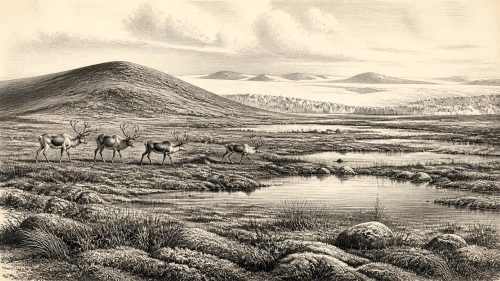
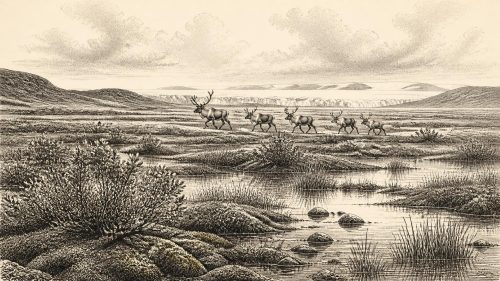
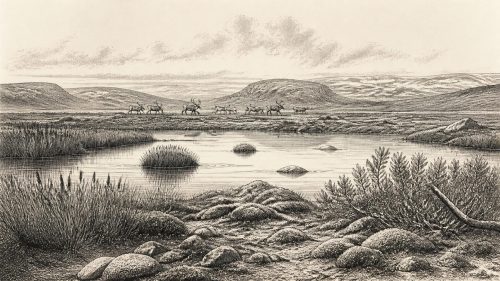
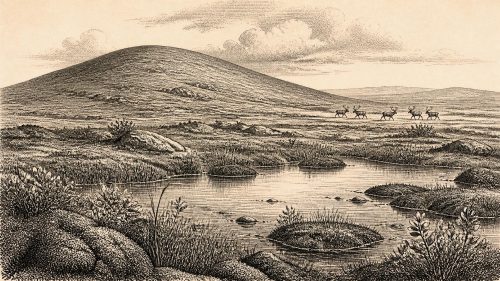
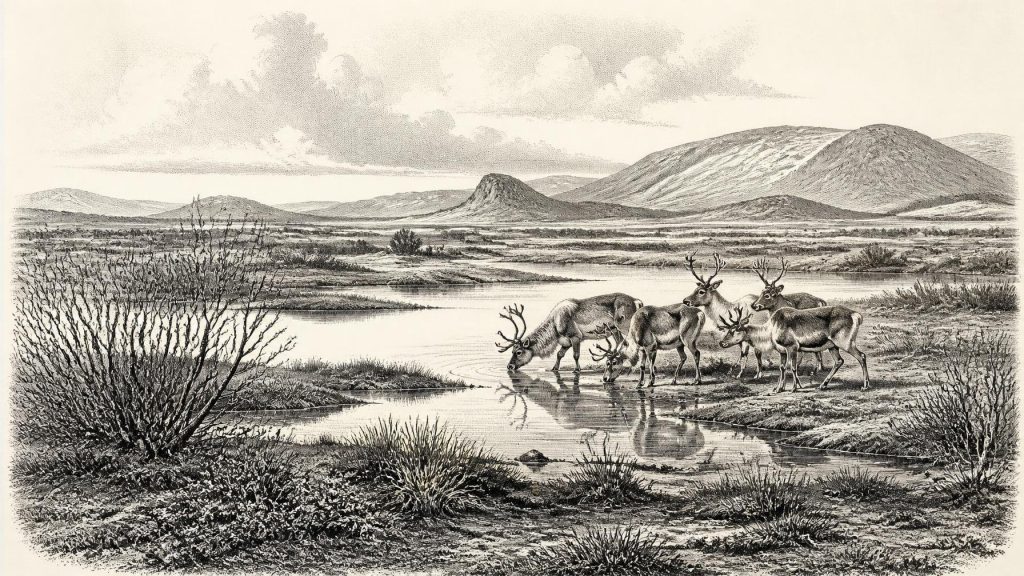
The deposits contained plant and animal remains indicating an open, treeless, periglacial wetland. Mosses, sedges and aquatic or waterside plants survived around freshwater pools and saturated ground. Finds reported from the sequence include bogbean, water-milfoil, willow, mountain avens and fringed sandwort, alongside mosses associated with cold environments. Such evidence does not recreate a postcard-perfect scene, but it firmly rules out the familiar wooded Ireland of later millennia. There were no broad oakwoods, enclosed fields or peat-cutting communities. Derryvree’s local setting was a cold, open muskeg or fen, with shallow water, muddy margins and low vegetation exposed to a severe climate.
An Island at the Edge of Ice
Derryvree also establishes a larger geological point: Irish ice history was neither simple nor uniform. The lower till proves an earlier glacial advance; the upper till proves that ice returned after the wetland phase. Between them lay enough time for water to pond, sediment to accumulate and a specialised flora and fauna to occupy the ground. This sequence makes Ireland’s environmental history more complicated than a single advancing ice sheet followed by a final thaw. It shows repeated regional changes in ice cover and drainage, though the precise extent and timing of each advance remain subjects of reconstruction and debate.
Across the island, the surviving evidence is patchy because later glacier ice eroded, redeposited or concealed older sediments. Caves, protected hollows and deposits sealed beneath tills are disproportionately valuable for that reason. They are not necessarily representative samples of the whole country. A wetland at Derryvree cannot demonstrate that Cork, the western seaboard and the Irish Sea basin looked identical. It does, however, show that cold terrestrial habitats existed in Ireland during this part of the last glacial cycle, rather than an unbroken blanket of ice.
Sea level was considerably lower than today, so modern coastlines are a poor guide to the geography of the period. Areas now beneath the Irish Sea and Atlantic shelf formed part of a wider, changing landscape of lowlands, shallow seas, ice margins and river systems. Whether particular routes were dry, glaciated, marshy or marine depended on date and location. It is reasonable to see Ireland as connected environmentally to the wider north-west European zone; it is not responsible to draw a permanent land bridge or a regularly used migration route on the strength of one calendar-year label.
Animals and a Cave in North Cork
Castlepook Cave, near Doneraile in County Cork, provides a different kind of evidence. Known historically as Mammoth Cave, it has yielded an important collection of Late Pleistocene animal remains, much of it recovered during early twentieth-century excavations. Reassessment and redating have shown that some southern Irish cave fauna is much older than earlier radiocarbon results suggested. Castlepook preserves evidence for animals including woolly mammoth, reindeer, giant deer, brown bear, fox, hare, lemmings and spotted hyaena. The exact date and relationship of each bone require separate assessment, since cave deposits can be mixed by carnivores, water, excavation and later disturbance.
The presence of hyaena is especially revealing. Caves could be dens, places where carnivores dragged prey or scavenged carcasses, as well as natural traps and shelters. A concentration of bones is therefore not automatically a human hunting camp. The mammoth remains and the reindeer, carnivore and small-mammal assemblage point to episodes when a cold-adapted fauna reached southern Ireland, but they do not prove that every species lived together at once. Nor do they establish a uniform ‘mammoth-steppe’ across the entire island. Their chief value is to show that Ireland could support, or at least receive, large mammals and predators during favourable intervals of the late Pleistocene.
The Reindeer Femur Question
One Castlepook object makes this era historically exceptional: a reindeer femur bearing a deep surface mark interpreted by zooarchaeologist Ruth Carden as a fresh-bone chop or cut made during butchery with a sharp stone implement. County Cork’s heritage publication dates the bone to about 31,000 BC and presents it as possible evidence of Palaeolithic hunters processing a reindeer. If that interpretation is confirmed, it would push evidence for human activity in Ireland tens of millennia earlier than the long-established post-glacial record.
Its significance should be neither dismissed nor exaggerated. The bone itself is evidence that a reindeer died; the mark is evidence of an action only if microscopic and taphonomic analysis securely distinguishes stone-tool damage from carnivore, trampling, excavation or other processes. The cave has not produced a securely associated hearth, stone-tool assemblage, dwelling surface, human burial or repeated concentration of butchered animals of this age. Moreover, a date on bone dates the animal’s death, not the exact instant of any marking. At present, the reindeer femur is best described as a serious and potentially transformative indication of human handling, rather than proof of a settled Irish population.
Lives Beyond the Evidence
There is no evidence for political institutions, named groups, diplomacy, territorial government, warfare, formal religion, monuments, farming or metalworking in Ireland at this date. It would be misleading to fill the silence with imagined Palaeolithic clans. If people did visit Ireland during a relatively milder interval, they were likely highly mobile hunter-gatherers whose survival depended on knowledge of animals, weather, shelter, stone and seasonal movement. That is an inference from the wider Upper Palaeolithic world, not a fact demonstrated by an Irish campsite.
Likewise, there is no direct evidence for Irish trade. Long-distance social contacts may have been vital to small hunter-gatherer populations elsewhere in north-west Europe, but no Irish lithic source, exchanged ornament or food store of this age has been identified. The practical economy visible in the Irish record is ecological rather than commercial: wetland plants growing in cold ground, herbivores and predators moving through suitable habitats, and perhaps people exploiting a carcass on one occasion.
That modest conclusion is the real importance of 31,427 BCE. Ireland was not yet a historical society, and no responsible account can invent one. But the island was not an empty abstraction either. Beneath a Fermanagh drumlin lay the remains of a cold freshwater world; in a Cork cave lay the bones of animals that had crossed a changing north-western landscape. Together they show an Ireland of intermittent opportunity, deep climatic uncertainty and tantalising human possibility—an archive still being tested rather than a past already fully known.
Primary Sources
- A Middle Midlandian Freshwater Series at Derryvree, Maguiresbridge, County Fermanagh, Northern Ireland
- A reconsideration of the radiocarbon dating of the Marine Isotope Stage 3 fauna from southern Ireland
- New insights on the fauna of Ireland's Younger Dryas and Early Holocene from Alice & Gwendoline Cave
- The subdivision of the Quaternary Period in Ireland
- Soils of Co. Waterford
- Exploring controls of the early and stepped deglaciation on the western and northern marine sectors of the British–Irish Ice Sheet
- Dimensions and chronology of the last ice sheet in Western Ireland
- A stratigraphic framework for abrupt climatic changes during the Last Glacial period based on three synchronized Greenland ice-core records: refining and extending the INTIMATE event stratigraphy
- Consistently dated Atlantic sediment cores over the last 40 thousand years
- The Greenland Ice Core Chronology 2005, 15–42 ka. Part 1: constructing the time scale
- The anatomy of past abrupt warmings recorded in Greenland ice
- Heritage Artefacts of County Cork
- 2022:564 – Castlepook Cave, Castlepook South, Cork
- Ireland's Palaeolithic Archaeology – Fleeting Footprints in a Frozen Land
- The Mesolithic in Ireland: when was it?
- Irish Pleistocene biostratigraphy
- Pleistocene Glacial, Glaciomarine and Associated Deposits of Mell and Tullyallen Townlands, near Drogheda, Eastern Ireland
- A North-Western Habitat: the Paleoethology and Colonisation of a European Peninsula
- The Irish Quaternary Fauna Project
- BSBI: Dryas octopetala