
Derryvree’s Tundra Basin31308 BCE
At the notional date 31,308 BCE, Ireland’s past is reconstructed from sediments and fossils rather than historical records. Derryvree, County Fermanagh, preserves an ice-free interval between glacial advances, dated broadly to 36,900–31,700 calibrated years before present. Its freshwater deposits indicate open tundra, wetland plants, seasonal growth and severe periglacial conditions. Castlepook Cave, County Cork, contains mixed remains of mammoth, giant deer, reindeer, predators and other cold-stage fauna, demonstrating repeated animal access. A marked reindeer femur, dated about 33,000 years ago, may indicate human butchery, yet lacks secure context. Ireland was a climatically shifting habitat, not a society or settled nation.
Dateline
The modern label 31,308 BCE gives a useful place in a long sequence, but it cannot identify a year in the historical sense. No calendar, writing, named community or event record survives from Ireland at this depth of time. In archaeological terms it is roughly 33,257 years before AD 1950, in the Late Pleistocene and Marine Isotope Stage 3 (MIS 3), a highly variable part of the last Ice Age. Evidence is dated in broad calibrated ranges, not to individual years. The most responsible account of Ireland at this point is therefore one of buried sediments, cave fauna, changing ice margins and the very limited possibility of human visits.
A Date Inside a Range
The closest important Irish environmental archive is Derryvree, near Maguiresbridge in County Fermanagh. Roadworks in 1969 cut through a drumlin and revealed a remarkable sequence: thick glacial till below, freshwater silts and fine sands with organic material in the middle, and another till above. The order of these deposits is decisive. An earlier glacier had crossed the district; subsequently, water, plants and animals occupied an ice-free landscape; then a later ice advance buried the evidence beneath fresh debris.
The organic horizon produced the radiocarbon determination BIRM-166, conventionally reported as 30,500 radiocarbon years before present, with a substantial uncertainty. A radiocarbon age is not the same thing as a calendar age. Atmospheric carbon-14 has varied through time, so measurements must be calibrated against independently dated records. Modern reassessments place the Derryvree material broadly within about 36,900–31,700 calibrated years before present. This range encompasses the notional date of 31,308 BCE, but it does not mean that the Derryvree wetland formed, or that any animal lived there, in that precise year.
The deposit has been correlated cautiously with several short-lived Greenland interstadials, relatively milder episodes within the broader glacial period. Such comparisons are useful for setting Ireland within North Atlantic climate change, but they are not exact synchronisations. The original date has a wide error margin, and an organic layer can accumulate over time. Derryvree is best understood as a window on an interval of cold, ice-free conditions in north-central Ireland, rather than a snapshot of one season.
Wet Ground Between Glaciers
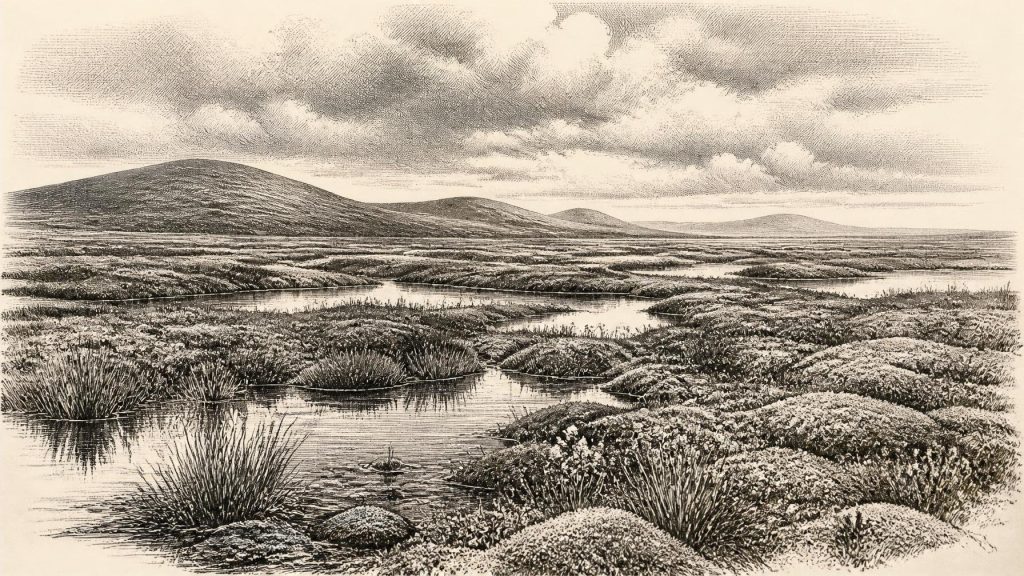
Derryvree’s plant and animal traces reveal a landscape very unlike modern Fermanagh. The original investigators found evidence for open tundra vegetation and a periglacial climate: conditions shaped by intense winter cold, seasonal thaw and frozen or frost-affected ground. This was not necessarily a featureless white wilderness. The freshwater sediments indicate pools, slow water or saturated hollows, while the organic material records plants able to survive in damp ground during short growing seasons.
Among the fossils were remains of bogbean (Menyanthes trifoliata) and alternate water-milfoil, species associated with freshwater or wetland habitats. Mosses, pollen and insect evidence added to the picture of a wet, largely treeless environment sometimes described as muskeg: waterlogged, peaty ground with shallow pools and sedge-rich margins. Mountain avens and other cold-adapted plants point beyond the wet hollows towards open mineral ground. These are direct environmental clues, though turning them into a full landscape scene remains an interpretation. Local vegetation could vary sharply according to shelter, drainage, snow cover and season.
There were no mature forests of oak, hazel or elm. Instead, wind-exposed ground, low vegetation, wet depressions and patches of bare sediment probably formed a mosaic. Summer could bring a brief but productive burst of plant growth; winter brought prolonged cold. The presence of freshwater life matters especially because it demonstrates that this was not permanently sealed beneath ice. Water moved, plants grew and organic matter accumulated before later glaciation entombed the basin.
An Island Not Yet Familiar
“Ireland” is used here as a geographical convenience, not as the island nation, society or cultural landscape of later history. Coastlines and sea passages differed as sea level fell and rose with global ice volume. Lower sea levels exposed wider shelf areas around Ireland, although the exact character and continuity of routes to Britain and continental Europe changed through time and cannot simply be read from a modern map. Fauna evidently reached the region during suitable phases, showing that movement across the wider north-west European landscape was possible.
The crucial regional development was the unstable growth of the British–Irish Ice Sheet. Older models often treated the approach to the Last Glacial Maximum as a simple advance towards total ice cover. More recent work instead emphasises a dynamic, uneven history of growth, retreat and reorganisation. The Derryvree deposits demonstrate an ice-free interval in Fermanagh before the major late-glacial expansion. They do not prove that every part of Ireland was simultaneously ice-free, nor do they map the precise position of an ice margin in 31,308 BCE.
Nevertheless, the broader chronology is clear enough. The vast ice sheet that later transformed Ireland had not yet reached its greatest extent. Major advances and the maximum glacial occupation belong chiefly to a later span, especially after about 27,000 years before present. Around the period represented at Derryvree, parts of the island could sustain tundra wetlands and animal populations, even while ice was present in other uplands, northern sectors or neighbouring seas. Later ice erosion is also why the evidence is so fragmentary: it stripped, redistributed or deeply buried much of the older landscape.
Castlepook’s Animal Archive
County Cork provides the other principal archive relevant to this distant period. Castlepook Cave, near Doneraile, is Ireland’s richest known cave assemblage for vertebrate life before the Last Glacial Maximum. Excavations in the early twentieth century recovered more than 2,000 bones from complex chambers and galleries. Direct dates from individual specimens span a long interval, roughly 45,700 to 19,950 years before present. The cave is therefore a time-compressed repository, not a single occupation surface or an intact camp.
Its fauna includes woolly mammoth, giant deer, reindeer, brown bear and spotted hyena, with Arctic fox, wolf, hare and lemmings represented in later Ice Age deposits. Not all these animals necessarily shared Castlepook at the same moment, and the cave’s water disturbance, early excavation history and mixed deposits prevent a simple reconstruction. Even so, the assemblage proves that an impressive cold-stage fauna repeatedly reached Ireland during the long period around and before the date considered here.
Spotted hyena is particularly revealing. Hyenas could carry carcass parts into caves, gnaw bones and leave accumulations that can resemble human refuse to an untrained eye. The cave may have served different purposes at different times: a carnivore den, a trap or resting place for animals, and a sedimentary storehouse reshaped by water. Thus the mammoth and reindeer remains are strong evidence for faunal presence, but weak evidence on their own for how people, if any, used the landscape.
The Reindeer Femur Question
A reindeer femur from Castlepook has made this period important to Irish archaeology as well as palaeoecology. Re-examined from an old collection and publicised in 2021, the bone was radiocarbon dated to about 33,000 years ago and bears a deep mark interpreted as consistent with cutting by a sharp stone tool. If that interpretation is sustained, it would indicate that one or more people processed a reindeer carcass in Ireland during the Upper Palaeolithic, far earlier than the previously accepted evidence for human presence.
The word “if” is essential. The bone does not come from a modern controlled excavation, and no securely associated hearth, dwelling, stone-tool assemblage, burial or repeated occupation level has been found with it. Natural breakage, carnivore damage, sediment movement and the limitations of antiquarian recovery all complicate the reading of a single marked bone. It is reasonable to describe Castlepook as possible evidence for a brief human incursion; it is not responsible to turn it into proof of a settled population, a named people or continuous occupation.
Current fieldwork at Castlepook seeks exactly the evidence needed to resolve that question: undisturbed, stratified faunal deposits, directly dated material and, ideally, unequivocal stone tools or humanly modified remains in context. The distinction is not pedantic. A lone visit by mobile hunters and a long-established community would leave very different archaeological signatures. At present, Ireland near 31,308 BCE may have been visited by humans, but the scale, duration and frequency of any presence remain unknown.
Society Beyond the Evidence
There is no evidence for political institutions, chiefs, territories, diplomacy, organised warfare, religion, formal learning, exchange networks or permanent settlements in Ireland at this time. Nor can these absences prove that none existed among any visitors. They reflect the severe limits of a record consisting chiefly of environmental deposits and animal bones. It would be anachronistic to supply tribal names, hunting parties, rituals or social rules merely because comparable groups elsewhere in Upper Palaeolithic Europe are better documented.
If people did reach Ireland, their immediate economy would almost certainly have depended on mobile foraging: obtaining meat, fat, hides, bone and perhaps antler from wild animals, alongside seasonal plant foods where available. That is a general inference from Upper Palaeolithic lifeways, not a demonstrated Irish economy. Reindeer would have been valuable prey, but the Castlepook femur does not establish a specialised reindeer hunt, trade in animal products or a regular migration route.
The strongest story for this date is therefore environmental resilience and archaeological uncertainty. Derryvree preserves freshwater life in an open, cold landscape between ice advances. Castlepook preserves the remains of animals that ranged through a changing Ice Age Ireland and one contested clue to human activity. Together they show that the island was neither a timeless frozen blank nor a prehistoric nation awaiting its first history. It was a shifting northern habitat, repeatedly transformed by climate and ice, whose deepest past can be approached only through patient reading of sediments, bones and calibrated ranges.
Primary Sources
- A Middle Midlandian Freshwater Series at Derryvree, Maguiresbridge, County Fermanagh, Northern Ireland
- Cork County Geological Site Report: Castlepook Cave
- Figure 6: The Subdivision of the Quaternary Period in Ireland
- Exploring Controls of the Early and Stepped Deglaciation on the Western Margin of the British Irish Ice Sheet
- The Timing and Magnitude of the British–Irish Ice Sheet Between Marine Isotope Stages 5d and 2
- Growth and Retreat of the Last British–Irish Ice Sheet, 31,000 to 15,000 Years Ago: the BRITICE-CHRONO Reconstruction
- Pattern and Timing of Retreat of the Last British-Irish Ice Sheet
- Trimlines, Blockfields and the Vertical Extent of the Last Ice Sheet in Southern Ireland
- Episodic Speleothem Deposition Tracks the Terrestrial Impact of Millennial-Scale Last Glacial Climate Variability in SW Ireland
- The IntCal20 Northern Hemisphere Radiocarbon Age Calibration Curve (0–55 cal kBP)
- IntCal Publications
- IntCal History
- A 60,000 Year Greenland Stratigraphic Ice Core Chronology
- A Stratigraphic Framework for Abrupt Climatic Changes During the Last Glacial Period Based on Three Synchronized Greenland Ice-Core Records
- First Evidence of a Late Upper Palaeolithic Human Presence in Ireland
- New Insights on the Fauna of Ireland's Younger Dryas and Early Holocene from Alice & Gwendoline Cave
- Castlepook Cave, Castlepook South, County Cork: 2022 Excavation Report
- Archaeology Research Excavation Grant Report: Castlepook Cave Project
- Maximum Extent and Dynamic Behaviour of the Last British–Irish Ice Sheet West of Ireland
- Character of Advance and Retreat of the Southwest Sector of the British-Irish Ice Sheet During the Last Glaciation
- Cosmogenic 10Be Chronology of the Last Deglaciation of Western Ireland, and Implications for Sensitivity of the Irish Ice Sheet to Climate Change
- The Irish Quaternary Fauna Project
- Menyanthes trifoliata: Fossil Record in Fermanagh
- Myriophyllum alterniflorum: Fossil Record in Fermanagh