Doneraile’s Hyena Country31295 BCE
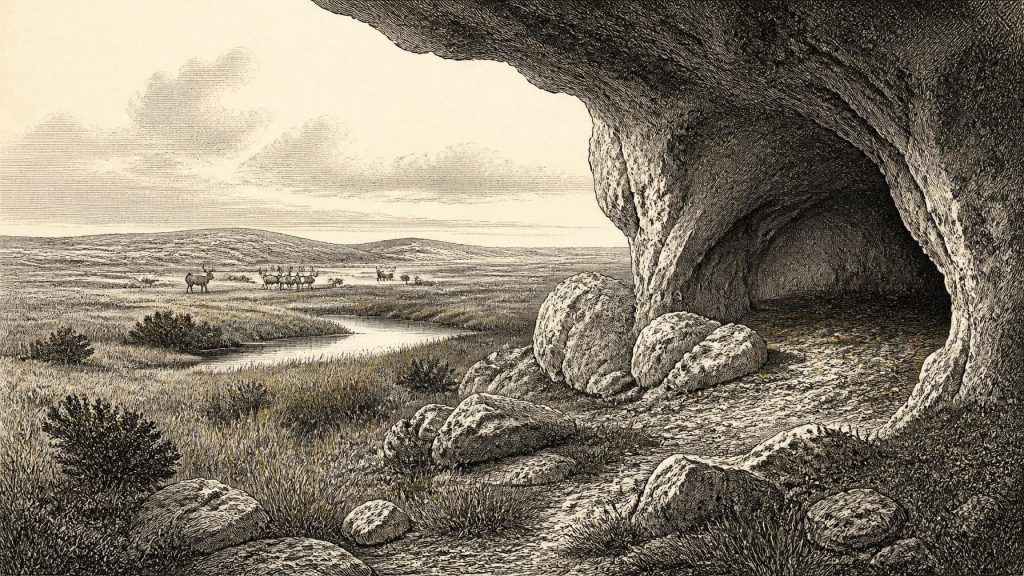
Around 31,295 BCE is a modern approximation within Ireland’s climatically unstable Middle Midlandian, not a precise historical date. Derryvree, County Fermanagh, preserves a wetland between glacial tills, demonstrating ice-free intervals with cold, open tundra vegetation and freshwater habitats. Castlepook Cave near Doneraile records diverse pre-Last Glacial Maximum fauna, including mammoth, giant deer, reindeer, hyena, wolves and Arctic species, though deposits are mixed. A cut-marked reindeer femur may indicate brief human butchery, but cannot prove settlement. No evidence exists for communities, politics, religion or farming. The period instead reveals a shifting, periglacial Atlantic landscape supporting cold-adapted animals and possibly transient foragers.
Dateline
Modern calendar-year precision is not available for Ireland at this depth of time. “31,295 BCE” is a convenient modern label, roughly corresponding to 33,244 years before AD 1950, rather than a date on which an Irish event can be placed. No written record, annual chronology, named individual or contemporary political community exists. The responsible approach is to place the notional year within a broader Late Pleistocene interval: the Middle Midlandian in Irish usage, broadly within Marine Isotope Stage 3, before the fullest growth of the last British-Irish Ice Sheet. The evidence consists chiefly of buried sediments, fossil animals, cave deposits and radiocarbon measurements with substantial uncertainty.
A Date Without a Chronicle
Radiocarbon ages are not themselves calendar dates. They must be calibrated against changing concentrations of atmospheric carbon-14, and the uncertainty grows markedly in the period around 33,000 calendar years ago. A deposit may also represent centuries or longer, rather than a single moment. For that reason, it would be misleading to say that a particular herd crossed Ireland, a glacier advanced, or people arrived in the exact year 31,295 BCE. It is more defensible to discuss the environmental world that may be illuminated by dated evidence spanning approximately 36,900–31,700 calibrated years BP at Derryvree in County Fermanagh, and by the wider pre-Last Glacial Maximum faunal record.
That distinction matters especially because later ice repeatedly eroded and rearranged Ireland’s older landscapes. The island has not yielded a continuous Palaeolithic settlement sequence comparable with those of France, Iberia or central Europe. What survives is fragmentary: a wetland trapped beneath glacial deposits in Fermanagh, animal bones recovered from caves in Cork and elsewhere, and a handful of objects whose meanings remain under examination. These remains provide remarkable evidence for life on the north-western edge of Europe, but not a conventional national history.
Derryvree’s Buried Wetland
The clearest Irish environmental window close to this broad horizon was exposed during roadworks in 1969 at Derryvree, near Maguiresbridge in County Fermanagh. Workers cut through a drumlin, a streamlined hill formed beneath moving ice, revealing fine sands, silts and organic-rich sediment sealed between two distinct tills. Till is unsorted material left by glacier ice. The sequence therefore records a profound alternation: glaciation, a period in which freshwater sediments accumulated in an ice-free locality, and a later glacial advance that buried the wetland.
Organic material from the Derryvree deposit produced the conventional radiocarbon determination BIRM-166, 30,500 radiocarbon years BP, with an uncertainty of roughly a millennium. Calibration permits a broad calendar range, not a precise historical date. Nevertheless, the stratigraphy is decisive evidence that at least part of inland northern Ireland was not continuously overridden by ice during this portion of the last glacial cycle. It also warns against imagining the country as either wholly frozen or wholly hospitable: the conditions changed greatly through time and varied between regions.
The Derryvree flora and fauna point to an open, cold and periglacial landscape. Periglacial describes ground affected by severe cold, frost and thaw near an ice margin; it does not mean that the site itself lay beneath a glacier. Pollen, plant macrofossils, mosses and invertebrate remains indicate sparse tundra-like vegetation, wet hollows and shallow freshwater. Sedges, grasses, herbs and mosses were more important than trees. Arctic-alpine plants and low shrubs could exploit sheltered or damp patches, while short growing seasons and winter cold constrained the landscape. Occasional tree pollen is not proof of a local forest: it may have travelled far or been redeposited.
Open Ground and Unstable Climate
In the wider North Atlantic, Marine Isotope Stage 3 was climatically unstable. Greenland ice cores record abrupt shifts between relatively milder interstadials and colder stadials, although it is not safe to assign the Derryvree silts to a single named Greenland event or to transpose Greenland temperatures directly to Fermanagh. The useful conclusion is more modest: Ireland’s climate did not progress smoothly towards maximum glaciation. Cold, biologically active terrain could exist between episodes of expanding ice, and its vegetation and animal populations would have responded to changing snow cover, growing seasons, sea level and routes of access.
Sea level was much lower than today because enormous quantities of water were stored in ice sheets. Ireland’s coastline was consequently very different, with broader coastal plains in places and narrower or altered sea crossings. Yet lower sea level did not automatically make Ireland a simple extension of Britain or continental Europe. The position, width and nature of land connections altered over the glacial cycle, while glacier ice and cold seas could make movement difficult. Mammals clearly reached Ireland at several points in the Pleistocene, but each arrival needs to be demonstrated from the evidence rather than assumed from a map.
The Cave Record at Castlepook
Castlepook Cave, also called Mammoth Cave, near Doneraile in north County Cork is the principal Irish archive for large mammals before the Last Glacial Maximum. Excavations in the early twentieth century recovered more than 2,000 bones from its passages and chambers, including places named Hyenahall and Elephant Hall. The National Museum of Ireland holds important material from those investigations. Later radiocarbon work and renewed excavations have reinforced the cave’s importance while also demonstrating its difficulty: water movement, disturbance and the collection methods of an earlier era mean that the deposits cannot be treated as one undisturbed occupation floor.
The assemblage documents a far richer Irish Ice Age fauna than survives on the island now. Identifications include woolly mammoth, giant deer, reindeer, brown bear, wolf, Arctic fox, mountain hare, collared lemming, Norwegian lemming and spotted hyena. Not every species need have occupied Castlepook at exactly the same time, and a bone from a cave does not necessarily indicate an animal that died there. Carnivores could carry prey or scavenged remains into a den; water could redistribute bones; and deposits of different ages could become mixed. Still, the total record securely establishes that varied cold-stage mammals reached Ireland during the wider interval before and into the approach to the glacial maximum.
The spotted hyena is particularly striking. Its Irish fossil record is centred on Castlepook, where skulls, teeth, bones and coprolites suggest that the cave was at least sometimes used by these powerful scavengers and hunters. Their presence helps explain why a cave could become a repository of animal remains without requiring human hunters to have made every accumulation. Wolves, bears and foxes likewise belonged to an ecosystem in which carcasses were contested resources. A reindeer or mammoth bone is evidence of an animal population and landscape, not automatically of human subsistence.
The Reindeer Femur Question
A reindeer femur from Castlepook has made this period unusually important for Irish archaeology. Zooarchaeologist Ruth Carden identified a deep incision on the bone as consistent with modification of fresh bone by a sharp stone implement, perhaps in butchery. County Cork’s heritage publication associates the specimen with about 31,000 BCE. If the mark was made by people shortly after the animal’s death, it would be evidence for a brief Upper Palaeolithic human presence in Ireland far earlier than the long-established terminal Pleistocene evidence from County Clare.
That possibility deserves attention, but not exaggeration. A direct date on a bone dates the animal, not necessarily the act that marked it. The specimen derives from an old cave collection rather than a newly excavated, sealed context, and no securely associated stone-tool assemblage, hearth, house floor, burial, human bone or repeated occupation surface of comparable age has yet been found in Ireland. The most cautious reading is that the femur may record the processing of one animal by visiting people. It cannot demonstrate a resident population, a seasonal camp, a family group or a permanent colonisation of the island.
What Cannot Be Recovered
There is consequently no evidence from around this horizon for political institutions, rulers, territories, diplomacy, organised warfare or formal alliances in Ireland. Nor can archaeology identify language, ethnicity or an Irish identity. “Ireland”, “Cork” and “Fermanagh” are modern geographical terms used to locate ancient evidence, not names known to its makers or inhabitants. A possible butchered reindeer bone does not reveal who held authority, how food was shared, whether groups returned annually, or how they related to communities in Britain or continental Europe.
The same restraint applies to religion, culture and learning. No shrine, grave, figurative art, musical instrument, ornament or inscribed object can be securely assigned to Ireland around 31,295 BCE. Upper Palaeolithic communities elsewhere in Europe possessed complex technologies, social knowledge and symbolic practices, but importing cave art, named archaeological cultures or ritual systems from France into Ireland would convert analogy into false Irish evidence. If people did visit Castlepook, they must have carried practical environmental knowledge, hunting skills and social traditions; the content of that knowledge is beyond recovery here.
Economy at the Edge of Ice
The economy most securely visible is ecological rather than human. Wetland plants used shallow water and damp ground at Derryvree; grazing mammals and their predators moved through open country in other Irish localities; caves became dens, traps or repositories. Reindeer were adapted to cold open environments and may have travelled seasonally, while mammoth and giant deer indicate the availability, at least intermittently, of substantial forage across a broad landscape. These animals were not the familiar inhabitants of later wooded Ireland. Their presence belongs to a colder world in which open vegetation, strong seasonality and glacial instability shaped the possibilities of life.
There is no evidence for farming, herding, settled villages, pottery, metalworking, long-distance commerce or managed fields. If the Castlepook cut mark proves human, the relevant activity was mobile foraging and carcass processing, not a documented trading economy. A small travelling party might have used stone tools, shared meat and moved on; equally, the available evidence cannot establish the size, duration or frequency of any such visits. The strongest historical development is therefore environmental: before later ice-sheet expansion transformed much of the island, parts of Ireland supported cold-adapted plants and animals, and perhaps fleeting human visitors, on a changing Atlantic frontier.
Primary Sources
- A Middle Midlandian Freshwater Series at Derryvree, Maguiresbridge, County Fermanagh, Northern Ireland
- The Irish Quaternary Fauna Project
- Castlepook Cave: County Geological Site Report
- Spotted Hyena Skull
- Heritage Artefacts of County Cork
- Castlepook Cave, Castlepook South: Excavations 2022
- The Colonization of Ireland: A Human Ecology Perspective
- New Insights on the Fauna of Ireland’s Younger Dryas and Early Holocene from Alice & Gwendoline Cave
- Dimensions and Chronology of the Last Ice Sheet in Western Ireland
- Radiocarbon Constraints on the Age of the Maximum Advance of the British-Irish Ice Sheet in the Celtic Sea
- Periglacial Trimlines and the Extent of the Kerry-Cork Ice Cap, SW Ireland
- Extent and Retreat History of the Barra Fan Ice Stream Offshore Western Scotland and Northern Ireland During the Last Glaciation
- Reconstruction and 36Cl Based Geochronology of the Deglaciation of Central Ireland
- Palaeoecology: The Middle Midlandian Palaeoenvironment of South Fermanagh
- The Subdivision of the Quaternary Period in Ireland
- Soils of County Waterford
- The IntCal20 Northern Hemisphere Radiocarbon Age Calibration Curve (0–55 cal kBP)
- Recent Developments in Calibration for Archaeological and Environmental Samples
- Radiocarbon Dating and Chronological Modelling
- A Stratigraphic Framework for Abrupt Climatic Changes During the Last Glacial Period Based on Three Synchronized Greenland Ice-Core Records
- Pleistocene Vertebrates in the British Isles
- Irish Association for Quaternary Studies: About Us