Mammoth Archive31219 BCE
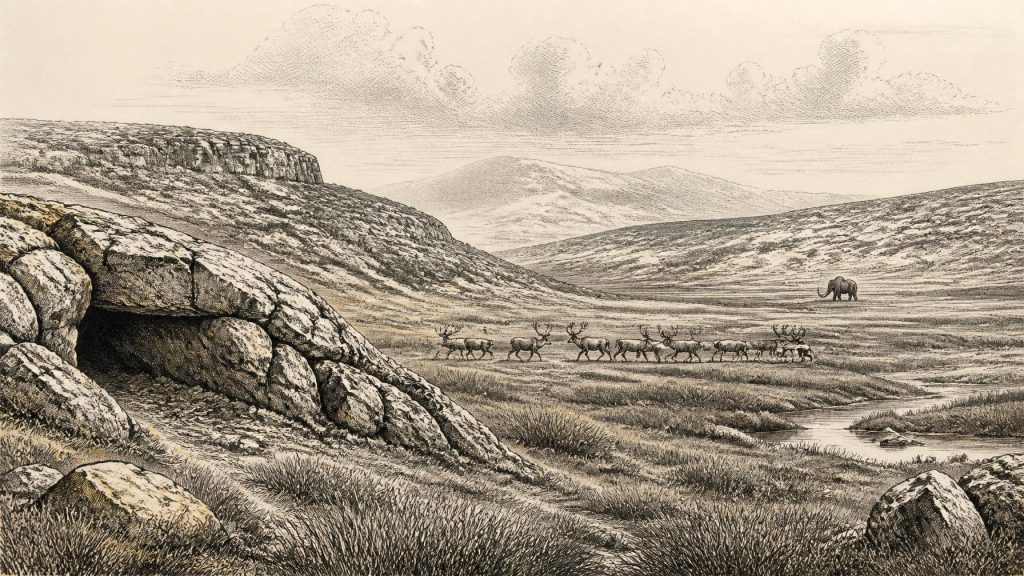
Labelled 31,219 BCE, this period in Ireland belongs to unstable Marine Isotope Stage 3, not a precisely knowable historical year. Castlepook, or Mammoth Cave, County Cork, preserves Ireland’s richest pre-Last Glacial Maximum vertebrate archive, although disturbed deposits and revised dating demand caution. Its mammoths, reindeer, giant deer, hyaenas and fauna indicate intermittent cold, open habitats, without proving a single contemporary landscape or route of arrival. A reindeer femur bearing a possible stone-tool incision may record butchery and a human presence. However, no settlement exists. Subsequent ice-sheet growth reshaped landscapes and erased evidence, leaving qualified environmental evidence and possible human trace.
Dateline
A Date Beyond the Calendar
31,219 BCE is a modern chronological label, not a year that anybody in Ireland could have named, recorded or remembered. No calendar, settlement sequence or event horizon can be resolved to that precision in the Late Pleistocene. In simple calendar arithmetic, it lies about 33,170 years before AD 1950, conventionally expressed as c. 33.2 thousand calibrated years BP. That conversion should not be mistaken for a radiocarbon measurement. At this depth of time, radiocarbon results require calibration and normally produce probability ranges rather than a single calendar year.
The responsible setting is therefore broad: later Marine Isotope Stage 3, a climatically unstable part of the last Ice Age, before the fullest expansion of the last British–Irish Ice Sheet. For Ireland, the evidence closest to this notional date is not a house, grave, hearth or tool-making floor. It is an uneven archive of animal bones, cave sediments, geological deposits and old museum collections. These can show that large mammals entered and at times lived on the island; they can suggest the character of certain habitats; and one bone has raised the possibility of human activity. They cannot supply a narrative of a particular Irish community in a particular year.
Castlepook’s Long Bone Archive
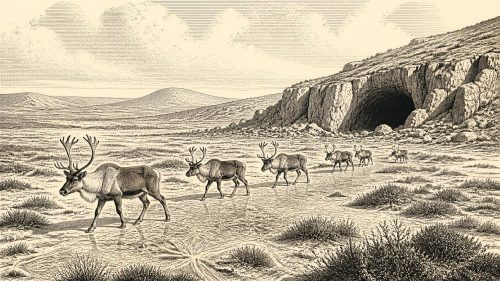
The key place is Castlepook Cave, also called Mammoth Cave, near Doneraile in north County Cork. It is a maze-like limestone cave system above the Awbeg valley. Excavations conducted mainly between 1904 and 1918 recovered a remarkable assemblage, much of which entered the National Museum of Ireland. Later dating programmes and reassessments have made Castlepook the island’s richest known vertebrate archive for the period before the Last Glacial Maximum.
The cave does not represent one neatly sealed episode. It collected remains over a long interval. Water movement, collapse, frost, scavengers and early excavation all complicated its deposits, while the standards of recording used in the early twentieth century were far removed from modern field practice. Geological Survey Ireland summarises the dated span of individual Castlepook bones as roughly 45,700 to 19,950 radiocarbon years BP. That breadth is vital: a bone from the cave is evidence for an animal, and sometimes for the processes that brought it underground, but not automatically for every other animal or activity in the collection.
Recent redating has made the caution sharper rather than less important. Improved preparation of bone collagen showed that several formerly obtained dates from southern Irish caves were too young, in some cases by thousands of radiocarbon years. The revised results place parts of the Castlepook fauna firmly within Marine Isotope Stage 3 and indicate that animals such as giant deer and spotted hyaena may have disappeared locally before the climatic severity of the Last Glacial Maximum. The lesson is not that all uncertainty has vanished, but that museum specimens and old cave collections can still materially change Ireland’s deep history.
A Tundra-Edge Fauna
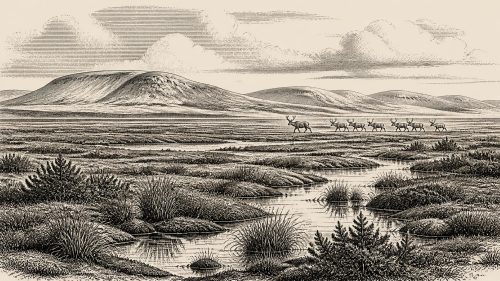
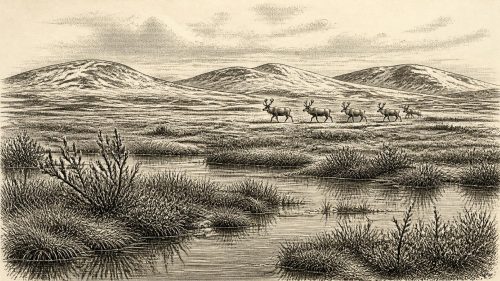
Castlepook’s fauna evokes an Ireland radically unlike the wooded island of later prehistory. Woolly mammoth, reindeer, giant deer, brown bear, wolf, Arctic fox, collared and Norwegian lemmings, and spotted hyaena are among the animals identified from the cave. The combination points to open, cold environments at least during the periods represented by the relevant remains: landscapes in which herb-rich grasslands, sedges, low shrubs and exposed ground could sustain grazing and browsing mammals, alongside predators and scavengers.
Yet it would be unsafe to turn that list into a photographic reconstruction of the whole island in 31,219 BCE. Animals have different ranges, cave deposits mix time, and Ireland’s terrain produced local variation. Some lowlands may have offered sheltered feeding grounds while uplands and northern districts were harsher; rivers, seasonal snow cover and sea level altered routes and habitats. The cave assemblage demonstrates that suitable environments existed in Ireland at intervals. It does not prove that mammoths, reindeer, hyaenas and every other listed species stood together beside the Awbeg on one day.
Sea level was substantially lower than today during the wider glacial period, changing the outlines of coasts and enlarging adjoining shelves. Ireland’s relationship with Britain and the continental landmass was also unlike the modern island geography, but the exact routes available to animals or people at this particular moment remain uncertain. The presence of terrestrial mammals proves that dispersal occurred during the Pleistocene. It does not identify a single crossing point, a continuous land bridge, or a route used by a human group.
The Reindeer Femur
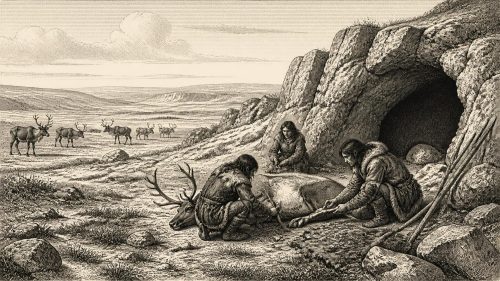
One fragment of reindeer femur gives this period an exceptional, if highly qualified, place in Irish archaeology. County Cork heritage publications present the bone as dating to about 31,000 BC and describe a deep mark on it as having been made by a sharp stone implement while the carcass was fresh. Zooarchaeologist Ruth Carden’s interpretation is that it may record butchery. If correct, it would be evidence that people used a cutting edge on a reindeer in Ireland during the Upper Palaeolithic, vastly earlier than the island’s well-established post-glacial settlement record.
The inference must remain narrower than the popular headline. The date applies to the animal bone, not directly to the incision. The fragment came from an old collection, rather than from a modern excavation of an intact occupation surface that held stone tools, hearths, food waste and the marked bone together. Marks on bone can be difficult to distinguish from carnivore damage, sediment abrasion, breakage or damage caused during recovery. Nor does a single modified limb bone reveal whether people killed the reindeer, found a carcass, took meat or sinew from it, or processed it elsewhere before scavengers or water carried part of it into the cave.
Accordingly, the reindeer femur is best described as possible evidence of a brief human visit or activity episode, not proof of permanent settlement. There is no securely associated dwelling, burial, lithic assemblage, hearth, art object or stratified campsite in Ireland of this age. The National Museum of Ireland continues to state that clear evidence for a Palaeolithic human presence has not yet emerged. That institutional caution is compatible with taking the Castlepook mark seriously: it recognises both the object’s potential importance and the need for independently excavated corroboration.
People, If Present
If the incision was made with a stone tool, the smallest defensible conclusion is economic rather than political: one or more people had access to a sharp lithic edge and to a reindeer carcass. Reindeer could supply meat, marrow, fat, hide, sinew, bone and antler. Mobile Upper Palaeolithic communities elsewhere in north-west Europe possessed the knowledge to hunt large game, make varied stone tools, maintain clothing and shelters, and organise seasonal movement. Those continental comparisons indicate what was possible, but they cannot be converted into facts about an Irish camp for which no camp has been found.
Nothing in the Irish evidence permits named peoples, a language, a leader, kin group, territory, religion or diplomatic relationship to be identified. There is no basis for describing tribal politics, warfare, ritual or exchange networks in Ireland at this date. Likewise, it would be unwarranted to claim regular trade across the sea merely because animals or perhaps people reached the island. A possible butchery mark is a remarkable trace, but it is not a constitution, a map of allegiance or a record of belief.
Everyday life is similarly elusive. A visiting party may have known fire, hide-working, food preservation and the practical skills familiar to Upper Palaeolithic hunter-gatherers elsewhere, but Castlepook does not demonstrate any of these practices in Ireland. It cannot establish population size, sex and age composition, length of stay or whether visitors returned. The strongest historical achievement is to preserve the distinction between what a wider European analogy makes plausible and what an Irish find actually attests.
Before the Great Expansion of Ice
31,219 BCE also predates the best-established maximum of the last British–Irish Ice Sheet. Large-scale reconstructions describe sustained ice-sheet growth from about 31,000 years BP to 26,000 years BP, with maximum overall extent later, around 26,000 years BP, and maximum ice volume around 23,000 years BP. These are ranges and modelled reconstructions, not a claim that all parts of Ireland changed at once. Ice accumulated, advanced and responded differently in different sectors.
The target date, c. 33.2 thousand calendar years BP, should therefore not be pictured simply as Ireland buried beneath the maximum ice sheet that later scoured much of the landscape. The faunal evidence itself indicates that at least some Irish environments had supported substantial mammals in the preceding millennia. But subsequent glaciation was historically decisive: it reshaped terrain, displaced or extinguished local faunas, buried and eroded deposits, and likely destroyed much of the fragile evidence that brief human visits might have left.
For this reason, 31,219 BCE is best understood not as a lost year of Irish political history but as a threshold in the island’s recoverable environmental past. Castlepook shows that Ice-Age Ireland could be part of a wider north-west European world of reindeer, mammoths and large carnivores. Its lone marked femur raises the possibility that people entered that world too. The evidence is too slight to populate the landscape with certainty, yet too significant to ignore. In deep prehistory, intellectual honesty lies in allowing both statements to stand together.
Source References
Hover over a number to see the source. Select it to open the source.

- [1] A Reconsideration of the Radiocarbon Dating of the Marine Isotope Stage 3 Fauna from Southern Ireland
- [2] The Irish Quaternary Fauna Project
- [3] Castlepook Cave: County Geological Site Report
- [4] Archaeological Heritage of County Cork
- [5] Heritage Artefacts of County Cork
- [6] Spotted Hyena Skull
- [7] Prehistoric Details
- [8] 2022:564 – Castlepook Cave, Castlepook South, Cork
- [9] Quaternary Site Descriptions
- [10] New Insights on the Fauna of Ireland’s Younger Dryas and Early Holocene from Alice & Gwendoline Cave
- [11] Occurrence of Mammalia Relicts at Site Castlepook Cave
- [12] Exploration of Castlepook Cave, Co. Cork
- [13] Pleistocene Vertebrates in the British Isles
- [14] Castlepook Caves
- [15] Mammoth Cave
- [16] Growth and Retreat of the Last British–Irish Ice Sheet, 31,000 to 15,000 Years Ago: the BRITICE-CHRONO Reconstruction
- [17] Maximum Extent and Readvance Dynamics of the Irish Sea Ice Stream and Irish Sea Glacier Since the Last Glacial Maximum
- [18] The Evolution of the Terrestrial-Terminating Irish Sea Glacier During the Last Glaciation
- [19] Stratigraphic and Palaeo-Geomorphological Evidence for the Glacial-Deglacial History of the Last British-Irish Ice Sheet in the North-Western Irish Sea
- [20] The IntCal20 Northern Hemisphere Radiocarbon Age Calibration Curve (0–55 cal kBP)
Primary Sources
- A Reconsideration of the Radiocarbon Dating of the Marine Isotope Stage 3 Fauna from Southern Ireland
- The Irish Quaternary Fauna Project
- Castlepook Cave: County Geological Site Report
- Archaeological Heritage of County Cork
- Heritage Artefacts of County Cork
- Spotted Hyena Skull
- Prehistoric Details
- 2022:564 – Castlepook Cave, Castlepook South, Cork
- Quaternary Site Descriptions
- New Insights on the Fauna of Ireland’s Younger Dryas and Early Holocene from Alice & Gwendoline Cave
- Occurrence of Mammalia Relicts at Site Castlepook Cave
- Exploration of Castlepook Cave, Co. Cork
- Pleistocene Vertebrates in the British Isles
- Castlepook Caves
- Mammoth Cave
- Growth and Retreat of the Last British–Irish Ice Sheet, 31,000 to 15,000 Years Ago: the BRITICE-CHRONO Reconstruction
- Maximum Extent and Readvance Dynamics of the Irish Sea Ice Stream and Irish Sea Glacier Since the Last Glacial Maximum
- The Evolution of the Terrestrial-Terminating Irish Sea Glacier During the Last Glaciation
- Stratigraphic and Palaeo-Geomorphological Evidence for the Glacial-Deglacial History of the Last British-Irish Ice Sheet in the North-Western Irish Sea
- The IntCal20 Northern Hemisphere Radiocarbon Age Calibration Curve (0–55 cal kBP)