Castlepook’s Deep-Time Reindeer31206 BCE
31,206 BCE is a modern label for a Late Pleistocene interval, not a recoverable Irish historical year. Derryvree, County Fermanagh, preserves organic sediments between glacial tills, indicating an ice-free, treeless wetland of sedges, mosses, pools and cold-adapted insects during Marine Isotope Stage 3. Castlepook Cave, County Cork, contains a mixed fauna including mammoth, reindeer, giant deer, carnivores and small cold-climate mammals, though its deposits lack precise stratigraphic control. A marked reindeer femur may indicate butchery by people, potentially Ireland’s earliest human trace, but proves neither settlement nor permanent population. Climatic deterioration expanded the British-Irish Ice Sheet, destroying or concealing evidence.
Dateline
“31,206 BCE” is a modern calendar label applied to a point far beyond the reach of annals, named rulers or year-by-year memory. It should not be mistaken for a date on which an identifiable Irish event occurred. In radiocarbon convention this point lies roughly 33,155 years before AD 1950, but the evidence available for Ireland consists of deposits and bones dated within broad probability ranges, not historical years. The responsible setting is the later part of the Late Pleistocene, within Marine Isotope Stage 3: a climatically unstable interval before the fullest expansion of the last Irish Ice Sheet.
For this approximate moment, Ireland’s history is principally environmental. The island’s landscape, fauna and possible human use can be approached through a small number of unusually important archives: organic sediments buried beneath later ice deposits in County Fermanagh, and fossil animal assemblages recovered from caves in the south. They illuminate long spans of time, often centuries or millennia. They cannot tell us what happened in this exact numbered year.
A Date Beyond Chronicle
There were no Irish kingdoms, states, written records or recoverable named communities in 31,206 BCE. Indeed, the available evidence does not establish a permanent human population in Ireland at this time. It is therefore misleading to supply prehistoric equivalents for politics, diplomacy, warfare, religion or trade. No settlement hierarchy, burial ground, shrine, fortification, exchange network or artistic tradition of this age is securely known from Ireland.
That absence is itself historically significant. Ireland’s deep past was shaped by abrupt climatic shifts, changing ice margins, sea-level change and the movements of animals across north-west Europe. Human communities existed elsewhere in Europe during the Upper Palaeolithic, but it does not follow that a continental archaeological culture, its beliefs or its social organisation can be assigned to Ireland. The Irish record must stand on its own evidence.
Chronology needs equal care. Radiocarbon laboratories measure the remaining carbon in once-living material and return an age with a statistical uncertainty; researchers then calibrate it against past variation in atmospheric radiocarbon. At around 33,000 years ago, calibrated results frequently span many centuries. A bone date tells us when the animal lived and died within a range, not necessarily the precise moment when it was moved, gnawed, cut or buried. Thus 31,206 BCE is best treated as a point lying within wider archaeological and environmental ranges, rather than as a recoverable episode.
Derryvree’s Cold Wetland
The clearest Irish environmental evidence relevant to this broad period comes from Derryvree near Maguiresbridge, County Fermanagh. Roadworks in 1969 exposed organic freshwater silts and sands enclosed between two beds of glacial till within a drumlin. The sequence records a powerful local history: ice laid down the lower till; the site subsequently became an ice-free freshwater environment; and later ice deposited the upper till over it. It is direct evidence against a simple image of Ireland as continuously ice-covered throughout the whole Late Pleistocene.
A conventional radiocarbon determination from the Derryvree organic deposits was 30,500 ± 1,200 radiocarbon years before present. Later calibration has placed the deposit broadly at about 36,900–31,700 calibrated years before present. The modern label 31,206 BCE falls within the long chronological neighbourhood represented by that range, but it cannot demonstrate that the sampled pool, plants or insects existed in that particular year. Nor should one Fermanagh exposure be treated as a weather station for the entire island.
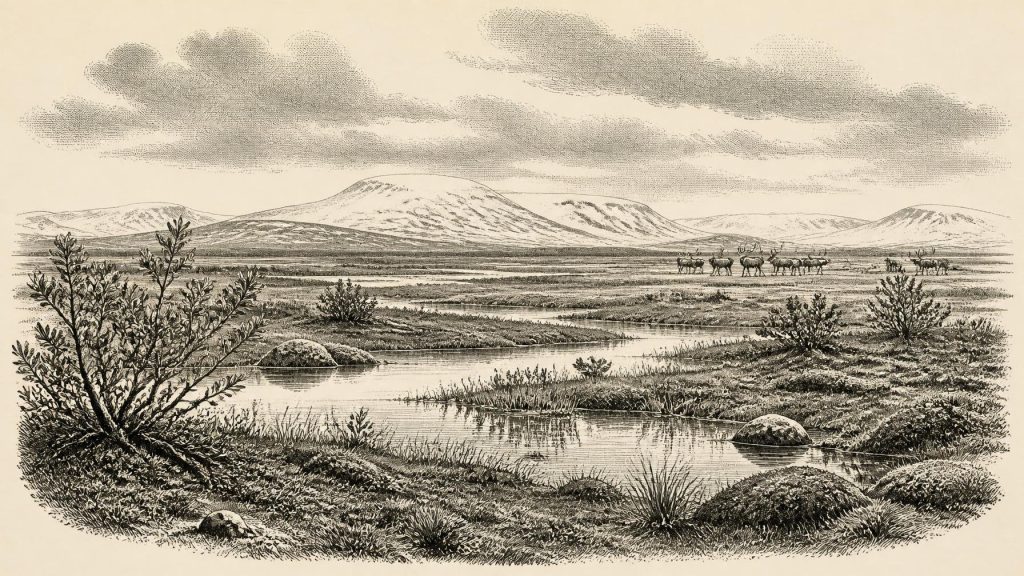
What Derryvree does reveal is vivid. Pollen, plant macrofossils and beetle remains point to a treeless, cold, waterlogged landscape often described as tundra or muskeg. Sedges and grasses grew among mosses and herbs; low shrubs, including dwarf willow, had a place in the vegetation. Fossils of water plants such as bogbean and alternate water-milfoil show that shallow open water occurred amid the wet ground. The result was not a featureless white wilderness, but a patchwork of pools, saturated mossy ground, sedge-rich margins and exposed mineral surfaces.
Winters were severe and the growing season short. Yet the wetland evidence demonstrates biological productivity: plants rooted, insects completed life cycles and freshwater habitats persisted for long enough to leave a layered record. It also suggests regional variation. Sheltered basins and watercourses could support richer local ecologies than windswept uplands or ground close to advancing ice. Ireland around this date was environmentally fragmented, with opportunities and hazards changing across short distances and over generations.
The Cave at Castlepook
In north County Cork, Castlepook Cave near Doneraile—also called Mammoth Cave—provides a contrasting archive. Its deposits and museum collections contain a notable Late Pleistocene fauna, including woolly mammoth, reindeer, giant deer, brown bear, wolf, Arctic fox, mountain hare, lemmings and spotted hyaena. Together these remains show that, at intervals before the Last Glacial Maximum, parts of Ireland supported a substantial cold-stage food web. Large herbivores required extensive forage; carnivores followed prey and scavenging opportunities; smaller mammals belonged to open, cold-adapted habitats.
This list must not be converted into a single painted scene. Cave assemblages are accumulations, not snapshots. Animals may have died in different centuries or millennia; carnivores may have dragged bones underground; water and gravity may have moved material; and excavation methods used at Castlepook in the early twentieth century did not provide the stratigraphic control expected today. Recent reassessment and improved radiocarbon pretreatment have also shown that some older Irish dates require revision. The cave is invaluable, but it is a complicated archive.
Its most arresting object is a reindeer femur fragment identified in the National Museum of Ireland’s collections. The bone has been publicised as approximately 33,000 years old and bears a deep surface mark interpreted by zooarchaeologist Ruth Carden as consistent with cutting or chopping by a sharp stone tool while the bone was fresh. If that reading is confirmed, it would be potentially the earliest evidence of human activity in Ireland, enormously earlier than the well-supported terminal-Pleistocene evidence from Alice and Gwendoline Cave in County Clare.
The qualification matters. The femur offers a possible trace of carcass processing, not a settlement. It does not prove that a reindeer was killed at Castlepook, that a group lived in the cave, or that the island had a resident population. No securely associated hearth, stone-tool assemblage, dwelling floor, human burial, art or repeated occupation horizon of comparable age has been established there. The date of the bone is also not an exact date for the mark. The strongest conclusion is deliberately modest: people may have encountered, butchered or transported reindeer in Ireland during this broad period.
People at the Atlantic Edge
If people did reach Ireland, they would have faced a demanding world. Their practical economy would have depended on close knowledge of animal movements, sheltered ground, fuel, water, stone and weather. Reindeer offered meat, marrow, hides, sinew and bone; other game and scavenged resources may have been important. But these are informed possibilities drawn from the ecological setting and wider Upper Palaeolithic experience, not demonstrated Irish practices. The Castlepook bone cannot reveal the size of a party, its language, kinship system, technology beyond the suggested sharp implement, or how long it stayed.
Nor is there evidence for regular trade. Lower sea levels altered the outline of the Irish Sea and reduced some distances, but the coastlines, channels and practical routes of this period were unlike those of today. Animal and human movement between Ireland, Britain and continental Europe may have been possible at intervals, whether by land connections, narrow water crossings or combinations of both; the evidence does not permit a date-specific route map for 31,206 BCE. What is secure is ecological connection: Irish fauna belonged to wider north-west European populations rather than developing in isolation.
Political affairs and conflict are beyond recovery. Predators and scavengers competed over carcasses, but that is not evidence of human warfare. Likewise, there is no Irish material from this horizon from which to infer ceremony, religious belief, cave art, teaching or formal learning. The absence of evidence should not be turned into a claim that Ice Age visitors lacked culture. It simply recognises that no such culture has yet been recovered in Ireland.
Approaching the Great Ice
At the scale of the whole island, the most consequential development was climatic deterioration and the eventual growth of the British-Irish Ice Sheet. The Last Glacial Maximum came later, broadly between about 26,000 and 20,000 calibrated years before present, but ice expansion was neither instantaneous nor uniform. Evidence from Derryvree and other northern Irish sequences indicates that north-central Ireland retained ice-free ground until at least around 34,000 years ago. Around the notional date of 31,206 BCE, Ireland was therefore in a long transition rather than already a uniformly frozen island.
Later ice repeatedly reshaped the terrain, deposited tills and obscured earlier surfaces. This is one reason why the evidence is so sparse: camps on exposed ground were unlikely to survive intact, while caves and sediment-filled hollows preserved only selected traces. The archaeological silence may reflect genuinely brief or rare human visits, but it also reflects the destructive force of subsequent glaciation and the limited modern investigation of old collections.
The year’s proper historical emphasis, then, is not a fabricated episode but a precarious horizon. Derryvree preserves an ice-free northern wetland within a cold, treeless Ireland; Castlepook preserves the bones of a southern fauna rich enough to include reindeer and mammoth; and one marked reindeer bone raises, without conclusively answering, the question of an Upper Palaeolithic human presence. In 31,206 BCE, Ireland was not yet a country of documented inhabitants. It was an Atlantic-edge landscape of sedge water, open tundra, large animals and approaching ice—known through fragments, and requiring restraint as much as imagination.
Primary Sources
- A Middle Midlandian Freshwater Series at Derryvree, Maguiresbridge, County Fermanagh, Northern Ireland
- A Reconsideration of the Radiocarbon Dating of the Marine Isotope Stage 3 Fauna from Southern Ireland
- The Irish Quaternary Fauna Project
- Trimlines, Blockfields and the Vertical Extent of the Last Ice Sheet in Southern Ireland
- Dimensions and Chronology of the Last Ice Sheet in Western Ireland
- First Evidence of a Late Upper Palaeolithic Human Presence in Ireland
- New Insights on the Fauna of Ireland’s Younger Dryas and Early Holocene from Alice & Gwendoline Cave
- The Exploration of Castlepook Cave, County Cork
- Heritage Artefacts of County Cork
- 2022:564 – Castlepook Cave, Castlepook South, Cork
- Mammoth Cave, County Cork
- Salix herbacea L. in Fermanagh: Fossil History
- Myriophyllum alterniflorum DC. in Fermanagh: Fossil Occurrence
- Cenozoic: Tertiary and Quaternary
- Soils of County Waterford
- The IntCal20 Northern Hemisphere Radiocarbon Age Calibration Curve (0–55 cal kBP)
- The ‘Red Lady’ Ages Gracefully: New Ultrafiltration AMS Determinations from Paviland
- The Brown Bear (Ursus arctos L.) in Ireland
- Pleistocene Vertebrates in the British Isles
- A Palaeo-Glaciological Reconstruction of the British-Irish Ice Sheet