

Cork’s Deep Bone Question31192 BCE
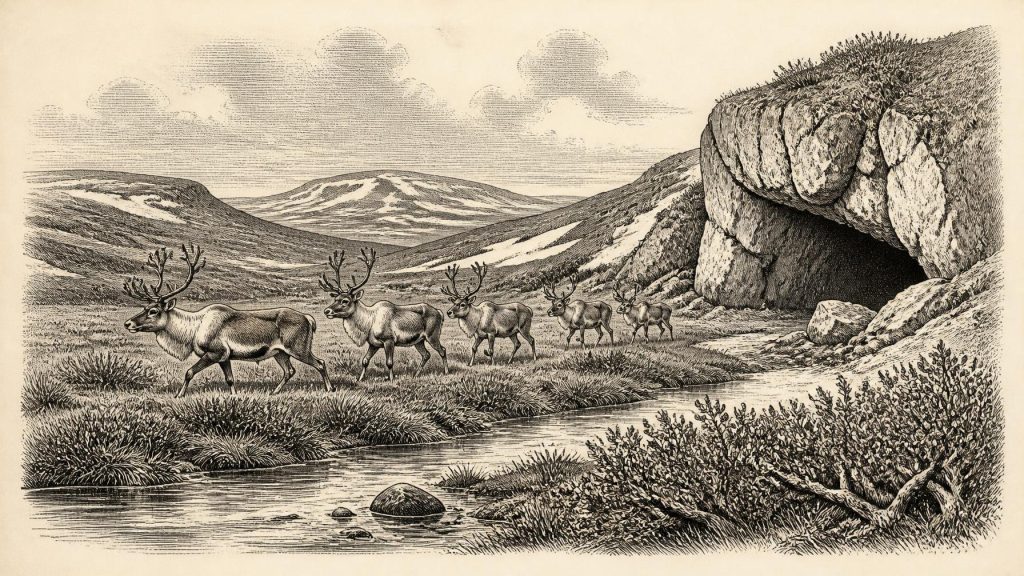
Around 31,192 BCE, Ireland lay within the unstable, cold conditions of Marine Isotope Stage 3, before the Last Glacial Maximum. Evidence derives from broadly dated bones, sediments, plants and insects rather than year-specific events. Castlepook Cave in County Cork preserves fauna including reindeer, mammoth, giant deer, predators and cold-adapted smaller animals. A marked reindeer femur may indicate human butchery, yet cannot prove settlement or even a dated hunting episode. Derryvree, County Fermanagh, records an ice-free wetland interval between glacial advances. Together, these traces depict open tundra-grassland habitats and possible transient human visits, while confirming profound uncertainty about Ireland’s earliest inhabitants.
Dateline
Modern calendar-year precision is not available for Ireland in 31,192 BCE. That label corresponds very approximately to 33,141 years before AD 1950, but archaeological and environmental evidence at this depth of time is dated in broad radiocarbon and calibrated ranges, not by individual years. The responsible subject is therefore Ireland during the later part of Marine Isotope Stage 3 (MIS 3), a volatile interval of the last Ice Age. It was long before the fullest expansion of the last British–Irish Ice Sheet, and long before any securely demonstrated, lasting human settlement of the island.
A Date Within Deep Time
The most informative evidence near this notional date does not record a battle, ruler, settlement or named people. It consists of cave bones, waterlogged sediments, fossil plants and insects, glacial deposits, and laboratory measurements made many millennia after their formation. Radiocarbon ages are conventionally counted backwards from AD 1950; because the amount of atmospheric carbon-14 has changed through time, those measurements must be calibrated. At around 33,000 calendar years ago, a result may convert to a wide interval, sometimes with more than one possible part of the calendar curve. A date such as 31,192 BCE is useful for arranging a year-by-year archive, but it cannot identify an event that happened in that year.
In broad terms, this was a cold, open and unstable Irish landscape during MIS 3. Temperatures and ice margins changed repeatedly across centuries and millennia. Ireland was not yet in the most severe phase usually associated with the Last Glacial Maximum, when ice expanded dramatically after roughly 27,000–26,000 years ago and later covered much of the island. Yet this was no mild countryside awaiting later history. The land was shaped by periglacial processes: repeated freezing and thawing, sparse vegetation, exposed soils and seasonally difficult ground. Its coastlines were also unlike those of today, because global sea level was lower; nevertheless, neither the precise form of the Irish Sea nor a specific route of travel can be reconstructed for this single date.
Castlepook and the Reindeer
The most striking Irish evidence associated with this period comes from Castlepook Cave, also known as Mammoth Cave, near Doneraile in north County Cork. Excavations and collecting there in the late nineteenth and early twentieth centuries recovered a remarkable Ice Age fauna. Reindeer, woolly mammoth, giant deer, brown bear, wolf, Arctic fox, hare, lemmings and spotted hyaena are among the animals represented in the wider cave collection. Modern re-dating has been especially important: improved pretreatment of bone collagen showed that some older radiocarbon results from Irish caves had underestimated the true age of specimens by thousands of years.
For the horizon around this article’s nominal date, reindeer are particularly significant. Their presence is direct evidence for cold-adapted grazing animals in southern Ireland during MIS 3. A cave, however, is not a transparent picture of a living herd. Bones can be brought in by carnivores, dragged by water, moved during collapse, disturbed by later digging or selected by early collectors. Castlepook should therefore be understood as an archive of animal life and deposition over a long period, not as a single camp-site frozen in time.
One reindeer femur fragment has generated exceptional interest because it bears a deep linear mark interpreted by zoologist Ruth Carden as consistent with cutting or chopping by a sharp stone implement on fresh bone. County Cork heritage material has presented the specimen as possible evidence that Upper Palaeolithic hunters processed a reindeer in the Doneraile area about 31,000 BCE. If this interpretation is confirmed, it would extend evidence for human activity in Ireland far beyond the better-established terminal-Pleistocene evidence from County Clare.
That conclusion must remain carefully qualified. The dated bone establishes the age of the animal, not an exact date for the mark or the place where a carcass was killed. The object was recovered from an old cave collection rather than a modern excavation with an associated hearth, stone-tool assemblage, shelter floor or repeated occupation layers. Natural processes can mark and break bone, while cave deposits often mix material of different ages. The incision is an important research question, not proof of a resident population, a village, or a year-specific hunting expedition.
A Country of Open Ground
The Castlepook fauna nonetheless allows a restrained reconstruction of the world beyond the cave. Reindeer indicate open country with forage adequate for herds; mountain hare, Arctic fox and lemmings reinforce the impression of cold, largely treeless environments. Mammoth and giant deer broaden the picture of a productive grazing landscape, though their remains need not all belong to one moment or one locality. Spotted hyaena is equally revealing: it was a powerful scavenger and predator whose denning and bone-accumulating habits may themselves have helped create cave assemblages.
This was not the familiar green, wooded Ireland of later millennia. Pollen, plant macrofossils and insect remains from Irish interstadial deposits point instead towards mosaics of herb-rich tundra, grassland, dwarf shrubs, sedges, mosses and wet ground. Plant cover would have varied by exposure, drainage, altitude and season. Summers could produce a brief but biologically active growing season; winters were severe, and permafrost or deeply frozen ground affected drainage and soil formation. The apparently empty expanses of a cold landscape could sustain specialised herbivores, carnivores and scavengers, but they did not necessarily support humans year-round.
Derryvree’s Buried Wetland
In County Fermanagh, near Maguiresbridge, the Derryvree sequence provides a complementary record. Roadworks exposed sediments within a drumlin: an older glacial till below, freshwater silts, sands and organic deposits in the middle, and later till above. This sequence demonstrates a non-glacial interval between advances of ice. During that interval, pools, marshes or shallow-water habitats accumulated sediment and preserved organic remains; a subsequent glacier sealed them beneath fresh debris.
A radiocarbon determination from Derryvree, BIRM-166, was reported as 30,500 radiocarbon years BP with a substantial uncertainty. Calibration produces a broad calendar range rather than a date that can be attached to a particular season or year. It is reasonable to treat the deposit as evidence for an ice-free or locally ice-free environmental window in later MIS 3, broadly overlapping the world represented by the 31,192 BCE label. It is not responsible to claim that a particular Derryvree pool existed in that numbered year.
The organic remains are valuable because they show that cold Ireland was not simply an unbroken ice sheet. Records from inter-till deposits include aquatic and wetland plants such as bogbean and water-milfoil, alongside mosses, sedges and cold-tolerant terrestrial flora. Beetle and other biological evidence can add details about ground conditions and vegetation. Together, they point to freshwater habitats set within an open, cold landscape. Such places would have concentrated food for animals and created sheltered patches of productivity, although no evidence demonstrates human use of Derryvree at this time.
People: Possibility, Not Population
Across north-west Europe, Homo sapiens communities of the Upper Palaeolithic made sophisticated stone tools, used animal skins and bone, maintained social networks across large territories, and in some regions created ornaments, figurative objects and cave art. It would be misleading, however, to transfer all of that evidence automatically to Ireland. No securely associated Upper Palaeolithic tool-kit, human remains, dwelling, burial, art panel or hearth of approximately 33,000 years ago has been recovered from the island.
If the Castlepook mark is human-made, the most cautious interpretation is a brief visit or a small-scale hunting and carcass-processing episode, perhaps made by mobile people moving through the western fringe of the European world. A party following reindeer or exploiting seasonal resources need not have founded a permanent colony. Conversely, the absence of sites cannot prove that no person ever arrived: later glaciation eroded and buried landscapes, changing coastlines drowned possible sites, and Irish cave collections are unevenly excavated and documented. The evidence supports uncertainty rather than a simple tale of either settlement or total emptiness.
No Polities, but a Real Past
There can be no responsible account here of political affairs, diplomacy, warfare, law, religion or learning in the conventional historical sense. There are no names, monuments, inscriptions or settlements from which to infer institutions or beliefs. Nor is there evidence for farming, trade routes, metalwork or organised exchange within Ireland. Any claim that reindeer hunters were “Irish”, that they belonged to a known archaeological culture, or that they held particular religious ideas would exceed the evidence.
Yet the period is not ahistorical. Around the notional year 31,192 BCE, Ireland formed part of a changing north-west European ecological zone. Its story survives in a reindeer bone from Cork, cold-water sediments beneath a Fermanagh drumlin, and faunal assemblages whose dates have been transformed by modern laboratory methods. The great development of this interval is not a recorded human event but the survival of evidence through later ice, erosion and excavation. Castlepook’s marked femur and Derryvree’s wetland deposits remind us that Ireland’s deepest past is reconstructed from traces: powerful enough to revise old assumptions, but too fragile to bear inventions.
Primary Sources
- A reconsideration of the radiocarbon dating of the Marine Isotope Stage 3 fauna from southern Ireland
- The Irish Quaternary Fauna Project
- Heritage Artefacts of County Cork
- New insights on the fauna of Ireland’s Younger Dryas and Early Holocene from Alice & Gwendoline Cave
- New insights on the fauna of Ireland’s Younger Dryas and Early Holocene from Alice & Gwendoline Cave (open-access PDF)
- The IntCal20 Northern Hemisphere radiocarbon age calibration curve (0–55 cal kBP)
- The IntCal20 approach to radiocarbon calibration curve construction: a new methodology using Bayesian splines and errors-in-variables
- IntCal: International Radiocarbon Calibration
- Outreach and Education Resources
- Field Guides
- Publications
- Irish Quaternary Association Guide 17
- Maximum extent and dynamic behaviour of the last British–Irish Ice Sheet west of Ireland
- Oscillating retreat of the last British-Irish Ice Sheet on the continental shelf offshore Galway Bay, western Ireland
- Timing, pace and controls on ice sheet retreat: an introduction to the BRITICE-CHRONO transect reconstructions of the British-Irish Ice Sheet
- Pattern, style and timing of British–Irish Ice Sheet advance and retreat over the last 45,000 years: evidence from NW Scotland and the adjacent continental shelf
- Response of the Irish ice sheet to abrupt climate change during the last deglaciation
- Investigating seasonal mobility in Irish giant deer Megaloceros giganteus through strontium isotope analysis
- Pleistocene vertebrates in the British Isles
- Ireland’s Palaeolithic Archaeology – Fleeting Footprints in a Frozen Land