
Mammoths Above the Awbeg31193 BCE
31,193 BCE denotes a modern chronological point within Marine Isotope Stage 3, not a documented Irish year. Before the Last Glacial Maximum, Ireland experienced variable ice cover and cold, open tundra-like wetlands, evidenced at Derryvree, Greenagho and Aghnadarragh. Castlepook Cave in County Cork preserves a rich, intermittently accumulated fauna including mammoth, reindeer, giant deer, bear, wolf, Arctic fox, lemmings and hyaena, demonstrating ecological links with Britain and Europe. A cut-marked reindeer femur may indicate brief human carcass processing, but cannot prove settlement or occupation. Evidence remains fragmentary, dating broad, and interpretations may change through improved excavation, analysis and ancient-DNA research.
Dateline
31,193 BCE is not a date from which Ireland has an annual history. No Irish calendar, written record, named person or recoverable political event can be assigned to this particular year. The label is a modern way of locating a point roughly 33,140 years before the conventional radiocarbon reference year of AD 1950; it is not itself a radiocarbon determination. At this depth of time, evidence comes in broad, calibrated ranges and from deposits accumulated over generations or millennia. The responsible subject is therefore Ireland during the later part of Marine Isotope Stage 3, within the last Ice Age, rather than an invented episode in a precisely known year.
A Landscape Before Maximum Ice
In broad terms, 31,193 BCE falls before the fullest expansion of the last Irish Ice Sheet. The global Last Glacial Maximum is generally placed much later, around 26,500–19,000 years ago. That distinction matters. Ireland was not simply an island uniformly buried beneath ice at this date, nor was it a familiar green and wooded landscape. Its climate and ice cover were changing sharply over comparatively short geological intervals, and conditions differed between regions. The island lay within the shifting climatic frontier of the north-east Atlantic, affected by changing sea levels, sea ice, atmospheric circulation and the advance or retreat of glaciers.
Evidence from beneath later glacial deposits demonstrates that parts of Ireland were ice-free during portions of this wider period. At Derryvree near Maguiresbridge in County Fermanagh, freshwater silts and organic material lay between two tills: sediments deposited by ice before and after the wetland episode. A conventional radiocarbon determination of 30,500 ± 1,100 BP has been calibrated to a wide range of about 36,900–31,700 cal BP. It cannot be converted into a precise date for a single pond, plant or animal, but it establishes that a cold, non-glacial landscape existed in this part of the north during a span relevant to the early thirty-third millennium before present.
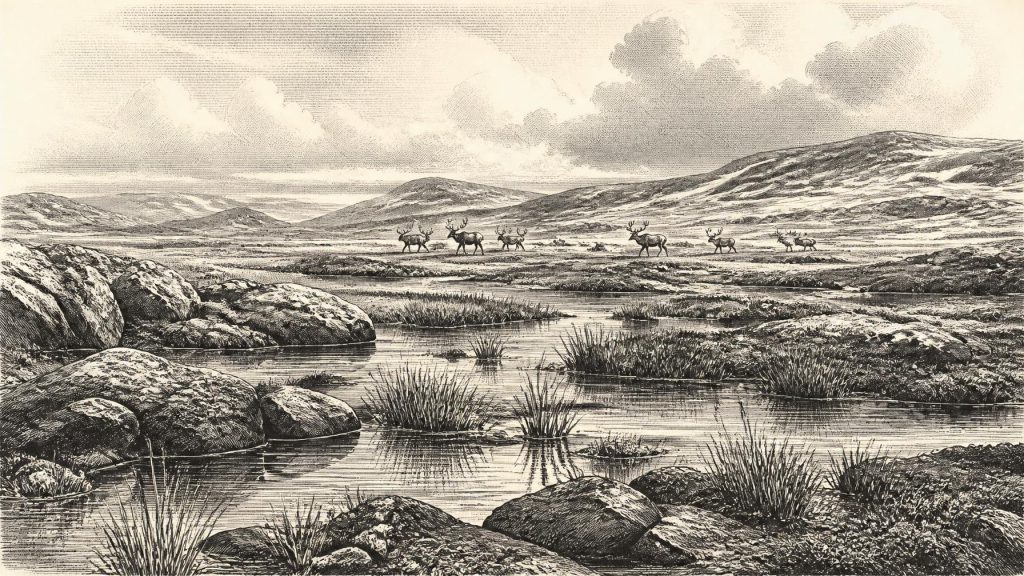
The Derryvree evidence points to treeless, waterlogged tundra or muskeg-like ground, with freshwater pools, sedges, mosses and herbs. It does not yield a panoramic map of Ireland, but it strongly cautions against imagining dense woodland. Other sequences, including Greenagho in Fermanagh and Aghnadarragh beside Lough Neagh in County Antrim, likewise preserve rare windows onto the fluctuating Midlandian cold stage. Pollen, plant remains and fossil insects indicate open vegetation and severe seasonality. Some beetles associated with these records now live far to the north in Scandinavia. The exact temperatures and seasons of 31,193 BCE cannot be recovered, but the available evidence supports an exposed, cold environment with wetlands and sparse plant cover rather than a settled agricultural landscape.
Fauna at the Edge of Ice
The most vivid Irish evidence comes from cave deposits, particularly Castlepook Cave—also called Mammoth Cave—near Doneraile in north County Cork. The cave was excavated largely in the early twentieth century, before modern standards of stratigraphic recording. Its collections are nevertheless exceptionally important. Reassessment and improved radiocarbon dating have shown that at least part of its fauna belongs to Marine Isotope Stage 3, well before the Last Glacial Maximum. The wider Irish Quaternary Fauna Project concluded that a considerably richer mammal fauna reached Ireland intermittently between at least about 45,000 and 20,000 years ago.
Castlepook has produced remains attributed to woolly mammoth, reindeer, giant deer, brown bear, wolf, Arctic fox, mountain hare, lemmings and spotted hyaena. This formidable list should not be turned into a scene in which every species shared one valley on one day. A cave accumulates material in complicated ways: carnivores may drag in prey, water may move bones, collapses may mix layers, and old excavations can obscure original relationships. Yet the assemblage securely changes the scale on which Ireland’s Ice Age ecology must be understood. At suitable times, parts of the island supported or were visited by large grazing and browsing mammals, together with predators and scavengers absent from modern Ireland.
Reindeer are especially suggestive of open, cold-adapted country, while mammoth and giant deer indicate extensive plant resources across the wider landscape. Spotted hyaena, known in Ireland principally from Castlepook, is equally important: it warns that some cave bone concentrations may be carnivore accumulations rather than human rubbish. Wolves and hyaenas would have competed for carcasses and may have transported limbs into shelter. The cave therefore documents an ecological network and recurrent movement, not a permanent local herd count. Ireland was connected biologically to Britain and continental north-west Europe at intervals, but the precise routes—whether across exposed shelf terrain, narrowed sea passages or changing coastal margins—remain unresolved.
The Marked Reindeer Femur
One Castlepook object brings the question of people unusually close to this period. A reindeer femur in the old collection has been presented by County Cork heritage material as dating to about 31,000 BC and carries a deep incision interpreted by zooarchaeologist Ruth Carden as a cut made with a sharp stone tool during carcass processing. If that interpretation is sustained, it is potentially Ireland’s earliest evidence that people handled an animal, vastly earlier than the island’s securely recognised post-glacial settlement record.
Its significance must be stated with equal care. The bone was not recovered from a modern excavation of a sealed occupation floor. No securely associated hearth, dwelling, human burial, stone-tool assemblage or organised butchery area of comparable age has been found at Castlepook. The date of the animal’s death does not independently date the incision, identify its maker, prove where the animal was killed or establish how long any people stayed in Ireland. Surface modification also requires specialist taphonomic judgement, because carnivore damage, trampling, breakage and weathering can leave misleading traces.
The most cautious conclusion is therefore limited but important. In the broader period near 31,193 BCE, reindeer were present in or reached north Cork, and one bone may record cutting with a stone edge. That is compatible with a brief visit by mobile Upper Palaeolithic people exploiting a carcass. It is not proof of a village, a resident population, a regular hunting territory or uninterrupted occupation. Even a genuine cut mark would not reveal whether people hunted the reindeer, found it already dead, removed hide or sinew, took meat, or left the limb where carnivores later carried it into the cave.
Life Beyond the Evidence
For society and everyday life, the archaeological record allows only tightly bounded inference. If humans did visit Ireland in this period, they would have belonged to small, mobile foraging groups able to travel through a demanding cold-stage world and use sharp stone edges. Reindeer and other large mammals could have provided meat, fat, hides, sinew, bone and antler, but none of these specific practices can be demonstrated from the Castlepook femur alone. No Irish evidence of this age identifies a camp layout, family group, language, clothing, boat, weapon type or seasonal round.
There is still less basis for political affairs, diplomacy or warfare. No chiefdom, territory, alliance, conflict or named community can responsibly be reconstructed. The relevant relationships were ecological rather than governmental: herbivores, predators, scavengers, shifting vegetation and advancing ice shaped the opportunities available to any passing people. Nor is there evidence for formal religion, monuments, burials, cave art, writing or institutional learning in Ireland at this date. A possible practical incision on a reindeer bone is not evidence of symbolic art or ceremony.
Trade, in the usual historical sense, is equally invisible. The presence of animals with continental affinities shows that Ireland was not ecologically isolated throughout the Ice Age, but animal dispersal is not commerce. No imported artefact, quarry source, exchange network or boat has been securely associated with Irish human activity around this horizon. The island’s later prehistoric monuments, farming settlements and political landscapes lay tens of millennia in the future.
An Archive, Not an Annal
The principal development illuminated by this date is thus environmental and archaeological: Ireland retained, or repeatedly regained, ice-free habitats during a volatile part of the last glaciation; those habitats supported a remarkable cold-stage fauna; and Castlepook preserves a tantalising possible trace of human carcass processing. Derryvree, Greenagho, Aghnadarragh, Crag Cave and Castlepook are not interchangeable records. Each samples a different environment and time range, and each has its own dating and preservation limits.
Later ice advance, erosion, changing sea level and early excavation methods destroyed or obscured much evidence. Future controlled excavation, refined radiocarbon work, microscopic analysis of bone surfaces and sedimentary ancient-DNA research may strengthen, revise or overturn parts of the present picture. For now, 31,193 BCE should be understood not as a year of known Irish events, but as a carefully placed point within a cold, open and changing Pleistocene Ireland—one where mammoths and reindeer belonged to the landscape, and where a single marked bone raises, but does not settle, the question of the first people.
Primary Sources
- A Reconsideration of the Radiocarbon Dating of the Marine Isotope Stage 3 Fauna from Southern Ireland
- The Irish Quaternary Fauna Project
- Heritage Artefacts of County Cork 2021
- The Archaeological Heritage of County Cork
- Figure 6: The Subdivision of the Quaternary Period in Ireland
- A Middle Midlandian Freshwater Series at Derryvree, Maguiresbridge, County Fermanagh, Northern Ireland
- Middle Midlandian Interstadial Deposits at Greenagho, Near Belcoo, County Fermanagh, Northern Ireland
- Aghnadarragh ASSI
- Aghnadarragh
- Trimlines, Blockfields and the Vertical Extent of the Last Ice Sheet in Southern Ireland
- Late Pleistocene Chronostratigraphy and Ice Sheet Limits, Southern Ireland
- Dimensions and Chronology of the Last Ice Sheet in Western Ireland
- The Timing and Magnitude of the British–Irish Ice Sheet Between Marine Isotope Stages 5d and 2
- Timing and Pace of Ice-Sheet Withdrawal Across the Marine–Terrestrial Transition West of Ireland During the Last Glaciation
- Episodic Speleothem Deposition Tracks the Terrestrial Impact of Millennial-Scale Last Glacial Climate Variability in SW Ireland
- Exploring the Glacial History of the North-Western Sector of the Last British–Irish Ice Sheet
- New Insights on the Fauna of Ireland’s Younger Dryas and Early Holocene from Alice & Gwendoline Cave
- Quaternary Site Descriptions
- The IntCal20 Northern Hemisphere Radiocarbon Age Calibration Curve (0–55 cal kBP)
- A Stratigraphic Framework for Abrupt Climatic Changes During the Last Glacial Period Based on Three Synchronized Greenland Ice-Core Records