Cork’s Pleistocene Reindeer31180 BCE
About 31,180 BCE, Ireland lay within the cold, unstable conditions of Marine Isotope Stage 3, rather than a datable historical year. Derryvree, County Fermanagh, preserves freshwater sediments indicating treeless tundra, wet hollows and seasonal periglacial environments. Castlepook Cave, County Cork, contains a mixed fauna including reindeer, mammoth, hyaena, wolf and giant deer, demonstrating intermittent access for large mammals. A cut-like mark on a dated reindeer femur may indicate Palaeolithic butchery, but cannot prove settlement or identify its maker. Approaching the Last Glacial Maximum, later ice expansion obscured much evidence, leaving reconstructions dependent on ranges, landscapes and probabilities rather than certainties.
Dateline
The label 31,180 BCE is useful only as a modern point on a very long timescale. It does not mark an Irish event that can be recovered to a particular year, season or generation. Ireland had no written records, named rulers, settlements or political boundaries that archaeology can place at this date. In calendar terms it is roughly 33,130 years before AD 1950, the conventional ‘present’ used in radiocarbon reporting. The responsible frame is therefore a broad one: later Marine Isotope Stage 3, during the Midlandian cold stage, before the Last Glacial Maximum reached its greatest extent over Ireland.
A Date Within Ranges
Radiocarbon measurements do not translate directly into modern calendar years. They give ages in radiocarbon years before present, with statistical uncertainty, and must then be calibrated against records of past atmospheric carbon. At more than 30,000 years ago, those calibrated ranges can be wide. IntCal20, the principal Northern Hemisphere calibration curve, extends to 55,000 calendar years before present, but it cannot turn a deep-prehistoric label such as 31,180 BCE into a securely dated Irish episode.
The closest local chronological guide is the freshwater deposit found beneath a drumlin at Derryvree, near Maguiresbridge in County Fermanagh. Organic-rich silts and sands lay between two tills: deposits left by separate glacial advances. Material from the freshwater sequence produced a conventional radiocarbon determination of 30,500 +1,170/−1,030 BP. Published calibrations have placed the episode broadly in the range of about 36,900–31,700 cal BP. The modern year-label in question falls within that extensive interval, but it cannot be assigned to one stratum, one plant, or one moment in the life of the wetland.
This distinction is essential. Derryvree is evidence for conditions in one Fermanagh basin during a broad climatic phase; it is not a diary of all Ireland. Castlepook Cave in north County Cork preserves animal remains of broadly comparable pre-Last Glacial Maximum age, but the cave deposits were excavated long before modern recovery and recording methods. Their contents represent a complicated accumulation rather than a single, sealed occupation layer. The evidence is powerful, but its limits are as important as its promise.
Treeless Ground and Moving Water
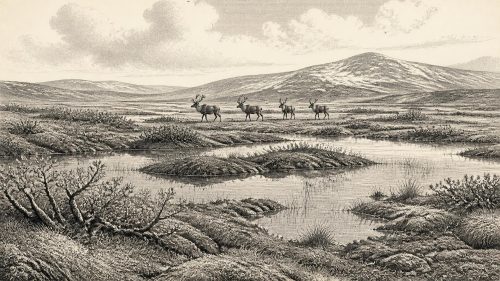
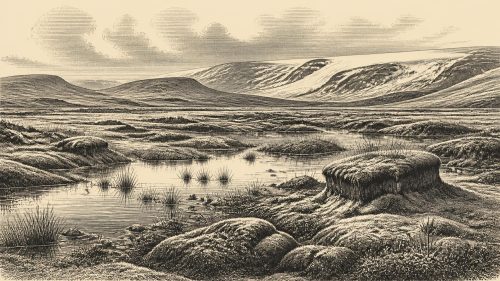
At Derryvree, pollen, plant macrofossils, mosses and insects indicate a cold, open, periglacial setting. Sedges, grasses and hardy herbs belonged to a landscape without forest cover, while the freshwater deposit itself points to pools, wet ground and slow-moving water. Moss-rich vegetation and aquatic plants could flourish locally during the short growing season, even though winters were severe. The best reconstruction is not an unbroken white wilderness but a tundra-muskeg mosaic: damp hollows and shallow water set amid sparsely vegetated ground affected by frost.
That local picture should not be mistaken for uniform Irish weather. Altitude, exposure, drainage and proximity to the Atlantic mattered. Yet the overall evidence supports a markedly colder and more seasonal Ireland than today. Repeated glacial expansion had already shaped the terrain, while later ice would override and rearrange large areas. Soils were thin or unstable in many places; freeze-thaw processes disturbed ground; and plant communities could move quickly as climate altered. The island’s familiar wooded appearance belonged to a much later age.
Sea level was lower globally because much water was locked in northern ice sheets, but it does not follow that a simple land bridge joined Ireland to Britain or continental Europe at this precise time. The Irish Sea basin has complex depths, changing coastlines and local crustal movements caused by ice loading. There may have been broader coastal plains and altered routes in parts of the Irish Sea world, but the geography of crossings remains uncertain. Any people or animals reaching Ireland did so within an unstable north-west European landscape, not across a confidently mapped modern-style road.
The Castlepook Fauna
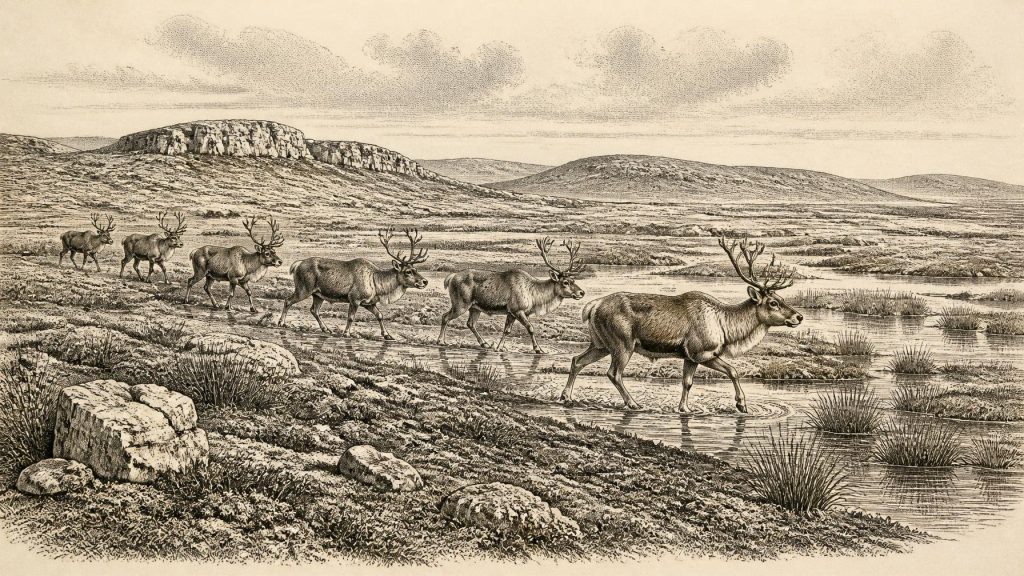
Castlepook Cave, near Doneraile in County Cork, is central to understanding Ireland’s deep Ice Age past. Its bone assemblage includes animals associated with cold, open country: reindeer, woolly mammoth, spotted hyaena, wolf, Arctic fox, lemmings, hare, bear and giant deer. Not every species need have lived beside the cave at precisely the same time, and cave bone collections can combine deaths, carnivore activity and later disturbance. Nevertheless, the assemblage establishes that Ireland was accessible enough, at least intermittently, for a diverse Pleistocene fauna.
Reindeer are particularly evocative because they suggest herds adapted to exposed, low-vegetation terrain. Mammoths and giant deer point to productive patches within a wider cold-steppe or tundra environment; hyaenas and wolves demonstrate that large carcasses could be scavenged, transported and consumed by predators. A cave is not necessarily where an animal died. Carnivores can drag bones into dens, water can move material, and nineteenth- and early twentieth-century excavations did not record every association now expected by archaeologists. The cave therefore reveals an ecological community more securely than it reveals a single scene.
The fauna also corrects a simplistic idea that Ireland was continuously sealed beneath ice throughout the whole cold stage. Around this broad interval, at least some areas supported animals, water and vegetation. But the word ‘supported’ must not be exaggerated into a claim of environmental comfort. This was a demanding habitat of cold winters, short summers, shifting resources and substantial predation risk. Its capacity to sustain large mammals may have varied sharply through time and from region to region.
A Marked Bone, Not a Settlement
A reindeer femur from Castlepook has given this period exceptional archaeological importance. Zooarchaeological study identified a deep incision interpreted as a possible cut mark made by a stone tool during carcass processing. The bone has been dated to around 33,000 years ago, and County Cork’s heritage record presents it as possible evidence that Palaeolithic hunters butchered reindeer in Ireland. If that interpretation is confirmed, it would be Ireland’s earliest known indication of human activity by many millennia.
Yet the conclusion must remain carefully qualified. The radiocarbon determination dates the death of the reindeer, not necessarily the making of the mark. No stone tools, hearth, dwelling floor, human bone or securely associated group of butchered remains has been recovered from the cave to demonstrate an occupation. Nor can the incision identify the species, language, ancestry or cultural tradition of its maker. The safest interpretation is that the femur preserves a serious and important possibility of a brief human encounter with a reindeer carcass, rather than proof of permanent settlement.
Such an encounter could have involved a very small, mobile party exploiting a carcass or hunting an animal during a favourable interval. It is equally possible that the kill occurred outside the cave, with a bone later moved by scavengers. The distinction matters: a butchery trace is evidence for an action, not for a village. Ireland’s later Mesolithic settlement record cannot be projected backwards onto this much earlier, harsher world.
Society Beyond the Evidence
There is no basis for describing political affairs, warfare, diplomacy, trade networks, farming communities or formal religious institutions in Ireland at this date. No chief, tribe, territory or monument can responsibly be named. There is likewise no evidence for cultivation, livestock, pottery, metalworking, writing, schools or a settled economy. The absence of evidence does not prove that no person ever crossed this landscape; it does mean that archaeology cannot reconstruct a resident society.
If people were present, their everyday life would have been governed above all by movement, weather and food. Reindeer meat, marrow, hide, sinew and bone would have been valuable resources, but even this is an inference from the marked femur and from broader Upper Palaeolithic practice elsewhere in Europe, not a documented Irish subsistence system. Stone tools, if used, may have been carried away, lost beyond later ice erosion, or remain undiscovered in caves, river deposits or submerged landscapes. The most honest cultural history is consequently a history of potential, not of established institutions.
Religion and learning are similarly beyond direct recovery. A group capable of navigating seasonal landscapes would have possessed detailed practical knowledge: animal behaviour, safe routes, weather signs, raw materials and the risks of cold exposure. But no Irish object or site of this age allows archaeologists to identify ritual, art, language, myth or teaching practices. To supply them would be imaginative reconstruction, not history.
Before the Maximum Ice
The broader trajectory is clearer than the individual year. Ireland was moving towards the Last Glacial Maximum, when the British-Irish Ice Sheet expanded across most of the island and continental shelf, reaching maximum extent broadly between about 27,000 and 23,000 cal BP. That later advance removed, buried or disturbed many earlier land surfaces. It helps explain why the record for 31,180 BCE is so slight and why cave bones, inter-till sediments and scattered geological exposures carry such disproportionate importance.
For Ireland around this date, then, the principal story is neither kingdom nor conquest. It is an island of cold open ground, freshwater hollows and large mammals, poised within a changing glacial world. Derryvree offers the clearest environmental evidence; Castlepook offers the clearest faunal evidence and a tantalising human question. Together they show that Ireland’s history at this depth is real, recoverable and fascinating—but resolutely measured in ranges, landscapes and probabilities rather than in calendar-year events.
Primary Sources
- A Reconsideration of the Radiocarbon Dating of the Marine Isotope Stage 3 Fauna from Southern Ireland
- The Irish Quaternary Fauna Project
- Early Midlandian–Middle Midlandian, Pleistocene, Northern Ireland
- Palaeoecology: South Fermanagh, Northern Ireland
- Figure 6.— The Subdivision of the Quaternary Period in Ireland
- Castlepook Cave, County Geological Site Report
- Heritage Artefacts of County Cork
- Occurrence of Mammalia Relicts at Site Castlepook Cave
- Middle Midlandian Interstadial Deposits at Greenagho, Near Belcoo, County Fermanagh, Northern Ireland
- The IntCal20 Northern Hemisphere Radiocarbon Age Calibration Curve (0–55 cal kBP)
- IntCal Publications
- The Last Irish Ice Sheet: Extent and Chronology
- Advances in Irish Quaternary Studies
- Late Pleistocene Chronostratigraphy and Ice Sheet Limits, Southern Ireland
- Response of the Irish Ice Sheet to Abrupt Climate Change During the Last Deglaciation
- Oscillating Retreat of the Last British-Irish Ice Sheet on the Continental Shelf Offshore Galway Bay, Western Ireland
- Trimlines, Blockfields and the Vertical Extent of the Last Ice Sheet in Southern Ireland
- Growth and Retreat of the Last British–Irish Ice Sheet, 31,000 to 15,000 Years Ago: the BRITICE-CHRONO Reconstruction
- Ireland: Submerged Prehistoric Sites and Landscapes
- Pleistocene Vertebrates in the British Isles
- Proceedings of the Royal Irish Academy: Castlepook Cave Exploration