Maguirebridge’s Freshwater Interlude31181 BCE
Although 31,181 BCE is a modern, misleadingly precise label, evidence from Marine Isotope Stage 3 shows Ireland experienced fluctuating Ice Age conditions. At Derryvree, County Fermanagh, freshwater sediments between tills preserve tundra wetland plants and small animals, proving local ice-free conditions between glacial episodes. Crag Cave stalagmites indicate recurrent milder phases in south-west Ireland. Castlepook Cave contains a time-mixed fauna including reindeer, mammoth and hyaena, demonstrating intermittent animal access. A possibly stone-cut reindeer bone suggests, but does not establish, brief human visits. No evidence supports permanent settlement, politics or beliefs. The period is understood through sediments, fossils, water and uncertainty.
Dateline
31,181 BCE is a modern chronological label, not a year that anyone in Ice Age Ireland could have recognised or recorded. It corresponds roughly to 33,130 years before AD 1950 in calibrated calendar terms, but that apparent precision is misleading. For this depth of time, radiocarbon results have substantial uncertainty, calibration curves are themselves refined as evidence improves, and Irish deposits rarely preserve a continuous sequence that can be resolved to a single year. The responsible subject is therefore Ireland during a broad interval around this date: the later Pleistocene, within Marine Isotope Stage 3 (MIS 3), a climatically unstable part of the last Ice Age.
Reading a Date Through Ranges
The most valuable Irish environmental evidence close to this notional year comes from Derryvree, near Maguiresbridge in County Fermanagh. Roadworks in 1969 cut through a drumlin, a hill formed and streamlined by glacier ice. Between two thick layers of till—stony sediment deposited by ice—investigators found fine sands and silts laid down in freshwater conditions. Organic remains within this buried deposit returned a conventional radiocarbon determination of 30,500 years BP, with a large laboratory uncertainty of +1,170 and −1,030 years.
Radiocarbon years are not calendar years. Using modern calibration, the Derryvree deposit has been placed broadly within about 36,900–31,700 calibrated years BP, approximately 34,950–29,750 BCE. The conventional label 31,181 BCE falls within that broad span, but no individual plant, insect, animal or episode can be assigned to it. Derryvree is not a diary. It is an accumulation of sediment that represents an interval, later sealed beneath renewed glacial deposits.
Even so, its sequence establishes something important. At this northern locality, an earlier phase of glaciation had been followed by a period when open water, wet ground and vegetation could exist; later, ice again affected the landscape. It is unusually direct evidence that Ireland’s last cold stage was not a simple story of permanent island-wide ice. Conditions changed sharply over thousands of years, and their timing and geographical reach remain matters of active research.
A Tundra Wetland, Not a Familiar Ireland
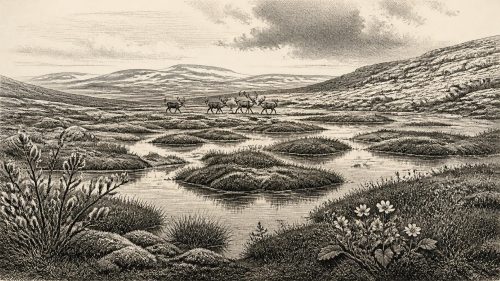
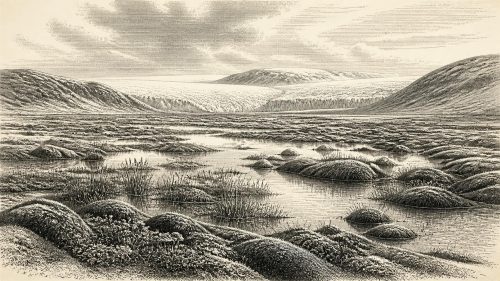
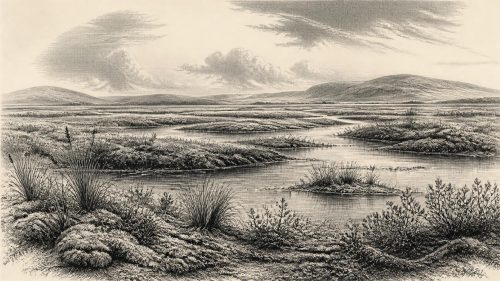
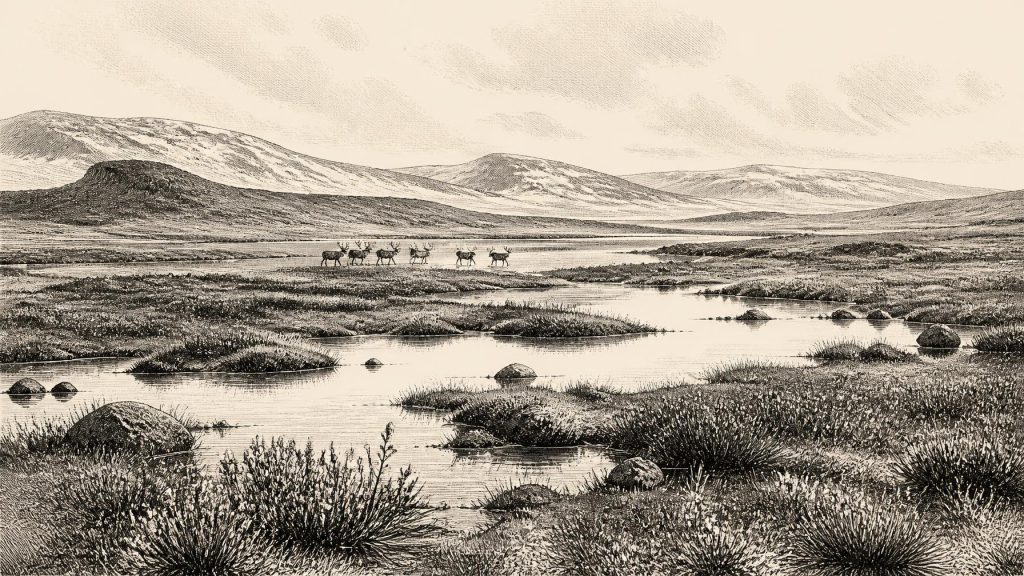
The Derryvree flora and small-animal remains point to open tundra vegetation and a periglacial climate: ground affected by severe cold, freezing and thawing, rather than a wooded countryside. A fossil seed of bogbean, a plant associated with wet places, is one memorable trace from the deposit. Mosses, sedges and other cold-tolerant plants, together with aquatic and wetland conditions, indicate that water persisted locally despite a generally harsh climate. The scene was not an Irish bog in the modern sense, nor evidence for a mild, settled landscape. It was a cold freshwater hollow within a sparsely vegetated environment.
That distinction matters. The record supports a local reconstruction of a wetland edge: shallow water or saturated sediment, low vegetation and short productive seasons. It does not permit an exact temperature for 31,181 BCE, a map of every habitat in Ireland, or a claim that all regions looked alike. Ireland’s varied relief, Atlantic position and shifting ice margins would have produced regional differences. What Derryvree securely shows is that plants and small animals were able to occupy at least one ice-free or ice-free-adjacent landscape during a cold interval.
Evidence from Crag Cave in County Kerry complements this northern archive without turning it into an annual weather report. Uranium-thorium dates show that calcite formations in the cave grew episodically through much of MIS 3. Since stalagmite growth requires moving liquid water, these deposits indicate recurrent ameliorations in south-west Ireland, probably when average annual temperatures rose above freezing. The cave record also shows abruptness: favourable growth ceased in colder stadial phases. Around the date represented here, Ireland belonged to a North Atlantic world of pronounced climatic oscillation, not a uniformly descending march towards the glacial maximum.
Animals in a Fragmentary Archive
Irish cave deposits provide the chief evidence for larger animals during this part of the Pleistocene. Castlepook Cave near Doneraile, County Cork, is especially important. Its collections include remains attributed to reindeer, brown bear, wolf, Arctic fox, hare, lemmings, spotted hyaena, giant deer and woolly mammoth. These animals make ecological sense in a largely open, cold landscape, but the cave assemblage must not be treated as a single living community photographed at one moment. Bones entered caves through carnivore activity, natural death, water movement and excavation disturbance, and direct re-dating has shown that some earlier determinations were seriously too young.
The safest conclusion is that a varied, cold-adapted fauna reached Ireland during MIS 3, and that the island was intermittently habitable for animals capable of moving through changing north-west European landscapes. Reindeer are particularly relevant to the open habitats suggested by Derryvree. They could exploit seasonal vegetation and travel widely. Yet fossils alone cannot tell us how numerous their herds were, whether they returned every year, or whether they crossed by a single route. Nor do they demonstrate that mammoths, hyaenas, bears and reindeer all met in one Cork valley at 31,181 BCE.
The landscape was also approaching a more severe phase. The maximum extent of the last British-Irish Ice Sheet lay later, principally around 26,000–20,000 years BP, although the growth, extent and behaviour of ice before and around 31,000 years ago are still debated. It would be wrong to picture the whole island already smothered beneath the later ice sheet; equally, it would be wrong to imagine an unbroken refuge. Ice advances, permafrost, erosion and subsequent sea-level change removed or disturbed much of the evidence that might otherwise settle the question.
The Human Question at Castlepook
The possibility of people in Ireland around this broad period rests on exceptionally slight evidence. A reindeer bone from Castlepook Cave has been reported as bearing a deep mark interpreted as fresh-bone modification by a sharp stone implement, and it has been associated in public discussion with an age of about 33,000 years ago. If that interpretation is sustained, it may indicate the butchery of a carcass by people during MIS 3 and would push evidence for human activity in Ireland far earlier than the post-glacial Mesolithic settlements.
But this is not proof of a village, a permanent population or a named Palaeolithic community. The bone is not a house floor, hearth, campsite or tool assemblage. Its date concerns the animal bone, while identifying the mark as human work requires separate taphonomic judgement. Castlepook’s deposits were also excavated long ago and have complicated histories. The interpretation is important precisely because it is testable: new excavation, microscopic study, secure stratigraphy and further direct dating may confirm, qualify or overturn it.
If people did reach Ireland in this interval, the most cautious model is of small, highly mobile hunter-gatherer parties making brief use of a changing landscape, perhaps following or encountering animal resources. Carcass processing would have provided meat, fat, hide, sinew and bone, but this remains an inference from a possible modified bone, not a documented subsistence system. There is no secure evidence here for dwellings, boats, clothing styles, family groups, food stores or a regular crossing route between Ireland and Britain.
No Polities, No Recorded Beliefs
Political affairs, diplomacy and warfare cannot responsibly be reconstructed for Ireland at this date. There are no names, languages, territories, leaders, graves or monuments, and no written source by many tens of millennia. Nor is there direct Irish evidence for ritual, art, formal burial practice or religious belief around 31,181 BCE. The absence of evidence should not be turned into a claim that people lacked culture; it means only that the surviving Irish record cannot reveal it.
The same caution applies to economy and trade. A possible episode of reindeer butchery would imply skilled knowledge of animal bodies and cutting tools, but not markets, exchange networks or established seasonal camps. The sea and adjoining lands were shaped by much lower global sea levels and by shifting ice, yet no securely dated evidence identifies the route by which animals—or people, if present—entered Ireland. Mobility is plausible; a mapped transport corridor is not.
What This Interval Leaves Behind
The significance of Ireland around 31,181 BCE lies less in a single event than in the survival of a few difficult archives. Derryvree preserves a freshwater interlude between glacial deposits, with tundra plants and wetland life. Crag Cave records episodes when liquid water again circulated beneath south-west Ireland. Castlepook preserves a time-averaged animal record and a provocative, but still limited, clue to human action. Together they replace the old image of an unchanging frozen blank with one of fluctuating cold landscapes, ecological opportunities and repeated loss of evidence.
That is the proper scale for this year-by-year entry. Modern calendar-year precision is unavailable. What can be said is that, within calibrated ranges embracing this notional date, parts of Ireland supported open, cold-climate ecosystems; freshwater habitats existed at Derryvree; large mammals moved through the island at different times in MIS 3; and a possible humanly modified reindeer bone keeps open the question of very early visits. The strongest history of 31,181 BCE is therefore a history of sediments, bones, water and uncertainty.
Primary Sources
- A Middle Midlandian Freshwater Series at Derryvree, Maguiresbridge, County Fermanagh, Northern Ireland
- A Middle Midlandian Freshwater Series at Derryvree, Maguiresbridge, County Fermanagh, Northern Ireland
- The IntCal20 Northern Hemisphere Radiocarbon Age Calibration Curve (0–55 cal kBP)
- IntCal20 Northern Hemisphere Radiocarbon Age Calibration Curve (0–55 cal kBP)
- IntCal History
- The Irish Quaternary Fauna Project
- The Irish Quaternary Fauna Project
- A Reconsideration of the Radiocarbon Dating of the Marine Isotope Stage 3 Fauna from Southern Ireland
- A Reconsideration of the Radiocarbon Dating of the Marine Isotope Stage 3 Fauna from Southern Ireland
- Episodic Speleothem Deposition Tracks the Terrestrial Impact of Millennial-Scale Last Glacial Climate Variability in SW Ireland
- Spatio-Temporal Dynamics of Speleothem Growth and Glaciation in the British Isles
- The Timing and Magnitude of the British–Irish Ice Sheet Between Marine Isotope Stages 5d and 2
- Growth and Retreat of the Last British–Irish Ice Sheet, 31,000 to 15,000 Years Ago: the BRITICE-CHRONO Reconstruction
- Stratigraphic and Palaeo-Geomorphological Evidence for the Glacial-Deglacial History of the Last British-Irish Ice Sheet in the North-Western Irish Sea
- Timing and Pace of Ice-Sheet Withdrawal Across the Marine–Terrestrial Transition West of Ireland During the Last Glaciation
- Dimensions and Chronology of the Last Ice Sheet in Western Ireland
- Last Glacial Maximum Cirque Glaciation in Ireland and Implications for Reconstructions of the Irish Ice Sheet
- Oscillating Retreat of the Last British-Irish Ice Sheet on the Continental Shelf Offshore Galway Bay, Western Ireland
- New Insights on the Fauna of Ireland’s Younger Dryas and Early Holocene from Alice & Gwendoline Cave
- Heritage Artefacts of County Cork
- Irish Fauna: Ground Floor
- Menyanthes trifoliata
- Irish Quaternary Association