
Castlepook’s Faunal Borderland31070 BCE
31,070 BCE is a modern label for a Late Pleistocene, climatically unstable Ireland approaching glaciation. Evidence indicates varied local conditions rather than uniform ice cover. Derryvree silts in Fermanagh preserve treeless tundra wetland plants, showing that cold, productive habitats existed between glacial episodes. Castlepook Cave in Cork yielded reindeer, mammoth, giant deer, predators and other cold-stage fauna, though mixed deposits complicate interpretation. A marked reindeer bone may indicate human butchery around 33,000 radiocarbon years ago, but remains unconfirmed without associated tools or settlements. Changing sea levels affected possible movement routes. The period’s secure history is environmental, not political or cultural.
Dateline
31,070 BCE is not a year to which Irish archaeology can attach an event, a ruler, a journey or a settlement. It is a modern, retrojected calendar label, roughly equivalent in arithmetic to 33,000 calibrated years before 1950. At this depth in time, even carefully dated deposits normally provide ranges of centuries or millennia, not a historical calendar. The responsible view is therefore regional and probabilistic: Ireland lay within the Late Pleistocene, during Marine Isotope Stage 3, in a climatically unstable North Atlantic world that was moving towards the great expansion of the last British–Irish Ice Sheet.
A Landscape Before the Maximum
This was long before the Last Glacial Maximum, when the island was more extensively covered by ice and the ice sheet reached its greatest volume around 23,000 years ago. Yet it was not a benign pre-glacial countryside. Ice sheets and local glaciers had repeatedly altered the Irish landscape during earlier cold stages; permafrost, seasonal freezing, powerful meltwater and sparse vegetation were important agents of change. Recent reconstructions of the British–Irish Ice Sheet begin their detailed sequence at about 31,000 years before present, but they also emphasise that advance was uneven. Conditions at any one Irish locality depended on altitude, distance from the Atlantic, changing snowfall and whether ice margins lay nearby.
It would be misleading to picture all Ireland as either an unbroken ice cap or a uniformly open plain in this notional year. The surviving evidence is patchy and comes from different places and dates. What it does show is a country of severe environmental contrasts. Some lowland and coastal areas could support cold-adapted animals and plants during ice-free intervals; high ground and western maritime margins responded differently to climate and accumulating ice. Later glaciers then removed, reworked or buried much of the evidence that might have preserved a fuller record.
Wetlands Beneath Later Ice
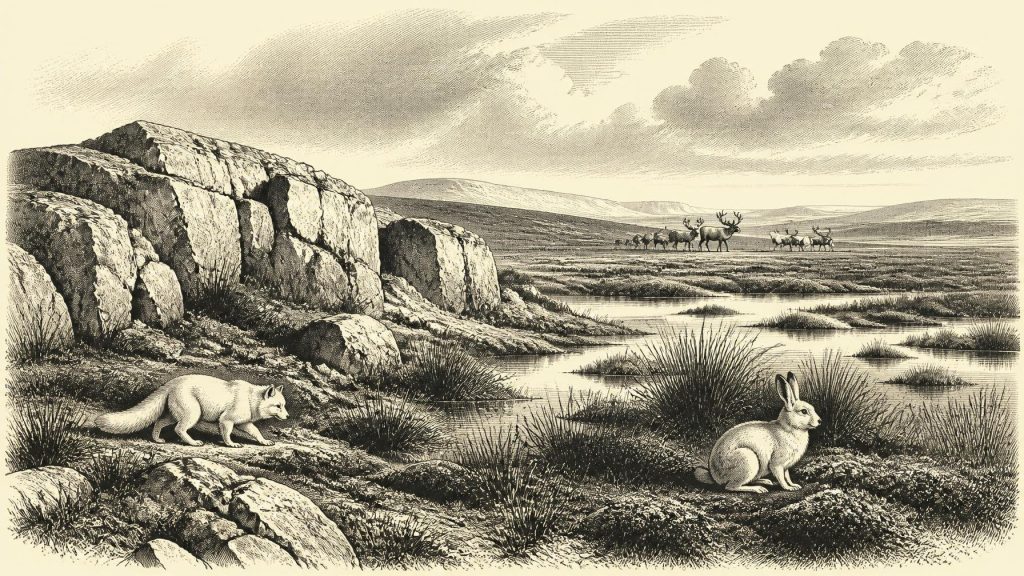
One important window lies at Derryvree near Maguiresbridge in County Fermanagh. There, organic silts sealed between glacial deposits have yielded plant remains from a treeless, cold-climate wetland or muskeg. Mosses, sedges and herbs, together with plants such as bogbean, water-milfoil, dwarf willow and mountain-avens, indicate shallow freshwater, saturated ground and open tundra-like vegetation rather than woodland. The deposit is immensely valuable because it records life between episodes of glaciation. It is not, however, a diary entry for 31,070 BCE, nor proof that the entire island shared precisely the same habitat at the same moment.
The Derryvree material is best used to establish possibilities: parts of Ireland could contain pools, sedge marshes and low vegetation during cold, largely treeless intervals in the later Pleistocene. Such places would have been seasonally productive. They could sustain insects, small mammals and grazing animals, while also offering water and shelter to predators. But the sequence’s age, its relationship to separate ice advances and the representativeness of one Fermanagh basin remain subjects for geological interpretation. An ancient wetland is evidence for its own locality first, and only cautiously for Ireland more widely.
Castlepook’s Animal Evidence
The chief Irish faunal assemblage relevant to this broader period comes from Castlepook Cave, also known as Mammoth Cave, near Doneraile in north County Cork. Excavations and collecting there recovered bones from a remarkable cold-stage community: reindeer, woolly mammoth, giant deer, mountain hare, lemmings, foxes, wolves, bears and spotted hyaenas. A mammoth bone was radiocarbon dated to 33,500 ± 1,200 radiocarbon years before present, while a hyaena bone has produced a broadly comparable result. Those are uncalibrated radiocarbon determinations, not calendar dates; when calibrated, they point substantially further back than the numerical radiocarbon ages suggest.
The cave fauna cannot be compressed into a single living herd or a single season. The original excavations took place early in the twentieth century, before modern standards of stratigraphic recording, and the cave’s galleries contained deposits of more than one age. Some specimens may have been moved by water, carnivores or later disturbance; the occurrence of animals unsuited to a cold open environment warns against assuming that every bone belonged to one assemblage. Even so, the repeated presence of cold-stage mammals makes Castlepook the strongest direct indication that southern Ireland could support a varied Pleistocene fauna in the millennia before the climatic maximum.
Hyaenas are especially revealing. Their bones, teeth and traces of feeding show that caves were not simply shelters waiting for people: they were part of a predator’s landscape. A mammoth or reindeer carcass might be consumed, scattered and redeposited by several agents. Reindeer may have moved through open country in seasonal herds; mammoths required extensive forage; wolves and hyaenas competed over carrion and prey. This is a reason for caution as well as for imagination. Animal bone records a living ecosystem, but cave accumulation is not a straightforward census of every species outside its entrance.
The Human Question
A reindeer femur from Castlepook has made this period unusually important in the history of Irish archaeology. Re-examination has identified a deep mark interpreted as consistent with cutting or chopping by a sharp stone implement, and the bone has been reported as about 33,000 radiocarbon years old. If that interpretation is confirmed through further microscopic study, secure contextual work and additional finds, it would be evidence for human handling of a carcass in Late Pleistocene Ireland far earlier than the island’s formerly accepted human record.
That conclusion must remain carefully limited. The dated bone establishes the age of the animal, while the mark must separately be shown to be human-made and contemporaneous with butchery. Castlepook has not yet produced a securely associated stone-tool assemblage, hearth, dwelling surface, human burial or repeated concentration of butchered animals from this phase. Nor can one marked bone identify the people involved, their language, ancestry, route of arrival, group size or length of stay. At most, it raises the serious possibility of a brief hunting or scavenging visit during a period when the island’s environmental conditions allowed such movement.
Movement, Not a Known Homeland
Lower global sea levels altered the geography of north-west Europe, exposing parts of today’s continental shelf. Whether a practicable land connection linked Ireland and Britain at particular points in the Late Pleistocene has long been debated, because ice loading, crustal movement, local relative sea level and topography all mattered. It is unsafe to assume a simple permanent land bridge in 31,070 BCE. Nor does the Castlepook evidence demonstrate one. It does show why the question matters: the arrival of mammals, and any possible human visitors, depended on changing corridors across a landscape that is now partly drowned, buried or glacially transformed.
No political affairs, warfare, diplomacy, religion, art, language, exchange network or social hierarchy can responsibly be described for Ireland at this date. There is likewise no evidence for farming, permanent villages, pottery, monuments or organised trade. If people did reach the island, their economy would have depended on mobile hunting, scavenging and close knowledge of cold-country animal behaviour; that is an inference from the possible butchery trace and the fauna, not a demonstrated description of an Irish community. The most secure history here is environmental: a precarious northern borderland in which animals, ice, water and weather shaped the possibilities of life.
What the Date Can Mean
For 31,070 BCE, Ireland’s archive is not a chronicle but a collection of difficult witnesses: cave bone, a cutmark under debate, pollen and plant macrofossils in buried silts, glacial sediments and offshore cores. Calibrated age ranges and stratigraphic relationships are more meaningful than the apparent precision of a single BCE year. The major development was the approach of a harsher glacial world, not an identifiable political or cultural episode. Castlepook and Derryvree preserve rare evidence that, before later ice remade so much of the island, parts of Ireland supported open wetlands and a striking cold-stage fauna. Whether people briefly shared that world remains one of the most consequential unanswered questions in Irish prehistory.
Primary Sources
- Growth and Retreat of the Last British–Irish Ice Sheet, 31 000 to 15 000 Years Ago: The BRITICE-CHRONO Reconstruction
- British–Irish Ice Sheet and Polar Front History of the Goban Spur, Offshore Southwest Ireland Over the Last 250,000 Years
- Late Quaternary Stratigraphy and Glacial History of Southern Ireland – INQUA Field Guide
- Quaternary Deposits and Glacial Stratigraphy in Ireland
- Figure 6.— The Subdivision of the Quaternary Period in Ireland
- Irish Pleistocene Biostratigraphy
- The Irish Quaternary Fauna Project
- Pleistocene Vertebrates in the British Isles
- Occurrence of Mammalia Relicts at Site Castlepook Cave
- Heritage Artefacts of County Cork
- Ireland's Palaeolithic Archaeology – Fleeting Footprints in a Frozen Land
- Archaeology Research Excavation Grant 2022
- The Problem of a Late Quaternary Landbridge Between Britain and Ireland
- The Island of Ireland: Drowning the Myth of an Irish Land-Bridge?
- Deglaciation, Earth Crustal Behaviour and Sea-Level Changes in the Determination of Insularity: A Perspective from Ireland
- On the Postglacial Isostatic Adjustment of the British Isles and the Shallow Viscoelastic Structure of the Earth
- Stoats (Mustela erminea) Provide Evidence of Natural Overland Colonization of Ireland
- Radiocarbon Calibration
- Explanation of Radiocarbon Results
- IntCal Publications
- IntCal Data