Doneraile’s Reindeer Evidence31046 BCE
Around 31,046 BCE, Ireland was a changing late-Pleistocene landscape rather than a place with recorded history. Radiocarbon dates provide broad calibrated ranges, not precise years. Derryvree, County Fermanagh, preserves sediments between glacial tills showing a cold, tundra-like freshwater environment during an ice-free interval. Castlepook Cave near Doneraile, County Cork, contains reindeer, giant deer and hyaena remains, demonstrating intermittent ecological links with north-west Europe. A marked reindeer femur may indicate human butchery, but its complex context prevents certainty. No secure evidence confirms settlement, tools, dwellings or social organisation. Later ice and coastal change destroyed or buried much of Ireland’s archaeological record.
Dateline
“31,046 BCE” is a modern calendar label, not a date that people in Ireland could have recorded or that archaeology can resolve to a particular year. In the conventional archaeological timescale it falls roughly 33,000 calibrated years before present, where “present” means AD 1950. At such depth in time, even a well-measured radiocarbon determination commonly corresponds to a wide calendar range. The responsible subject, therefore, is not an event in one year but Ireland during a broad late-Pleistocene interval: the later part of Marine Isotope Stage 3, before the Last Glacial Maximum.
This was an unstable phase of the last Ice Age. Ireland was not the settled, wooded island familiar from later prehistory. Its climates, coasts, ice margins and animal communities changed over millennia and, at times, far more quickly. Much of the evidence has been erased by later glacial erosion. What survives is fragmentary: sediments trapped beneath ice-laid deposits, cave bone collections, pollen and plant remains, insects, landforms, and laboratory measurements. These sources can illuminate environments and animal movements. They cannot provide kings, borders, battles, languages or a dated political history.
A Date Within a Range
The most useful chronological distinction is between radiocarbon years and calibrated calendar years. A radiocarbon measurement records the remaining carbon-14 in once-living material; it does not directly return a calendar date. Atmospheric carbon-14 levels have varied, so results must be calibrated against internationally maintained curves. IntCal20 extends to 55,000 calibrated years before present, but uncertainty remains substantial at around 33,000 years ago. A named BCE year is consequently a useful filing point, not a known season, generation or episode.
Nor should the Last Glacial Maximum be projected backwards too simply. The global Last Glacial Maximum is usually placed at about 26,500–19,000 years ago, several millennia after this nominal year. Research on the British–Irish Ice Sheet shows that ice growth and decay varied sharply by region. Around 33,000 calibrated years ago, Ireland lay in an increasingly cold North Atlantic world, but the evidence does not warrant a map showing every part of the island either continuously ice-covered or uniformly ice-free. Local histories mattered.
Derryvree Between the Tills
One of Ireland’s most important windows on this wider interval was exposed in 1969 at Derryvree townland near Maguiresbridge, County Fermanagh. Road works cut through a drumlin and revealed freshwater silts and fine sands, including organic material, held between two thick and distinct layers of till. Till is debris deposited directly by glacier ice. The sequence gives a secure relative order: an earlier phase of glaciation laid down the lower till; an interval without glacier cover at that spot permitted waterborne sediment and organic remains to accumulate; then a later ice advance overrode and sealed the deposit beneath upper till.
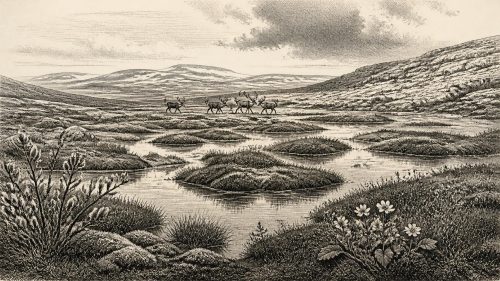
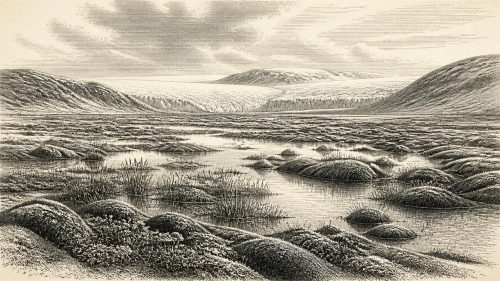
The organic series produced the conventional radiocarbon determination Birm-166, 30,500 radiocarbon years before present, with an uncertainty of more than a thousand years. Its calibrated placement spans a broad part of late Marine Isotope Stage 3, rather than a particular historical year. Yet its environmental meaning is unusually strong. The plant and insect evidence indicates open tundra vegetation and a periglacial regime: a cold landscape shaped by frost, with little or no woodland, wet ground and freshwater habitats. Mosses, sedges and other water- or marsh-associated plants demonstrate that this was not simply a featureless frozen plain.
Derryvree is important precisely because it limits speculation. It demonstrates that an ice-free freshwater locality existed in this part of Fermanagh during a cold interval between ice advances. It does not demonstrate that all Ireland was ice-free, nor that its wetland persisted unchanged across the whole calibrated range. The sediments record a local ecological opportunity, subsequently buried by ice, rather than an enduring landscape available to later communities.
Open Country and Animal Routes
Southern Irish caves provide a different kind of archive. Castlepook Cave, near Doneraile in north County Cork, was explored in the early twentieth century and produced a large, complicated collection of animal remains. Modern redating has shown why the cave matters: improved pretreatment methods pushed some of its faunal dates thousands of radiocarbon years older than earlier results had suggested. The cave is now recognised as one of the rare Irish repositories with evidence relevant to both pre- and post-Last Glacial Maximum faunas.
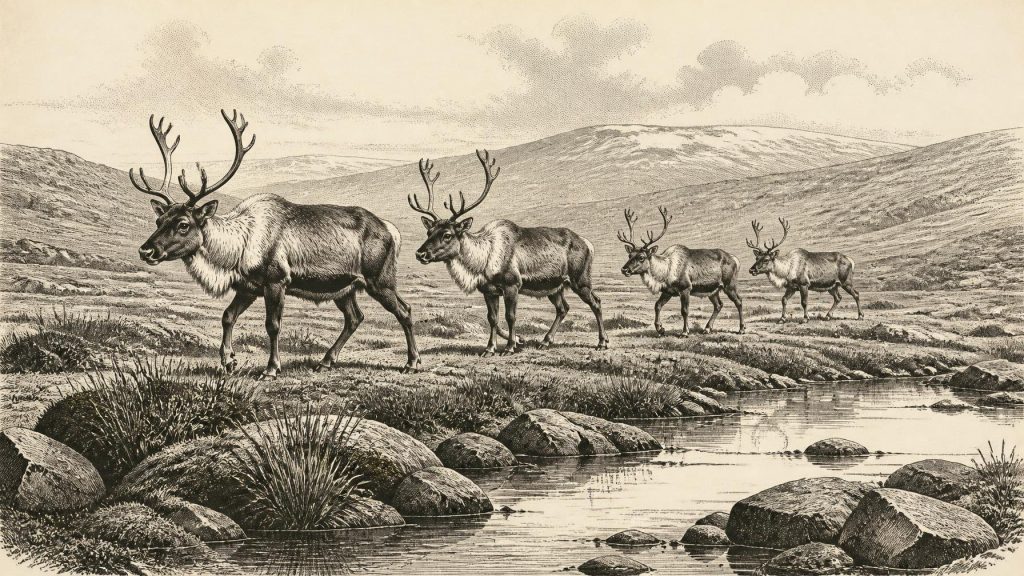
Its older assemblages include animals associated with cold, open environments and with large carnivores, notably reindeer, giant deer and spotted hyaena. Such bones are evidence that these species reached Ireland during parts of Marine Isotope Stage 3. They also show that Ireland was ecologically connected, at least intermittently, to the wider north-west European world. Lower sea levels altered the configuration of coasts and crossings, while animals could spread through changing landscapes. But cave finds do not show a continuous land bridge, a single migration route or a permanent local population for every species. Bones could arrive through natural death, carnivore activity, flooding and sediment movement; cave deposits are rarely simple living floors.
For an Irish landscape around this broad horizon, the secure picture is therefore one of cold, largely treeless country capable of supporting grazing animals, scavengers and predators. Reindeer imply available forage and seasonal mobility, while hyaena remains point to a food web more diverse and dangerous than any historic Irish fauna. The exact mix of habitats would have varied between limestone lowlands, uplands, river margins, sheltered basins and the edges of glaciers. No source permits a detailed reconstruction of the weather on a particular day in 31,046 BCE.
The Marked Reindeer Bone
A reindeer femur from Castlepook has made Doneraile especially significant in discussions of the earliest possible human activity in Ireland. The bone, held in the National Museum of Ireland’s Natural History collections, has been reported to bear a deep linear mark interpreted as fresh-bone cutting or chopping by a sharp stone tool. County Cork’s heritage publication has presented it as a Palaeolithic reindeer bone of about 31,000 BC. If the mark is anthropogenic and contemporary with the animal’s death, it may indicate that a person processed part of a reindeer carcass in Ireland during this broad period.
That conditional wording is essential. The bone’s date concerns the animal, not necessarily the moment at which a surface mark was made. Castlepook’s collection also derives from a complex cave system excavated long ago, with material accumulated by several natural processes and without a modern, intact excavation context for this individual specimen. No securely associated hearth, stone-tool assemblage, dwelling surface, burial, repeatedly occupied camp or concentration of butchered carcasses has yet established a settled human presence in Ireland at this age.
The femur is thus neither proof of a Palaeolithic village nor a reason to dismiss the possibility of a brief visit. It is a serious but limited piece of evidence. The most cautious interpretation is that it raises the prospect of a small, mobile Upper Palaeolithic party entering an Irish landscape where reindeer and other large mammals were present. Whether such visitors arrived once, repeatedly or not at all cannot presently be decided from one modified bone. Future microscopic analysis, dating, recovery of securely stratified artefacts and renewed cave investigation could alter the balance of evidence.
Society Without a Chronicle
There is no basis for describing political institutions, warfare, diplomacy, named peoples or territorial control in Ireland at this time. If humans did reach the island, they left no securely dated evidence of houses, graves, art, ritual sites, food stores, boats or exchange goods. We cannot identify their language, beliefs, kinship system or cultural affiliation. Nor can evidence from better-known Upper Palaeolithic societies elsewhere in Europe be transferred wholesale across the sea to Ireland.
The same restraint applies to economy and trade. Reindeer hunting is a plausible interpretation only if the Castlepook mark proves to be human-made; it is not demonstrated as an established Irish subsistence system. There is no evidence for farming, herding, metalworking, pottery, long-distance trade networks or durable settlement. The most defensible account of everyday life concerns animals and environments: water gathered in Fermanagh wetlands, sparse vegetation grew during cold seasons, and grazing mammals moved through open habitats subject to abrupt climatic change.
What This Moment Means
For Ireland, the importance of this nominal year lies in the tension between survival and loss. Derryvree preserves a wetland because later ice sealed it. Castlepook preserves bones because a cave protected them, although it also mixed and complicated their history. Elsewhere, the expanding and later retreating Irish Ice Sheet removed or buried much of the terrestrial record. The apparent silence of human archaeology may reflect genuine absence, brief and unsuccessful incursions, or the destructive power of ice and changing coasts. It cannot by itself settle the question.
Ireland around 31,046 BCE should therefore be understood as a changing Ice-Age landscape, not a year of recorded history. Its strongest evidence concerns cold freshwater habitats in Fermanagh and a southern cave fauna that includes reindeer and major carnivores. Its most tantalising human clue is the marked Castlepook femur. Together they reveal a place at Europe’s north-western edge where life could enter during favourable intervals, while ice, climate and geography repeatedly narrowed the possibilities of lasting occupation.
Primary Sources
- A Middle Midlandian Freshwater Series at Derryvree, Maguiresbridge, County Fermanagh, Northern Ireland
- A Reconsideration of the Radiocarbon Dating of the Marine Isotope Stage 3 Fauna from Southern Ireland
- New Insights on the Fauna of Ireland’s Younger Dryas and Early Holocene from Alice & Gwendoline Cave
- The IntCal20 Northern Hemisphere Radiocarbon Age Calibration Curve (0–55 cal kBP)
- IntCal20 Database
- The Deglaciation of the Western Sector of the Irish Ice Sheet from the Inner Continental Shelf to its Terrestrial Margin
- Trimlines, Blockfields and the Vertical Extent of the Last Ice Sheet in Southern Ireland
- Growth and Retreat of the Last British–Irish Ice Sheet, 31,000 to 15,000 Years Ago: The BRITICE-CHRONO Reconstruction
- Response of the Irish Ice Sheet to Abrupt Climate Change During the Last Deglaciation
- Pattern and Timing of Retreat of the Last British–Irish Ice Sheet
- Ice Sheet Extension to the Celtic Sea Shelf Edge at the Last Glacial Maximum
- Reconstructing the Last Irish Ice Sheet 2: A Geomorphologically-Driven Model of Ice Sheet Growth, Retreat and Dynamics
- HERITAGE ARTEFACTS of County Cork
- The Exploration of Castlepook Cave, Co. Cork. With 3 Plates
- The Exploration of Castlepook Cave, County Cork, Being the Third Report from the Committee Appointed to Explore Irish Caves
- Occurrence of Mammalia Relicts at Site Castlepook Cave
- Irish Quaternary Association Field Guide: The Quaternary of Fermanagh
- First Evidence of a Late Upper Palaeolithic Human Presence in Ireland
- First Evidence of a Late Upper Palaeolithic Human Presence in Ireland — Atlantic Technological University Record
- Phylogeographic, Ancient DNA, Fossil and Morphometric Analyses Reveal Ancient and Modern Introductions of a Large Mammal: The Complex Case of Red Deer (Cervus elaphus) in Ireland
- The Irish Quaternary Fauna Project
- Outreach and Education Resources — Irish Quaternary Association