Castlepook’s Thirty-Three-Millennia Fauna31003 BCE
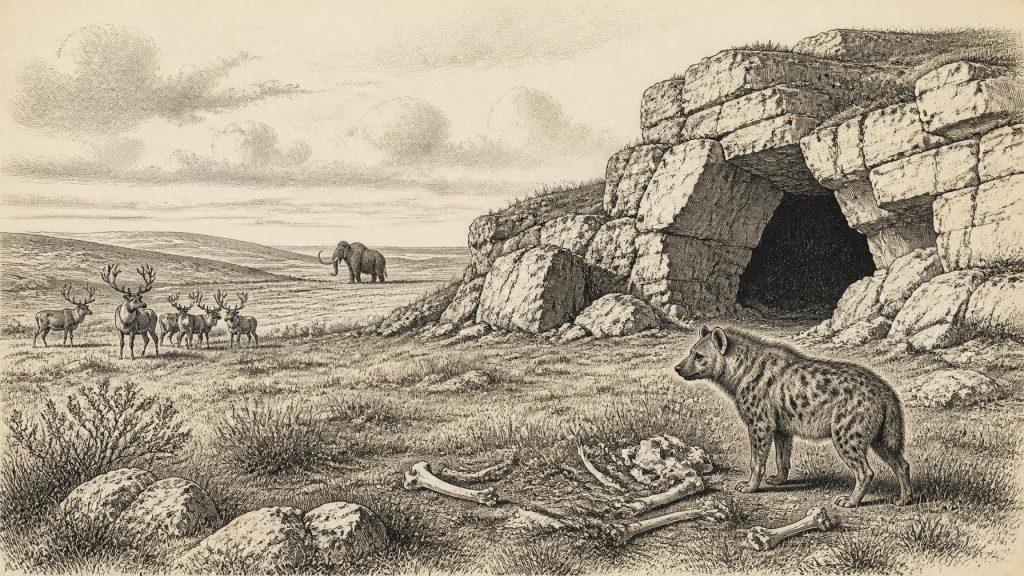
Around 33,000 radiocarbon years before present, Ireland was a cold, open, low-sea-level landscape within wider north-west Europe, not a modern island. Castlepook Cave, County Cork, preserves over 2,000 Late Pleistocene bones deposited across millennia, including mammoth, giant deer, reindeer, brown bear and spotted hyaena. These remains demonstrate a diverse but fluctuating fauna, shaped by climate, predators, water and cave processes. A marked reindeer femur may indicate stone-tool butchery and Ireland’s earliest human presence, but remains unconfirmed and cannot prove settlement. No evidence supports permanent communities, institutions or occupation. Castlepook chiefly records an environmentally changing Ice Age frontier before maximum glaciation.
Dateline
The label 31,003 BCE is useful only as a modern filing point. No event in Ireland can be assigned to that exact calendar year, and no person, settlement or political episode can responsibly be placed within it. At this depth of time, chronology comes from radiocarbon measurements, geological sequences and comparison with wider climatic records; each has margins of uncertainty. The best approach is therefore to examine Ireland in the broad interval around 33,000 radiocarbon years before present, within Marine Isotope Stage 3, while distinguishing that laboratory timescale from calibrated calendar ages. The period was long before the Last Glacial Maximum, but it belonged unmistakably to the last Ice Age.
For Ireland, the outstanding evidence is not a village, graveyard or tool-making floor. It is a scattered record of animal bones, cave sediments, landforms and environmental deposits. Together they show an island—or, more accurately, a western peninsula within a much lower-sea-level north-west European landscape—whose climate, coastlines and living communities differed profoundly from those of modern Ireland. They do not provide a continuous national story. They instead preserve brief, uneven glimpses of a cold-world frontier.
Dating a Calendarless World
Radiocarbon years are conventionally counted from 1950, not from the present calendar. Nor are they identical to calendar years: changes in atmospheric carbon mean that a radiocarbon determination must be calibrated against an internationally maintained curve. Around 33,000 radiocarbon years before present, calibration can produce broad and sometimes irregular calendar ranges rather than a single equivalent date. Consequently, it is safer to speak of a later Marine Isotope Stage 3 setting, broadly in the tens of thousands of years before the global ice maximum, than to treat 31,003 BCE as an archaeological timestamp.
This caution matters particularly at Castlepook Cave, near Doneraile in north County Cork. The cave is Ireland’s richest known repository of vertebrate remains dating to the interval before and around the approach to the Last Glacial Maximum. More than 2,000 bones have been recovered through antiquarian excavation and later investigation. Direct radiocarbon dating has shown that the assemblage spans a considerable length of time, rather than representing one moment or one neatly bounded animal community. Individual bones document repeated deposits between roughly 45,700 and 19,950 radiocarbon years before present. A bone dated from the cave tells us when that animal died, not automatically when a different animal entered, when a carnivore used the cave, or when a human may have handled a carcass.
A Cold, Open Ireland
Ireland around this broad horizon was part of the Late Pleistocene cold stage. It was not simply the modern island covered in snow. The British–Irish Ice Sheet had a complicated history of growth, advance and fluctuation, and its precise pre-maximum extent remains debated. Research does, however, agree that the continental-scale maximum came later, principally between about 27,000 and 21,000 years ago. At the time represented by the older Castlepook fauna, substantial areas of Ireland could support grazing animals and predators, even as the climate was colder, more variable and generally more continental than today.
Sea level was much lower than now because immense quantities of water were held in northern ice sheets. The seas around Ireland did not have their modern outlines: broad shelves were exposed, rivers crossed landscapes now submerged, and the distance to Britain and continental Europe was reduced. Lower sea level did not mean that every route was a simple, dry land bridge at every moment. Ice margins, channels, estuaries and changing coastal terrain created shifting obstacles. Nonetheless, Ireland was less isolated geographically than it later became after post-glacial sea-level rise drowned the surrounding lowlands.
Vegetation evidence from Ireland is fragmentary for this exact interval, and it must not be stretched beyond what it can bear. The animal assemblage, however, supports the picture of an open, cold-adapted landscape: mosaics of grassland, herb-rich steppe, sparse shrub vegetation, exposed ground and wet hollows rather than a closed, oak-rich woodland. Such terrain could feed large herbivores, though it was seasonally severe and vulnerable to abrupt climatic change. Caves, sheltered slopes, river corridors and wetland margins would have mattered disproportionately within an otherwise exposed country.
Castlepook’s Mammal Community
The fauna from Castlepook provides the clearest Irish evidence for this landscape. It includes woolly mammoth, giant deer, reindeer, brown bear and spotted hyaena, with later or differently dated cave material also including foxes, wolves, mountain hare and lemmings. These species should not be imagined standing together in a single Ice Age tableau. The cave deposits accumulated over thousands of years, and water movement, carnivore activity, earlier disturbance and old excavation methods complicate their context. Yet the combined record securely establishes that Ireland could support a far more varied Pleistocene mammal fauna than the island’s modern terrestrial fauna suggests.
Reindeer indicate cold, open country with extensive forage and, potentially, seasonal movement across broad landscapes. Mammoths and giant deer point to substantial grazing and browsing resources. Brown bears may have used caves intermittently, while wolves and spotted hyaenas were active predators and scavengers. Hyaenas are especially important because their use of caves can explain why bones entered and accumulated underground: they carried carcass parts, gnawed bones and left remains where humans might also later have sheltered or passed. Castlepook is therefore not an ordinary hunting camp. It is a complex natural archive shaped by animals, water, geology and excavators.
That distinction changes how everyday life can be discussed. There is no demonstrated resident human population for Ireland at this date. No securely associated house, hearth, stone-tool assemblage, burial, midden or repeatedly occupied camp has been published from Castlepook’s Marine Isotope Stage 3 horizon. It follows that there is no evidence for Irish political institutions, diplomacy, communal territories, ritual practices, language, farming, domestic animals, pottery, metalworking, trade networks or formal learning. Those categories belong to much later Irish prehistory and cannot be projected backwards merely because people elsewhere in Upper Palaeolithic Europe practised varied forms of social life.
The Reindeer Femur Question
One object makes this period unusually significant for Irish archaeology: a reindeer femur from Castlepook reported to bear a deep linear mark interpreted as having been made by a sharp stone tool while the bone was fresh. Public heritage accounts have connected the specimen with an age of about 33,000 years and with the possibility of reindeer butchery. If the interpretation of the mark as anthropogenic, and its association with the dated animal, are confirmed, it would be Ireland’s earliest known indication that an Upper Palaeolithic person processed an animal on the island.
The conditional language is essential. A single mark is not equivalent to a settled population. It cannot establish how many people arrived, where they came from, whether they crossed in one expedition or repeatedly, how long they stayed, or whether they left descendants. The cave’s deposits are not a sealed occupation layer, and old collections often lack the precise stratigraphic records expected today. Carnivore damage, sediment movement and damage from excavation all have to be considered when interpreting a modified bone. The specimen is best understood as an important and testable claim, not as a licence to populate Ice Age Ireland with permanent communities.
Even so, the possibility is historically meaningful. Across western Europe, people of the Upper Palaeolithic were highly mobile hunter-gatherers who used stone tools, fire, hides, social knowledge and seasonal movement to live through difficult climates. The Castlepook femur does not demonstrate that such a community occupied Ireland, but it leaves open the possibility of a brief visit, an opportunistic hunt or the processing of a found carcass. In a landscape later reshaped by ice, rising seas and erosion, a light and short-lived human presence would be exceptionally difficult to detect.
Landscape Without States
In this setting, the most consequential ‘regional change’ was environmental. Ireland’s inhabitable zones could expand or contract as temperatures, precipitation, vegetation and ice margins altered. Animals capable of moving through open country could arrive during favourable phases and disappear when conditions deteriorated. The record suggests colonisation and local loss rather than stable continuity. Giant deer and spotted hyaena, for example, appear to have been absent from Ireland by the time of the Last Glacial Maximum, while later recolonising faunas were more restricted.
There was no Irish economy in the later sense, but herbivore movements and scavenging opportunities structured the energy available to any animal—and perhaps any occasional human—on the landscape. Reindeer meat, marrow, hide, sinew, antler and bone would have been valuable resources to Upper Palaeolithic hunters if they were present. This is a reasonable inference from wider European evidence, not a fact demonstrated at Castlepook. Likewise, a cave may have offered temporary shelter, but its principal demonstrated role is as a repository of faunal remains, partly formed through carnivore behaviour.
Thus the Ireland of this notional year was not yet a society with rulers, monuments or named peoples. It was a changing Ice Age environment inhabited by large mammals and predators, with Castlepook Cave preserving the strongest evidence. Its reindeer femur offers a provocative possible human trace, while the wider faunal archive provides firmer ground: a cold, open and biologically richer Ireland, poised before the far harsher expansion of the ice sheet that would later transform much of the island.
Primary Sources
- A reconsideration of the radiocarbon dating of the Marine Isotope Stage 3 fauna from southern Ireland
- The Irish Quaternary Fauna Project
- Castlepook Cave: County Geological Site Report
- 2022:564 – Castlepook Cave, Castlepook South, Cork
- Occurrence of Mammalia Relicts at Site Castlepook Cave
- The Exploration of Castlepook Cave, County Cork
- The timing and magnitude of the British–Irish Ice Sheet between Marine Isotope Stages 5d and 2: implications for glacio-isostatic adjustment, high relative sea levels and ‘giant erratic’ emplacement
- Extent and timing of the Last Glacial Maximum (LGM) in Britain and Ireland: a review
- Maximum extent and dynamic behaviour of the last British–Irish Ice Sheet west of Ireland
- Timing and pace of ice-sheet withdrawal across the marine–terrestrial transition west of Ireland during the last glaciation
- Last Glacial Maximum cirque glaciation in Ireland and implications for reconstructions of the Irish Ice Sheet
- Dimensions and chronology of the last ice sheet in western Ireland
- Trimlines, blockfields and the vertical extent of the last ice sheet in southern Ireland
- Late Pleistocene chronostratigraphy and ice sheet limits, southern Ireland
- The Island of Ireland: Drowning the Myth of an Irish Land-Bridge?
- The IntCal20 Northern Hemisphere Radiocarbon Age Calibration Curve (0–55 cal kBP)
- Figure 6.— The subdivision of the Quaternary Period in Ireland
- Heritage Artefacts of County Cork
- New age constraints for the maximum extent of the last British-Irish Ice Sheet (NW sector)
- New insights on the fauna of Ireland’s Younger Dryas and Early Holocene from Alice and Gwendoline Cave