The Derryvree Drumlin Window30924 BCE
Around 30,924 BCE, Ireland has no recoverable annual history, but Derryvree in County Fermanagh provides an environmental window within a calibrated range. Organic freshwater sediments between two tills show a locally ice-free interval during the later Middle Midlandian, supporting treeless, tundra-like vegetation, pools, insects and mossy ground. Cave deposits, especially Castlepook, indicate diverse cold-country mammals, including mammoth, reindeer, giant deer and predators, though not necessarily contemporaneously. Approaching ice-sheet expansion repeatedly altered and erased landscapes. No secure evidence proves resident people, settlement or culture; a tool-marked reindeer bone suggests only a tentative early human visit. Evidence remains local, fragmentary and contested.

Dateline
30,924 BCE is not a recoverable Irish historical year. Nobody in Ireland left a written date, a named ruler, a settlement plan or an event record that can be assigned to it. The number is a modern point on a calendar, roughly 32,874 years before AD 1950, used here to orient a much broader Late Pleistocene story. At this depth in time, radiocarbon measurements must be calibrated and normally produce ranges rather than exact calendar years. The most responsible account is therefore of Ireland around this point: during Marine Isotope Stage 3, in the later Middle Midlandian cold stage, when climate, ice, plants and animal movements shaped a landscape that would later be profoundly remade by glaciation.
Calendar Date, Geological Timescale
The closest important Irish chronological anchor is Derryvree, near Maguiresbridge in County Fermanagh. Roadworks in 1969 cut through a drumlin and exposed organic freshwater silts and fine sands sealed between two separate layers of glacial till. The order of those deposits is more secure than any attempt to narrate a particular year: glacier ice had deposited the lower till; an interval without ice at that spot permitted fresh water, sediment and organic matter to accumulate; later ice advanced and laid down the upper till.
Material from the organic bed returned a conventional radiocarbon age of 30,500 +1,170/−1,030 radiocarbon years BP. Published calibration has expressed this broadly as about 36,900–31,700 calibrated years BP, or approximately 34,950–29,750 BCE. The modern label 30,924 BCE falls within that wide range. It does not demonstrate that a particular Derryvree pool, plant colony or animal was present in that named year, nor that conditions were constant across the entire interval. It does, however, make Derryvree the best local environmental window for Ireland near this horizon.
Fresh Water Between the Tills
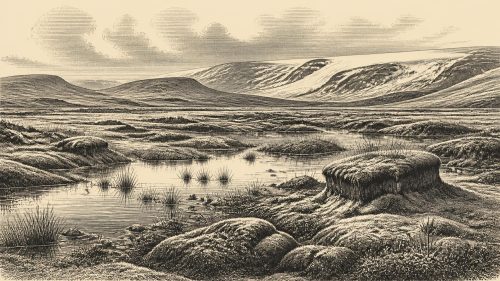
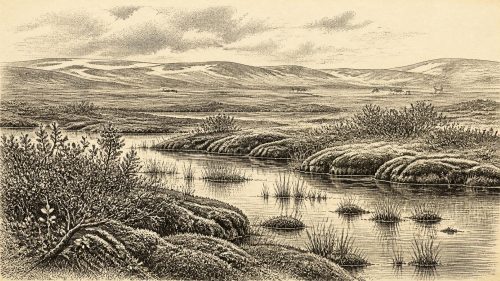
Derryvree was not a familiar green Irish bogland and certainly not a wooded countryside. Fossil pollen, plant remains, mosses and insects indicate a cold, open, treeless landscape with a periglacial regime. Grasses, sedges, herbs and juniper were among the vegetation recorded, while the insect evidence points to wet, plant-rich ground, open pools and mossy margins: a tundra-like muskeg rather than dense forest. The important qualification is scale. These are the conditions shown by a buried freshwater deposit in Fermanagh, not a weather report for every shore and upland across the island.
Nevertheless, the Derryvree evidence overturns any simple image of an Ireland uniformly entombed beneath ice throughout the Ice Age. It records a locally ice-free freshwater environment at some stage between glacial episodes. Pools and saturated ground would have created small refuges for aquatic plants and insects; exposed mineral soils and low vegetation occupied surrounding ground. Such a mosaic was probably highly seasonal. Winter cold, frozen ground, strong winds and short growing seasons limited what could live there, while summer thaw and water movement altered the margins of ponds and channels.
An Unstable Ice-Age Ireland
The wider setting was one of rapid and uneven change. The Last Glacial Maximum, the period of the greatest late-glacial expansion of the British–Irish Ice Sheet, still lay ahead, but its growth was becoming an increasingly important constraint on the region. Modern reconstructions show that ice expansion did not occur everywhere at once. Scottish ice had expanded markedly by about 31,000 years ago, and the British–Irish Ice Sheet later advanced to the continental shelf edge in some western sectors. The timing, thickness and reach of ice varied from one region to another.
This makes sweeping claims hazardous. The Derryvree sequence and related Fermanagh deposits demonstrate that northern Ireland had supported non-glacial environments before renewed ice cover. They cannot tell us whether all of Ireland was open at 30,924 BCE. Equally, later glacial erosion and deposition destroyed, buried or rearranged earlier surfaces, so the surviving record is inherently patchy. The physical map of the island was also unlike that of today: sea level was lower on the continental shelves, while ice, water depth and changing coastlines governed possible routes between Ireland, Britain and mainland Europe. A continuous land bridge should not simply be assumed.
Animals of Open Country
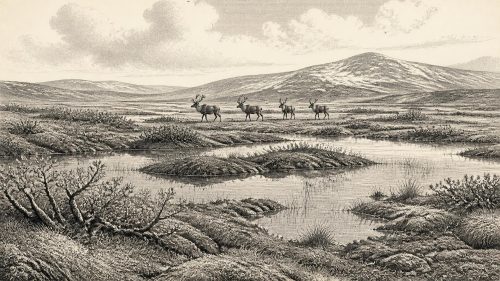
Caves preserve another, different archive. Castlepook Cave near Doneraile in north County Cork is Ireland’s richest known repository of vertebrate remains from the long period leading towards the Last Glacial Maximum. Its collections include woolly mammoth, giant deer, reindeer, brown bear, spotted hyaena, wolf, foxes, hares and lemmings. Together they show that Ireland supported a far broader cold-stage fauna than its modern fauna. Reindeer and lemmings suggest severe, open conditions; mammoth and giant deer indicate extensive grazing landscapes; hyaenas and wolves show that large predators also used the region.
Yet Castlepook is not a frozen tableau of one day or one generation. Bones accumulated over a long interval through carnivore activity, natural deaths, water movement and early excavations. Improved radiocarbon pretreatment has also shown that some older cave dates required substantial revision. Castlepook can therefore illuminate the kinds of animals present in pre-maximum Ice Age Ireland, but it cannot prove that every listed species stood together in County Cork in 30,924 BCE.
A further directly dated clue comes from Waterford caves. Genetic work on bones formerly identified as red deer showed that some were actually reindeer, but confirmed red-deer specimens include a pre-Last Glacial Maximum date of about 32,930–31,280 calibrated years BP. This overlaps the modern calendar position used here. It is modest but valuable evidence that animal communities and habitats differed by region and changed through time. The animals were not simply passive occupants: their grazing, browsing, predation and seasonal movements were central ecological forces in a sparsely vegetated landscape.
People: A Possibility, Not a Population
No securely dated camp, hearth, dwelling, burial, tool scatter or human bone demonstrates a resident human community in Ireland at this horizon. Consequently there is no responsible basis for describing tribes, chiefs, political authority, warfare, diplomacy, family arrangements, language, ritual practice or learning. There was no Irish state, and no evidence permits the projection backwards of later Gaelic identities, monuments or traditions.
There is, however, an important question. A reindeer femur from Castlepook has been publicly reported as about 33,000 years old and as bearing a deep mark interpreted as damage made by a stone tool during carcass processing. If that interpretation is confirmed through full scholarly publication and comparison, it would indicate a very early Upper Palaeolithic human visit to Ireland. It would not establish permanent settlement, a large population or continuous occupation. A marked animal bone can show possible handling of a carcass; it cannot reveal whether the people concerned hunted it, scavenged it, crossed from Britain, travelled by boat, remained for an afternoon or returned over generations.
The distinction matters particularly for everyday life and economy. In north-west Europe, people of the Upper Palaeolithic possessed sophisticated stone technologies and depended on flexible hunting, gathering and social networks. That continental context makes a short Irish foraging visit plausible, especially where large grazing animals ranged through open country. But there is no Irish assemblage of securely contemporary tools from which to identify a technology, no hearth from which to reconstruct food preparation, and no settlement debris from which to infer exchange, clothing, shelter or artistic practice. These remain possibilities, not evidence for Ireland.
What This Date Can Mean
The best history of Ireland around 30,924 BCE is consequently environmental and archaeological rather than political. Derryvree records freshwater life and low vegetation enclosed between two phases of glaciation. Castlepook and other caves preserve evidence for mammals and predators adapted to open, cold habitats. Ice-sheet research explains why these traces are discontinuous: advancing ice repeatedly transformed the terrain and erased many surfaces on which people or animals might once have left clearer marks.
This was a world of shallow water, sedge-rich margins, mosses, low shrubs, exposed ground and mobile herds—not a world of farms, towns, monuments or kingdoms. Its most significant development was not an annual event but an ongoing regional transformation: the narrowing of ecological opportunities as the last great ice-sheet expansion approached. The surviving Irish evidence is slight, local and sometimes contested. Properly read, that limitation is not a failure of history; it is the essential fact of Ireland’s deep past.
Primary Sources
- A Middle Midlandian Freshwater Series at Derryvree, Maguiresbridge, County Fermanagh, Northern Ireland
- Irish Pleistocene Biostratigraphy
- Freshwater Organic Deposits and Stratified Sediments Between Early and Late Midlandian (Devensian) Till Sheets, at Aghnadarragh, County Antrim, Northern Ireland
- The Irish Quaternary Fauna Project
- A Reconsideration of the Radiocarbon Dating of the Marine Isotope Stage 3 Fauna from Southern Ireland
- Trimlines, Blockfields and the Vertical Extent of the Last Ice Sheet in Southern Ireland
- Growth and Retreat of the Last British–Irish Ice Sheet, 31,000 to 15,000 Years Ago: the BRITICE-CHRONO Reconstruction
- The Timing and Magnitude of the British–Irish Ice Sheet Between Marine Isotope Stages 5d and 2: Implications for Glacio-Isostatic Adjustment, High Relative Sea Levels and ‘Giant Erratic’ Emplacement
- The Subdivision of the Quaternary Period in Ireland
- References and Recommended Reading
- Dryas octopetala
- Castlepook Cave: County Geological Site Report
- Archaeological Heritage of County Cork
- Heritage Artefacts of County Cork
- Phylogeographic, Ancient DNA and Morphometric Analyses Reveal Ancient and Modern Introductions of a Large Mammal: The Complex Case of Red Deer (Cervus elaphus) in Ireland
- First Evidence of a Late Upper Palaeolithic Human Presence in Ireland
- Palaeolithic Ireland – New Evidence Emerges from the Emerald Isle
- New Insights on the Fauna of Ireland’s Younger Dryas and Early Holocene from Alice & Gwendoline Cave
- 2022:564 – Castlepook Cave, Castlepook South, Cork
- The IntCal20 Northern Hemisphere Radiocarbon Age Calibration Curve (0–55 cal kBP)
- The Problem of a Late Quaternary Landbridge Between Britain and Ireland
- Ireland: Submerged Prehistoric Sites and Landscapes