Derryvree’s Mountain-Avens Pool30893 BCE
At the modern reference date of 30,893 BCE, Ireland has no year-specific historical record; evidence instead describes unstable Late Pleistocene environments. At Derryvree, County Fermanagh, freshwater sediments sealed between glacial tills, radiocarbon-dated broadly to 36,900–31,700 calibrated years before present, preserve cold, treeless wetland flora including mosses, sedges, bogbean and mountain-avens. They demonstrate a locally ice-free tundra interval, not island-wide conditions. Castlepook Cave, County Cork, contains Ice Age mammals, but disturbed contexts prevent a single-date fauna. No secure human settlement is known. A possibly tool-marked reindeer bone may indicate brief human activity, yet remains inconclusive. These fragmentary deposits constitute recoverable history.
Dateline
Modern calendar-year precision is not available for Ireland in 30,893 BCE. No community on the island kept a calendar that can be correlated with this number, and neither archaeological nor environmental dating can isolate a particular twelve-month period so far back. The date is therefore best treated as a modern signpost: approximately 32,842 years before the conventional radiocarbon reference year of AD 1950, within the Late Pleistocene and the climatically unstable Marine Isotope Stage 3. Ireland’s evidence is not a chronicle of events, rulers or settlements, but a small and uneven archive of sediments, plants, animal remains, caves and glacial landforms.
A Range Rather Than a Year
The most useful evidence near this horizon comes from Derryvree, close to Maguiresbridge in County Fermanagh. Road construction in 1969 cut through a drumlin and revealed fine freshwater sands, silts and organic material caught between two deposits of glacial till. That arrangement is itself significant. The lower till shows that glacier ice had previously affected the locality. Water, sediment and living organisms then accumulated during an interval when that particular place was ice-free. Finally, later ice or ice-related sediment buried the wetland under an upper till. The deposit survived precisely because it was sealed within this sequence.
Organic material from Derryvree produced the conventional radiocarbon determination of 30,500 radiocarbon years before present, with a substantial uncertainty of +1,170 and −1,030 years. A radiocarbon measurement is not a calendar date: atmospheric carbon-14 has varied through time, and calibration produces probability ranges rather than a single answer. Published discussion has rendered the Derryvree interval broadly as about 36,900–31,700 calibrated years before present, or roughly 34,950–29,750 BCE. The assigned year falls within that broad span, but cannot be attached to a particular layer, animal, season or human action. Derryvree records an environmental phase accumulated across a long period, not a diary entry.
Fresh Water Beneath the Drumlins
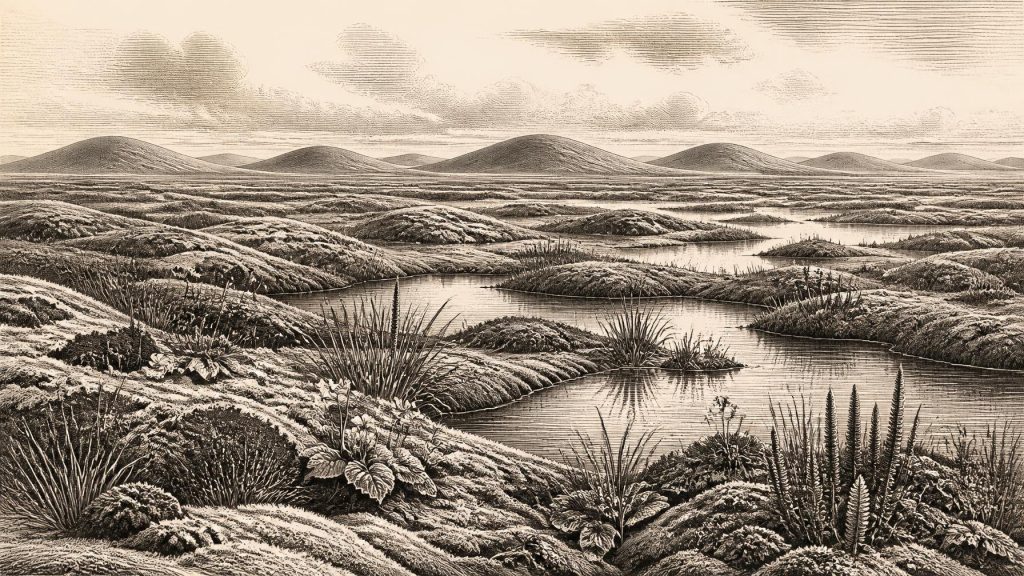
The fossils indicate an exposed, treeless and cold landscape, not the oak-and-hazel Ireland familiar from later prehistory. Pollen was poorly preserved, but plant macrofossils, mosses and small animal remains give the reconstruction substance. Grasses, sedges, juniper and herbaceous plants occurred alongside a rich moss flora. Bogbean, water-milfoil, mountain-avens and lesser clubmoss are especially revealing finds. Some point to standing or slow-moving fresh water; others favour open ground and cold conditions. Together they suggest shallow pools, wet sedge margins and low vegetation in a periglacial setting, where frost strongly shaped ground and drainage.
Earlier investigators compared the wetland to muskeg: waterlogged, organic-rich ground broken by pools and patches of moss and sedge. That comparison should not be turned into a painted panorama of uniform bog. Water levels, vegetation cover, sediment supply and freezing conditions would have changed through the life of the deposit. Yet the core conclusion is secure: at least in this part of Fermanagh, living freshwater habitats existed amid open tundra during a phase of the last Ice Age. The Derryvree sequence is important because repeated glaciation removed or disturbed so much older evidence elsewhere in Ireland.
The record does not prove that all of Ireland was ice-free at once, nor does it establish a single island-wide climate. Fermanagh’s inland basin, drainage and geology differed from the limestone country around Doneraile in County Cork, from Atlantic headlands and from upland interiors. Local ice, snowfields and glacier margins could have varied considerably. What can responsibly be said is narrower and more valuable: Derryvree provides direct evidence for a cold, locally ice-free wetland interval in north-central Ireland before later ice advances transformed the landscape.
Animals in a Changing Country
Cave collections from southern Ireland offer a separate line of evidence for the broader period. Castlepook Cave, near Doneraile in north County Cork, is particularly important. Its complex passages yielded a remarkable Late Pleistocene fauna, investigated first during antiquarian excavations and subsequently reassessed with modern radiocarbon methods. Woolly mammoth, reindeer, giant deer, brown bear, wolf, Arctic fox, lemmings and spotted hyaena are among the animals represented in its deposits or old collections. Such species show that Ireland intermittently formed part of a wider north-west European cold-stage world, capable of supporting large herbivores and their predators.
However, a cave assemblage is not a census taken in one generation. Carnivores could carry bones into caves; water, roof collapse and burrowing could move sediments; and early excavators did not record contexts to modern standards. Re-dating has also shown that some older Irish cave dates require revision because improved pretreatment can remove contamination and substantially alter a result. Castlepook therefore confirms that Ice Age mammals reached Ireland over a wide interval, but it cannot demonstrate that every species listed was present together in 30,893 BCE, or that a particular animal grazed beside the Derryvree pools.
By this broad stage, the last Irish ice sheet was still part of a developing and variable glacial system, rather than a static wall of ice. The later Last Glacial Maximum would cover much of Ireland and extend onto the surrounding continental shelf, eroding surfaces and masking earlier landscapes. Its approach and subsequent retreat help explain why evidence from before the maximum is so fragmentary. Derryvree’s buried wetland and Castlepook’s cave deposits are exceptional survivals, not samples sufficient to map every valley, coast or mountain.
The Human Question
There is no securely demonstrated settlement in Ireland that can be assigned to this horizon. No excavated dwelling, hearth, stone-tool assemblage, burial, repeatedly occupied camp or stratified food-processing area provides a firm basis for describing a resident population. Consequently, there is no evidence for political communities, leaders, territorial boundaries, warfare, diplomacy, language, religious practice, art, formal learning, farming, exchange networks or seafaring in Ireland at this date. To populate the landscape with named tribes or organised hunters would be invention, not history.
One object makes the question more complicated. A reindeer femur from Castlepook has been publicly presented as dating to about 31,000 BCE and as bearing a deep modification interpreted as a mark made with a sharp stone tool while the bone was fresh. If that interpretation is confirmed, it would be potentially important evidence that a person or people processed a reindeer in Ireland during the Upper Palaeolithic. It would not, by itself, prove a settlement. The bone derives from an old cave collection, and its date measures the animal’s death within a statistical range, not the precise moment when the mark was made. Natural damage, carnivore activity and collection history must all be excluded before the claim can carry its fullest weight.
Even on the most favourable reading, the Castlepook femur would indicate a brief human encounter with an animal, not a recoverable society. Visitors might have killed a reindeer, encountered a carcass, removed meat or sinew, or left the discarded bone to be scavenged elsewhere before it entered the cave. The evidence does not show where people came from, how many there were, whether they returned, or whether they left descendants. Comparisons with better-known Upper Palaeolithic communities in Britain and continental Europe may suggest possibilities, but they cannot fill Ireland’s evidential silence.
An Environmental History
Ireland around this notional year is thus best understood as an environmental history. A Fermanagh freshwater basin supported cold-adapted plants, mosses and small fauna between episodes of glaciation. Across the island, or during neighbouring phases, large mammals moved through landscapes very unlike modern Ireland. Cave predators and geological processes gathered bones in places such as Castlepook. The evidence implies ecological connection with Britain and continental north-west Europe at some times, but does not identify the routes, seasons or frequency of movement.
The absence of evidence for ordinary historical subjects is itself a finding. There were no known Irish states to negotiate, no documented conflicts to narrate, no villages or farms to describe, and no material basis for assigning beliefs or identities. What survives instead is more ancient and more fragile: a seed of bogbean, spores of lesser clubmoss, freshwater mud, a moss assemblage, a reindeer bone and the tills above and below them. These are not minor substitutes for lost history. Properly read, they are the history that can responsibly be written for Ireland around 30,893 BCE.
Primary Sources
- A Middle Midlandian Freshwater Series at Derryvree, Maguiresbridge, County Fermanagh, Northern Ireland
- Palaeoecology: IQUA Field Guide 16
- The Subdivision of the Quaternary Period in Ireland: IQUA Field Guide 17
- Menyanthes trifoliata: BSBI Fermanagh Fossil Record
- Dryas octopetala: BSBI Fermanagh Fossil Record
- Selaginella selaginoides: BSBI Fermanagh Fossil Record
- Myriophyllum alterniflorum: BSBI Fermanagh Fossil Record
- A Reconsideration of the Radiocarbon Dating of the Marine Isotope Stage 3 Fauna from Southern Ireland
- The Irish Quaternary Fauna Project
- New Insights on the Fauna of Ireland's Younger Dryas and Early Holocene from Alice & Gwendoline Cave
- Trimlines, Blockfields and the Vertical Extent of the Last Ice Sheet in Southern Ireland
- Oscillating Retreat of the Last British-Irish Ice Sheet on the Continental Shelf Offshore Galway Bay, Western Ireland
- First Evidence of a Late Upper Palaeolithic Human Presence in Ireland
- Heritage Artefacts of County Cork
- Quaternary Site Descriptions: IQUA
- Quaternary Geology of Ireland
- Geology of Ireland
- The IntCal20 Northern Hemisphere Radiocarbon Age Calibration Curve (0–55 cal kBP)
- Radiocarbon Calibration
- The Colonization of Ireland: A Human Ecology Perspective
- Phylogeographic, Ancient DNA, Fossil and Morphometric Analyses Reveal Ancient and Modern Introductions of a Large Mammal: the Complex Case of Red Deer in Ireland