
Castlepook Beyond Derryvree30848 BCE
Around 30,848 BCE, Ireland lay within the cold, unstable Late Pleistocene, but evidence cannot identify events in a single year. Derryvree sediments in Fermanagh record an ice-free interval between glacial deposits, with treeless freshwater wetlands supporting cold-adapted plants and insects. Castlepook Cave and other sites preserve remains of mammoth, reindeer, giant deer, horse, predators and smaller fauna, demonstrating open habitats and animal movement. A marked reindeer bone from Castlepook may indicate Upper Palaeolithic butchery, although it proves neither settlement nor permanent population. Subsequent ice expansion reshaped landscapes, leaving a fragmentary record of changing environments, fauna and possible early human visits.
Dateline
30,848 BCE is a modern chronological label, not a year that anyone in Ireland could have named, recorded or remembered. It lies about 32,800 calendar years before AD 1950, the reference point conventionally used for archaeological dates. That arithmetic does not make the evidence precise to a single year. At this depth of time, radiocarbon measurements carry substantial uncertainty, calibration converts them into ranges rather than single dates, and deposits may have formed over generations or millennia. The responsible question is therefore not what happened in Ireland in one exact year, but what the island’s surviving evidence can reveal about the broad period around it.
That period belongs to the Late Pleistocene, within Marine Isotope Stage 3 (MIS 3): a long, cold and climatically volatile phase of the last glacial cycle. Ireland had no states, rulers, written language, settlements or political frontiers known to archaeology. Indeed, there is no securely identified habitation site from the island that can be assigned to this particular horizon. What survives instead is a fragmentary environmental record: wetland sediments trapped beneath later ice deposits in County Fermanagh, animal bones recovered from caves in County Cork and elsewhere, and the wider record of an ice sheet that would subsequently transform much of the landscape.
A Date Within a Range
The label 30,848 BCE should be treated as a point within a broad chronological neighbourhood, not as a fixed historical moment. A central Irish archive, the Derryvree freshwater sequence near Maguiresbridge in County Fermanagh, produced a conventional radiocarbon determination of about 30,500 ± 1,100 radiocarbon years before present. Calibration places that measurement broadly in the later part of MIS 3, but not neatly in a single calendar year; published recalculations and modern calibration curves necessarily yield wide ranges. The Derryvree sediments are therefore directly relevant to the environmental world of this article, while not proving that their plants, insects or waters existed precisely in 30,848 BCE.
Likewise, several animal remains from Castlepook Cave near Doneraile, County Cork, fall within the broad pre-Last Glacial Maximum span. Reassessment of older cave collections has shown why caution matters: improved methods of removing contamination from bone collagen have altered some earlier chronologies substantially. The evidence is real and important, but it is not a dated photograph of an entire island. It records particular animals, in particular places, whose bones passed through cave and sedimentary processes before modern recovery.
Cold Ground and Fresh Water
Derryvree is valuable because it preserves a local interruption between two tills, the unsorted deposits laid down by glacier ice. Road cutting in 1969 exposed organic freshwater silts and fine sands sealed between a lower and upper glacial deposit. The basic sequence is clear: ice had affected the site; an ice-free interval then allowed standing or slowly moving fresh water, sediment and plant material to accumulate; later ice again crossed or influenced the locality. It is compelling evidence that this part of Fermanagh was not continuously buried beneath ice throughout the relevant part of the late glacial cycle.
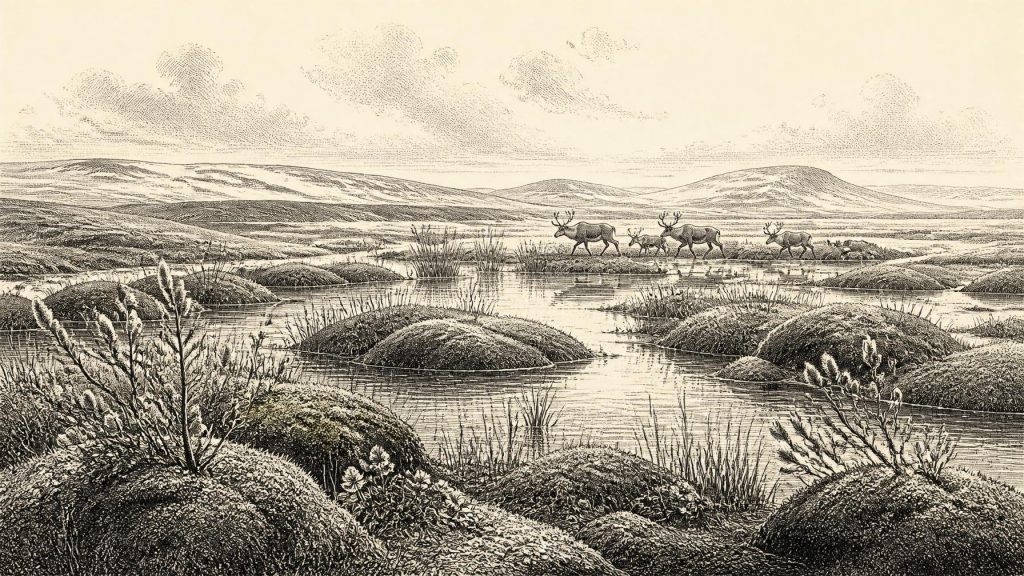
The organic material points to a treeless, cold wetland often described as muskeg or tundra-marsh. Mosses, sedges and other plant macrofossils, alongside pollen and insect evidence, indicate open ground rather than woodland. Recorded plants include dwarf willow, mountain avens, bogbean, water-milfoil and clubmosses: a mixture consistent with cold, exposed terrain containing shallow water, marshy hollows and seasonally wet ground. Such a habitat could be biologically productive in its short growing season, yet harsh for much of the year. Permafrost or persistently frozen subsoil is a reasonable environmental interpretation for parts of this landscape, but the evidence should not be stretched into a claim that every Irish valley had identical conditions.
At this scale, regional change matters more than a national picture. Fermanagh’s drumlin country held low-lying basins capable of catching water and preserving fine sediments. Upland, coastal and southern districts may have differed sharply in snow cover, exposure, drainage and proximity to ice. Later glaciers eroded, buried and rearranged deposits over immense areas. The survival of Derryvree is exceptional, and its rarity explains why the Irish record for this time is so much thinner than those of some continental European regions.
Animals at the Edge of Ice
The cave fauna from southern Ireland shows that, during parts of MIS 3, the island supported or received a more varied large-mammal community than its modern fauna suggests. Castlepook’s historic collections include remains attributed to mammoth, giant deer, reindeer, red deer, horse, brown bear, spotted hyaena, Arctic fox, mountain hare and lemmings. No responsible reconstruction should place all these animals beside one another on a single day. Cave assemblages can accumulate over long spans, and bones may arrive through carnivore activity, natural deaths, water transport, collapse or excavation disturbance. Nevertheless, their combined presence establishes that cold open habitats and animal movement across the Irish landmass were possible before the Last Glacial Maximum.
Reindeer are especially evocative because they fit an open, seasonal tundra-steppe landscape and could have ranged widely. Mammoth and giant deer point in the same broad direction: landscapes with extensive open vegetation rather than closed forest. Spotted hyaena remains indicate a large predator and scavenger capable of exploiting carcasses and using caves, not a peaceful pastoral scene. The food web was mobile and uncertain, shaped by season, climatic swings and the availability of grazing. For people, if they were present, such animals would have represented potential food, skins, bone and sinew; but these are possibilities inferred from wider Upper Palaeolithic practice, not demonstrated Irish economic activity.
The Castlepook Human Question
One reindeer femur from Castlepook has made this period unusually significant for the history of human presence in Ireland. Its deep linear modification has been interpreted as a possible stone-tool mark made while fresh bone was being processed, and the specimen has been presented as approximately 33,000 years old. If that interpretation is sustained, it would show that one or more Upper Palaeolithic people handled or butchered a reindeer in Ireland far earlier than the formerly accepted post-glacial evidence of human activity.
Yet the distinction between an intriguing trace and a known settlement is crucial. The bone is not part of a securely excavated camp floor accompanied by a hearth, stone-tool assemblage, dwelling, burial or a concentrated food refuse deposit of matching age. Its mark must also be assessed against natural damage, excavation history and the cave’s complicated taphonomy. The animal’s date is not automatically the date of the modification, though researchers argue that the character of the mark is consistent with fresh-bone processing. The most careful conclusion is that Castlepook raises a serious possibility of human activity in Ireland during the Upper Palaeolithic; it does not establish a permanent population, a named group, or continuous occupation.
People Without Politics
There is consequently no evidential basis for political affairs, diplomacy, organised warfare, social rank or formal religious institutions in Ireland around this date. Nor can archaeology identify Irish language, ethnicity, tribal names, artistic traditions or systems of teaching. It would be misleading to borrow detailed customs from better-known communities in France, Britain or central Europe and treat them as Irish facts. Upper Palaeolithic groups elsewhere possessed sophisticated knowledge, social ties and cultural practices, but Ireland’s evidence cannot tell us whether a visitor to Castlepook shared particular traditions, travelled alone or with companions, crossed from Britain, or stayed beyond a brief episode.
Even the geography of access requires restraint. Sea level was much lower than it is today, but Ireland’s connection to neighbouring lands changed repeatedly with ice-sheet growth, sea level, crustal movement and the form of the Irish Sea basin. A lower sea does not by itself prove a simple, dry land bridge at every point. Animals clearly reached Ireland at various times, and the island’s pre-maximum geography may have made movement easier than it later became; the precise routes available around 32,800 years ago remain a matter for palaeogeographical reconstruction rather than certainty.
A Precarious Irish World
The most important development around 30,848 BCE was environmental, not political. Ireland was part of a north-west European world oscillating between relative openings for plants and animals and the renewed advance of ice. The later Last Glacial Maximum, when the British–Irish Ice Sheet became far more extensive, lay ahead. Recent reconstructions place major ice-sheet expansion and its maximum configuration principally after this broad horizon, especially from about 31,000 to 25,000 years ago, though individual sectors behaved differently. Future ice would scour terrain, rework sediments and make the survival of open-air archaeological traces exceptionally unlikely.
For that reason, Ireland at this date is best approached through disciplined uncertainty. Derryvree demonstrates cold freshwater habitats in an ice-free Fermanagh interval. Castlepook and other cave sites demonstrate that an Ice Age fauna moved through parts of the island. A modified reindeer bone may preserve the earliest known sign of people, but it remains insufficient to populate the country with settlements, chiefs or traditions. The historical reality is both modest and remarkable: long before later communities made monuments, farmed fields or wrote names, changing ice, water, vegetation and animals were already shaping the conditions in which Ireland’s human story might occasionally begin.
Primary Sources
- A Middle Midlandian Freshwater Series at Derryvree, Maguiresbridge, County Fermanagh, Northern Ireland
- The Irish Quaternary Fauna Project
- A Reconsideration of the Radiocarbon Dating of the Marine Isotope Stage 3 Fauna from Southern Ireland
- Irish Quaternary Vertebrates
- The Quaternary History of South Fermanagh
- Figure 6.— The Subdivision of the Quaternary Period in Ireland
- Quaternary Deposits and Glacial Stratigraphy in Ireland
- Quaternary Data and Maps
- Quaternary Stratigraphy of Great Britain and Ireland – Selected References
- Growth and Retreat of the Last British–Irish Ice Sheet, 31,000 to 15,000 Years Ago: the BRITICE-CHRONO Reconstruction
- Timing, Pace and Controls on Ice Sheet Retreat: an Introduction to the BRITICE-CHRONO Transect Reconstructions of the British–Irish Ice Sheet
- Maximum Extent and Readvance Dynamics of the Irish Sea Ice Stream and Irish Sea Glacier Since the Last Glacial Maximum
- BRITICE-CHRONO Maps and GIS Data of the Last British-Irish Ice Sheet 31 to 15 ka
- Stratigraphic and Palaeo-Geomorphological Evidence for the Glacial-Deglacial History of the Last British-Irish Ice Sheet in the North-Western Irish Sea
- The Colonization of Ireland: A Human Ecology Perspective
- New Insights on the Fauna of Ireland's Younger Dryas and Early Holocene from Alice & Gwendoline Cave
- Phylogeographic, Ancient DNA, Fossil and Morphometric Analyses Reveal Ancient and Modern Introductions of a Large Mammal: the Complex Case of Red Deer in Ireland
- The Standard Stratigraphic Nomenclature of Ireland
- The IntCal20 Northern Hemisphere Radiocarbon Age Calibration Curve (0–55 cal kBP)
- The Global Benthic δ18O Stack