The BIRM-166 Freshwater Horizon30694 BCE
Rather than a datable event, 30,694 BCE represents a broad Late Pleistocene interval in Ireland. Derryvree, County Fermanagh, preserves freshwater silts between glacial tills, indicating locally ice-free, wet tundra with sparse shrubs, sedges, aquatic plants and insects before renewed glaciation. Its radiocarbon range spans millennia, while ice-sheet expansion and timing remain uncertain. Castlepook Cave, County Cork, contains Marine Isotope Stage 3 fauna including reindeer, mammoth, giant deer, bears, wolves, Arctic foxes and hyaenas, revealing intermittent ecological links with Europe. A possibly cut-marked reindeer bone suggests human activity, but cannot establish settlement. Evidence documents environments and fauna, not societies or events.
Dateline
The label 30,694 BCE gives a misleading impression of precision. No one in Ireland marked this year, and no archaeological deposit can be tied responsibly to a single modern calendar year so far back. In conventional archaeological terms it lies about 32,644 years before AD 1950, within the Late Pleistocene and broadly Marine Isotope Stage 3. The closest Irish evidence is dated in radiocarbon and calibrated ranges that can span many centuries or millennia. What survives is not a chronicle of events, rulers or communities, but a small number of environmental archives and cave-bone assemblages.
One deposit is especially valuable: the freshwater sediments exposed at Derryvree, near Maguiresbridge in County Fermanagh. Their conventional radiocarbon determination, BIRM-166, was 30,500 ± 1,100 radiocarbon years before present. Later calibration has placed that broad determination at approximately 36,900–31,700 calibrated years before present. Thus 30,694 BCE falls within the wide chronological horizon that Derryvree can illuminate, but it cannot be identified as the year when the mud, plants or insects were laid down. The appropriate subject is an interval of changing Ice-Age conditions, not a dateable incident.
A Wetland Between Ice Advances
Derryvree was revealed in 1969 when road works cut through a drumlin. Beneath a later sheet of glacial till, excavators found fine sands and organic silts; beneath those lay another till. This sequence matters because the organic layer records a period when freshwater accumulated at the site rather than ice flowing across it. The deposit therefore provides strong local evidence that part of north-central Ireland was ice-free during the interval represented by the sediments, before a subsequent glacier overrode and sealed them.
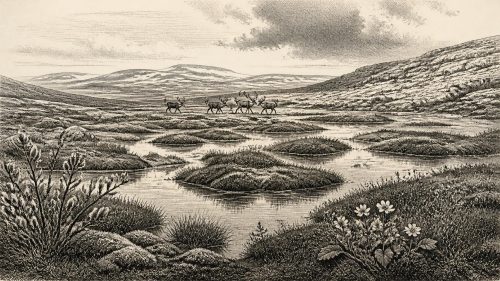
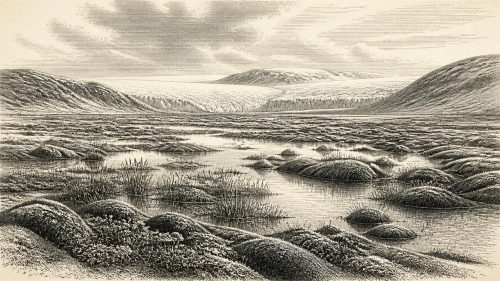
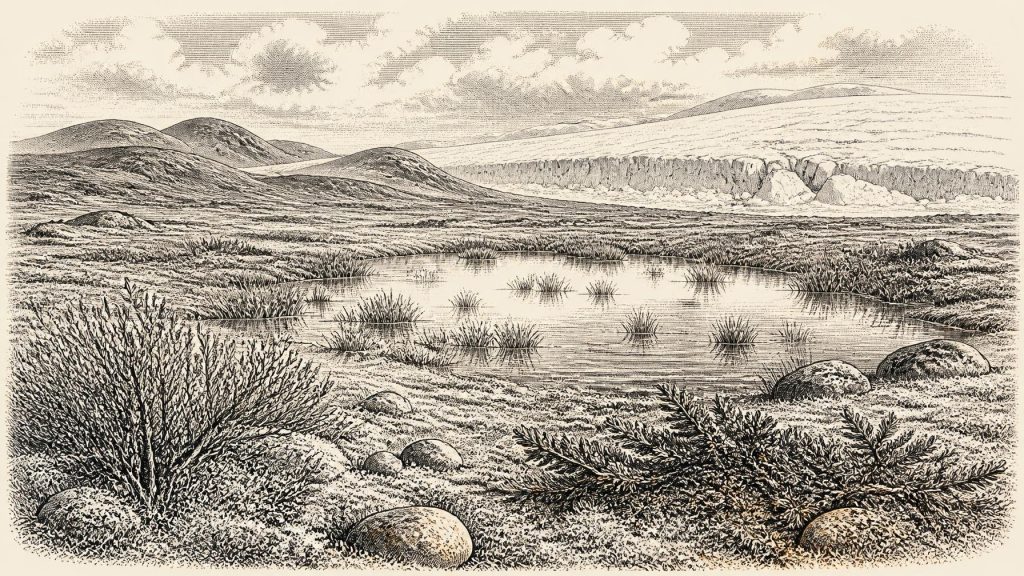
Its plant and animal remains describe a cold but not lifeless landscape. Pollen, seeds, mosses and insect evidence have been interpreted as an open, treeless tundra or muskeg: wet ground with sedges and grasses, dwarf shrubs and herbs, mossy margins, and shallow pools. Bogbean, water-milfoil and other aquatic or wetland plants indicate standing or slow-moving freshwater. Juniper and dwarf willow belonged to a low, sparse vegetation cover rather than woodland. Such evidence supports a picture of seasonally wet basins amid periglacial terrain, where repeated freezing and thawing shaped soils and drainage.
That reconstruction should not be enlarged into a postcard view of all Ireland on one day. Derryvree is a local archive, and its sediments accumulated over time. Still, it offers a firmer guide than modern assumptions about an invariably ice-covered island. Ireland’s climate at this stage was highly unstable. Greenland ice-core records show abrupt warmer interstadials and colder stadials across Marine Isotope Stage 3, while the British–Irish Ice Sheet was developing in complex and regionally uneven ways. Conditions suitable for freshwater vegetation in Fermanagh could coexist with advancing ice in uplands, northern waters or other sectors of the Irish landscape.
The Approaching Ice Sheet
Ice-sheet history is one of the central uncertainties surrounding this period. Older interpretations often imagined large pre-Last Glacial Maximum ice cover, whereas several dated organic deposits, including Derryvree, have been used to argue for ice-free conditions across substantial areas until roughly 34,000 calibrated years ago. More recent reconstructions of the British–Irish Ice Sheet suggest a rapid expansion around 31,000–29,000 years ago, with northern Irish ice centres and upland ice caps growing and coalescing. At about the horizon represented by 30,694 BCE, Ireland may therefore have been experiencing a major transition: habitats were becoming less secure as ice expanded, even though the pace, exact margins and local timing remain debated.
This is why a single date should not be made to carry more than it can. At Derryvree, the upper till proves later glaciation, not the precise day or century when the advance arrived. Offshore evidence, geomorphology, radiocarbon ages and ice-sheet modelling each measure different parts of a changing system and have different uncertainties. The responsible conclusion is that the wetland lay within a landscape vulnerable to renewed glaciation. Within a few thousand years, the Last Glacial Maximum would transform much of Ireland’s surface and remove, bury or disturb many earlier traces.
Cork’s Mammoth-Cave Fauna
County Cork provides the other principal window onto Ireland at this depth of time. Castlepook Cave, near Doneraile and sometimes called Mammoth Cave, yielded an exceptionally rich Pleistocene bone collection from excavations in the early twentieth century and later investigations. The assemblage includes reindeer, woolly mammoth, giant deer, brown bear, wolf, Arctic fox and spotted hyaena. Direct radiocarbon reassessment has shown that elements of this fauna belong to Marine Isotope Stage 3, with some animal remains dating to well before the Last Glacial Maximum. It demonstrates that sizeable mammals and their predators reached Ireland during this broader period.
The cave is not, however, a neatly preserved snapshot of a herd or camp. Bones could have entered passages through carnivore activity, natural death, water movement, sediment disturbance and early excavation. Spotted hyaena is particularly significant: gnawed and broken bones, together with the animal’s own remains, make a convincing case that carnivores helped create at least part of the assemblage. A mammoth or reindeer bone in the cave proves that an animal, or part of one, arrived there; it does not by itself establish a population size, season of occupation or a continuous local ecosystem.
Taken alongside Derryvree, Castlepook nevertheless suggests an Ireland capable, in suitable intervals, of supporting a cold-adapted large-mammal community. Reindeer imply open forage-rich country rather than closed forest. Mammoth, giant deer and predators point to broad ecological connections with north-western Europe, although the routes by which animals moved into and out of Ireland remain uncertain. Lower sea levels altered coastlines, but neither the Derryvree record nor the cave fauna authorises a simple claim that there was a continuously passable land bridge. Repeated dispersal, short-lived habitat corridors and crossings over water are possibilities that require separate evidence.
The Question of People
A reindeer femur from Castlepook has made this era important to the history of human presence in Ireland. The bone, held in the National Museum of Ireland’s natural-history collections, has been interpreted as bearing a deep fresh-bone mark made during carcass processing with a sharp stone implement. Public heritage interpretation has connected it with a date of roughly 33,000 years ago. If that interpretation is confirmed, it would indicate that people handled a reindeer in Ireland during the Late Pleistocene, far earlier than the long-accepted evidence for human activity on the island.
But the limits are crucial. A marked animal bone is not a house floor, hearth, toolkit, burial or settlement. No securely associated stone implements, human remains, enduring occupation surface or population can presently be assigned to 30,694 BCE. The date of the bone and the diagnosis of the mark are also different scientific questions: radiocarbon dating addresses the animal’s age, while microscopic and taphonomic analysis must distinguish human modification from natural damage. Castlepook is therefore a serious and promising indication of possible human action, not proof of a resident society.
It would be equally unsafe to import the richly documented Upper Palaeolithic cultures of France, Iberia or central Europe directly into Ireland. Elsewhere in Europe, hunter-gatherers made sophisticated stone and organic tools, used animal resources, maintained social networks and sometimes created art. Those comparisons can frame questions about what brief visitors to Ireland might have known or done; they cannot fill the Irish evidential gap. Ireland has no securely demonstrated art, ritual site, named group, language, political institution, warfare, diplomacy or trade network from this precise horizon.
Life Beyond the Historical Record
Accordingly, political affairs cannot be described for this date. There were no states, written treaties, chiefs known by name or borders recoverable from the evidence. Conflict is visible only at an ecological level: predators, scavengers and herbivores competed within a severe environment, while advancing ice repeatedly contracted the terrain available to plants and animals. Even this should not be romanticised as a permanent “mammoth steppe”. The Irish evidence records episodes and locations, not an uninterrupted national biome.
Nor can religion, culture and learning be reconstructed as Irish institutions. A wetland was not necessarily sacred; a cave was not necessarily a human dwelling; an animal bone was not necessarily hunting waste. The most defensible cultural statement is negative but important: there is no evidence for writing, farming, pottery, metalworking, monuments or established villages. If people visited, their economy may have included opportunistic use of animal carcasses or hunting, but the evidence falls far short of demonstrating a regular subsistence system or trade.
The great development around this horizon was environmental rather than political. Derryvree preserves a rare interval of open wet tundra in Fermanagh. Castlepook retains traces of a remarkably varied cold-stage fauna in Cork. Together they show that Late Pleistocene Ireland was neither an empty abstraction nor a fully knowable human landscape. It was a shifting north-western environment, periodically able to sustain freshwater vegetation and large mammals, then increasingly overtaken by ice. Its history survives in silts, pollen, insects and broken bones: powerful evidence, but evidence that demands restraint.
Primary Sources
- A Middle Midlandian Freshwater Series at Derryvree, Maguiresbridge, County Fermanagh, Northern Ireland
- A reconsideration of the radiocarbon dating of the Marine Isotope Stage 3 fauna from southern Ireland
- Growth and retreat of the last British–Irish Ice Sheet, 31,000 to 15,000 years ago: the BRITICE-CHRONO reconstruction
- The timing and magnitude of the British–Irish Ice Sheet between Marine Isotope Stages 5d and 2: implications for glacio-isostatic adjustment, high relative sea levels and ‘giant erratic’ emplacement
- Radiocarbon constraints on the history of the western Irish ice sheet prior to the Last Glacial Maximum
- Timing and pace of ice-sheet withdrawal across the marine–terrestrial transition west of Ireland during the last glaciation
- The deglaciation of the western sector of the Irish Ice Sheet from the inner continental shelf to its terrestrial margin
- Character of advance and retreat of the southwest sector of the British-Irish Ice Sheet during the last glaciation
- Exploring controls of the early and stepped deglaciation on the western margin of the British Irish Ice Sheet
- New insights on the fauna of Ireland's Younger Dryas and Early Holocene from Alice & Gwendoline Cave
- The Irish quaternary fauna project
- Occurrence of mammalia relicts at site Castlepook Cave
- The exploration of Castlepook Cave, County Cork
- HERITAGE ARTEFACTS of County Cork
- Castlepook Caves
- Castlepook Cave, Co. Cork, 2022: Excavations Bulletin report 32564
- Irish Pleistocene biostratigraphy
- The IntCal20 Northern Hemisphere Radiocarbon Age Calibration Curve (0–55 cal kBP)
- Guide to the National Museum of Ireland – Natural History
- Irish Quaternary Association: Publications