Castlepook’s Reindeer Limb30695 BCE
Around 30,695 BCE, Ireland experienced unstable Late Pleistocene conditions during the Midlandian glaciation, with shifting ice, lowered seas and cold, open habitats. Derryvree sediments in County Fermanagh preserve evidence of freshwater, tundra-like vegetation and ecological communities between ice advances. Castlepook Cave, County Cork, contains a complex accumulation of mammoth, giant deer, reindeer, hyena and other animal remains, indicating diverse cold-adapted fauna. A deeply incised reindeer femur may record butchery with a stone tool and possibly Ireland’s earliest human presence. However, its context and dating remain uncertain. No evidence supports claims of permanent settlement, social organisation, monuments, politics or named peoples.

Dateline
“30,695 BCE” is a modern calendar label, not a date that can be matched to an Irish event, ruler, community or season. Around this remote point in the Late Pleistocene, modern calendar-year precision is simply unavailable. Converted only approximately into the archaeological convention of years before AD 1950, it falls near 32.6 thousand years ago. The responsible evidence comes instead from radiocarbon ranges, ice-sheet reconstructions, cave deposits and environmental sequences, each carrying uncertainties of centuries or millennia. What can be written for Ireland at this point is therefore a cautiously framed history of landscapes, animals and a possible human trace rather than a narrative of recorded affairs.
An Island at a Cold Threshold
This was part of the Midlandian glaciation, Ireland’s name for the last glacial cycle. It preceded the fullest expansion of the last British–Irish Ice Sheet, which occurred later, in the broad interval conventionally called the Last Glacial Maximum. Ireland was not a static white wilderness awaiting that maximum. Ice grew, retreated and reorganised across different regions at different times; mountains, lowlands, coasts and the adjoining sea basin could have had sharply different conditions. Recent reconstructions of the British–Irish Ice Sheet begin at 31,000 years before present precisely because older evidence is sparse and uncertain, while showing ice accumulating in northern sectors and advancing through the later part of this cold phase.
It would be misleading to colour the whole island as either entirely ice-covered or entirely habitable in one notional year. At roughly 32.6 thousand years ago, Ireland lay within a changing north-west European glacial world. Colder conditions, lowered sea levels, extensive ice and exposed coastal shelves altered routes for animals and, potentially, people. Yet the precise shape of coastlines and any passable connection towards Britain cannot be read straightforwardly from a modern map. The Irish Sea was a complex, glaciated and marine landscape. The movement of fauna into Ireland demonstrates that pathways existed at some stages, but it does not identify one permanent dry-land road, nor prove that every species and every visitor followed the same route.
Derryvree’s Buried Waters
Far from north Cork, a road cutting at Derryvree near Maguiresbridge, County Fermanagh, provides a different kind of witness. There, freshwater silts and fine sands containing organic remains lay between two tills: sediment left by ice on separate advances. The sequence was described as a Middle Midlandian freshwater series. Its famous radiocarbon determination, Birm-166, is conventionally reported at about 30,500 radiocarbon years before present, with a substantial error range. Radiocarbon years are not identical to calendar years, and calibration gives broad possibilities rather than a point on a historical calendar.
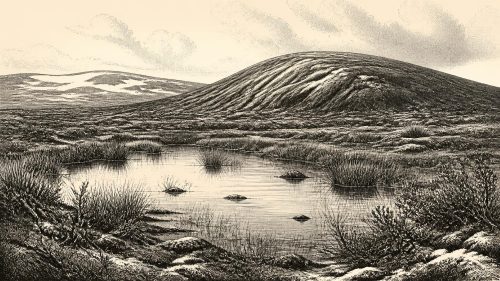
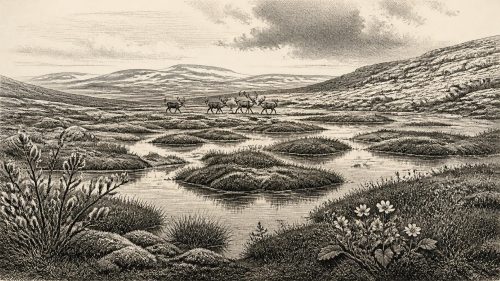
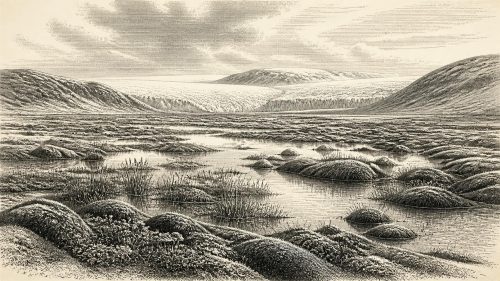
The Derryvree deposits are nonetheless important for the world surrounding the requested date. Pollen, seeds, mosses, insect remains and aquatic plants indicate an interval in which freshwater existed in a cold, treeless and waterlogged landscape before later ice overrode or enclosed the sediments. Bogbean, water-milfoil, sedges, dwarf willow, mountain-avens and other cold-climate indicators do not reconstruct a pleasant modern-style bog; they point to shallow water, wet margins and sparse tundra-like vegetation under severe conditions. Such deposits show that parts of Ireland could sustain local ecological communities during a glacial interval. They do not prove that Derryvree was open water in 30,695 BCE exactly, nor do they establish the weather of a single year.
Attempts to correlate Irish records with the rapid warm and cold shifts detected in Greenland ice cores are useful but tentative. Irish radiocarbon dates, reworked sediments and gaps in the record make one-to-one matches insecure. The sound conclusion is that the late Marine Isotope Stage 3 landscape was unstable on long timescales: intervals of ice-free or less heavily glaciated ground could be followed by renewed ice advance. This is the environmental background against which the better-known animal evidence from Castlepook must be understood.
A Cave Repository in North Cork
Castlepook Cave, also called Mammoth Cave, near Doneraile in County Cork, is Ireland’s richest known archive of vertebrate remains from the period leading towards the Last Glacial Maximum. Excavations undertaken in the early twentieth century by Richard J. Ussher and the Royal Irish Academy’s cave-exploration work recovered more than two thousand bones from narrow galleries and chambers with memorable names such as Hyena Hall and Elephant Hall. The assemblage includes woolly mammoth, giant deer, reindeer, brown bear and spotted hyena; other deposits have produced wolf, Arctic fox and lemmings. Direct dates on individual bones span a very long interval, rather than a single occupation episode.
The animals make a powerful case for a cold, open and ecologically varied Ireland, but the cave was not a census station. A bone in Castlepook proves that an animal, or part of it, reached the cave. It does not by itself prove the size of a local herd, the exact character of the surrounding vegetation or that all listed species lived there simultaneously. Hyenas and other carnivores could drag material into their den; water could move sediment and bones; and early excavations did not preserve the finely recorded contexts expected today. Improved radiocarbon pretreatment has also shown that some older cave dates require reassessment. The cave is invaluable precisely because it is a complicated archive, not because it supplies easy certainties.
Nevertheless, the broad faunal picture is striking. Reindeer and lemmings indicate cold-adapted communities; mammoth and giant deer evoke open terrain capable of supporting large grazers and browsers; predators such as wolf and spotted hyena reveal a food web with scavenging, hunting and competition. The term “mammoth steppe” can be a useful comparison with continental Eurasia, but it should not become a painted backdrop imposed on Ireland. Irish evidence supports an open, cold landscape with large mammals; its sparse record does not warrant precise claims about grass height, migration seasons or the density of animal populations around Doneraile.
The Mark on a Reindeer Bone
One object gives this notional year its special importance: a reindeer femur from Castlepook. County Cork heritage material has presented it broadly as c. 31,000 BCE, and zooarchaeologist Ruth Carden has interpreted a deep linear incision on the limb bone as a cut made by a sharp stone tool while a fresh carcass was being butchered. If that interpretation is confirmed, it would be evidence that a person or people handled a reindeer in Ireland far earlier than the long-accepted terminal-Pleistocene evidence for human activity on the island.
The claim deserves attention, but also exact limits. A radiocarbon result dates the animal’s bone within a range; it does not independently timestamp the incision to a particular day. The specimen came from an old cave collection, not from a sealed floor with a hearth, stone tools and a clear sequence of deposits. Castlepook has yielded no securely associated Upper Palaeolithic tool kit, dwelling, burial, human remains or settlement surface of comparable age. Nor can the marked femur tell us whether people killed the reindeer, found an already dead animal, butchered it beside the cave, or lost the bone after carnivores moved it underground.
The inference that people may have visited is therefore stronger than any claim for permanent settlement. It is reasonable to say that reindeer offered meat, fat, marrow, hide, sinew and bone to mobile hunter-gatherers, because those are practical properties of the animal and are documented in Upper Palaeolithic lifeways elsewhere. It is not reasonable to fill the Irish evidence gap by importing a named continental culture, a language, a population size or a seasonal camp routine. Even the route taken by any visitors remains unknown. Their presence, if the cut mark is accepted, could have been brief and episodic at the far north-west edge of the European world.
No Politics, No Monuments, No Recorded Belief
For political affairs, diplomacy and conflict, the evidence is silent. There were no states, kingdoms, written agreements or identifiable peoples in Ireland from which such institutions could be recovered. The presence of predators and mobile large herbivores does show that danger, competition and survival structured the landscape, but it cannot be translated into human warfare or territorial politics. Likewise, there is no securely dated Irish evidence from around this time for a shrine, grave, image, ceremonial gathering, formal instruction or enduring settlement. Absence of evidence is not proof that individuals had no beliefs, stories or learned skills; it does mean that archaeologists cannot responsibly describe their religion, art or social organisation.
There was no economy in the later sense of farms, fields, markets, coinage or managed long-distance trade. If people were present, subsistence would have depended on mobility, detailed environmental knowledge and the immediate use of animal and plant resources. Stone tools are implied only by the contested interpretation of the reindeer-bone mark, not recovered as an Irish assemblage of this age. There is no basis for claiming pottery, metalworking, textile production, seafaring networks or exchange partnerships. The most defensible picture is one of a landscape in which animals moved through changing habitats and where a small number of people may, for a short time, have entered or crossed Ireland.
What This Date Can Mean
Thus 30,695 BCE should not be treated as Ireland’s “first year” of anything. Its value lies in focusing attention on evidence that is older, patchier and more ambiguous than the familiar post-glacial human story. Derryvree preserves the trace of cold freshwater environments between ice advances. Castlepook preserves a long, mixed record of large mammals and carnivores, together with a reindeer limb whose incision may be the earliest sign of human action yet recognised in Ireland. The former reveals environmental possibility; the latter raises a searching archaeological question.
Future work may refine these conclusions through new excavation, microscopic study of bone surfaces, direct dating, sedimentary DNA and improved modelling of ice and sea level. For now, the honest history of Ireland around this point is one of tundra wetlands, cave-borne animal remains, advancing ice and a possible moment of carcass processing. It is a history with no names and no calendar dates, but not one without evidence.
Primary Sources
- A Middle Midlandian Freshwater Series at Derryvree, Maguiresbridge, County Fermanagh, Northern Ireland
- The Irish Quaternary Fauna Project
- A Reconsideration of the Radiocarbon Dating of the Marine Isotope Stage 3 Fauna from Southern Ireland
- Growth and Retreat of the Last British–Irish Ice Sheet, 31,000 to 15,000 Years Ago: the BRITICE-CHRONO Reconstruction
- Early Deglaciation of the British-Irish Ice Sheet on the Atlantic Shelf Northwest of Ireland Driven by Glacioisostatic Depression and High Relative Sea Level
- Timing and Pace of Ice-Sheet Withdrawal Across the Marine–Terrestrial Transition West of Ireland During the Last Glaciation
- Maximum Extent and Readvance Dynamics of the Irish Sea Ice Stream and Irish Sea Glacier Since the Last Glacial Maximum
- Trimlines, Blockfields and the Vertical Extent of the Last Ice Sheet in Southern Ireland
- Exploring Controls of the Early and Stepped Deglaciation on the Western Margin of the British–Irish Ice Sheet
- The Problem of a Late Quaternary Landbridge Between Britain and Ireland
- Origin of British and Irish Mammals: Disparate Post-Glacial Colonisation and Species Introductions
- Stoats (Mustela erminea) Provide Evidence of Natural Overland Colonization of Ireland
- Could Brown Bears (Ursus arctos) Have Survived in Ireland During the Last Glacial Maximum?
- First Evidence of a Late Upper Palaeolithic Human Presence in Ireland
- New Insights on the Fauna of Ireland’s Younger Dryas and Early Holocene from Alice & Gwendoline Cave
- Archaeology Research Excavation Grant 2022: Castlepook Cave, Co Cork
- Castlepook Cave: County Geological Site Report
- Spotted Hyena Skull
- Heritage Artefacts of County Cork
- Radiocarbon Dating, Volume 16, Number 1 (including Castlepook 1 determination D-122)
- The Exploration of Castlepook Cave, County Cork: Third Report from the Committee Appointed to Explore Irish Caves
- Occurrence of Mammalia Relicts at Site Castlepook Cave
- Geology of Ireland
- Quaternary Geomorphology
- Irish Quaternary Association