The Falls Road Curfew1970 CE
1970 marked a decisive hardening of the Northern Ireland conflict and its impact on the Republic. Security reforms replaced the B Specials with the Ulster Defence Regiment, while Ian Paisley’s election and the Alliance Party’s foundation reflected polarised and alternative politics. The British Army’s thirty-four-hour Lower Falls curfew, searches, gun battles and civilian deaths alienated Catholic communities. In Dublin, the Arms Crisis split Fianna Fáil after allegations of illegal arms imports, despite subsequent acquittals. A prolonged bank strike and cement dispute disrupted economic life. Ireland also opened European Community negotiations, while Dana’s Eurovision victory provided a notable all-island cultural moment.
Dateline
In 1970, Ireland’s political geography was painfully apparent. The Republic, governed in Dublin by Jack Lynch’s Fianna Fáil administration, remained constitutionally separate from Northern Ireland, where the Unionist government at Stormont operated within the United Kingdom. Yet events crossed the Border constantly: through refugee relief, demonstrations, diplomatic visits, weapons allegations, trade, broadcasting and family ties. The year did not yet have the scale of killing associated with the worst years of the Troubles, but it was a decisive stage in the hardening of conflict. Institutions meant to contain the crisis were altered, political loyalties were tested, and daily life in the Republic was disrupted by an extraordinary banking stoppage.
A Northern Crisis Deepens
Northern Ireland entered 1970 after the violence and displacement of 1969, with trust between communities, police and government already gravely damaged. The split within the Irish Republican Army at the end of 1969 quickly became a practical reality during 1970: the Official and Provisional wings developed separate organisations and strategies. Republican activity, loyalist violence and confrontations with the security forces added to an atmosphere in which many neighbourhoods, particularly working-class areas of Belfast and Derry, viewed security through communal experience rather than as an impartial public service.
Security reform was therefore politically charged. The recommendations of the Hunt Report, published in late 1969, were being implemented: the Ulster Special Constabulary, widely known as the B Specials, was wound up, while the new Ulster Defence Regiment became operational on 1 April 1970. The change was presented as part of a move away from military policing by the Royal Ulster Constabulary. But its reception differed sharply. Many unionists regarded the disappearance of the B Specials with alarm; many nationalists and civil-rights campaigners remained unconvinced that structural reform could quickly overcome long-standing discrimination and mistrust. The UDR’s local recruitment was intended to strengthen protection of life and property, but in the polarised conditions of 1970 it could not by itself establish confidence across the divide.
Political alternatives were also beginning to emerge. On 16 April, the Reverend Ian Paisley won the Bannside by-election to the Northern Ireland House of Commons, a result that demonstrated the force of Protestant unionist opposition to reform. Five days later, on 21 April, the Alliance Party of Northern Ireland was founded. Its founders sought a cross-community politics based on constitutional government, civil liberties and practical social and economic questions. In the immediate circumstances this was a difficult project: public debate was increasingly organised around security, identity and the constitutional future of Northern Ireland. Nonetheless, Alliance’s foundation was an important indication that not every political response accepted a simple nationalist–unionist division.
The Lower Falls Under Curfew
The most consequential single episode of the year came in west Belfast. From the afternoon of 3 July, the British Army imposed a curfew on the Lower Falls area while conducting extensive house-to-house searches for weapons and members of the IRA. The restriction lasted about thirty-four hours, through 4 July and into the morning of 5 July. Residents faced severe limits on movement; food supplies became an immediate concern, while searches caused extensive damage to houses and possessions. Women from Andersonstown broke through the military cordon carrying food, and the curfew ended soon afterwards.
The episode involved more than an arms search. Gun battles took place between the Army and both IRA factions, and three civilians died from Army action during and immediately after the operation. The discovery of weapons and explosives did not outweigh, in nationalist opinion, the shock of containment, searches and deaths. The curfew decisively weakened such goodwill as remained towards the Army in Catholic districts. It also made clear that British troops, initially welcomed by some nationalists in 1969 as protection from hostile policing and loyalist attack, were becoming another armed authority to be feared and resisted.
Its political consequences reached Dublin immediately. On 6 July, Patrick Hillery, the Republic’s Minister for External Affairs, made an unofficial visit to the Falls Road. The Northern Ireland government and British authorities criticised the visit. Hillery’s presence, however, reflected an unavoidable fact for the Irish government: violence in Belfast was not an external matter in any ordinary sense. It affected citizens’ relatives, public feeling, border communities and the legitimacy of Dublin’s claim to speak for the island as a whole. The limits of what the Republic could actually do were equally evident.
Conflict-related deaths remained far below the totals that would follow in 1971 and 1972, but the human cost was already serious. The Sutton Index records twenty-six deaths related to the conflict during 1970. Numbers alone cannot convey the experience behind them: bereavement, imprisonment, intimidation and sudden displacement were altering the rhythms of ordinary life. By year’s end, heightened security had not supplied a stable political settlement, and the boundaries between policing, military action and political conflict had become ever less clear.
The Arms Crisis in Dublin
In the Republic, Northern Ireland precipitated the gravest cabinet crisis of Jack Lynch’s premiership. On 6 May, Lynch dismissed Charles Haughey, Minister for Finance, and Neil Blaney, Minister for Agriculture and Fisheries. They were accused of involvement in an attempt to import arms from continental Europe without lawful authority. Kevin Boland resigned from cabinet in protest. The affair exposed competing views within Fianna Fáil and beyond it: whether the State’s response to the Northern crisis should remain firmly constitutional and diplomatic, or whether assistance to armed nationalist defence groups could be justified by the vulnerability of Catholic communities in the North.
The legal proceedings require careful distinction from the political crisis. Haughey, Irish Army intelligence officer Captain James Kelly, John Kelly and Belgian businessman Albert Luykx faced a conspiracy charge. Blaney’s case did not proceed to the principal trial after he was discharged at district-court level in July. A first Central Criminal Court trial in September was abandoned; the second ran from 6 to 23 October. Haughey and the three co-accused were acquitted. The verdict did not restore political unity. Lynch maintained that the information available to him had required decisive action, while the acquittals enabled Haughey’s supporters to portray him as vindicated.
The Arms Crisis was thus not simply a courtroom drama. It brought difficult questions about ministerial responsibility, Army intelligence, Garda information, cabinet confidence and the State’s monopoly over the importation of weapons into public view. It also demonstrated how the Northern emergency could destabilise politics in the Republic itself. Lynch’s decision asserted that the Dublin government would not permit ministers or officials to conduct an independent armed policy towards Northern Ireland. The political arguments it unleashed, particularly within Fianna Fáil, endured long after 1970.
Pay, Credit and Everyday Exchange
Even without the Northern crisis, 1970 would have stood out for industrial disruption. A national cement strike ran from 2 February to 25 June, severely affecting construction and contributing to lay-offs. More remarkable still was the bank dispute. From 1 May, the main Associated Banks closed during a strike that lasted more than six months; they reopened on 17 November. This was an era before cash machines, debit cards and electronic transfers. A large part of the ordinary banking system had therefore ceased to function just as wage payments, shop credit, farm transactions and small-business accounts still depended heavily on paper records and personal reputation.
People adapted rather than simply stopping economic activity. Cash, post-office services, informal credit and cheques circulating between people who trusted one another all became more important. This adaptability should not romanticise the episode. The absence of normal clearing arrangements increased risk, complicated credit and delayed settlement, while the long cement dispute reduced output in construction. The OECD later judged both disputes significant enough to affect economic growth in 1970. For households and traders, the year demonstrated both the fragility of formal financial systems and the importance of local networks when those systems failed.
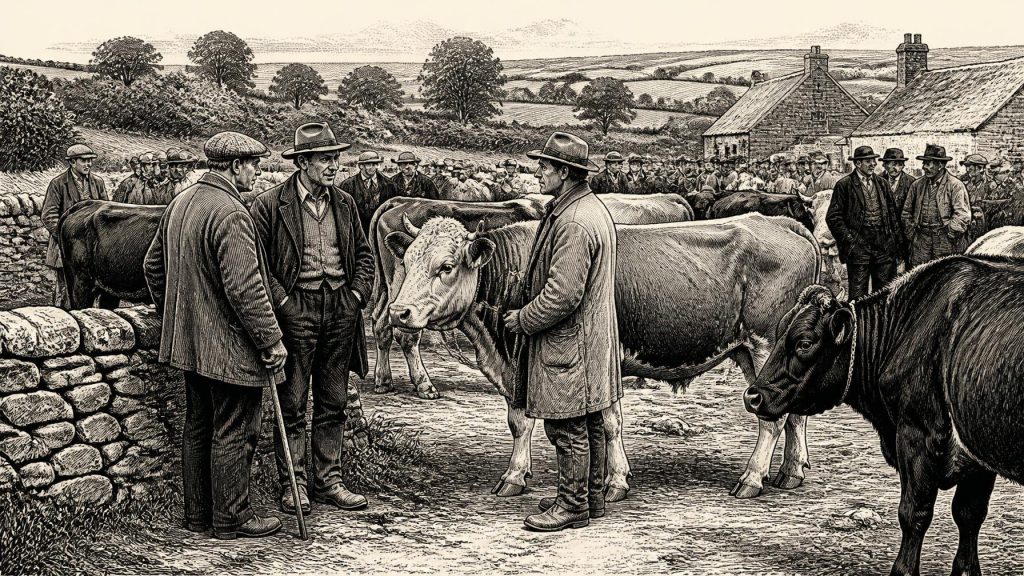
The wider economy was in transition. Agriculture still mattered deeply to employment, exports and rural society, but the direction of policy and planning favoured industrial expansion, new firms, exports and services. Official forecasts expected the agricultural labour force to continue shrinking as production became more efficient and opportunities outside farming expanded. Tourism was growing, although political disorder on the island and industrial unrest posed obvious risks. This was not yet the later, more prosperous Europeanised Ireland; emigration and uneven regional opportunity remained part of the country’s social landscape. But the older overwhelmingly agricultural economy was already changing.
Europe and a Cultural Landmark
While immediate security concerns dominated headlines, the Republic was quietly preparing for a major external reorientation. In April the government published Membership of the European Communities: Implications for Ireland, setting out issues including agriculture, fisheries, industry, taxation and free movement. Ireland’s prospects were closely tied to Britain’s application, because the British market was so important for Irish trade. Formal accession negotiations for Ireland opened on 30 June. Membership was not secured in 1970, and no outcome should be read back into the year; nevertheless, the negotiations marked a concrete step towards the European Communities that Ireland would join in 1973.
There was also a rare all-island cultural moment untouched by constitutional agreement. On 21 March, eighteen-year-old Rosemary Brown, performing as Dana, won the Eurovision Song Contest in Amsterdam for Ireland with All Kinds of Everything. It was the State’s first Eurovision victory. Dana came from the Bogside in Derry, a place associated internationally with civil-rights protest and tension; her success offered a very different, popular image of Irish life. RTÉ’s coverage and the homecoming celebrations showed the expanding reach of television in a society where politics, music and international connection increasingly entered domestic life through the screen.
By the close of 1970, no settlement had been found for Northern Ireland, and the Republic had learned how directly that unresolved conflict could penetrate cabinet government and public order. Yet the year also contained signs of other futures: cross-community political organisation in the North, European negotiations in Dublin, and a cultural success shared across borders. These strands did not cancel the violence or uncertainty. They reveal instead an Ireland pulled simultaneously towards conflict, institutional change and wider connections.
Primary Sources
- A Chronology of the Conflict – 1970
- Hunt Report, 1969
- Sutton Index of Deaths: Year of the Death
- Northern Ireland House of Commons, 1921–1972
- 1970 Westminster Elections in Northern Ireland
- Our History
- The British Army
- The Arms Trial Outcome
- Haughey, Charles James (C.J.)
- Nomination of Members of Government: Motion, Dáil Éireann, 8 May 1970
- Confidence in Government: Motion, Dáil Éireann, 13 May 1970
- GunPlot Uncovered – A Deeper Dive into the Archives
- Bank Strike Ends
- Bank Strike
- Money and Credit: Lessons of the Irish Bank Strike of 1970
- OECD Economic Surveys: Ireland 1971
- Financial Statement – Budget, 1970
- OECD Economic Surveys: Ireland 1970
- Membership of the European Communities, Implications for Ireland, April 1970
- Ireland’s Accession to the EU: A Visit to Uncover Some of the Treasures Kept in the Council’s Archives
- The Accession of Ireland to the European Communities, 1972–2022
- Dana Home After Eurovision Win 1970
- RTÉ 1970s
- Census 1971 Reports