Browne, Bodkin and Ballot1951 CE
In 1951, Noel Browne’s resignation over the Mother and Child Scheme exposed conflicts between social reform, Catholic authority, medical interests and governmental caution. The inter-party government then fell amid agricultural disputes; May’s election returned Fianna Fáil as largest party, enabling Éamon de Valera to lead a minority administration. The census recorded 2,960,593 people, as emigration largely offset natural increase amid economic insecurity. Welfare pensions rose, agricultural workers gained half-holidays, and electrification and peat development continued. The Arts Act established An Chomhairle Ealaíon. In Northern Ireland’s Westminster poll, Unionists retained dominance despite Nationalist victories and a narrowly contested West Belfast seat.
Dateline
In 1951 the Republic of Ireland experienced a year of argument, electoral reversal and institutional beginnings. Its best-known episode, the collapse of the Mother and Child Scheme and the resignation of the Minister for Health, Dr Noel Browne, exposed tensions over public medicine, clerical influence and political responsibility. Yet the same year also brought a general election, a census that recorded the country’s fragile demographic position, new social measures, the statutory foundation of An Chomhairle Ealaíon, and continuing changes in rural work, energy and communications. Across the border, Northern Ireland’s Westminster election underlined the strength of Unionism while also revealing sharp local variations.
A Health Scheme Defeated
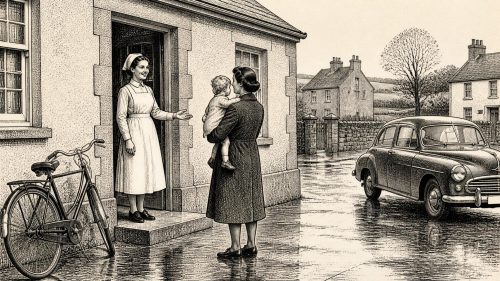
The defining crisis came to a head on 11 April, when Noel Browne resigned from the inter-party government led by John A. Costello. Browne, a Clann na Poblachta minister and qualified doctor, had tried to introduce the maternal and child provisions envisaged under the Health Act 1947. His version sought a comprehensive service without a means test: care for mothers before and after childbirth, and medical provision for children up to the age of sixteen. It answered real concerns about preventable illness and poor child-health outcomes, while also representing a more universal conception of the State’s duties than many Irish politicians were ready to accept.
Opposition did not arise from one quarter alone. Some doctors feared the effect on private practice and professional independence. Catholic bishops objected to the proposed arrangements on grounds that included parental rights, the extent of State authority, and anxieties about medical personnel and moral teaching. Archbishop John Charles McQuaid of Dublin became the most prominent ecclesiastical figure in the controversy, though other bishops were equally forceful. The dispute is often remembered as a simple contest between Church and State. That description catches something important, but it can obscure the combined influence of cabinet caution, party politics, medical lobbying and differing views about how a poor State could finance universal care.
Browne’s resignation was therefore not merely a ministerial departure. He released correspondence relating to the affair, bringing an unusually private confrontation into public view. For supporters, the abandonment of the scheme demonstrated how far religious and professional power could constrain social reform. For critics, the proposal had been mishandled or had exceeded what the country could afford and administer. The immediate programme failed, but its central questions did not disappear. A modified mother-and-child service would eventually be enacted in 1953, with narrower provision and a means test.
From Costello to De Valera
The health controversy gravely weakened the first inter-party government, but it did not in itself formally bring it down. Its final loss of support centred on agricultural politics, particularly disagreement over milk prices and the support of farm-based deputies. President Seán T. O’Kelly dissolved the Thirteenth Dáil on 7 May. The general election followed on 30 May, returning 147 deputies.
Fianna Fáil emerged as the largest party with 69 seats, two short of an overall majority. Fine Gael won 40 seats and Labour 16. Clann na Poblachta, whose electoral breakthrough in 1948 had helped make the inter-party experiment possible, was reduced to two seats. The result did not give Éamon de Valera an uncomplicated popular mandate, but it restored him to the centre of parliamentary power. It also showed the difficulty of holding together a coalition that ranged from Fine Gael and Labour to smaller republican, agrarian and independent elements.
The Fourteenth Dáil first met on 13 June. Costello’s attempt to continue in office failed, while de Valera was approved as Taoiseach and formed a single-party Fianna Fáil minority government. Independent support was indispensable. The change mattered beyond personalities: de Valera returned after three years out of office, and Fianna Fáil again held the initiative in a State that had become a republic only two years earlier. However, the narrow parliamentary arithmetic ensured that the new ministry had little room for complacency.
The Census and the Limits of Growth
On the night of 8 April, shortly before Browne’s resignation, the State conducted its census of population. It counted 2,960,593 people: 1,506,597 males and 1,453,996 females. This was an increase of only 5,486 from the 1946 total. The figure is striking because it was achieved despite natural increase. Emigration continued to remove many people, especially younger adults seeking work and wages in Britain and elsewhere, and thus checked population growth almost completely.
The census should not be treated as a snapshot of uniform national experience. Dublin and other towns offered employment in administration, commerce, transport and manufacturing, while much of the country remained shaped by small-scale agriculture. In rural districts, work often depended on the family farm, seasonal labour and uneven access to cash income. Census occupation schedules recorded farmers, agricultural labourers and assisting relatives, but they could not fully capture the unpaid domestic and farm work on which households depended, particularly that performed by women.
The broader economic setting was uneasy. The post-war balance-of-payments problem, which had emerged in 1950, worsened during 1951. Imports strained limited external resources, while protected domestic industry and an agricultural export economy did not generate enough secure employment. It would be misleading to project the later economic expansion backwards: in 1951, the prevailing conditions were uncertainty, restricted opportunity and the persistent expectation that leaving Ireland might be necessary for advancement.
Work, Welfare and Modernisation
The legislation of 1951 offers a more varied picture than the political crisis alone suggests. The Agricultural Workers (Weekly Half-Holidays) Act was passed during the year. Its subject may appear modest, but it acknowledged a significant inequality: farm labourers were seeking a regular respite that industrial and urban workers had more readily secured. Debate around the measure made plain the practical pressures of livestock care and harvest work, but also the belief that agricultural labour should not be excluded from ordinary protections of time and rest.
The Social Welfare Act 1951 increased old-age and blind pensions; from 5 October the maximum weekly rate rose from 17 shillings and sixpence to £1. Such sums remained limited, especially for people living alone or relying on purchased fuel and food, but the increase mattered in households where pensions formed a dependable part of the weekly budget. The year’s statute book also included measures concerning trade unions, medical practitioners, pharmacy, seeds and fertilisers, freshwater fisheries, grain storage and telephone capital. Together, these were signs of a State engaged in the detailed management of a still predominantly agricultural society.
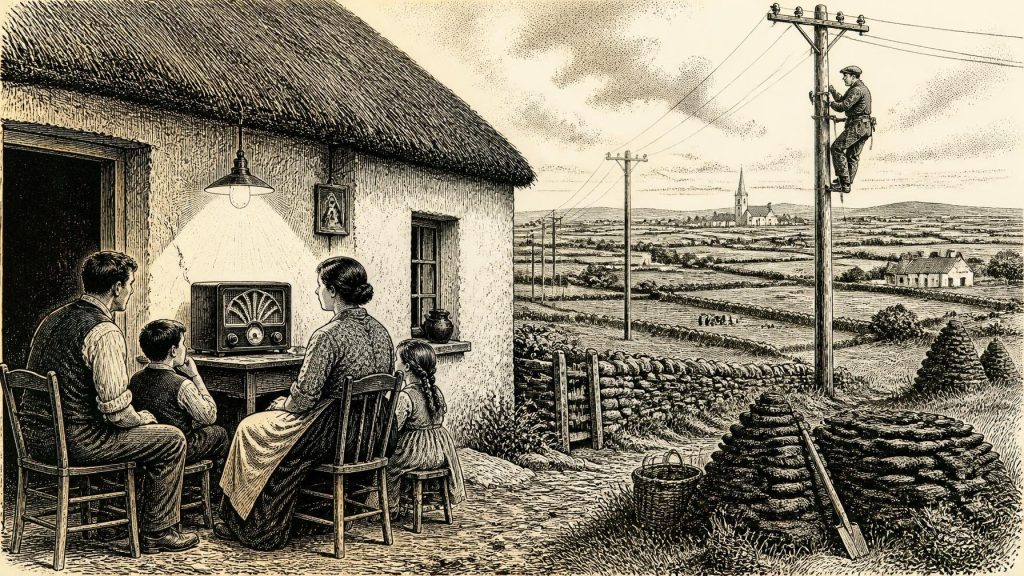
Rural modernisation continued unevenly. The ESB’s Rural Electrification Scheme, launched in 1946 and still being extended through the early 1950s, was gradually altering domestic routines and farm work wherever lines arrived. Electricity did not erase poverty or isolation, but it could change lighting, communications and the use of machinery. Peat remained important both as household fuel and as a national resource. A 1951 transport-works order under the Turf Development Act reflected Bord na Móna’s continuing work in the altered bog landscapes of the Midlands, where drainage, railways and mechanised extraction connected remote cutaway areas to wider systems of fuel supply.
An Arts Council in Law
One of the year’s more durable cultural developments was the Arts Act 1951. It established An Chomhairle Ealaíon, the Arts Council, after a report by the art historian Thomas Bodkin had warned that the arts in the twenty-six counties were suffering neglect. The Act gave the new body responsibility for stimulating public interest and improving standards in painting, sculpture, architecture, music, drama, literature, design and the applied arts. Patrick J. Little was appointed its Director on 4 December. The Council’s first full meeting would take place in January 1952, but its legal creation belonged firmly to 1951.
The Act represented a modest but consequential assertion that artistic life deserved public support. Its significance lay less in immediate transformation than in creating a permanent national institution. Irish culture also had an international dimension. In Paris, Samuel Beckett’s Molloy and Malone meurt were published in 1951 by Éditions de Minuit. Beckett was an Irish writer working in French, distant from the official cultural world of Dublin, but the appearance of these novels marked an important stage in a body of work that would become central to twentieth-century literature.
Northern Ireland’s October Poll
Partition remained the framework within which all these southern developments took place. Northern Ireland was governed through Stormont and sent members to Westminster, rather than participating in the Dublin election. At the United Kingdom general election of 25 October 1951, the Unionist Party won nine of Northern Ireland’s twelve seats, taking 59.4 per cent of the votes cast. Four Unionist candidates were returned unopposed, a reminder that electoral dominance was reinforced by the political geography of the province.
There were, nevertheless, important qualifications. Nationalists won Fermanagh and South Tyrone and Mid Ulster. In West Belfast, John Beattie of Irish Labour defeated the Unionist Thomas Teevan by only 25 votes. The result was an exceptionally close local contest, but the overall pattern confirmed Unionism’s commanding position. Thus Ireland in 1951 was not a single political arena: it was an island of linked yet separate jurisdictions, in which questions of welfare, culture and migration unfolded beside an unresolved constitutional division.
By the year’s end, the Mother and Child confrontation had revealed the limits placed on reform, the election had returned de Valera to office, and the census had registered a population scarcely growing at all. Yet 1951 was not solely a year of stasis. New welfare provisions, rural infrastructure and the foundation of the Arts Council pointed towards forms of change that would outlast the immediate crises. Their benefits, however, were distributed unevenly, and the pressures driving Irish men and women to seek futures elsewhere remained deeply embedded.
Primary Sources
- Census through History
- Census 1951 Volume 1 – Population, Area and Valuation of Each DED and Each Larger Unit of Area
- Census 1951 Volume 3 – Occupations, Industries and Industrial Status
- Census 1951 Volume 2 Part II – Ages and Conjugal Conditions, Classified by Occupations
- Dáil and Seanad Terms
- Committee on Finance: Vote 67—Health, 11 July 1950
- Health Bill, 1947—Second Stage, 1 May 1947
- Browne, Noel Christopher
- Church-State Relations and the Development of Irish Health Policy: The Mother-and-Child Scheme, 1944–53
- Mother and Child Scheme
- The Irish Economy During the Century After Partition
- Chronological Table of the Statutes (1951)
- Agricultural Workers (Weekly Half-Holidays) Bill, 1950—Second Stage
- Report – Appropriation Accounts 1951-1952
- Our Origins and Archive
- 60 Years of the Arts Council, 1952–2012
- Beckett, Samuel Barclay
- Samuel Beckett – Trinity Writers
- Rural Electrification
- The History of the ESB
- Turf Development Act, 1946
- Turf Development Act 1946: Statutory Instruments Made Under the Act
- 1951 Westminster Elections in Northern Ireland
- West Belfast 1950-1970
- National Archives of Ireland: Women in 20th-Century Ireland, 1922-1966