Maureen Flavin’s Weather Book1944 CE
During 1944, neutral Ireland endured Emergency shortages, rationing and transport disruption while remaining strategically entangled in the war. At Blacksod Point, Maureen Flavin’s weather observations assisted Allied forecasting before the Normandy landings, illustrating neutrality’s limits. De Valera rejected Allied demands to expel Axis diplomats, defending sovereignty amid espionage concerns and partition. Fianna Fáil won a Dáil majority in May. Children’s allowances began in August, easing family pressures. December’s Transport Act prepared Córas Iompair Éireann, while the Abbey staged Joseph Tomelty’s Belfast-set play, The End House. The year combined democratic continuity, cautious social reform and preparations for postwar reconstruction across Ireland.
Dateline
For Ireland, 1944 was a year in which distant war pressed unusually close to ordinary life. The state, officially neutral and still governed under the exceptional arrangements of the Emergency, faced the practical consequences of blockade, scarcity and military anxiety. At the same time, people voted in a decisive general election, a new children’s allowance began reaching households, and legislation prepared a major reorganisation of transport. One modest weather station on the far western edge of Mayo also became connected to the timing of the Normandy landings.
Blacksod and the Atlantic
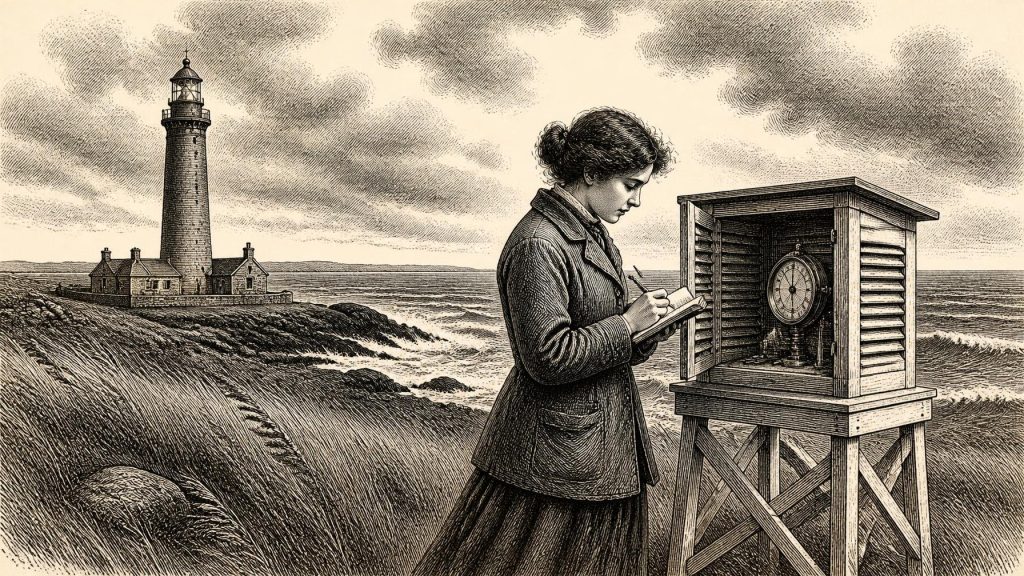
The year’s best-known Irish contribution to the wider war came from Blacksod Point on the Mullet Peninsula. In the early hours of 3 June, Maureen Flavin, later Maureen Sweeney, was on duty at the local post office and weather station. It was her twenty-first birthday. Her observation recorded worsening weather: rain and drizzle, a rapidly falling barometer and strong winds. Such readings from the exposed Atlantic coast were especially valuable because the behaviour of low-pressure systems west and north-west of Ireland was difficult for Allied forecasters to judge from the limited reports then available.
The Blacksod information did not, by itself, determine the Allied invasion of Normandy. It was one important item within a much larger forecasting effort involving British, American and naval meteorologists. Yet it supported the British assessment that conditions on 5 June would be unsuitable for a cross-Channel assault. General Dwight D. Eisenhower’s commanders provisionally postponed the operation by twenty-four hours. Reports from Blacksod on 4 June then showed pressure rising after a cold front had passed farther south than expected. A narrow weather window followed, and the Normandy landings went ahead on 6 June.
The episode captured an important paradox of Irish neutrality. Éire was outside the war, but its geography, communications and Atlantic weather placed it within the operational horizon of both sides. The weather station was a small civilian institution in an isolated community, not a military outpost. Nevertheless, its carefully recorded readings acquired international importance at a moment when the course of the European war hinged on wind, cloud, sea state and visibility.
Neutrality Under Pressure
Neutrality remained the central principle of Éamon de Valera’s government, but in 1944 it was tested by the approach of an Allied return to continental Europe. On 21 February, the American minister in Dublin, David Gray, delivered a strongly worded note asking that German and Japanese diplomatic and consular representatives be removed from Ireland. Washington and London feared that Axis missions in Dublin might facilitate espionage during the coming invasion. The request exposed the very different ways in which the Allies and the Irish government understood a neutral state’s obligations.
De Valera rejected the demand. In a formal reply delivered on 7 March, he argued that expelling accredited representatives of foreign states at another power’s request would be a first step towards war and a betrayal of Ireland’s neutral position. He maintained that the government had taken extensive measures against espionage, including holding the German minister’s wireless transmitter in official custody, and referred to suspected agents already in detention. These were the claims and arguments of the Irish government, not evidence that the Allies’ concern had disappeared. The disagreement left relations with the United States strained precisely as the Allied campaign in Europe entered its decisive phase.
The diplomatic clash was also inseparable from partition. Northern Ireland was part of the United Kingdom and fully committed to the Allied war effort; the twenty-six-county state insisted upon a separate foreign policy. The contrast made the island strategically sensitive. Irish neutrality did not mean insulation from the war, while the existence of the border made neutrality a question of sovereignty as well as security.
A Fresh Mandate
Domestic politics turned on 30 May, when the general election for the Twelfth Dáil was held. Fianna Fáil had governed as a minority after the election of June 1943. In 1944, de Valera secured the stronger mandate he had sought: Fianna Fáil won 76 of the 138 seats and 48.9 per cent of the vote. That total included the outgoing Ceann Comhairle, returned automatically under the electoral rules, but it still gave the party a clear working majority in the Dáil.
The opposition was divided. Fine Gael, led by Richard Mulcahy, took 30 seats. Labour’s wartime split was reflected in the returns: Labour won eight seats and National Labour four. Clann na Talmhan, the farmers’ party which had emerged from discontent in rural Ireland, won nine seats, while independents took eleven. The result did not remove the hardships of the Emergency, but it showed that many voters accepted the government’s claim to have protected the state’s independence in dangerous circumstances.
The election was held under emergency provisions designed to avoid a gap in parliamentary life during wartime. This mattered symbolically as well as administratively. Ireland’s democracy was operating with censorship, rationing, internment and extensive executive powers in the background, but the electorate still changed the composition of the Dáil through a competitive vote. The result strengthened de Valera’s authority at home while he defended a contested neutrality abroad.
Allowances and Austerity
One firmly dated social development came earlier in the year. The Children’s Allowances Act received the President’s signature on 23 February. It created a weekly payment of two shillings and sixpence for each qualified child beyond the first two, with a child defined as being under sixteen. The scheme was to be administered through claims, investigation and payment arrangements overseen by the Department of Industry and Commerce, with provision for payment through the Post Office. The first allowances became payable from 1 August to claimants who met the qualifying conditions on 1 May.
In a country where family budgets were under pressure, this was a substantial development in public provision for children. It did not transform the unequal distribution of income or relieve every household’s difficulties, but it established a regular state payment linked to family size. Its arrival during the Emergency gave it an immediate everyday significance: money could not conjure unavailable goods into the shops, yet it could help families meet the costs of food, clothing and fuel.
Scarcity shaped the rhythm of the year. Coal, turf, tea, bread, butter, margarine and soap were rationed or tightly controlled; eggs and imported fruit were difficult to obtain. Private motoring had largely vanished because petrol was unavailable. In April even the small petrol allocation still available to some doctors and clergy in urban areas was withdrawn. Bicycles, walking, horses, carts and limited public transport therefore mattered more than they had before the war. Turf, cut and transported under state-backed emergency schemes, was indispensable but could not simply reproduce the heat or convenience of imported coal.
Planning Beyond the Emergency
Wartime restriction also exposed the importance of transport networks. Trains could run irregularly on turf fuel, roads were poor, and the lack of petrol constrained buses, lorries and private vehicles alike. On 8 December the Transport Act provided for the incorporation of Córas Iompair Éireann and for the transfer of the Great Southern Railways Company and the Dublin United Transport Company to it. The new undertaking was not established during 1944 itself: the Act fixed 1 January 1945 as its establishment date. Still, the legislation was a significant year-end decision, placing rail, road and associated services on a new statutory footing for the postwar future.
This was not merely administrative housekeeping. The Emergency had made mobility a public problem: how could people reach work, markets, schools, hospitals and relatives when fuel and imported machinery were scarce? The answer was not yet modernisation in the later sense. It was consolidation, state direction and an attempt to preserve essential connections in a country whose economic life remained heavily dependent on transport by rail, road and sea.
A Stage Across the Border
Cultural life continued despite restrictions. On 28 August the Abbey Theatre in Dublin premiered The End House, a three-act play by the County Down writer Joseph Tomelty. Set around the Falls Road in Belfast and against the Royal Ulster Constabulary’s 1937 campaign against the IRA, it brought a northern urban story to the national theatre in Dublin. Its first production featured actors including Cyril Cusack, Denis O’Dea and Siobhán McKenna.
The play did not describe a new crisis in 1944; its dramatic setting looked back to an earlier episode. Its importance in that year lay instead in the cultural connection it made. At a time when wartime arrangements and partition divided political experience on the island, Tomelty’s Belfast-centred work placed working-class northern lives, policing and political violence before a Dublin audience.
Thus 1944 in Ireland combined unusually intimate and unusually global realities. A young observer’s weather notes at Blacksod helped forecasters assess an invasion across the Channel. In Dublin, a government won electoral endorsement while resisting Allied pressure over diplomacy. Families navigated ration books, fuel shortages and a new children’s payment; legislators set the groundwork for a new transport company; theatre kept difficult Irish histories in view. The Emergency was not over, but the year showed Ireland already preparing, cautiously and unevenly, for the world that would follow it.
Primary Sources
- Blacksod Point and the D-Day Forecast
- Forecasting Weather for D-Day Landings
- Foreign Relations of the United States, 1944, Volume III: The Acting Secretary of State to the Minister in Ireland, 8 March 1944
- Foreign Relations of the United States, 1944, Volume III: The Minister in Ireland to the Secretary of State, 21 February 1944
- Memorandum, Walshe to de Valera: Conference at the Dominions Office on Travel, Communication, Trade and Other Restrictions to be Placed on Ireland
- Éamon de Valera Papers: Descriptive Catalogue
- Irish Elections 1922–44: Results and Analysis
- Dáil Elections Since 1918
- Children's Allowances Act, 1944
- Children's Allowance Act, 1944 – No. 2 of 1944
- Report: Appropriation Accounts 1944–1945
- Chronological Table of the Statutes: 1944
- Transport Act, 1944
- Emergency Defence Plans
- World War II Unit Journals, 1939–1946
- Medals of the Irish Defence Forces
- Emergency Rations – An Irishman’s Diary on Christmas 1944
- Past Imperfect: Motoring During the Emergency
- Emergency Economics: Ireland During the Second World War
- The End House
- Joseph Tomelty
- Abbey Theatre Archive
- A Pictorial History of Óglaigh na hÉireann: The Emergency, 1939–1946