Rotunda, Ratebooks and Veld1899 CE
In 1899, Ireland saw institutional, cultural and political developments without resolving its constitutional future. Elections under the Local Government Act replaced grand-jury administration with elected county, rural and urban councils, widening participation though property restrictions remained. The Agriculture and Technical Instruction Act created a department to promote farming, fisheries, industry and education, associated with Horace Plunkett’s cooperative ideas. Dublin’s Irish Literary Theatre inaugurated productions amid controversy, while the Gaelic League’s Oireachtas demonstrated language-revival organisation. The Second Boer War exposed divided loyalties: Irish people served Britain, whereas nationalists supported the Boers. Together, these changes expanded Irish public life, debate and organisation.
Dateline
In 1899 Ireland did not experience a single rupture that settled its political future. Instead, the year brought a set of beginnings whose importance lay in the institutions, arguments and loyalties they exposed. Electors chose the first county and rural district councils under the new local-government system; Parliament created a department intended to reshape agricultural and technical life; Dublin audiences saw the first productions of the Irish Literary Theatre; and the war in South Africa gave Irish nationalists a new imperial conflict through which to express dissent. These developments did not point in one uncomplicated direction. They showed an Ireland still governed from Westminster, economically dependent upon farming and overseas markets, religiously diverse, and politically divided, but increasingly capable of organising its own public life.
County Government Takes the Field
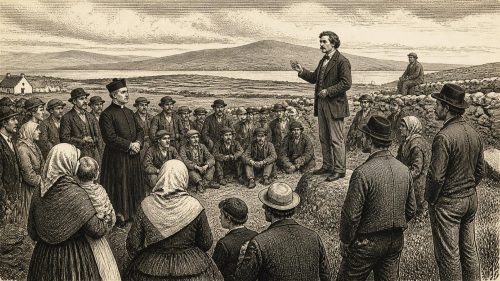
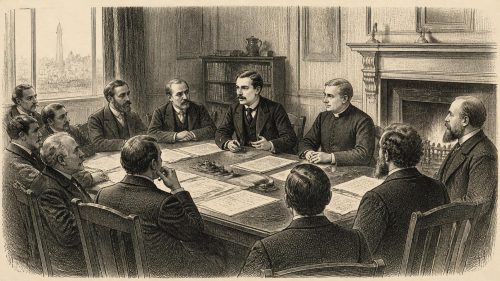
The most immediately tangible change came with the first elections held under the Local Government (Ireland) Act of 1898. On 6 April 1899, voters elected county councils and rural district councils across Ireland. The elections replaced the county grand juries, bodies dominated by large property holders and appointed magistrates, in many of their administrative roles. The reform also created urban district councils, producing a more coherent framework for local administration than the scattered older arrangements of grand juries, poor-law unions, town commissioners and borough corporations.
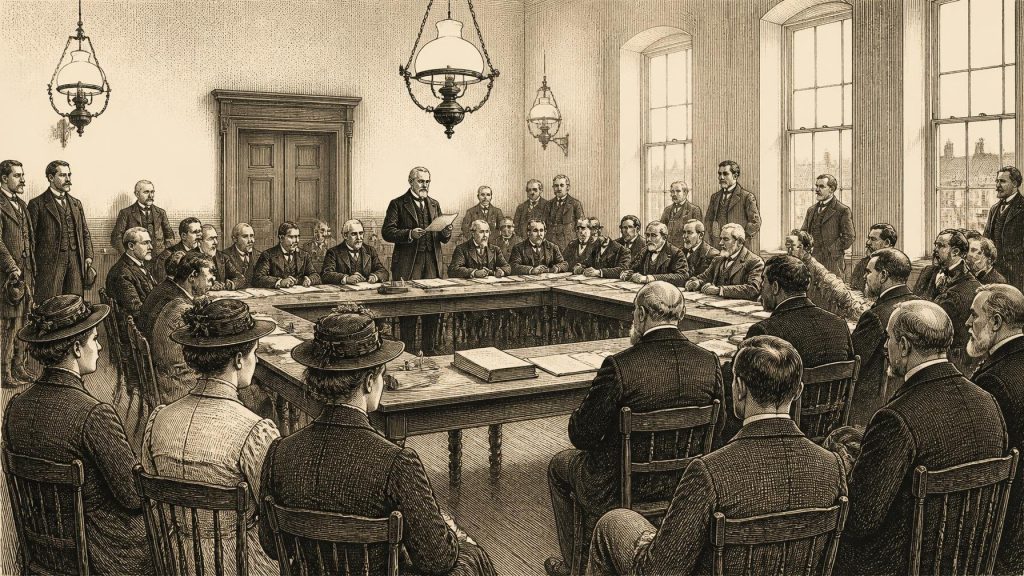
The new councils mattered because they brought questions of roads, bridges, rates, sanitation, local borrowing, public works and the supervision of county services nearer to elected representatives. Most county councils first assembled on 22 April. Their meetings were public, a significant alteration in political practice: ratepayers could now see discussions of expenditure and local priorities conducted in an elected chamber rather than largely through the older, socially restricted grand-jury system.
This was a major widening of participation, but not democracy in the modern universal sense. Men over twenty-one who were householders, or rented part of a house valued at at least £10 annually, could vote. Women over thirty who met the same property qualification could also vote; they could stand for rural and urban district councils, though eligibility for county councils was not yet extended to them. Since an agricultural labourer’s average annual wage was about £25, the qualification excluded many poorer households. Nevertheless, the elections made women visible as local electors and gave farmers, shopkeepers, tradesmen and professional people a substantially greater voice.
Nationalist candidates won roughly three-quarters of county-council seats. That result did not create Irish self-government: the island remained part of the United Kingdom and central government retained extensive authority. Nor did it erase regional difference. Unionism remained strong, particularly in the north-east. Yet the elections created local political platforms, networks and experience that would prove valuable to several later generations of Irish public figures. In 1899, the point was more immediate: political argument was now connected to the mundane but consequential business of maintaining a road, assessing a rate or deciding where scarce local money should be spent.
A Department for Rural Improvement
A second institutional landmark followed on 9 August, when the Agriculture and Technical Instruction (Ireland) Act received royal assent. The Act established the Department of Agriculture and other Industries and Technical Instruction for Ireland. The Chief Secretary for Ireland was its president, while a vice-president would direct its work; that arrangement simultaneously recognised Irish needs and kept the new body within the machinery of Dublin Castle and Westminster.
The department was intended to bring together responsibilities connected with agriculture, fisheries, animal disease, industrial development and technical education. Its remit reflected a widely held diagnosis of Ireland’s difficulties. The country’s economy remained heavily rural, and many reformers believed that farming families required not merely lower rents or land purchase, but better production, credit, marketing, training and organisation. The Act therefore represented a practical, developmental answer to questions often framed solely in constitutional terms.
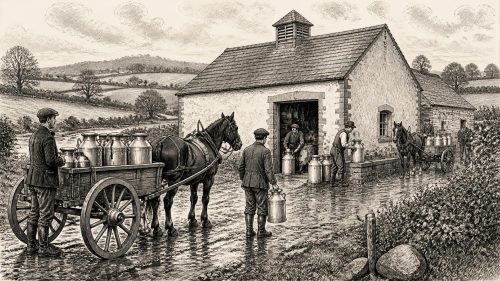
Sir Horace Plunkett was central to this approach. A unionist politician and advocate of agricultural co-operation, he had helped to promote creameries, credit societies, purchasing societies and other collective ventures through the Irish Agricultural Organisation Society. The movement was already substantial before the new department existed: a late-1898 assessment counted 243 societies with around 30,000 members. Such figures should be treated as the movement’s immediate background rather than as a tally produced during 1899 itself, but they show why official support now seemed plausible. Cooperative creameries and organised marketing promised small farmers more control over quality and access to markets than isolated household production could provide.
Plunkett’s appointment as vice-president was approved in early November 1899. His surviving diary conveys the unglamorous reality behind legislation: visitors seeking posts, committee meetings, work at Dublin Castle and efforts to establish an effective office. It also records his interest in associated credit for farmers. The new department did not instantly transform village life, nor could it solve congestion, poverty or emigration by administrative means. It did, however, mark a new willingness to make agriculture, industry and education matters of sustained public policy.
Stages, Songs and the Irish Language
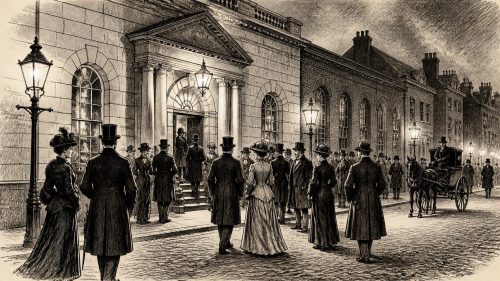
Institution-building was accompanied by a highly visible cultural revival. On 8 May, the Irish Literary Theatre gave its inaugural performance at the Antient Concert Rooms in Great Brunswick Street, Dublin, with W. B. Yeats’s The Countess Cathleen. Edward Martyn’s The Heather Field followed on 9 May. Lady Gregory had secured the temporary licence that made the venture possible, while Yeats, Martyn, Gregory and their associates sought to foster a serious Irish theatre rather than a stage dependent upon imported commercial fare.
The choice of Yeats’s drama ensured controversy. Its famine setting, folklore and supernatural bargain gave it an unmistakably Irish imaginative landscape, but its theological implications provoked objections from Catholic critics and students. Debate spread through newspapers, pamphlets and learned societies. That dispute was important not simply because audiences disagreed about a play. It revealed competing claims to define Irish identity: Catholic, national, literary, popular, Gaelic-speaking, English-speaking and modern. The production used professional actors from London, another reminder that the hoped-for national theatre was still more aspiration than settled institution. Even so, the performances began the short-lived Irish Literary Theatre experiment from which later theatrical developments would grow.
Yeats also published The Wind Among the Reeds in 1899, a collection steeped in Irish mythic names and landscapes. In the same year, Edith Somerville and Violet Martin, writing jointly as Somerville and Ross, published Some Experiences of an Irish R.M.. Their comic stories drew on the social frictions of the Irish countryside and the experiences of an English resident magistrate. These were very different literary visions: Yeats’s symbolic lyric world and Somerville and Ross’s observant comedy. Together they demonstrate that Irish writing in English could not be reduced to a single political or social outlook.
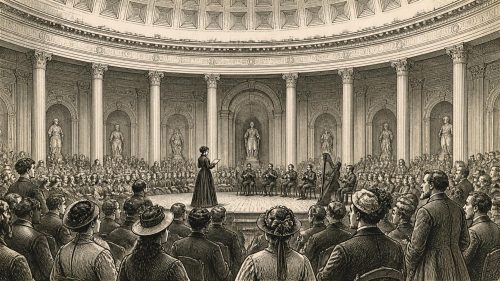
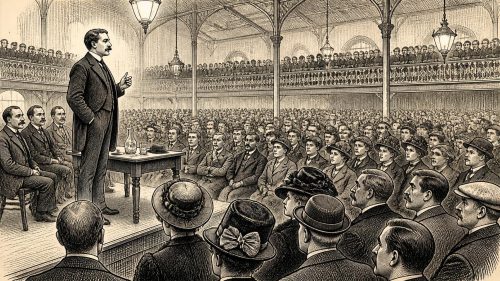
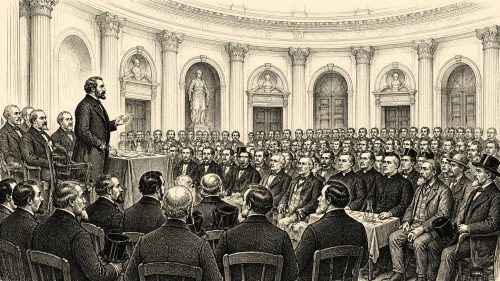
Irish-language activism had an equally public moment on 7 June. The third Oireachtas, organised by the Gaelic League, met at the Rotunda in Dublin. Competitions occupied the day, followed by a major evening gathering in the Round Room. Cardinal Michael Logue presided, while Douglas Hyde, president of the Gaelic League, and leading clerics, teachers and language advocates were among those present. The festival’s printed proceedings presented the earlier gatherings of 1897 and 1898 as experiments and proclaimed the Oireachtas an established institution. Such confidence was itself evidence of growing organisational capacity. Language revival was becoming not merely a programme of classes and publications but a public culture of music, recitation, competition, sociability and prestige.
South Africa and Divided Allegiances
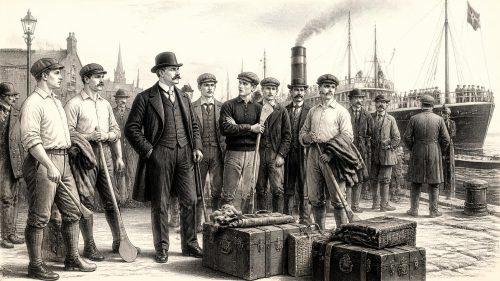
Events far from Ireland sharpened political feeling in the autumn. The Second Boer War began on 11 October 1899, between Britain and the Boer republics in southern Africa. Irish responses were divided. Many Irishmen served in the British army, including in Irish regiments, while advanced nationalists interpreted British policy towards the Transvaal and Orange Free State through their own experience of disputed sovereignty and imperial power.
That response had organised form even before the formal outbreak of war. The minute book of the Irish Transvaal Committee begins on 7 October 1899 and records a body formed to organise sympathy with the Boers. Its associated names included Maud Gonne, Arthur Griffith, John O’Leary, T. O’Neill Russell and William Redmond. In South Africa, John MacBride of Westport organised an Irish commando for service on the Boer side during the opening phase of the war. Neither pro-Boer activism nor military service under the British flag can be treated as the response of ‘Ireland’ as a whole. The contrast is the historical point: Irish political identity in 1899 could generate opposition to the Empire, participation in its forces, or simply concern for relatives and local communities caught up in its demands.
By year’s end, then, Ireland had acquired elected county institutions, a new developmental department, prominent cultural platforms and a fresh overseas controversy. None settled the constitutional question. But each enlarged the arena in which Irish people could argue about authority, livelihood, language and national allegiance. The practical world of council ratebooks and cooperative creameries stood beside the symbolic world of the Rotunda stage and the veld. That combination made 1899 a formative year: not a finished national turning point, but a year in which several future Irelands became more clearly imaginable.
Primary Sources
- Local Government (Ireland) Act, 1898
- Early Forms of Local Government: 125 Years of Irish Local Government
- 125 Years of Irish Local Government
- The First Local Government Elections, 1899
- Agriculture and Technical Instruction (Ireland) Act 1899
- 1899 Diary of Sir Horace Curzon Plunkett (1854–1932)
- Fifty Years of Irish Agriculture
- Agriculture Statistical Yearbook of Ireland 2017
- Agricultural Statistics (Ireland), House of Lords Debate, 11 July 1899
- Revival: The Abbey Theatre, Sinn Féin, The Gaelic League and the Co-operative Movement
- Proceedings of the Third Oireachtas Festival Held in 1899
- Conradh na Gaeilge Ard-Fheis Books & Reports
- Chapter I: The Theatre in the Making
- Our Irish Theatre
- Programme for Performances of The Countess Cathleen and The Heather Field Produced by the Irish Literary Theatre
- The Wind Among the Reeds
- Some Experiences of an Irish R.M.
- Minute Book of the Irish Transvaal Committee
- MacBride, John
- Ireland and the Second Boer War (1899–1902)
- Irish Settlement and Identity in South Africa Before 1910
- The Rhetoric of Conflict and Conflict by Rhetoric: Ireland and the Anglo-Boer War (1899–1902)