Davis and the Potato Rot1845 CE
In 1845, potato blight initiated Ireland’s Great Famine, although mortality remained limited compared with later years. Dependence on potatoes left labourers, cottiers and smallholders especially vulnerable, while food production continued beyond their purchasing power. Peel’s government commissioned scientific inquiries, secretly bought American maize, and linked the crisis to Corn Law repeal, but relief remained cautious. The Devon Commission documented insecure tenure and rural inequality. Educational reforms funding Maynooth and Queen’s Colleges provoked religious and nationalist disputes. Thomas Davis, Young Ireland’s inclusive cultural nationalist, died in September. By year’s end, blight, poverty, weak tenure and political division foreshadowed catastrophe to come.
Dateline
In 1845 Ireland stood at the edge of a disaster whose eventual scale nobody could yet measure. The year did not begin as a famine year. Politics still revolved around Daniel O’Connell’s weakened campaign to repeal the Union, Sir Robert Peel’s attempt to govern Ireland through reform, and fierce argument about religion, education and land. By the autumn, however, a new disease was turning apparently healthy potato fields black and rotten. For millions whose diet and fragile household economy rested upon that crop, the change was immediate and frightening. The Great Famine began with this first failure, but 1845 must not be confused with the years of greatest mortality that followed.
Two events in September gave the year a sombre symbolic character. Potato disease was reported publicly in early September and rapidly proved far more widespread than first hoped. On 16 September Thomas Davis, the poet, journalist and leading voice of Young Ireland, died in Dublin aged thirty. His death deprived Irish nationalism of an unusually inclusive and imaginative advocate just as the political questions he had helped to frame were about to be overwhelmed by the crisis of food, work and survival.
A Harvest Turns
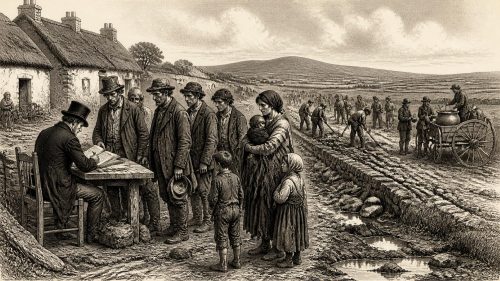
The potato was not Ireland’s only crop, nor was every Irish person dependent on it in the same way. Grain, livestock and dairy produce formed major commercial sectors, while townspeople, stronger farmers and many artisans had more varied diets. Yet for a vast rural population of labourers, cottiers and very small occupiers, potatoes supplied the essential daily food. A small plot, cultivated intensively, could sustain a family when wages were low, land access insecure and cash scarce. The same system left households exceptionally exposed when the crop failed. Potatoes also fed pigs and helped to support the small, interlocking economies of cabins, petty trade, rent payments and seasonal labour.
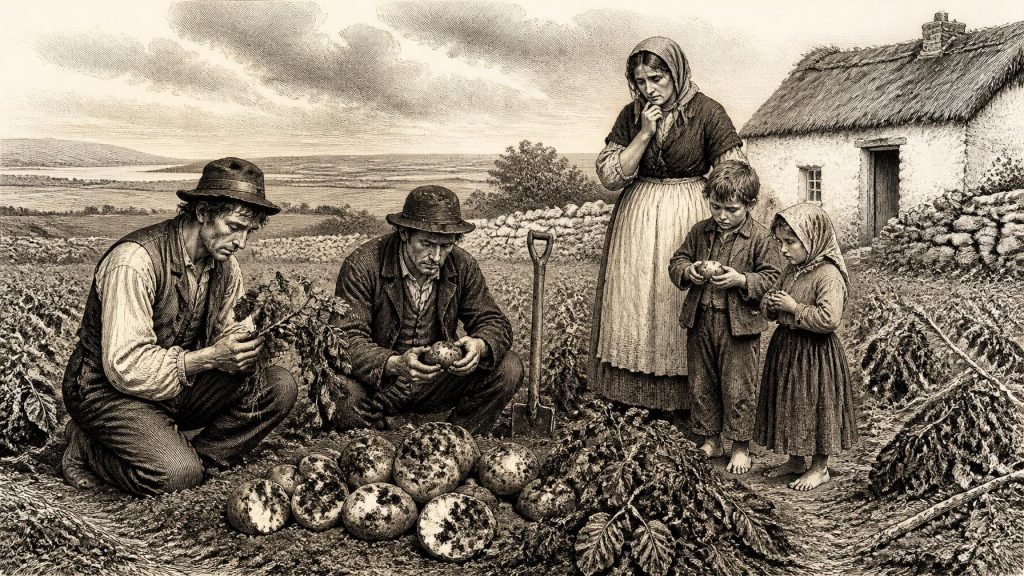
At the beginning of July the crop seemed promising. Then observers began to see an alarming decay in leaves and tubers. Reports reached newspapers in early September; samples of diseased potatoes arrived in Dublin from many districts. The organism now known as Phytophthora infestans spread in conditions favourable to blight, but contemporaries did not possess a secure explanation or a remedy. Some hoped the injury was local, weather-related or confined to particular varieties; others feared a calamity. The uncertainty mattered. Families had to decide whether to dig early, eat or sell doubtful potatoes, preserve seed, buy dearer food, or trust that the rot would stop.
The first failure was serious but uneven. Later historical estimates often put the loss at roughly a third of the harvest, while official contemporary assessments varied considerably. John Lindley and Lyon Playfair, sent with Robert Kane to investigate, reported on 15 November after inspecting fields and stores in parts of Leinster; they concluded that about half the crop was destroyed or unfit for human food. Their figure conveyed the menace, but it was an informed assessment rather than a complete agricultural census. What was already plain by the end of the year was that the poor were hit hardest: those who planted late, had least land and possessed no reserve of money or grain could least withstand even a partial loss.
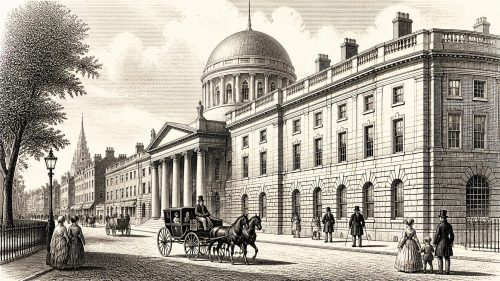
Warnings at Dublin Castle
Peel’s Conservative government did not ignore the reports. In October it appointed the scientific commission of Lindley, Playfair and Kane. The commission’s work reflects both the strengths and limits of mid-nineteenth-century administration: officials gathered evidence across counties and sought expert advice, yet knowledge of plant disease was incomplete and the mechanisms of rural vulnerability were much better described than repaired. The commissioners advised on storing and selecting potatoes, but their recommendations could not restore rotting food or guarantee healthy seed for the next planting.
Peel also treated the reports as a question of immediate government. On 10 November he ordered the secret purchase in North America of £100,000 worth of Indian corn, or maize, for Ireland. It was intended to supplement supplies and restrain exceptional price rises, not to replace the lost potato harvest. The secrecy showed his concern that public knowledge of state buying might fuel speculation and disrupt ordinary trade. It also revealed a government hesitating between emergency intervention and the prevailing belief that markets and local resources should remain central. The maize did not arrive in Ireland during 1845; its first shipments came in early 1846. In this year, the policy was a precaution whose adequacy could not yet be tested.
That caution had political consequences beyond Ireland. Peel’s conviction that grain imports must be made easier became bound up with his drive to repeal the Corn Laws, the protective duties on imported grain. The decisive parliamentary struggle lay in 1846, but the Irish crop failure was already central to his calculations in November and December 1845. In Ireland, meanwhile, the first blight coincided with a troubling fact: food continued to be produced and traded, yet much of it was beyond the purchasing power of those dependent on potatoes. The problem was not a simple absence of all food from the island; it was the collapse of the staple on which the poorest relied within an unequal rural economy.
Land Before Disaster
The year also produced a major official diagnosis of that rural economy. The Devon Commission’s report on the occupation of land in Ireland appeared in 1845 after extensive evidence from proprietors, agents, clergy, farmers and others. It recorded insecure tenures, small and subdivided holdings, and the importance of tenant-made improvements. In Ulster, it recognised the practical value of tenant right: a departing tenant could commonly receive payment for improvements or sell an interest in the holding. Comparable security was far less dependable elsewhere.
The report did not create a general legal tenant right, and its recommendations did not transform conditions before blight struck. Its importance in 1845 was diagnostic. It exposed how cultivation, housing and investment often depended on people who could lose their land without compensation, while landlords retained extensive power over rents and tenure. The potato disease therefore arrived not in a countryside of equal proprietors but in one marked by very different resources and bargaining power. Later arguments over land reform would return repeatedly to the evidence gathered by Devon’s commissioners.
Colleges, Churches and Contention
Peel’s Irish policy also made 1845 an important year for education. The Maynooth College Act received royal assent on 30 June. It reorganised the trusteeship of St Patrick’s College, Maynooth, and confirmed a much enlarged state endowment for the training of Catholic clergy. For Peel, support for Maynooth was part of an effort to conciliate Catholic Ireland and strengthen institutions capable of serving a rapidly growing population. To many Protestant opponents, however, the grant was an unacceptable public subsidy to the Catholic Church. Anti-Maynooth agitation demonstrated how readily reform could sharpen confessional distrust.
A second measure followed on 31 July: the Queen’s Colleges (Ireland) Act authorised state funding for new colleges, with up to £100,000 provided for buildings and establishment. The colleges envisaged for Belfast, Cork and Galway were designed to offer higher education beyond Trinity College Dublin and to admit students across religious divisions. Queen’s College Cork formally came into existence in December; the institutions would not open to students until 1849. Their creation nonetheless made 1845 a foundational year for the future universities of Belfast, Cork and Galway.
Mixed education divided nationalists as well as churches. Davis supported non-denominational colleges because he believed Irish nationality must include Catholics and Protestants rather than reproduce sectarian separation. O’Connell and Archbishop John MacHale opposed the proposed system, fearing that education without denominational control would endanger Catholic faith. Their disagreement was not a minor academic quarrel. It exposed a conflict between rival visions of Ireland: one centred on shared civic nationality, another on safeguarding a Catholic people long disadvantaged under Protestant ascendancy.
The Loss of Thomas Davis
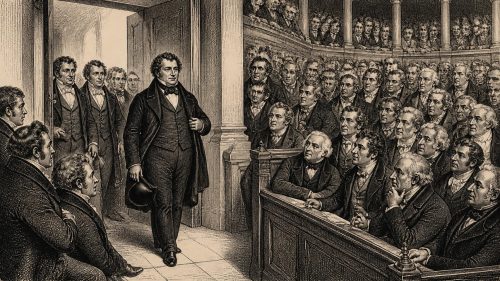
The dispute bitterly affected Davis. At Conciliation Hall in May, O’Connell publicly attacked him as sectarian, an accusation that wounded a writer who had worked to make Irish history, literature and political aspiration common ground. Through The Nation, founded in 1842 with Charles Gavan Duffy and John Blake Dillon, Davis had helped turn ballads, essays, antiquarian interest and political reporting into an energetic popular culture. His nationalism was constitutional and reforming, but it also gave Young Ireland a language more impatient and culturally expansive than O’Connell’s established leadership.
Davis continued writing during August. He died of scarlet fever at his mother’s home in Baggot Street on 16 September, and was buried at Mount Jerome. His funeral drew a large mourning procession. O’Connell himself recognised the loss, calling it a cruel blow to Irish nationality. Davis’s death did not cause the later division between Young Ireland and O’Connell, but it removed a potential mediator at a moment when the Repeal movement was already losing coherence and the food crisis demanded political imagination as well as relief.
An Unfinished Year
By December 1845, Ireland had not yet experienced the full catastrophe retrospectively associated with the Famine. There was no certainty that blight would recur, no mass programme of famine relief on the later scale, and no way for contemporaries to know how relentlessly the disease would return. But the foundations of calamity were visible: dependency on a single subsistence crop; poverty and weak tenure; uneven access to market food; contested institutions; and a state response that was active, yet cautious and limited. The year’s most durable image is therefore not one of sudden universal desolation, but of warnings accumulating while political and social structures proved unable to protect those with the least margin for failure.
Primary Sources
- Maynooth College Act 1845
- The Queen's Colleges (Ireland) Act 1845
- An Act to amend Two Acts passed in Ireland for the better Education of Persons professing the Roman Catholic Religion
- History
- Our History & Heritage
- University Governance
- The Foundation and Early Development of Queen’s College Belfast, 1845–1850
- Famine Records: Distress Papers and the Relief Commission
- Sources in the National Archives for Researching the Great Famine
- Researching the Irish Famine
- O'Connell, Daniel
- Davis, Thomas Osborne
- Mitchel, John
- Why Was the Potato So Important?
- Peel's Brimstone: the Temporary Relief Commission
- A Non-Famine History of Ireland?
- Food Exports from Ireland 1846–47
- Famine and Disease in Ireland
- Customs and Corn Importation Report
- Consolidated Annuities (Ireland)
- The Devon Commission, County Clare, 1845
- Tenure of Land (Ireland) Commission
- Population and Poverty in Ireland on the Eve of the Great Famine
- The Chemistry of Famine: Nutritional Controversies and the Irish Famine, c.1845–7
- The Great Hunger 1845–1850
- The Irish Crisis