Middlethird and the New Post Office1814 CE
In 1814, post-Union Ireland faced peace as Napoleon’s abdication altered wartime trade while rural poverty and land tensions persisted. Robert Peel’s government answered disturbances, notably in Tipperary’s Middlethird, with the Peace Preservation Act, creating salaried magistrates and constables and strengthened coercive powers against unlawful combinations. Catholic politics were divided over a proposed Crown veto on bishops, with Daniel O’Connell opposing state control; emancipation remained unresolved. Dublin saw Whitworth lay the General Post Office foundation stone and Chapel Royal inaugurated, while Belfast’s Academical Institution opened. Shaw Mason began his parochial survey, and the Apprentice Boys Club formed in Derry, reflecting division.
Dateline
In 1814 Ireland stood at an uneasy threshold. The European war that had shaped prices, trade, policing and political expectation for a generation appeared to be ending after Napoleon’s abdication in April and the first Treaty of Paris in May. Yet peace was not complete: Britain remained at war with the United States, and Napoleon’s final return was still to come. Within Ireland, the most firmly dated developments of the year were not celebrations of tranquillity but measures to impose it. New coercive legislation, a dispute over the freedom of the Catholic hierarchy, and conspicuous building projects in Dublin together revealed how government sought to make the post-Union state more secure, better connected and more visible.
Government Without an Irish Parliament
Ireland in 1814 was governed under the Union of 1801. Its parliament had disappeared, while Irish representatives sat at Westminster and executive authority was exercised through Dublin Castle in the name of the Lord Lieutenant, Charles Whitworth, Earl Whitworth. Robert Peel, Chief Secretary for Ireland since 1812, was the key minister responsible for daily Irish administration. He was only twenty-six when appointed, but in 1814 he drove measures which would have a long afterlife in the history of policing.
The constitutional setting mattered. Catholic emancipation had not been delivered with the Union, despite expectations raised at its inception. Most Irish Catholics remained excluded from Parliament and from important offices. The established Church of Ireland retained its privileged legal position, although its members were a minority of the population. Landed power, magistracy and local government also remained heavily Protestant and propertied. Government therefore faced a country in which political authority was distant from many of those governed, while rural life was vulnerable to disputes over rents, land, labour and customary access to resources.
Middlethird and the Peace Preservation Force
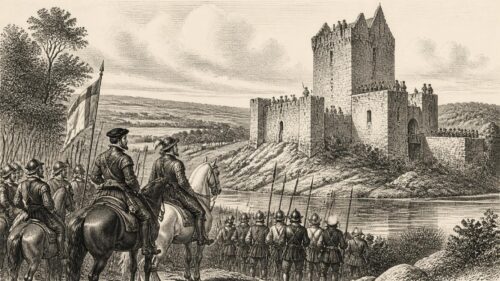
The clearest Irish political event of 1814 was the response to rural disturbance. In the spring and early summer, violence and intimidation in parts of the south-east and south persuaded Peel and the Dublin administration that the existing patchwork of local magistrates, baronial constables, militia and military detachments was inadequate. The disturbances should not be treated as a single national rising. They were local and varied, but they arose in a countryside where secret combinations, attacks on property, coercion of witnesses and conflict surrounding landholding could make ordinary law difficult to enforce.
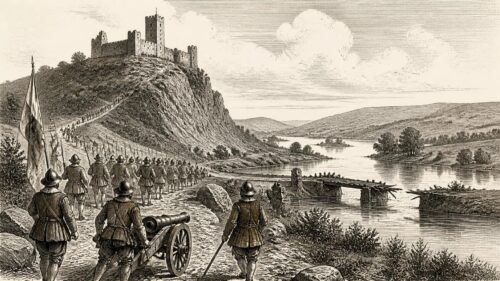
On 25 July Parliament passed the measure commonly called the Peace Preservation Act. Its formal title concerned the better execution of the laws in Ireland through superintending magistrates and additional constables. It allowed the Lord Lieutenant to proclaim an area disturbed and to send in a salaried chief or superintending magistrate with a chief constable and paid constables. The initial deployment was made in County Tipperary, including the barony of Middlethird. This was not yet a countrywide police service and it should not be confused with the Royal Irish Constabulary, which belonged to a later phase of the century. But it was a decisive experiment: a mobile force, directed from above and intended to operate where local civil power had failed.
Its character was revealing. The new force offered an alternative to calling out soldiers whenever disorder occurred, yet it was not politically neutral in the modern sense. Districts could be officially labelled disturbed; costs fell locally; and the system joined surveillance, magistracy and armed enforcement closely together. In later memory its men became associated with the name “Peelers”, after Peel. The force was subsequently overtaken by the county constabulary system of 1822 and then the Irish Constabulary, but 1814 supplied an important institutional starting point.
Parliament reinforced the approach days later with an Unlawful Combinations Act, often treated as a renewed Insurrection Act. The legislation enabled exceptional restrictions in proclaimed districts, including measures directed at assemblies and night movement. Such laws were presented by ministers as protection for life and property. Their recurrence also showed the limits of a state which claimed stability while repeatedly finding ordinary local institutions insufficient. For poor rural households, the official language of crime and conspiracy sat beside more immediate anxieties: insecure holdings, seasonal work, high rents and the uneven distribution of power in the countryside.
Peace Abroad, Anxiety at Home
The European events of 1814 were directly relevant to Ireland. Wartime demand had encouraged tillage, raised grain prices and made Ireland an important supplier of foodstuffs to Britain’s war economy. Export ports, merchants, graziers, farmers and landlords had all benefited unevenly from the long conflict. Cork’s provisioning trade and the wider commerce in grain, butter, livestock and linen were tied to imperial markets and naval requirements. The end of the continental war therefore brought both relief and uncertainty.
It would be misleading to place the full post-war agricultural depression in 1814. The major collapse in prices and the severe social consequences associated with the years after 1815 lay ahead. Nevertheless, contemporaries in 1814 could see that the extraordinary conditions which had sustained high prices could not last indefinitely. Ireland’s population was growing, small holdings were widely subdivided, and many labourers depended on a precarious mixture of potato cultivation, seasonal employment and casual earnings. The island’s apparent wartime prosperity was real in some sectors, but it did not remove entrenched poverty or make rural society less combustible.
The Catholic Veto Dispute
Religion and politics became particularly entangled in the controversy over a proposed Crown “veto” on Catholic episcopal appointments. Advocates of Catholic relief hoped that concessions over the appointment of bishops might reassure the British state of Catholic loyalty. Opponents feared that any governmental role in the selection of bishops would compromise the independence of the Church. The issue was therefore not a technical quarrel alone: it concerned who could speak for Irish Catholics and whether civil equality could be purchased at the cost of state influence over ecclesiastical life.
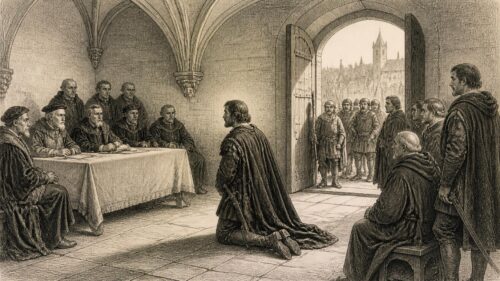
In February 1814 Monsignor Giovanni Battista Quarantotti, acting for the Roman Congregation of Propaganda, issued a rescript which rejected some proposed arrangements but suggested that securities for the loyalty of bishops might be permissible. It caused a fierce reaction in Ireland. The Irish bishops and many clergy and lay campaigners opposed the veto, while Daniel O’Connell was prominent among those determined that emancipation should not bring state control of the Catholic hierarchy. Westminster debates in April and May demonstrated that British legislators continued to regard Catholic admission to Parliament as a question of state security as well as religious liberty.
No emancipation settlement emerged in 1814. The episode instead deepened divisions between Irish Catholic opinion, Catholic advocates in Britain and officials in Rome, whose circumstances had been transformed by Napoleon’s defeat and the restoration of papal authority. In Ireland, it helped strengthen a more assertive Catholic political culture: one prepared to demand civil rights while resisting arrangements seen as subordinating the Church to Dublin Castle or Westminster.
Stone, School and Survey
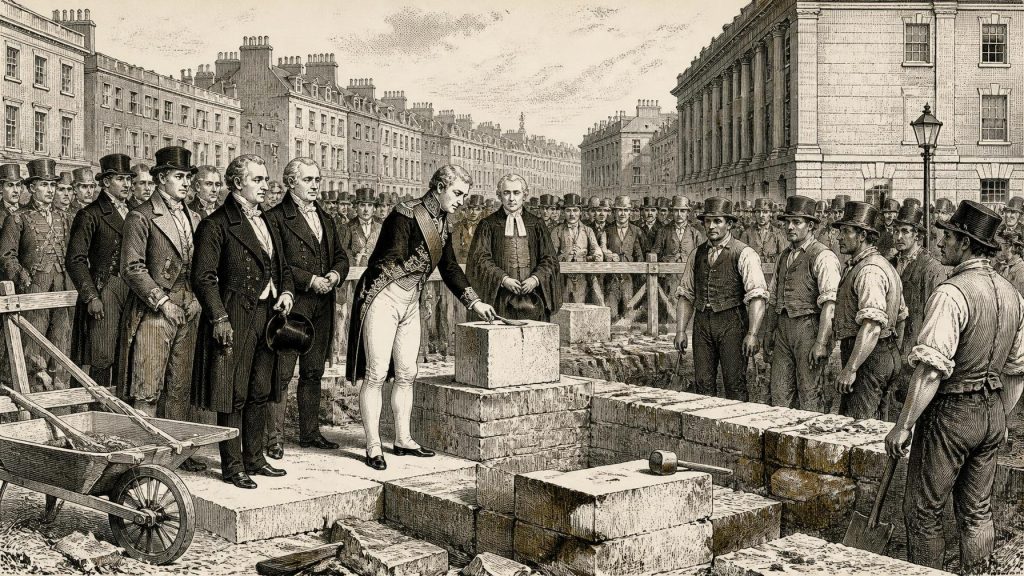
State and civic ambition were also expressed in buildings and institutions. On 12 August, Lord Whitworth laid the foundation stone of Dublin’s new General Post Office on Sackville Street. The architect was Francis Johnston, already a major figure in Irish public architecture. The building would not open for business until January 1818, so its later fame must not be read back into the ceremony. In 1814 it was a construction project, attended by the Irish postmasters general, promising a grander centre for the movement of letters, official information and commercial news through the capital and beyond.
Johnston’s Chapel Royal at Dublin Castle was inaugurated on Christmas Day. This Gothic Revival chapel served the Church of Ireland household of the Lord Lieutenant and gave ceremonial form to the religious establishment at the heart of government. The new chapel and the future post office made different claims for authority: one sacred and viceregal, the other administrative and commercial. Both, however, altered the urban face of a city whose political importance had been reduced by the Union but which remained the seat of Irish executive government.
In Belfast, the Belfast Academical Institution opened its school department on 1 February. Its founders, among them the physician and reformer William Drennan, aimed to provide practical and advanced education for a growing mercantile town. The collegiate department was to follow in 1815. Its opening did not erase religious divisions, but it represented the educational confidence of a town whose linen manufacture, commerce and population were expanding rapidly.
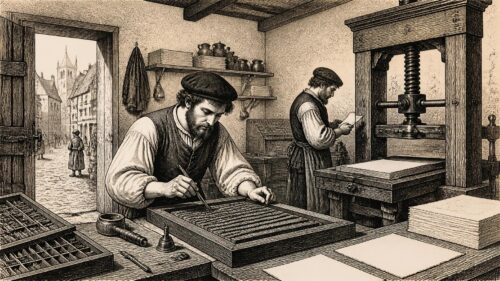
Another 1814 publication captured a different ambition to know and classify the country. William Shaw Mason issued the first volume of A Statistical Account, or Parochial Survey of Ireland, compiled from reports supplied by clergy. The work recorded parishes, land use, crops, population, schools, religious arrangements, manufactures and local poverty. It was not an impartial census: its clerical contributors brought their own priorities and blind spots. Yet its appearance marked an important effort to render Ireland legible through local observation, at precisely the moment when officials were expanding their instruments of order.
Memory and Division in Derry
In Derry, the Apprentice Boys of Derry Club was established in 1814, drawing on much older commemorations of the 1688–89 siege. The date requires care: earlier Apprentice Boys associations and siege celebrations had existed, but the organisation from which the present body developed dates to this period. Its formation shows that the Ireland of 1814 was not defined only by Catholic mobilisation. Protestant collective memory, especially in Ulster, was also being organised through associations, anniversaries and the public remembrance of siege, loyalty and resistance.
Thus 1814 was a year of beginnings rather than resolution. A force first sent into disturbed Tipperary anticipated a more centralised system of rural policing. A disputed Roman rescript exposed the difficulty of reconciling Catholic equality with state demands for control. New buildings in Dublin and a new institution in Belfast projected improvement, communication and learning. Beneath them all lay a society whose wartime economy was changing, whose communities remembered different pasts, and whose political future remained unsettled.
Primary Sources
- Irish Statute Book: 1814 (54 Geo. 3)
- The Office of the Chief Secretary of Ireland: Chronology
- National Archives of Ireland: Law and Order, Policing
- Preserving the Peace
- Irish Peace Preservation Bill, 11 March 1817
- Roman Catholics, 17 May 1814
- Mr. Speaker’s Speech to the Prince Regent, 22 April 1814
- Rural Disorder and Police Reform in Ireland, 1812–36
- Courting the Past
- The GPO – Two Hundred Years
- Dictionary of Irish Architects: General Post Office, Dublin
- View of the General Post Office (GPO), O’Connell Street Dublin
- Our History: Royal Belfast Academical Institution
- Royal Belfast Academical Institution
- History of the School of Medicine, Dentistry and Biomedical Sciences
- A Statistical Account, Or Parochial Survey of Ireland, Volume 1
- Irish History Online: A Statistical Account or Parochial Survey of Ireland
- Reform, Religion, and Radicalism
- Problems of Church and State in Canada and Ireland, 1790 to 1815
- The Royal Veto
- The Political Economy of Ireland and its Counterfactuals
- The Granary of Great Britain
- ‘Wholesome Regulation and Unlimited Freedom’: Governing Market Space in Southern Ireland Before the Famine
- The Apprentice Boys of Derry Clubs
- The Sieges of Derry
- The Choral Foundation of the Chapel Royal, Dublin Castle