O’Connell’s County Circular1810 CE
In 1810, nine years after Union, Ireland’s Catholics remained excluded from Parliament and offices despite earlier relief. Henry Grattan’s unsuccessful Westminster initiative exposed disputes over a proposed veto on episcopal appointments. Daniel O’Connell, opposing such control, issued a Dublin circular encouraging county committees to correspond with the Catholic Committee, strengthening constitutional, national organisation. Authorities nevertheless feared representative associations under the Convention Act. Parliament’s Unlawful Oaths (Ireland) Act punished coercive combinations amid rural insecurity. Meanwhile, agriculture dominated livelihoods, while Ulster linen connected production and Belfast commerce to wartime markets. Print, learned culture and Irish historical interests accompanied a contested public life.
Dateline
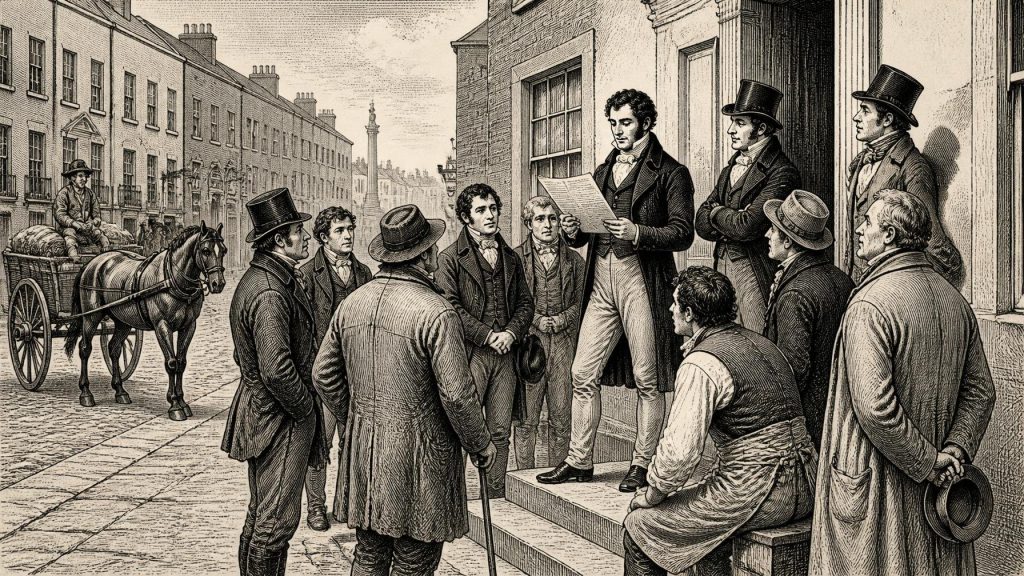
In 1810 Ireland was nine years into the United Kingdom created by the Act of Union, yet the island’s most important political question remained unresolved: whether the Catholic majority could obtain the full civil and parliamentary rights still withheld from it. This was not a year of rebellion or constitutional settlement. Its significance lay instead in organisation. Daniel O’Connell, a Kerry-born Catholic barrister practising in Dublin, helped turn an intermittent campaign of petitions led by nobles and bishops into a more connected public movement. His circular inviting county committees to correspond with the Dublin Catholic Committee marked a consequential attempt to give the cause a durable national machinery.
That initiative unfolded amid a wider atmosphere of wartime anxiety. Britain remained at war with Napoleonic France, and Ireland’s administration was alert to any organisation it could construe as disorderly, secret or disloyal. The same year therefore produced two sharply contrasting political developments: a renewed, public effort to press Catholic claims through constitutional means, and a coercive statute directed against unlawful oaths and clandestine associations. The contrast reveals much about Ireland in 1810: political association was becoming more important, but its acceptable limits were closely policed.
Government After the Union
Ireland had no longer possessed its own parliament since 1801. Irish affairs were managed through the Lord Lieutenant in Dublin Castle, the Chief Secretary and the Westminster parliament, where Ireland returned members but where Catholics could not sit. The Lord Lieutenant in 1810 was Charles Lennox, fourth Duke of Richmond; William Wellesley-Pole was Chief Secretary. Decisions affecting Irish religion, security and trade were thus made within a United Kingdom framework, while day-to-day administration still depended heavily on local magistrates, grand juries, landlords, clergy and municipal corporations.
For Catholics, the gains of the relief legislation of the late eighteenth century were substantial but incomplete. Catholic men meeting the property qualification could vote, Catholics could serve in a range of occupations, and the old penal code had been much reduced. But they remained excluded from parliament and from important offices. The political weight of the Catholic population was therefore not matched by equal access to the state. This disparity made petitions, meetings, newspapers, lawyers and personal networks exceptionally important. They supplied a means of political expression to people who, in the decisive constitutional arena, were still shut out.
In Westminster, Henry Grattan continued to advocate Catholic relief. On 18 May 1810 he moved that the Roman Catholic petitions be referred to a committee. The debate showed how closely the question of civil equality had become tied to the proposed ‘veto’ or to related schemes of domestic nomination: safeguards intended to give the Crown influence over the appointment of Catholic bishops. Grattan argued that an arrangement preserving Catholic spiritual authority while satisfying political concerns was possible. Opponents answered that relief could not safely be separated from protections for the Protestant establishment and the state. No parliamentary breakthrough followed in 1810.
The Veto and Catholic Independence
The argument over episcopal appointment was not a technical side issue. It raised a fundamental question: could Catholics gain emancipation if the British government acquired a recognised role in shaping their hierarchy? Some leading Catholic laymen and clerics were willing to consider an accommodation, believing it might remove a central objection to relief. Others regarded any governmental veto as an intolerable intrusion into church independence. The dispute crossed distinctions of rank, region and ecclesiastical office, and it complicated a movement that sought to speak for Catholics collectively.
O’Connell belonged emphatically to the anti-veto tendency. In 1810 he was not yet the universally acknowledged ‘Liberator’ of later memory, nor had he entered parliament; that lay far in the future. But his legal skill, forceful public language and distrust of concessions attached to Catholic rights were already increasing his influence. His position helped redefine the campaign. Emancipation was not to be treated as a favour purchased by controls over religion, but as a civil right to be claimed without conditions.
This principle had practical consequences. A movement dominated only by aristocratic Catholic figures could negotiate discreetly with ministers. A movement supported by organised local committees could instead publicise grievances, collect subscriptions, encourage petitions and make political leaders answerable to a wider constituency. Such activity also gave the Catholic cause a new social range, drawing particular energy from urban professionals, merchants, traders and provincial activists as well as from established Catholic gentry.
A Circular Across the Counties
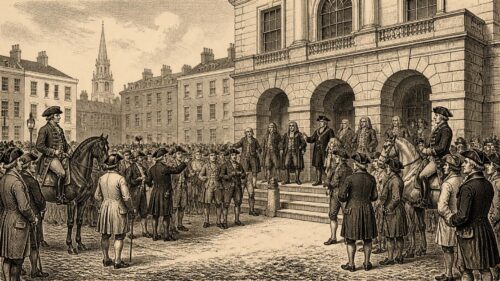
During 1810 O’Connell issued a circular from Dublin calling upon Catholics to establish local committees in correspondence with the central body. The exact rhythm and success of this effort varied from county to county, and it would be misleading to picture a modern mass-membership organisation suddenly appearing across Ireland. Communications were slow, local influence mattered greatly, and many people remained outside formal political activity. Nevertheless, the circular was important because it articulated a national ambition: that Catholic opinion in separate localities could be linked, reported and mobilised.
The initiative also exposed the legal vulnerability of collective politics. The Convention Act of 1793 had been designed to prevent representative bodies that might rival parliament. Authorities feared that county delegates or committees could amount to an unlawful convention, whatever their stated peaceful purpose. The ensuing friction was not simply a disagreement about procedure. It concerned who could legitimately claim to represent Ireland’s Catholics, and whether a community excluded from parliament could organise a public substitute for parliamentary voice.
Government suspicion did not erase the distinction between O’Connell’s constitutional agitation and clandestine violence. The Catholic Committee petitioned, debated and corresponded openly; its leaders sought to use law and public opinion. Yet officials could still regard extensive organisation as a political danger. That tension would remain central to Irish public life for decades: associations repeatedly tried to operate within the law, while governments repeatedly tested, restricted or dissolved them.
Unlawful Oaths and Rural Insecurity
On 20 June 1810 the Westminster parliament passed the Unlawful Oaths (Ireland) Act. Its wording was sweeping. It targeted oaths binding people to associations formed for seditious purposes, breaches of the peace, injury to persons or property, coercion, obedience to an unauthorised leader or committee, or silence about illegal acts. Administering such an oath was made a felony punishable by transportation for life; taking one carried transportation for seven years.
The Act belongs to the history of rural insecurity and of the state’s fear of oath-bound combinations. Long before 1810, parts of Ireland had experienced agrarian protest expressed through nocturnal assemblies, intimidation, threatening notices and attacks on property. These were not a single uniform movement, and labels such as Whiteboy, Ribbonman or Rockite were often used loosely by contemporaries and later commentators. It is therefore safer not to assign every local outrage to one named society. What can be said firmly is that the 1810 statute armed magistrates and prosecutors against the methods—secrecy, coercive oaths and collective intimidation—that officials associated with such unrest.
The severity of transportation sentences demonstrates the coercive reach of the post-Union state. For a poor household, accusation, imprisonment, the expense of legal defence or the removal of a family member could be devastating. The law’s offer of protection to magistrates and witnesses likewise indicates official concern that ordinary people might be afraid to inform against neighbours or local leaders. Public constitutional petitioning and clandestine rural coercion were very different forms of collective action, but the government encountered both through the shared language of association, loyalty and public order.
Work, Markets and Uneven Change
Most Irish people still lived by agriculture, labouring on farms or cultivating small holdings whose security could be precarious. Potatoes were essential to the diet of many poorer households, alongside oats, milk and other locally available food, but Ireland in 1810 should not be reduced to a later famine stereotype. The island’s economy was regionally varied, tied to wartime markets and increasingly connected to Britain through the Union. Cattle, grain, provisions and linen moved through ports; rents, credit and seasonal employment shaped daily choices in the countryside.
Ulster’s linen economy provides a particularly clear view of that connected world. Production was still largely domestic in the early nineteenth century. Flax was grown and prepared; women commonly spun yarn in farm households; weavers turned it into cloth; bleachers, drapers and merchants supplied the capital and marketing networks. Belfast was already an important commercial centre, its White Linen Hall helping northern producers deal with traders and assemble export cargoes. A later compilation of official figures records 36,898,270 yards of woven Irish linen exported in 1810—32,584,545 yards to Great Britain and 4,313,725 to foreign destinations. The figures convey scale, but not prosperity shared equally by all who made the cloth.
Indeed, linen linked household labour to distant markets without making rural life secure. A spinner’s work could fit around other domestic tasks, yet earnings depended on intermediaries, prices and demand beyond the household’s control. Belfast also had a growing cotton sector, where mechanised spinning was beginning to alter employment and urban life. The industrial future associated with nineteenth-century Belfast was not fully formed in 1810, but the contrast between commercialising north-eastern towns and the overwhelmingly agrarian character of much of the island was already visible.
Learning, Memory and a Changing Public
Political mobilisation depended upon literacy, print and educated intermediaries, even though access to schooling remained uneven. Dublin and Belfast supported newspapers, debating culture, learned societies and commercial publishing; provincial towns had printers, bookshops, inns and market spaces through which news travelled. Irish remained a principal everyday language in many districts, while English increasingly dominated administration, law and much public print. The political language of petitions and committees thus operated alongside multilingual local worlds that were not easily captured in official records.
On 12 April 1810 Joseph Cooper Walker, the Dublin-born antiquary and an original member of the Royal Irish Academy, died in County Wicklow. Walker’s death was not a national political event, but it offers a useful cultural marker. His work on Irish bards, music, dress and antiquities belonged to the sustained eighteenth- and early nineteenth-century effort to collect, interpret and sometimes romanticise Ireland’s past. In a year when Catholics were attempting to organise their political future, learned writers and institutions also continued to shape arguments about the island’s historical identity.
Thus 1810 did not deliver emancipation, a new constitution or a decisive uprising. Its importance was preparatory. Grattan’s parliamentary effort made the limits of reform plain; the veto dispute made Catholic independence a central issue; O’Connell’s county circular pointed towards a broader political public; and the Unlawful Oaths Act displayed the state’s readiness to punish feared forms of association. Ireland entered the new decade with its public life becoming more organised, more contested and more difficult for government to contain.
Primary Sources
- The Unlawful Oaths (Ireland) Act 1810
- Roman Catholic Petitions, 18 May 1810
- Roman Catholic Petition—Adjourned Debate, 1 June 1810
- Substance of the Speech of Sir John Cox Hippisley, Bart. on Seconding the Motion of Henry Grattan, 18 May 1810
- The Office of the Chief Secretary of Ireland: Chronology
- Daniel O’Connell and the Road to Emancipation 1810–1829
- New History of Ireland, Volume V: Ireland Under the Union, I: 1801–1870
- Daniel O’Connell
- The Proceedings of the General Committee of the Catholics of Ireland, Compared with the Proceedings of the Catholic Committee Which Sat in Dublin in 1810 and 1811
- Daniel O’Connell and the Catholic Committee
- The Belfast Linen Industry
- Documents Relating to Linen and Hempen Manufacture
- The Industrial Resources of Ireland, Part 8
- Silk and Wool
- Irish Agriculture: A Price History, from the Mid-eighteenth Century to the Eve of the First World War
- A Chronology of Ireland
- Secret Societies of Ireland: Content of the Registered Papers 1818–1833
- Walker, Joseph Cooper
- Joseph Cooper Walker
- Eighteenth Annual Report of the Registrar-General of Marriages, Births, and Deaths in Ireland, 1881
- The Belfast Monthly Magazine
- The Proceedings of the General Committee of the Roman Catholics of Ireland in 1792 and 1793 Compared with the Proceedings of the Roman Catholic Committee in 1810 and 1811