Maynooth, Diamond and Recall1795 CE
In 1795, wartime Ireland experienced reform, concession and sectarian conflict within its subordinate relationship to Britain. Lord Fitzwilliam’s arrival encouraged Catholic hopes of parliamentary admission, but London recalled him and defeated Grattan’s bill, undermining constitutional reform. United Irish leaders consequently moved further towards clandestine republicanism; Wolfe Tone departed for America seeking French support. Parliament nevertheless founded St Patrick’s College, Maynooth, to train Catholic clergy domestically. In County Armagh, the Battle of the Diamond confirmed Protestant dominance and prompted the formation of the Orange Order, followed by expulsions of Catholics. Routine infrastructure, legal and trade measures continued amid insecurity and polarisation.
Dateline
A Year of Reversed Expectations
In 1795 the Kingdom of Ireland remained constitutionally separate from Great Britain, with its own parliament in Dublin, but it was governed within the British imperial state and during a European war against revolutionary France. The year was not yet one of general rebellion. Rather, it was a year in which hopes of reform were dramatically raised, then withdrawn; in which a new Catholic college was legally founded; and in which local violence in County Armagh gave institutional form to a durable Protestant association. These developments did not cause every later crisis by themselves, but together they made the political atmosphere markedly more fearful, divided and combustible.
Ireland’s social order was unequal in both law and practice. The established Church of Ireland served a minority; Catholics formed the great majority of the population; and Presbyterians were numerous, especially in Ulster. The Catholic Relief Act of 1793 had enfranchised many Catholic forty-shilling freeholders and opened some professions, but Catholics still could not sit in parliament or hold the highest offices. The Irish House of Commons itself was overwhelmingly Protestant, narrow in franchise and shaped by patronage. Meanwhile, wartime government regarded French revolutionary ideas, radical print and voluntary political organisation as possible channels of invasion or insurrection.
Fitzwilliam’s Brief Viceroyalty
Lord Fitzwilliam arrived in Dublin as lord lieutenant in January 1795. His appointment produced genuine excitement among Catholics and reform-minded Protestants. A Whig grandee with Irish estates, he believed that concessions could steady Ireland and reduce the attraction of revolutionary politics. He dismissed prominent figures identified with the existing Castle system, notably John Beresford, and gave Henry Grattan reason to expect support for legislation allowing Catholics to sit in the Irish parliament.
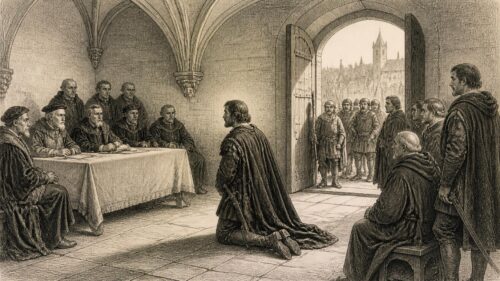
That expectation mattered well beyond the chambers of College Green. Catholic leaders had pursued relief through petitions, meetings and loyal declarations rather than through revolution. On 12 February Grattan introduced his Catholic relief bill. The measure proposed admission to parliament, not a democratic transformation of the representative system; nevertheless, it challenged a central boundary of Protestant ascendancy. Its opponents, including Lord Chancellor John FitzGibbon, saw the proposal as a threat to the established constitution and property settlement. Ministers in London, already fighting France, were unwilling to permit such a change.
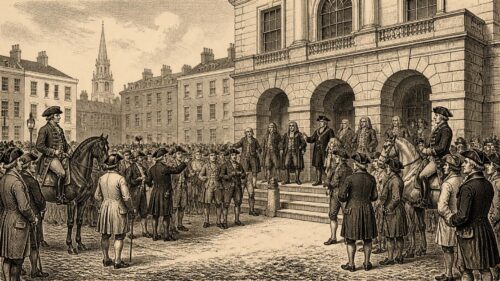
Fitzwilliam had moved more openly and more rapidly than the British cabinet authorised. His recall was set in motion within days of Grattan’s initiative. News of it provoked alarm and demonstrations in Dublin: on 27 February, according to the record of Catholic leader Edward Byrne, about 4,000 people met at Francis Street Chapel to protest. Fitzwilliam left Ireland on 25 March amid an unusually emotional public farewell. The bill did not pass. The episode left reformers with a sharp lesson: ministerial encouragement in Dublin could be overruled from London, while the Irish parliament’s structure remained intact.
The replacement, John Jeffreys Pratt, second Earl Camden, represented a different governing temper. His administration restored the political predominance of those whom Fitzwilliam had displaced and treated Catholic parliamentary admission as a danger rather than a remedy. It would be too simple to say that all Catholics, or all reformers, therefore embraced revolution in 1795. Many continued to seek constitutional redress. But the recall damaged confidence in gradual reform at precisely the moment when the United Irish movement was reconsidering its strategy.
Tone’s Departure and a Secret Cause
The United Irishmen had begun in 1791 as an association seeking parliamentary reform and a political union of “Catholic, Protestant and Dissenter”. By 1795 it had been driven underground. Government repression after the outbreak of war had made open organising hazardous, while the failed reform moment persuaded some leaders that a wholly independent Irish republic, aided by France, was the only remaining prospect.
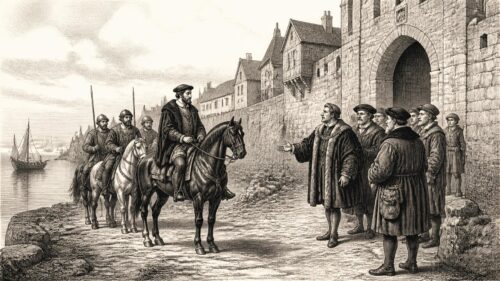
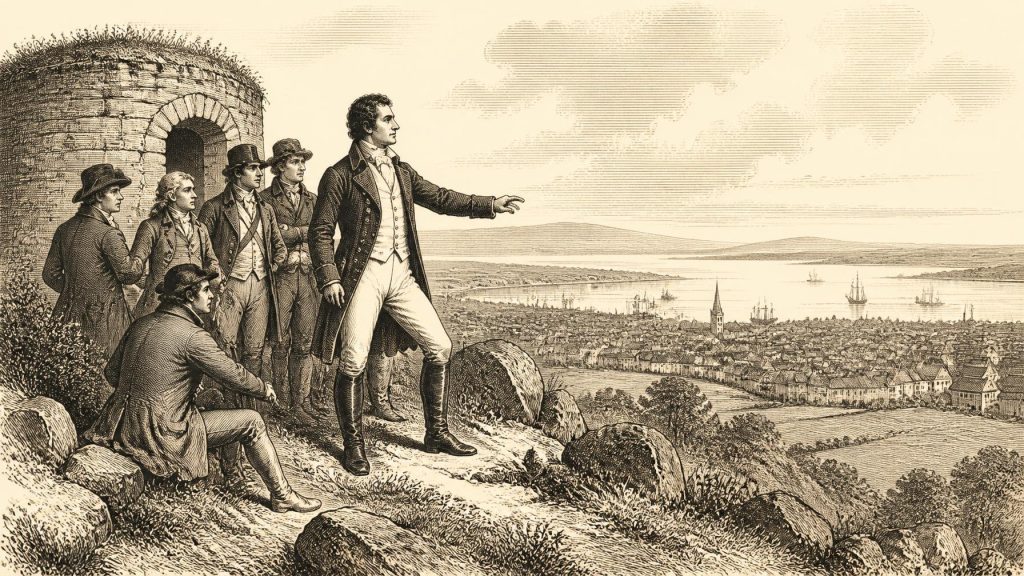
Theobald Wolfe Tone’s departure gives the year a particularly clear date and human scale. On 20 May he left Dublin with his family, having reached an arrangement that spared him prosecution in connection with the affair of the Revd William Jackson, a French-linked emissary tried for treason in April. Tone undertook to leave the kingdom. He travelled to Belfast, where he met leading northern United Irishmen. Before sailing, he and companions including Samuel Neilson, Henry Joy McCracken, Thomas Russell and Robert Simms visited McArt’s Fort on Cave Hill. There they pledged themselves not to desist until English authority in Ireland had been overthrown and Irish independence secured.
The famous Cave Hill oath belongs firmly to June 1795, though it should not be mistaken for a decision by a mass national organisation to rise at once. It was the resolve of a small revolutionary leadership. On 13 June Tone’s party sailed from Belfast aboard the Cincinnatus; they reached Wilmington, Delaware, on 1 August. In Philadelphia Tone approached the French minister, Pierre Adet, hoping to open a route to Paris and French military assistance. During 1795 this remained a project, not an invasion plan in execution. Yet Tone’s exile connected Irish radicalism to Atlantic and European diplomacy at a moment when French intervention seemed imaginable to both its advocates and its alarmed opponents.
A Seminary at Maynooth
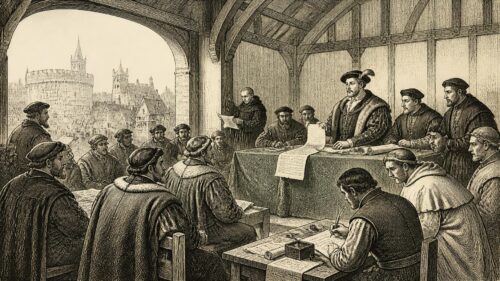
Amid political retreat, parliament enacted a major and more durable concession. The Maynooth College Act received royal assent on 5 June 1795. Its preamble openly recognised that existing law did not permit the endowment of a college or seminary exclusively for Roman Catholics, and declared that such a seminary had become expedient. The statute appointed a mixed body of Catholic bishops, Catholic laymen and senior state officeholders as trustees, empowered to establish and maintain an academy and acquire land and buildings.
The foundation of St Patrick’s College, Maynooth, was not Catholic emancipation. It did not give Catholics seats at College Green, nor did it end the Church of Ireland’s legal establishment. It was, however, a consequential alteration in religious and educational policy. For generations, Irish Catholic clergy had commonly received formation in continental colleges, particularly in France, Spain, Portugal and the Low Countries. The French Revolution’s disruption of the Irish colleges in France, and Britain’s war with France, made that system both less practical and politically suspect.
The government’s motives were therefore mixed. It wished to conciliate Catholics after the disappointments over parliamentary relief, but also hoped that a home seminary would lessen clerical exposure to French revolutionary influences and bring priestly education within a framework the state could observe. Catholic bishops, for their part, sought secure domestic training for clergy. The resulting college was a compromise born of war, religious need and political calculation. Its creation at Maynooth, County Kildare, was one of 1795’s clearest institutional achievements, and it would become central to Irish Catholic life.
The Diamond and Loughgall
The most violent event of the year occurred far from Dublin. County Armagh had experienced years of bitter local tension involving land, employment, linen weaving, arms and religious identity. Protestant groups known as Peep o’ Day Boys had carried out dawn raids, often seeking weapons and intimidating Catholic households. Catholic Defenders organised for protection and retaliation. Neither label should conceal the social pressures beneath the conflict: access to leases, competition in the weaving districts and the insecurity felt by small farmers and labourers intensified religious antagonism.
On 21 September, groups of Defenders and Protestant opponents confronted one another at the Diamond crossroads near Loughgall. The encounter, subsequently known as the Battle of the Diamond, ended in a Protestant victory. The precise numbers engaged and killed vary between accounts, so they should not be presented as certain; contemporary and later narratives nevertheless agree that the Defenders suffered the casualties and that the engagement was decisive in the local balance of power.
That same day, or immediately afterwards, the victors gathered at James Sloan’s inn in Loughgall and formed what became the Loyal Orange Institution, usually called the Orange Order. It adopted the imagery of William of Orange and pledged Protestant solidarity, loyalty to the crown and defence of the Protestant interest. The Order did not spring from an abstract anniversary celebration of the Battle of the Boyne. It emerged from a specific Armagh conflict, shaped by fear, local mobilisation and sectarian rivalry.
The aftermath was grave. During the later months of 1795 and into 1796, Catholic families were attacked and driven from parts of Armagh and adjoining districts; homes, furniture and weaving equipment were targeted. The scale cannot be fixed with complete confidence, but surviving administrative lists and subsequent research establish that many thousands left Ulster, some travelling west towards Connacht and others crossing to Scotland or emigrating across the Atlantic. The phrase “To Hell or Connaught”, associated with these expulsions, conveys the coercive character remembered by victims and observers. The movement of displaced people also helped carry Defender networks and resentments beyond their original local setting.
Law, Trade and an Uneasy Public Realm
Even in a year dominated by political crisis, parliamentary business continued. The Irish parliament passed legislation concerning the courts of justice in Dublin and authorised a bridge over the River Barrow at New Ross. Such measures reveal an Ireland still investing in urban administration, communications and commercial infrastructure. New Ross was a significant river port; the bridge act carefully regulated navigation, the opening of its portcullis and liability for damage caused by vessels. These practical concerns belonged to a trading society whose markets, ports and waterways linked local producers to Dublin, Britain and the wider Atlantic world.
Yet public life was increasingly shadowed by war and security. Proclamations during the year ordered a public fast, regulated trade with the United Provinces and imposed, then modified, an embargo on shipping. Such measures were not uniquely Irish, but they remind us that events in Dublin, Belfast, Armagh and Maynooth unfolded within a wider maritime conflict. Ireland was both a supplier of foodstuffs and manufactures and a strategically exposed island on Britain’s western approaches.
By December, Ireland had acquired neither Catholic emancipation nor peace between communities. It had, however, acquired a Catholic seminary sanctioned by the state, an Orange institution rooted in Armagh’s violence, and a more determinedly clandestine republican movement with Tone across the Atlantic. The contrast is the key to 1795: accommodation and coercion advanced side by side. The year’s most important legacy was not one settled outcome, but the hardening of rival answers to the question of who could belong, govern and feel secure in Ireland.
Primary Sources
- Maynooth College Act, 1795, Section 1
- University History
- Fitzwilliam, William Wentworth
- Grattan, Henry
- FitzGibbon, John
- Byrne, Edward
- Tone, Theobald Wolfe
- The Separatist Idea
- The Trial of Revd William Jackson, April 1795
- CAIN: Background: Chronology of Key Events 1169 to 1799
- The Men of No Popery: the Origins of the Orange Order
- Introduction – Faith, Fraternity and Fighting
- The Orange Institution: The Early Years
- Peep O'Day Boys and Defenders: Selected Documents on the Disturbances in County Armagh, 1784-1796
- Catholics Departing from Ulster in 1795–6
- The Battle of the Diamond 1795
- Statute Law Revision Act 2015
- The Dublin Gazette – Year 1795
- Erecting a Bridge over the River of Ross, at the Town of New Ross, in the County of Wexford Act, 1795
- The Four Courts
- CO. DUBLIN, DUBLIN, INNS QUAY, FOUR COURTS
- James Gandon