Grain Riots1727 CE
In 1727, Ireland experienced political continuity alongside acute social insecurity. George II succeeded George I, and a new Irish parliament assembled under a Protestant establishment managed through Dublin and London. Qualified Catholic freeholders still voted in the election, although legislation passed in 1728 subsequently disfranchised them. Harvest weakness and dear grain provoked resistance at Youghal and elsewhere to exports and interregional shipments, exposing conflict between commerce and subsistence. Linen exports did not ensure welfare. Swift criticised structural poverty, while Dublin’s workhouse expanded foundling provision amid uncertainty over dates. The year revealed unequal access to political rights, food, care and markets.
Dateline
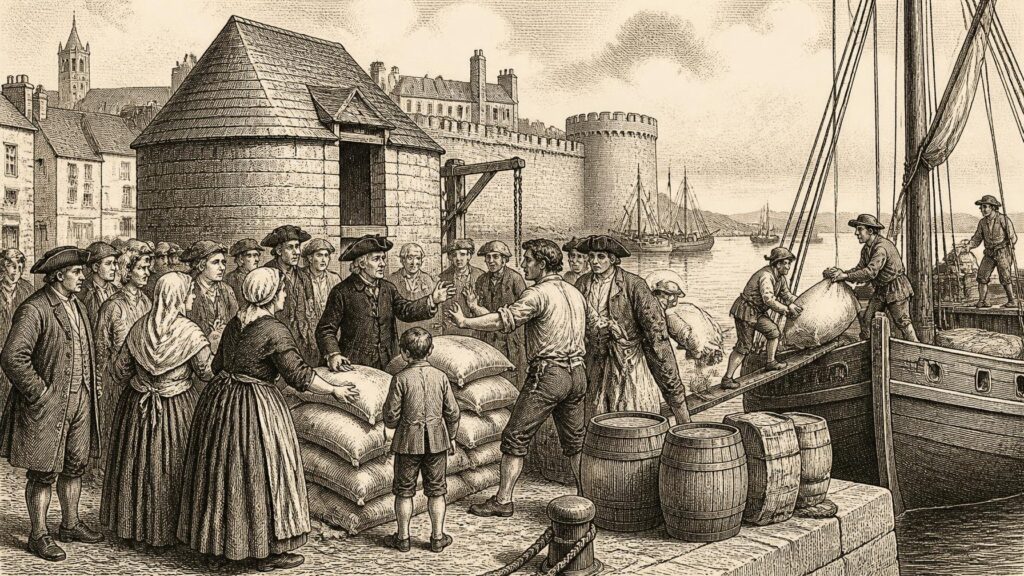
The most revealing Irish story of 1727 was not a battle or a grand constitutional settlement, but the struggle over grain. In and around the port of Youghal, County Cork, scarcity made corn a matter of public order. People resisted its removal to other markets, while the authorities allowed Irish traders access to the town’s commerce. The surviving notices do not securely date each disturbance, name its participants or measure its scale. Yet the episode belongs firmly to 1727 and illuminates a wider reality: food could be present in a commercial landscape without being safely or affordably available to those living beside it.
A New King, an Old System
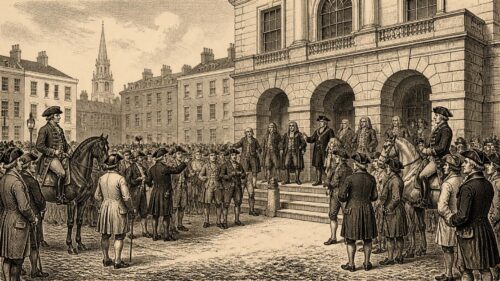
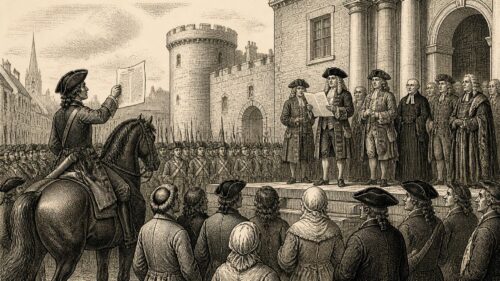
On 11 June, George I died at Osnabrück and his son succeeded as George II, king of Great Britain and Ireland. The change of monarch was immediately carried into Irish administration. A proclamation of 13 June ordered George II’s recognition in Ireland, required absent army officers to return to their regiments, and called an Irish parliament. Its intended meeting date was later altered; the new parliament ultimately assembled in Dublin on 28 November. The transition was orderly, but that calm should not be mistaken for broad political consent. Ireland’s government remained tied to London through the Crown, the lord lieutenant and English ministers, while the Irish executive operated from Dublin Castle.
For the Protestant political class, a new reign brought elections, office-seeking and the opportunity to establish influence with the incoming court. William Conolly, Speaker of the Irish House of Commons and one of the kingdom’s great landowners, remained an important figure. So did Hugh Boulter, the English-born Church of Ireland archbishop of Armagh and primate of All Ireland, whose correspondence shows how closely ecclesiastical patronage, London connections and political management overlapped. Lord Carteret continued as lord lieutenant, though he was often absent. Day-to-day influence therefore did not reside simply in one ceremonial office, but in a network of bishops, office-holders, large proprietors and officials able to shape appointments and parliamentary business.
An Election Before Exclusion
The parliamentary election associated with the accession took place before a decisive tightening of the penal code. Roman Catholic freeholders who met the property qualification could still vote in 1727, although they could not sit in parliament and faced far wider disabilities in religion, property and public life. The parliament that met late in the year was exclusively Protestant in membership: office and representation were structured by oaths and sacramental tests which excluded Catholics and also constrained Protestant Dissenters. A House of Commons of 300 members, heavily weighted towards boroughs under landlord or corporate influence, was scarcely a mirror of the country’s population.
It is important not to misdate what followed. A bill introduced in the 1727–28 session, later cited as 1 George II, chapter 9, barred Catholics from voting in parliamentary and municipal elections. It was not yet law in 1727: royal assent came on 6 May 1728 and the relevant prohibition commenced that month. Thus 1727 was the last general election in which qualifying Catholic electors could exercise the parliamentary franchise, not the year in which they legally lost it. The distinction matters, because it preserves both the limited political right that still existed in 1727 and the deliberate manner of its removal.
Scarcity and the Port
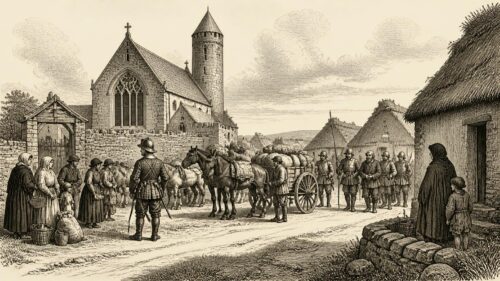
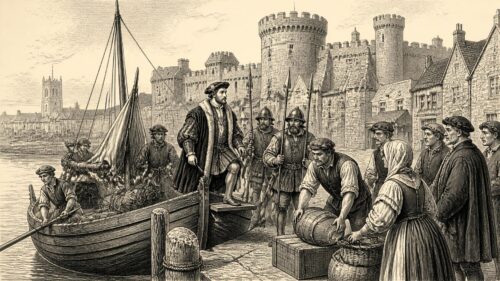
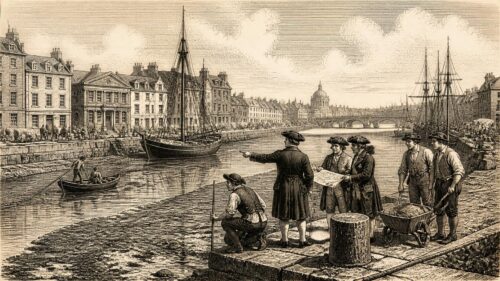
The food emergency unfolding in 1727 was the opening phase of a difficult late-1720s crisis, rather than the Great Frost famine of 1740–41 with which it is sometimes blurred. Harvest weakness and high prices made grain supplies precarious. In Youghal, reports record riots directed against the export of corn to England and to other Irish destinations. Such action was not a rejection of trade in the abstract. It was an immediate attempt to stop food leaving a locality when households feared dear bread, empty markets and hunger. The target was the movement of a necessity from a port town connected to wider circuits of commerce.
Events elsewhere show that Youghal was part of a broader pattern. Hugh Boulter later described a Dublin subscription purchasing oats, oatmeal and potatoes in Munster for shipment northward, only for easterly winds and popular resistance to prevent delivery. He named tumults at Limerick, Cork, Waterford and Clonmel as well as other places. That evidence does not allow every one of these incidents to be assigned a precise day in 1727, but it securely connects the year to a regional conflict over provisioning. It also reveals the cruel geography of scarcity: food might be cheaper in one district, desperately needed in another, and impossible to move without provoking those who believed their own supply was at risk.
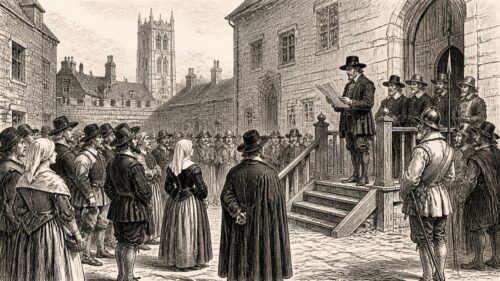
The authorities’ language would have described such crowds as disorderly; modern readers should also recognise the practical reasoning behind them. Grain exports and inter-regional shipments promised merchants a market, but poor consumers judged food by whether it remained within reach. In a society without a national welfare system, with weak transport links and little reserve against harvest failure, a rise in the price of meal or grain could swiftly become a crisis of nutrition, debt and social peace. The Youghal disturbances therefore bring ordinary people into view more clearly than the formal ceremonies of succession do.
Growth Amid Vulnerability
Scarcity coexisted with export growth. Customs figures for the year ending Lady Day, 25 March 1727, recorded linen-cloth exports valued at £238,444, alongside linen yarn worth £103,726. Linen was becoming Ireland’s principal manufacturing export, with spinning and weaving providing work in many districts, especially in Ulster. These totals should not be treated as a measure of general prosperity. They refer to recorded overseas trade over a financial year, not to wages, diet or security in every parish. Nevertheless, they show an economy capable of producing a valuable Atlantic-facing commodity while many households remained exposed to a poor grain harvest.
The contrast was structural. Much land was devoted to pasture and the provision trade in beef, butter, hides and other animal products; grain cultivation did not always offer the best return to landlords or farmers. Ireland’s commerce was also shaped by imperial regulation and unequal access to markets. Jonathan Swift, dean of St Patrick’s Cathedral, Dublin, wrote A Short View of the State of Ireland in 1727. It was a polemical diagnosis rather than a statistical survey, but its complaints about absentee rents, restricted trade, weak manufacture and impoverished tenants spoke to anxieties sharpened by the year’s scarcity. Swift’s manuscript belongs to 1727; its printing and wider circulation belong to the following year and should not be projected backwards.
Care, Abandonment and Dublin
Dublin’s institutions also register the pressure of poverty, though the dating requires care. Archaeological and transport-planning assessments identify 1727 as the year in which a foundling hospital was added to the City Workhouse at James’s Street, with new wings flanking the earlier poorhouse. The present-day St James’s Hospital history, however, dates the opening of the foundling hospital to 1730. The evidence therefore supports saying that 1727 was associated with the project or expansion, but not claiming an uncontested opening day. Either date points to the same social problem: abandoned infants, maternal poverty and the absence of secure family support in a growing city.
The institution was charitable, but charity did not remove hardship. Admission could save a child from immediate exposure, while also placing that child in an impersonal regime whose later history was marked by severe mortality. In 1727, the planned or newly created foundling provision stood beside the food crisis as another sign of urban vulnerability. It was an attempt by civic governors and subscribers to organise relief, not evidence that poverty had been mastered.
A Year Defined by Access
In 1727, access was the thread linking Ireland’s political and social life. Access to the throne changed smoothly from George I to George II, but access to power remained confined to a narrow Protestant establishment. Catholic freeholders still voted in the election, even as legislation was set in motion to deny that right. Access to grain became contested at Youghal and across the south, where communities acted to prevent food being carried away. Access to care for abandoned children was being enlarged at Dublin’s workhouse, although the exact institutional chronology remains contested. And access to expanding markets, demonstrated by linen exports, did not guarantee security at the hearth.
For that reason, Youghal’s grain barrier is an apt emblem of the year. It records neither a revolution nor a settled policy, but an encounter between local need and commercial movement. In the Ireland of 1727, the constitutional order changed its king, merchants continued to export, parliament prepared to narrow an already restricted electorate, and hungry communities insisted that subsistence came before the freedom of trade.

Primary Sources
- GEORGE II. 1st Year: 13 June 1727
- State Papers Ireland 1509–1782: government papers on Irish affairs
- Auditor General's Office; King's Letters; Vol. 2; 1727–1733
- Transcripts of State Papers Ireland from the Series, S.P. 63, Vols. 389–91, June 1727–December 1729
- Pre-Union Irish Statutes
- Irish Legislation Database: Regulating Parliament Elections, 1727
- Statutes in Chronological Order: The Reigns of King George I and II
- Irish Parliamentary Elections, 1727–68
- The Parliamentary Franchise in the Irish Counties
- Letters Written by His Excellency Hugh Boulter, D.D., Lord Primate of All Ireland
- Famine in Ireland, 1300–1900
- The Provision Trade
- History of the Commercial and Financial Relations between England and Ireland from the Period of the Restoration
- A Short View of the State of Ireland
- TEI Header for A Short View of the State of Ireland
- Our History: St James's Hospital
- Dublin: St James's Hospital, James's Street
- Archaeological Assessment: Proposed Luas Stop, St James's Hospital
- A Copy of Christopher Butler's Account with Lord Doneraile, 6 May 1727
- Boulter and His Letters