Clergy Registration1704 CE
In 1704, Queen Anne’s Irish parliament enacted measures reinforcing Protestant political supremacy after the Williamite wars. The Popish Clergy Register required Catholic secular priests to register, provide sureties and remain locally confined, while excluding new clergy and threatening noncompliance with punishment. Its companion Popery Act restricted Catholic inheritance, education, conversion, office holding and family autonomy, though implementation varied. Parliament simultaneously encouraged Protestant immigrants, notably Huguenots, through selective naturalisation. Other statutes established Dublin’s coercive workhouse system and regulated credit, excise and livestock trade. These measures classified clergy, heirs, migrants and poor people, extending state supervision into worship, households, markets and streets.
Dateline
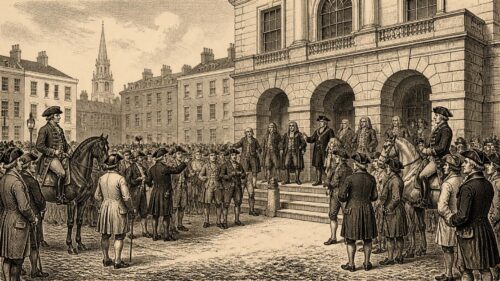
In 1704, Ireland’s most consequential development was neither a battle nor a change of ruler, but an attempt to make religious difference legible to the state. On 4 March, the Irish parliament’s first session under Queen Anne ended with royal assent to a cluster of statutes. Two became enduring symbols of the penal system: An Act to prevent the further Growth of Popery and An Act for registering the Popish Clergy. Together they sought to contain the Roman Catholic majority through landholding, family, education, office-holding and the practical organisation of worship. Their language was hostile and their ambitions large. Yet their immediate operation depended on local magistrates, clergy, landlords, families and parish communities, making 1704 the beginning of a difficult process rather than the instant remaking of Irish society.
A Parliament of Protestant Security
Queen Anne had succeeded William III in 1702, and James Butler, second duke of Ormond, was lord lieutenant in Ireland during 1704. His government operated in a kingdom still marked by the Williamite wars of 1689–91, confiscated estates and the political victory of the Church of Ireland. The Irish parliament was overwhelmingly Protestant in membership and outlook. Catholics were already excluded from parliament and many offices; Presbyterian and other Protestant dissenters also faced disabilities under the established religious order. The legislation of 1704 nevertheless concentrated especially on Catholics, whom Protestant politicians associated with the defeated Jacobite cause and with the Catholic powers fighting Britain and its allies in the War of the Spanish Succession.
That association should not be mistaken for evidence of a new Irish rising in 1704. The statutes’ preambles alleged danger from Catholic bishops, regular clergy and foreign influence, but their fearful language was political as well as descriptive. For Protestant landowners and office-holders, memories of seventeenth-century rebellion and war made Catholic political power appear threatening. The legislation was therefore designed not merely to punish particular crimes, but to preserve what its authors called the Protestant interest: a settlement in which landed wealth, public authority and the established church reinforced one another.
Registration and Restriction
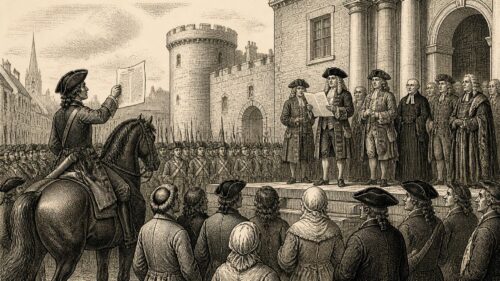
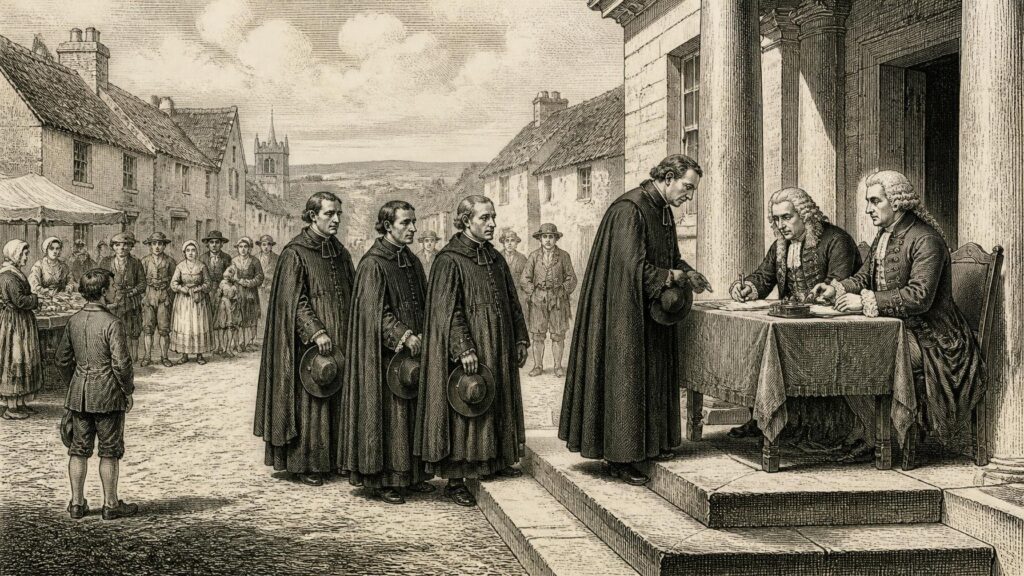
The Registration Act gave this policy a deliberately administrative form. Catholic priests already resident in Ireland were required, after 24 June, to appear at the next quarter sessions and record their names, ages, parishes, places and dates of ordination, and the bishops who had ordained them. Each was to provide two sureties of £50 for peaceable behaviour. A registered priest was not free to minister wherever he wished: he was to remain in the county of registration and could officiate only in the parish in which he had been serving when registered. Clerks of the peace were required to send the returns onwards, turning local lists into an instrument of central government.
The choice offered by the act was stark. Priests who failed to register faced imprisonment and transportation; those who conformed to the Church of Ireland were offered an annual pension of £20, charged on the locality in which they had last officiated. The law thus combined surveillance, confinement and inducement. It did not formally abolish Catholic worship by the registered secular clergy, but it attempted to stop renewal. Bishops, religious-order clergy and priests entering Ireland after the stipulated date were subject to the more severe provisions of earlier banishment legislation. An act assented to in October 1703, but operative from 1 January 1704, had specifically extended penalties to Catholic clergymen arriving from abroad.
For ordinary Catholic households, the register mattered because it placed pastoral life under a new, constrained geography. Baptism, marriage, confession and Mass depended on priests who could legally serve only within narrow limits. The system also exposed a priest’s identity, age and origin to the authorities. Its human scale is visible in local evidence. In July 1704, thirty-nine Catholic parish priests in the diocese of Kilmore submitted their names under the act. That surviving example should not be treated as a national total, but it shows that registration was not merely a parliamentary threat: in at least some districts it produced names, records and official acknowledgement.
Registration did not mean consent, nor did it mean that the government possessed full knowledge of Catholic religious life. Clergy and laypeople had long developed ways to sustain worship amid legal restrictions, while the capacity and willingness of officials to enforce every provision varied markedly between places and over time. Still, the act placed the Catholic Church in a legally precarious position. It made the survival of parish ministry depend upon an ageing, fixed and officially identified body of priests, while preventing the normal arrival and movement of replacements.
Property, Family and Conformity
The companion Popery Act reached more deeply into domestic life. Its provisions addressed conversion, guardianship, foreign education, political participation, pilgrimage and property. Its most notorious feature was the attempt to disrupt the continuity of Catholic estates. In broad terms, a Catholic landowner’s estate could be divided among his sons at death under gavelkind rather than passing intact by primogeniture; meanwhile, a son who conformed to the Church of Ireland could gain substantial advantages over his Catholic relatives. The law made family allegiance and inheritance matters of public policy.
These rules did not simply seize every Catholic holding in 1704, and it would be wrong to portray them as an overnight abolition of Catholic property. Their force lay in the insecurity they introduced. Estate planning, marriage arrangements and the upbringing of children all had to be considered in light of the possibility that a child’s religious conformity might alter the family’s future control of land. The act also strengthened penalties against inducing Protestants to become Catholics and restricted the sending of Catholic children abroad for education without official licence. State power therefore entered the household through inheritance and parental authority as well as through church doors.
Another provision required those claiming the legal benefits of conversion from Catholicism to demonstrate conformity in recognisably Anglican terms: reception of communion according to the usage of the Church of Ireland, the required declarations and oaths, and certification in Chancery. This was not an invitation to a broad religious pluralism. It defined valid Protestant status through adherence to the established church and made religious identity something to be proved in court and on paper.
The same parliamentary programme also sharpened the religious test for civil and military office. Those holding office, receiving public pay or exercising public trust were required to take prescribed oaths and declarations, including the oath of abjuration, in open court. The effect was to consolidate public authority around the established Protestant order. Catholics bore the principal weight of exclusion, but dissenting Protestants could also be disadvantaged by sacramental and oath requirements. Ireland’s constitutional life in 1704 was thus not a simple division between a free Protestant population and a restricted Catholic one; it was a hierarchy in which the Church of Ireland stood closest to political power.
Welcoming Some Newcomers
The year’s legislation reveals a striking contrast. While parliament tightened restrictions on Catholics, it passed an act naturalising Protestant strangers in Ireland. The measure revived and extended earlier encouragement for Protestant immigrants, subject to loyalty oaths and declarations against transubstantiation. It allowed newcomers a route to settlement and economic participation, though naturalised foreigners were still barred from voting in parliamentary elections or holding corporation office. The policy particularly suited the wider world of Protestant refugees, including French Huguenots, whose congregations and commercial networks were already established in Dublin and other Irish towns.
This was not religious toleration in the modern sense. It was selective incorporation. Protestant settlers were valued as loyal inhabitants, artisans, traders and potential contributors to a Protestant society; Catholic religious institutions were treated as a demographic and political danger. The two laws belonged to the same political imagination: one encouraged a preferred kind of population while the other sought to limit the institutional resilience of the majority.
Dublin’s Poor and Regulated Markets
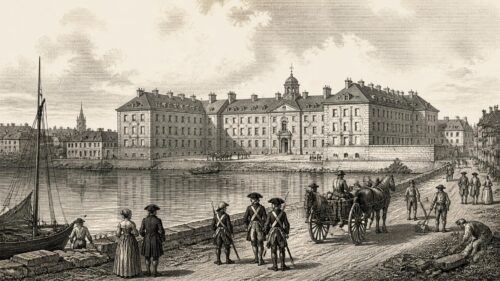
Parliamentary business in 1704 was not confined to religion. A Dublin workhouse act, assented to on 4 March and due to operate from 1 May, created a corporation of governors and guardians for employing and maintaining the city’s poor. Its preamble described the number and continuing increase of poor people in Dublin and its liberties as a serious burden. The proposed institution was both charitable and coercive. It was empowered to apprehend beggars and vagrants, set people to work, and hold poor children over the age of five for service or apprenticeship. Boys could be apprenticed until twenty-four and girls until twenty-one, and the statute specified Protestant masters.
This measure provides a rare direct glimpse of urban pressures at the opening of the eighteenth century. Dublin was a seat of government, a port and a growing consumer town, but its prosperity coexisted with visible poverty. The workhouse scheme did not offer a welfare entitlement; it aimed to regulate labour, movement and begging. Poor relief was bound to discipline, religious preference and civic authority. Its establishment belongs beside the penal legislation as evidence of a state and municipality seeking to classify, supervise and reorder vulnerable people.
Other acts addressed commerce and credit. Parliament legislated on excise, small debts, money lending and cattle marketing, including an act aimed at abuses in buying and selling cattle and in the slaughtering and packing of beef, tallow and hides. Such measures point to the importance of livestock and provisions in Ireland’s economy and to official concern for the conduct of urban and export trades. They should not be inflated into proof of an economic transformation occurring in this single year. Rather, they show legislators trying to impose predictable rules on markets, debt and the movement of goods in a kingdom whose revenues and connections depended heavily on trade.
A Year of Paper Power
There was no decisive military encounter in Ireland in 1704 to rival the importance of these statutes. The year’s great event was the production of categories: registered priest and unregistered priest; conforming heir and Catholic heir; approved Protestant immigrant and excluded Catholic office-holder; employable poor person and punishable vagrant. Those categories were made in Dublin but were intended to reach into parish, household, estate, market and street.
Their long-term consequences were substantial, though their enforcement was uneven and later laws amended, extended or relaxed particular provisions. For 1704 itself, the essential point is clear. Ireland’s Protestant governing class used parliament to make religious supremacy more durable, while also building institutions for urban discipline and commercial regulation. The register demanded from Catholic priests that they become known to the state. In doing so, it captured the larger purpose of the year: to make Irish society more governable according to the priorities of the Protestant settlement.

Primary Sources
- The making of a penal law (2 Anne, c.6), 1703–4
- Securing the Protestant Interest: The Origins and Purpose of the Penal Laws of 1695
- The Second Year of Anne: An Act to prevent Popish Priests from coming into this Kingdom
- Statutes by Subject: Clergy and Schoolmaster
- Statutes in Chronological Order: The Reign of Queen Anne
- Statutes by Subject: Immigration
- Introduction to Laws in Ireland for the Suppression of Popery
- Statute Law Revision (Ireland) Act 1878
- Leases for Lives Act 1777, section 6
- Statute Law Revision Act 2015
- James Butler, second duke of Ormond
- Ormond Papers: Additional Collection List
- State Papers Ireland 1509–1782: Government Papers on Irish Affairs
- French Protestant Refugees in Ireland, 1660–1714
- A History of the Irish Poor Law
- Religion: Background to Statutes of the Irish Parliament
- Penal Laws
- Fairs and Markets: Background to Statutes of the Irish Parliament
- Forestalling, Regrating, etc. Act 1844
- Naturalization Act 1870
- Statute Law Revision Act 2009, Schedule 1
- Kilmore