Plunkett Indictment1680 CE
In 1680, Popish Plot fears shaped Irish government despite no rebellion. Ormond sought English approval for proposed legislation, including measures against Catholic clergy, but no parliament met. He laid the foundation stone of the Royal Hospital at Kilmainham, a home for retired soldiers. At Dundalk, the prosecution of Archbishop Oliver Plunkett collapsed when witnesses failed to appear; he was nevertheless sent to London, while Archbishop Peter Talbot died untried in Dublin prison. Gaelic learning endured through the copying of Leabhar Cloinne Aodha Buidhe in Antrim. Borlase’s history of 1641 reinforced Protestant fears, demonstrating how memory, coercion and institutions governed Ireland.
Dateline
In 1680 Ireland stood in the long shadow of the Popish Plot: the fictitious conspiracy first promoted in England in 1678, which alleged a Catholic design to murder Charles II and overturn Protestant rule. The Plot was not an Irish rising, and no such rising occurred in 1680. Yet its language of invasion, massacre and clerical conspiracy crossed the Irish Sea with damaging force. It shaped official policy, sharpened old memories of 1641, placed Catholic priests under exceptional danger and made Ireland a field on which English political anxieties were fought out.
James Butler, duke of Ormond, governed as lord lieutenant for Charles II. He was a Protestant magnate, a survivor of civil war and restoration, and no friend of Catholic political equality. But he also valued legal procedure, public order and the revenues that stability brought. That disposition produced an uneasy contrast in 1680: Dublin saw the beginning of a grand royal institution for old soldiers, while Dundalk hosted a prosecution of the Catholic primate which could not be completed there, only for him to be sent to London. At the same time, a Gaelic manuscript was copied in County Antrim, preserving the learned inheritance of an old Ulster lineage. The year reveals an Ireland governed from above, watched suspiciously from England, and culturally more various than the politics of fear allowed.
A Parliament Deferred
Ormond’s government faced problems that had accumulated since the Restoration of Charles II in 1660: disputed land titles, the cost and organisation of the army, the Crown’s Irish revenue, and the relationship between the Protestant establishment and the Catholic majority. Ireland had not had a parliament since 1666. Ormond believed that a new one could help settle titles and support military and fiscal measures, but the proposal was contentious. Land settlement remained raw because the confiscations and rearrangements of the 1640s and 1650s had transformed ownership on a vast scale.
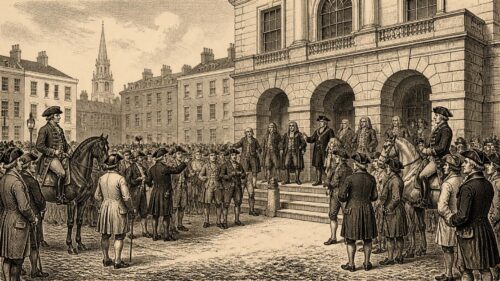
The calendar year provides a clear marker for this stalled constitutional programme. On 13 June 1680 Ormond sent a revised set of twenty-six proposed bills to England for royal consideration. Some were aimed particularly at Catholic clergy. Their dispatch did not mean that an Irish parliament had been called: no parliament met. Rather, it shows the limits of the Irish executive. Under Poynings’ Law, proposed legislation required English approval before an Irish parliament could consider it, and decisions at Westminster could determine whether Dublin’s plans proceeded at all. The proposed measures belong to the atmosphere of the Plot, but they also demonstrate that anti-Catholic policy could be discussed as administration and law, not merely as crowd alarm.
For ordinary people, such high politics mattered through its consequences: the security of a lease or estate, the burdens of taxation, the presence of troops, and the degree to which a priest or schoolmaster could work openly. The Crown’s interests were inseparable from military capacity. Ireland’s standing army was a source of royal authority and, in Protestant eyes, protection. To Catholics, particularly during the Plot, it could embody a state prepared to enforce exclusion. Ormond tried to keep that coercive power disciplined by law. His difficulty was that English politicians and informers could make local restraint look like dangerous softness.
Kilmainham’s First Stone
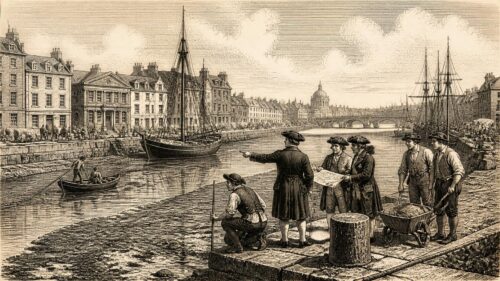
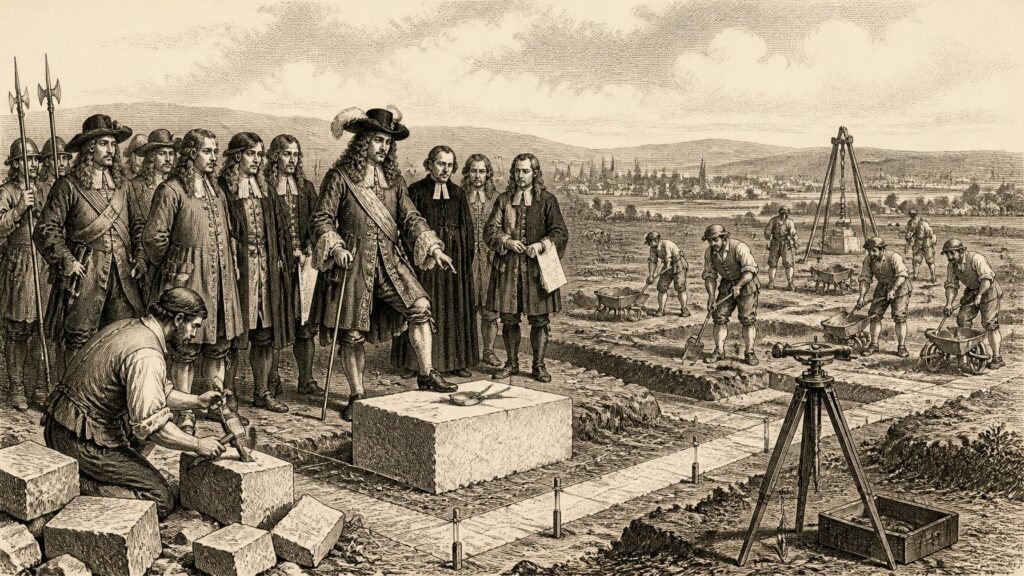
On 29 April, Ormond laid the first stone of the Royal Hospital at Kilmainham, west of Dublin. Francis Aungier, earl of Longford and master-general of the ordnance, laid the second. The site had previously belonged to the medieval priory of the Knights Hospitaller; after the dissolution of religious houses in the sixteenth century it had passed to the Crown. Its reuse was therefore richly symbolic: land once associated with a religious order was being remade into a royal charitable and military institution.
The hospital was intended as a home for retired soldiers, and its construction was entrusted to Sir William Robinson, the Crown’s surveyor-general in Ireland. Robinson’s design drew upon the continental and English language of ordered, monumental welfare for veterans, notably the model of Les Invalides in Paris. The building programme did not solve the hardships of all former soldiers, nor should it be mistaken for a modern public health service. It was a selective provision tied to service, discipline and royal patronage. Nevertheless, the foundation ceremony makes 1680 a significant year in the social history of Dublin: the state visibly committed resources to housing men worn down by its wars.
Its architecture also conveyed a political message. A formal quadrangle, planned ranges and a prominent setting on the approaches to Dublin asserted permanence after decades of upheaval. The institution linked military service to care, but it also made the army’s continuing place in Restoration Ireland conspicuous. At Kilmainham, the Crown advertised orderly government in stone just as its officials elsewhere pursued a religious-security crisis that was anything but orderly.
Oliver Plunkett at Dundalk
The gravest event of the year was the attempted prosecution of Oliver Plunkett, Roman Catholic archbishop of Armagh and primate of all Ireland. Plunkett had been arrested in Dublin in December 1679 after allegations connected to the Plot. He was accused of treasonable designs including raising men, collecting money from clergy and assisting a French invasion. Such charges were fantastical extensions of wider anti-Catholic panic, but their political usefulness was real. They could turn the pastoral organisation of a proscribed church into supposed evidence of rebellion.
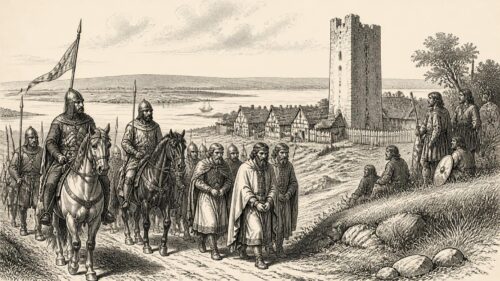
On 23 July 1680 Plunkett was brought before the assizes at Dundalk, within his ecclesiastical province. He faced bills alleging high treason and the exercise of papal jurisdiction. The proceedings did not result in an indictment. Crucially, witnesses expected for the prosecution did not appear, while Plunkett had people ready to rebut the accusations. The failure is important precisely because it resists a simplistic picture of inevitable conviction. In Ireland, where the allegations and the character of informers could be tested close to their origins, the case could not be carried through in July.
This was not an acquittal in any final sense, nor did liberty follow. Plunkett remained a prisoner. During the autumn the case was drawn into English politics, where supporters of the Plot sought a more favourable arena. Orders were made on 6 October for him to be sent for trial in London; by late October he had been transferred to Newgate. His eventual trial and execution belong to 1681, not 1680. The responsible conclusion for this year is narrower and more revealing: the Dundalk prosecution collapsed, but the machinery of accusation simply moved jurisdiction.
Plunkett’s ordeal shows how uneven the operation of power could be across the Stuart kingdoms. Ormond obeyed orders directed against Catholic clergy, yet he preferred formal legal process and distrusted reckless claims. His moderation did not make Ireland safe for Catholics. Clergy remained vulnerable, worship was constrained, and the state’s Protestant identity was unquestioned. But the difference between a failed local proceeding and a later English capital conviction mattered profoundly. It exposed the Plot less as a discovery of an Irish conspiracy than as a political framework capable of finding, or creating, a venue for punishment.
A Prison Death in Dublin
Another imprisoned archbishop did not survive the year. Peter Talbot, Catholic archbishop of Dublin, died in custody in Dublin during November 1680. The exact day is uncertain: modern biographical evidence places his death between 25 October and 22 November, while Ormond informed a correspondent on 20 November that Talbot was dead. This uncertainty should be retained rather than concealed. What is firm is that Talbot, arrested amid Plot allegations in 1678, died without trial after roughly two years in prison.
Talbot’s death gave the crisis a human scale. He had been a controversial and well-connected churchman, and his relations with Plunkett had not always been easy. Yet, as fellow prisoners, they were reconciled sufficiently for Plunkett to give him sacramental absolution near the end. For Dublin Catholics, the death of their archbishop in confinement was a stark demonstration that the Plot’s consequences extended beyond courtroom spectacle. A government might avoid a disorderly execution, but prolonged imprisonment could itself remove religious leadership and intimidate the wider community.
Manuscript and Memory
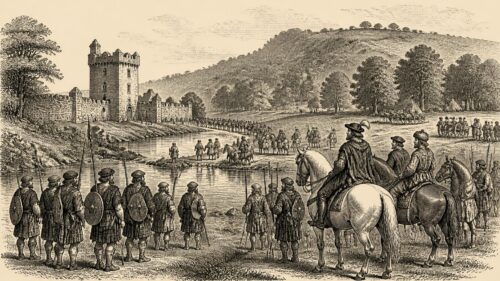
Political alarm did not extinguish learned work in Irish. In 1680 Ruaidrí Ó hUiginn copied the principal portion of Leabhar Cloinne Aodha Buidhe for Cormac mac Airt Óig Ó Néill of Clann Aodha Buidhe. The surviving manuscript, now Royal Irish Academy MS 24 P 33, was associated with the Ó Néill world around Shane’s Castle and Broughshane in County Antrim. It contains prose, genealogies, historical material and a duanaire, or collection of poems, relating to the Clann Aodha Buidhe branch of the Uí Néill.
The commission is an unusually tangible corrective to any assumption that late seventeenth-century Ireland possessed only an English-language, Protestant public culture. The manuscript did not restore the political power once enjoyed by Gaelic lordships. Its patron’s family lived in a transformed Ulster, under the pressures of plantation, land transfer and new confessional hierarchies. But compiling genealogies, rights, annals and praise poetry affirmed continuity, rank and collective memory. Paper, scribal skill and patronage connected a seventeenth-century household to texts and poetic traditions reaching back centuries.
Print also revisited the past in a more polemical register. Edmund Borlase’s The History of the Execrable Irish Rebellion was published in 1680, tracing the rebellion of 1641 to the Restoration land settlement. Its hostile title signals its purpose. The book helped sustain a Protestant reading of Irish history in which Catholic rebellion and Protestant insecurity were inseparable. In a year of Plot accusations, a printed history of 1641 was not neutral antiquarianism. It offered readers a vocabulary through which new fears could be understood and intensified.
The contrast between Borlase’s print and Ó hUiginn’s manuscript is telling. One mobilised a confessional account of catastrophe for a broad English-reading public; the other safeguarded a Gaelic dynastic archive for a particular Ulster lineage. Both were acts of memory. Both mattered in 1680 because the past was not past: it governed claims to land, credibility, religion and security.
By year’s end, Ireland had not erupted into the rebellion imagined by Plot propagandists. Instead, its most consequential developments were institutional and coercive: legislation prepared but not enacted, a veterans’ hospital begun, an archbishop’s case displaced to London, and another archbishop dead in prison. Alongside them, a manuscript quietly recorded another Ireland—one in which inherited learning and local patronage endured despite the narrowed political world around them.

Primary Sources
- Plunkett, St Oliver — Dictionary of Irish Biography
- Talbot, Peter — Dictionary of Irish Biography
- Butler, James — Dictionary of Irish Biography
- Murphy, Edmund — Dictionary of Irish Biography
- Dingley, Thomas — Dictionary of Irish Biography
- Steele, William — Dictionary of Irish Biography
- MS 24 P 33 (Leahbar Cloinne Aodha Buidhe) — Irish Script on Screen, Dublin Institute for Advanced Studies
- Leabhar Cloinne Aodha Buidhe — Irish Manuscripts Commission Digital Editions
- Leabhar Cloinne Aodha Buidhe, edited by Tadhg Ó Donnchadha
- Observations in a Voyage in the Kingdom of France; Observation in a Voyage through the Kingdom of Ireland — National Library of Ireland catalogue
- Travels in County Clare 1534–1911: Thomas Dineley, Journal of County Clare, 1681 — Clare Libraries
- The History of the Execrable Irish Rebellion — Folger Shakespeare Library catalogue
- The History of the Execrable Irish Rebellion, 1680 — digitised copy
- Histories of the Hospitals of Dublin: Appendix III — Chapters of Dublin
- Kilmainham and the Royal Hospital — Chapters of Dublin
- The Royal Hospital Kilmainham — Friends of the Royal Hospital Kilmainham
- The Trial and Execution of Oliver Plunket — The State Trials and the Politics of Justice in Later Stuart England
- Edmund Murphy, Oliver Plunkett and the Popish Plot — History Ireland
- Catholics and the Law in Restoration Ireland
- Accommodating the Law — Catholics and the Law in Restoration Ireland
- Charles II and His Ministers in Ireland — The Stuart Restoration and the English in Ireland
- The Court of Claims, Popery and Stuart Authority — The Stuart Restoration and the English in Ireland
- The Remonstrance of December 1661 and Catholic Politics in Restoration Ireland — Irish Historical Studies
- Restoration, Revival, and Survival, 1660–1700 — Irish Women in Religious Orders, 1530–1700
- A ‘Disorderly Tumultuous Way of Serving God’: Prayer and Order in Ireland’s Church and State, 1660–89 — Irish Historical Studies