Galway Surrender1652 CE
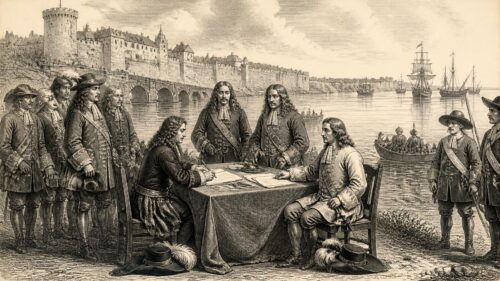
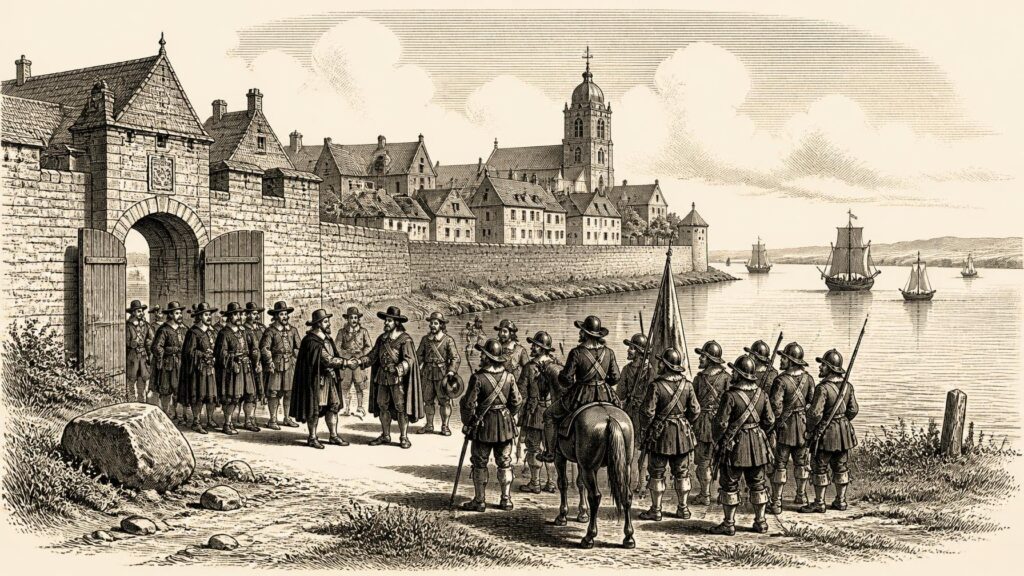
In 1652, Galway, the last major Confederate Atlantic port, surrendered to parliamentary forces after siege and blockade, ending its military significance but leaving Catholic inhabitants uncertain. Resistance persisted through irregular fighters, while agreements offered some soldiers foreign service. Charles Fleetwood’s appointment signalled army-backed civil rule. On 12 August, the Rump Parliament’s Act for the Settling of Ireland established punitive categories of guilt, enabling forfeiture, banishment and redistribution of land to soldiers and Adventurers, although later measures shaped transplantation. War, famine, disease and displacement devastated communities. Thus conquest evolved into a programme restructuring property, authority, religion and belonging under Commonwealth rule.
Dateline
For Ireland, 1652 was the year in which military defeat began to harden into a new political and social order. The wars that had begun with the rising of 1641 had not simply ended when the last great Catholic and royalist-held city yielded: armed resistance survived in scattered districts, hunger and epidemic disease were widespread, and the Commonwealth still had to turn victory into government. Yet two securely dated developments gave the year its defining shape. Galway, the principal remaining Atlantic port in Irish Confederate hands, accepted parliamentary terms in April; on 12 August the English Rump Parliament passed An Act for the Settling of Ireland, setting out an extraordinarily punitive framework for lives, property and political allegiance.
Galway’s Negotiated Defeat
Galway had been under severe pressure since 1651. Sir Charles Coote’s parliamentarian force enclosed it from the landward side, while Commonwealth warships helped deny relief by sea. The town was more than a local stronghold. Its merchants connected western Ireland with Iberia, France and the wider Atlantic; its walls, civic institutions and Catholic elite made it one of the last substantial centres of the Confederate cause. Thomas Preston, an experienced Catholic commander, served as its military governor. The prolonged siege compounded the shortages already experienced by inhabitants and displaced people who had reached the city during the war.
The precise terminology of the surrender matters. The surviving documentation includes parliamentary commissioners’ exceptions to the proposed articles dated 11 April 1652, while Charles Coote’s biographical record places the town’s surrender on 12 April. Other accounts refer to the final capitulation in May. Rather than treat these as irreconcilable dates, they indicate a process: articles were agreed in April, then scrutinised, amended and carried into effect. What can responsibly be said is that Galway passed out of Confederate control in spring 1652. The parliamentary authorities thought the original terms too generous and revised them, an early warning that even negotiated submission did not assure a stable or lenient settlement.
The articles offered protection for some persons and property, subject to obedience and to exclusions for alleged killings during the opening phase of the war. Such clauses reveal the awkward reality facing the conquerors. Parliament needed the city intact, wanted commerce and order restored, and could not instantly replace every inhabitant. At the same time, the new rulers intended to identify offenders, disarm opponents and make the port dependable. Galway’s fall therefore ended its role as a major military obstacle, but not the uncertainty facing its Catholic merchants, civic families, clergy and poorer inhabitants.
The naval dimension was equally significant. Commonwealth squadrons had patrolled the western coast, intercepting ships attempting to enter Galway Bay with supplies or leave with people and goods. With Galway’s submission, the Irish coast ceased to be a serious theatre of naval conflict between the Commonwealth and its Irish opponents. That did not mean maritime life recovered at once. A port dependent upon overseas connections had endured blockade, war and political rupture; traders now had to operate within a Commonwealth whose military priorities and religious assumptions were hostile to the old Catholic-led urban order.
Resistance After the Cities
The capture of Galway did not make 1652 a year of universal peace. The large field armies and walled-city garrisons that had confronted the parliamentary advance had largely disappeared, but smaller bands remained in difficult country. English sources often called such fighters “tories”, a term then used for irregular armed men rather than the later political party. Their operations depended on local knowledge, food, shelter and the weaknesses of an occupying army stretched across a devastated island. For civilians, the distinction between a guerrilla, a fugitive soldier, a kinsman under arms and a suspected helper could be perilously thin.
Negotiation accompanied coercion. Articles agreed in late June between Captain Henry Sankey and William Kelly allowed men laying down arms to be organised for foreign military service, provided the receiving power was at peace with the Commonwealth. The text envisaged a regiment of a thousand foot for service abroad and allowed time to arrange transport, even contemplating contact with Spain. Its exclusions were severe: protections did not extend to those accused of specified murders or robberies. Still, the agreement illustrates a practical route out of the conflict. Foreign service had long been familiar to Irish soldiers; in 1652 it also served the Commonwealth by reducing the number of trained, dispossessed men remaining at home.
In July, Charles Fleetwood was appointed commander-in-chief of the forces in Ireland and a commissioner for its civil government. He arrived in Ireland in the autumn, when Catholic military resistance was nearly broken but the administrative consequences of conquest were only beginning. His appointment marked a transition from the campaigning associated with Oliver Cromwell and Henry Ireton to an army-backed regime expected to police the country, judge alleged participants in the 1641 violence, manage confiscated property and secure a Protestant interest. Military command, civil authority and religious policy were therefore tightly intertwined.
The Act of 12 August
The most consequential firmly dated act of the year occurred at Westminster. On 12 August 1652, the Rump Parliament enacted An Act for the Settling of Ireland. Its title suggested order; its substance made the outcome of war depend upon a hierarchy of guilt. It divided Irish people associated with the rebellion and subsequent wars into qualifications, exposing different categories to death, banishment, forfeiture of estate or other penalties. The law was retrospective in ambition, reaching back to actions and allegiances since October 1641. In a society where survival had often required changing garrisons, paying contributions or serving one military master after another, the effort to classify political conduct had immense human consequences.
The Act should not be simplified into an instant, uniform confiscation of every Catholic holding or an immediate mass removal of all Catholics west of the Shannon. The famous transplantation programme was developed through later orders and legislation, especially in 1653 and afterwards. Nor did the Act mean that every person whom it affected was tried or treated identically. Implementation required surveys, claims, local enquiries, valuations and a continuing military occupation. Nevertheless, August 1652 was the legal watershed: it asserted that the Commonwealth could dispose of Irish land and determine the conditions under which many of the conquered population might live within the realm.
The intended beneficiaries were also clear. Land was expected to meet debts owed to the Adventurers who had financed parliamentary war policy and arrears owed to soldiers. The prospect of payment in land linked a distant parliamentary statute to the daily anxieties of families across Ireland. A proprietor might fear an inquiry into wartime conduct; a tenant might face a new landlord; an army officer might calculate the value of a future allotment; a merchant might wonder whether civic privileges would survive. The actual transfer of estates would be slow, contentious and often improvised, but the Act made dispossession a central instrument of post-war rule.
Hunger, Disease and Ordinary Survival
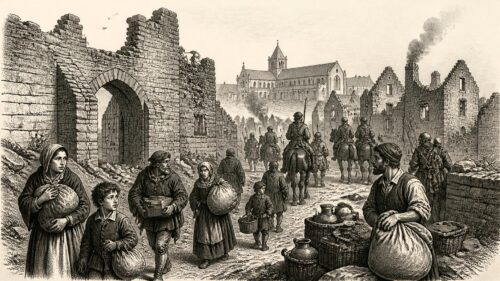
Political documents can give 1652 an appearance of orderly decision-making that was far removed from much of the country. Warfare had destroyed crops, driven people from homes, disrupted livestock rearing and interrupted markets. Garrisons required provisions and transport; mobile troops could seize or consume what remained. Famine and disease were already entwined with the military crisis and continued through this year. Modern scholarship rightly avoids pretending that the number of deaths can be calculated precisely, but agrees that Ireland suffered a demographic catastrophe across the conquest years. Hunger weakened bodies; displacement and crowding encouraged infection; disease in turn undermined work, harvests and household recovery.
A later Commonwealth-era observer who said that he travelled in Ireland in 1652 and 1653 remembered extensive desolation and people starving for want of food. Such testimony is vivid and politically coloured, and cannot substitute for a national census that does not exist. It nonetheless accords with wider evidence of an economy damaged by years of war. The experience varied by locality: places close to secure garrisons could have access to military markets, while districts exposed to raiding, clearance or the passage of troops could be stripped of food and stock. Women, children, elderly people and the landless were especially dependent on fragile kinship networks, charity, begging and whatever employment an army economy offered.
Religion intensified insecurity without ceasing to structure everyday life. The Catholic Confederacy’s political predominance had collapsed with the last major urban surrenders. Catholic worship and clerical networks did not disappear in 1652, but they operated under a victorious Protestant military government deeply suspicious of them. It would be misleading to place the formal January 1653 deadline for Catholic clergy to leave Ireland in this year; that was a subsequent measure. In 1652, however, the vulnerability of priests, religious communities and Catholic civic institutions was already unmistakable. Protestant settlers, soldiers and officials, meanwhile, anticipated a polity in which landholding, public authority and a reformed religious identity would be more closely aligned.
A Conquest Becomes a Settlement
By December, Ireland was not yet pacified in the full sense, nor had its new land map been drawn. The final formal surrender of the principal remaining Irish field force lay in 1653, and the Down Survey that would measure confiscated land belonged to 1656–58. Those later milestones should not be pulled back into 1652. Yet the year made them possible. Galway’s surrender removed the last great Confederate port; agreements such as that with William Kelly showed how resistance could be dissolved or exported; Fleetwood’s command prepared an army government for the work of occupation; and the Act of 12 August supplied the legal machinery for punishment and redistribution.
For contemporaries, the future was not a finished Cromwellian settlement but a landscape of fear, calculation and improvised survival. The decisive change of 1652 was that conquest no longer meant merely the movement of armies. It became a programme to reorder ownership, authority and belonging throughout Ireland.

Primary Sources
- An Act for the setling of Ireland
- Commissioners for Ireland: Exceptions to the Articles for the Surrender of Galway, and Replies to These Exceptions, April 11, 1652
- Articles agreed on by Captain Henry Sankey
- Proceedings of the Forces in Ireland under Sir Hardress Waller and Lord-Deputy Ireton, 1650–1651
- Coote, Sir Charles
- Fleetwood, Charles
- The Cromwellian Conquest, 1649–53
- Cromwell and the Cloister: Female Religious and the Impact of the Cromwellian Campaigns, 1649–60
- Extirpation and Annihilation in Cromwellian Ireland
- The Down Survey of Ireland: About
- ‘Pirates in Our Channel’: The Cromwellian Navy in Ireland, 1649–53
- Crowds and Political Violence in Early Modern Ireland: Galway and the 1641 Depositions
- Chapter Five
- Ireland Under the Stuarts
- Cromwellian Plantation in Ireland (1652–1658)
- The Present State of Ireland Together with Some Remarques upon the Antient State Thereof
- The Political Anatomy of Ireland, Chapter IV
- Act of Settlement [1662] and Act of Explanation [1665]
- Abstracts of Cromwellian Grants of Land in Ireland, 1653–1659
- An Act for the Setling of Ireland, Thursday, 12th August, 1652