

Athenry’s Unfinished Wall1576 CE
In 1576 Sir Henry Sidney extended Tudor authority through provincial journeys, submissions, hostages, county organisation and garrisons, but encountered persistent resistance. At Athenry, devastated during Burke conflict, he ordered a smaller defensible enclosure, yet reconciliation collapsed when Clanricarde’s sons defied restrictions, leaving rebuilding incomplete. Connacht’s new counties and Nicholas Malby’s command joined administration to coercive warfare. William Drury’s Munster presidency introduced courts, martial law and proposed composition, threatening lordly power. Rory Óg O’More’s resistance exposed instability in the midlands. Succession disputes, learned men’s deaths, fires and Essex’s death further marked a year in which expanding government failed to secure consent.
Dateline
In 1576, the Tudor government’s reach in Ireland expanded most visibly not through a single decisive battle but through journeys, courts, hostages, garrisons and building works. Sir Henry Sidney, lord deputy for Elizabeth I, moved through Munster and Connacht trying to turn negotiated obedience into a more durable system of counties, officials and enforceable agreements. Yet the same year showed how precarious that programme was. Athenry, a walled town already scarred by warfare, became a particularly vivid emblem: its repair was ordered, its perimeter was to be reduced and strengthened, but political reconciliation broke down before the work could secure the town.
Sidney’s Progress and Provincial Rule
The chronology of Sidney’s western progress is clearest in broad outline rather than in every day’s movement. The Annals of the Four Masters, written later from an Irish learned perspective, place him travelling from Cork to Limerick around the feast of St Brigid, 1 February. Chiefs from both the English and Irish political worlds of Munster, including figures of the Dál gCais, accompanied him. The annalists state that Sidney proclaimed peace in Munster and abolished coigny, kerne-ty and varieties of bonnacht: customary exactions by which military households, kern and hired soldiers were maintained from local communities.
Those measures mattered well beyond official terminology. Coigny and bonnacht transferred the costs of lordship and warfare directly to householders, farmers and tenants: food, lodging, cattle and labour could be demanded in kind. To abolish them promised relief, but it also challenged the practical resources by which Gaelic and Gaelicised magnates sustained followers. Sidney’s settlement therefore sought not simply peace, but a redistribution of authority away from armed lordly retinues and towards the crown’s courts, sheriffs and paid officials.
From Limerick Sidney went towards Galway, bringing O’Brien leaders with him. Thomond was in the process of being detached from Connacht’s administrative orbit and attached to Munster; the year’s sources connect this change directly with the new presidential arrangements. The remapping of provinces and shiring of territories should not be mistaken for instant transformation on the ground. Such measures made claims about jurisdiction, taxation, legal process and military command. Their effectiveness depended on whether local lords, inhabitants and crown officers could make those claims real.
Galway, Hostages and Athenry
At Galway, Sidney met major Connacht interests: Richard Burke, second earl of Clanricarde; the earl’s sons Ulick and John; John Burke, Mac William Íochtair; Murrough O’Flaherty; and the O’Kellys. The meeting produced submission, promises and hostages. The Dál gCais were held to guarantee agreements and restitution, while Donnell O’Brien was selected for crown service in Clare. The annalists credit his brief authority with a remarkable restoration of security, claiming that cattle needed no watchmen and doors no longer needed to be shut. Such a statement is rhetorical, not a statistical report, but it conveys what order meant to contemporaries: safety for livestock, households and movement through the countryside.
Sidney also carried the Burke brothers to Dublin as pledges for damage attributed to them during their father’s confinement. Ulick and John were known as the Mac an Iarla, the earl’s sons. Their earlier attacks had devastated parts of Clanricarde and ruined Athenry. In the spring, Sidney viewed the town and found an exceptional scene of destruction: its houses, collegiate establishment and parish church had been burned. The town’s fate was especially painful because Athenry had once been an important Anglo-Norman borough, defended by substantial walls and towers, but had long been economically weakened by surrounding conflict and lordly exactions.
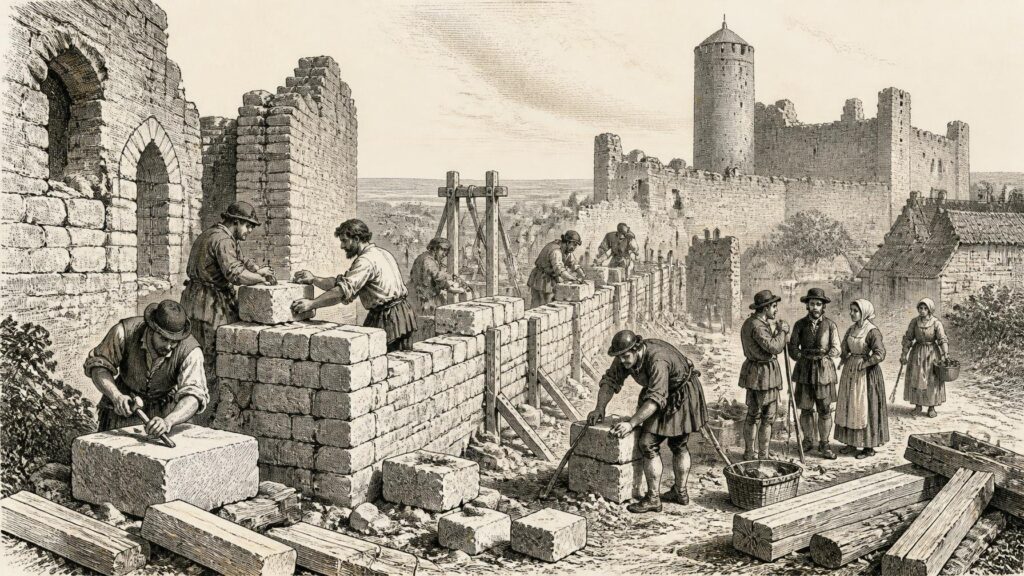
Sidney ordered reconstruction. Rather than restoring the entire extensive medieval enclosure, he proposed cutting the settlement into two, creating a smaller defensible space within the old walls. Local country was to bear a levy for the work, and masons began rebuilding. This was a practical response to depopulation as much as a military project: a reduced town needed fewer inhabitants to defend and fewer resources to maintain. The planned inner wall was thus an attempt to adapt an old urban landscape to the realities of sixteenth-century Connacht.
It did not resolve the political struggle which had produced the ruins. The Burke brothers were allowed to visit friends in adjoining territories under an undertaking not to return home without permission. They crossed the boundary nonetheless, apparently with their father’s support or connivance, according to the annalists. Within days Sidney pursued them as far as Athlone. Clanricarde surrendered Loughrea and extensive property, and was arrested as the queen’s prisoner. His sons and the government captains left in the lordship then fought and plundered one another through the autumn and winter. The same source contrasts the brothers’ hold on woods, mountains and difficult country with government possession of chief castles and more accessible land. That distinction captures the limits of Tudor power: forts and towns could be occupied, but control of an entire lordship was another matter.
Connacht Recast, Connacht Contested
Sidney’s progress was associated with the more systematic definition of Connacht into counties, notably Galway, Mayo, Roscommon and Sligo, while Clare’s altered provincial position was also confirmed. Courts and sessions, new county boundaries, garrisons and nominated officers were intended to make royal government legible across the west. In July Sir Nicholas Malby was appointed chief commissioner of Connacht. He travelled with Sidney in September and, after Sidney knighted him on 7 October, received sole military command with roughly 500 soldiers.
Malby’s appointment was consequential because it supplied the new administrative geography with coercive force. But it was not a peaceful civil reform. His immediate task was war against the Clanricarde rebels, and his subsequent methods included the seizure of supplies and the destruction of enemy resources. The clash in Connacht demonstrated that shiring could be experienced locally as an extension of military occupation, particularly where the crown sought to displace established magnates or demand compensation for ruined towns and crown subjects.
A New President in Munster
On 20 June, Sir William Drury was appointed lord president of Munster. He received an armed household of about 150 men and a commission of martial law. The presidency offered a standing provincial instrument of government in a region where the earls of Desmond and Ormond, the MacCarthys, O’Briens and many lesser lords exercised powerful and overlapping claims. Drury’s instructions and early activity envisaged circuit courts, punishment of robbery and rebellion, and pressure for a composition: a fixed, regular revenue intended to replace more variable lordly demands and military maintenance.
The year’s Irish annal records Drury travelling through Munster’s principal towns and executing men identified as thieves, rebels or opponents of the new order. Its account of hangings in the O’Brien country gives an important corrective to any simple picture of law as benign reform. Courts, executions and martial authority were inseparable in the first operation of the presidency. In November, Drury’s sessions at Clonmel indicted Sir Edmund Butler, brother of the earl of Ormond, an early indication that even powerful crown-connected families could not assume immunity from the new provincial jurisdiction.
For the moment, the larger confrontation with Gerald Fitzgerald, earl of Desmond, still lay ahead. Drury’s proposed composition would have required Desmond to curb his military following while his dependants paid fixed rents. That threatened the economic and social foundations of regional lordship. In 1576, therefore, Munster’s presidency was established, but its authority had not yet been securely accepted.
Leinster’s Unquiet Midlands
Elsewhere, reconciliation proved equally fragile. In Laois and Offaly, Rory Óg O’More’s renewed resistance grew from the violent consequences of plantation and the imposition of martial law by Francis Cosby, seneschal of Laois. O’More drew support from dispossessed O’Connor Faly dynasts and raided widely. The Four Masters describe Rory and Conor, son of Cormac O’Connor, gathering woodkern in forces of several hundreds and burning or desolating parts of Leinster, Meath and Fingal.
Sidney received Rory into the queen’s peace in June and hoped to accommodate him within the plantation settlement. That agreement did not remove pressure on O’More’s followers or land. It is therefore important to distinguish the dated submission from a genuine settlement: the violence of 1576 was a prelude to the intensified war of 1577 and not evidence that the midlands had been pacified.
Succession, Learning and Loss
Not all the year’s changes were driven by the state. Donough MacCarthy Reagh died and was buried at Timoleague; his brother Owen succeeded as MacCarthy Reagh under Gaelic succession custom, rather than Donough’s son Florence inheriting immediately. The transition shows that English-style hereditary assumptions and Gaelic political practice could coexist uneasily within one lordship. It also left Florence, still young, a crown ward under Drury’s authority.
The annals preserve quieter evidence of social and cultural life. William Óg Mac Ward, ollamh to O’Donnell, head of schools and patron of learned people, died on 22 February at Druim Mór. Boethius Óg Mac Clancy, an ollamh in jurisprudence to the Dál gCais, also died. Their notices show the continued standing of hereditary learned families, schools, poetry and legal expertise amid political disruption. A devastating fire at Cavan, which consumed the great monastery and much of the town down to the river, and Brian O’Rourke’s depredations in Annaly, meanwhile underline the vulnerability of towns, religious houses and rural communities.
Finally, Walter Devereux, earl of Essex, returned to Dublin in July as earl marshal of Ireland, visited his Farney interests and died of dysentery on 22 September. His death closed the career of the man whose private colonising venture in Ulster had brought severe violence without achieving the promised plantation. In 1576, government in Ireland was becoming more organised, provincial and intrusive. Yet Athenry’s unfinished wall, the broken hostage arrangements and the fighting from Connacht to the midlands made clear that maps, offices and proclamations could not by themselves command consent.
Primary Sources
- Annals of the Four Masters, Volume 5 English Translation
- Calendar of the State Papers Relating to Ireland, 1574–1585
- State Papers Ireland 1509–1782: Government Papers on Irish Affairs
- O'More (Ó Mórdha), Rory (Ruaidhrí Óg)
- Drury, Sir William
- Malby, Sir Nicholas
- O'Neill, Turlough Luineach
- Burke, Ulick
- Devereux, Walter
- MacCarthy Reagh, Florence (Finian, Finghín)
- Instructions of the Lord Deputy and Council to Sir W. Durries, President, and the Council of Munster, Dublin, June 20, 1576
- Letters from Sir H. Sydney to the Lords of the Council, Concerning the State of Ireland, 1575–1578
- Athenry: Walled Towns Day 2016
- Athenry Medieval Walled Town
- Athenry Castle
- Sixteenth Century
- When Did County Clare Belong to Connacht?
- The Lord Presidents of Munster
- William Drury, Knight, Lord President of Munster
- The Gaelic Dimension, 1560–1760
- Essex’s ‘Enterprise’
- Calendar of State Papers, Ireland, Tudor Period, 1568–1571