

Fitton’s Galway Summons1572 CE
In 1572 Sir Edward Fitton’s Galway court and arrest of the earl of Clanricarde provoked Ulick and John Burke’s rebellion across Connacht. Supported by gallowglasses and Scottish mercenaries, they attacked castles, towns, trade routes and government allies, devastating Athenry and threatening Galway. The crown released Clanricarde to restore peace, but negotiation merely suspended disputes over succession and authority. Meanwhile, rebels unsuccessfully aided James fitz Maurice during the siege and eventual fall of Castlemaine Castle, a key stage in the first Desmond rebellion. Deaths of churchmen, learned men and civilians, alongside reported human and cattle mortality, reflected insecurity amid Tudor rule.
Dateline
In 1572 the most consequential Irish fighting did not occur in a single set-piece battle. It unfolded across Connacht in the wake of a summons to Galway, as local rivalries, crown intervention and hired military service combined to wreck towns, castles and livelihoods. The year also saw the long first Desmond rebellion driven towards its close in Munster, where Castlemaine Castle finally fell after a prolonged siege. These connected crises showed how limited the Dublin government’s authority remained beyond its strongest centres: an official court, an arrest or a garrison could provoke as much resistance as it commanded obedience.
A Court at Galway
Sir Edward Fitton, president of Connacht, called a court at Galway around the feast of St Patrick. The summons was broad in ambition. Leading men from territories stretching from Limerick to Sligo were expected to attend: Richard Burke, 2nd earl of Clanricarde; his sons Ulick and John; the Mayo Burkes under John mac Oliver Burke; and chiefs and followers from Thomond and elsewhere. Such gatherings were meant to turn regional lordship into a hierarchy answerable to the queen’s officers. They were also opportunities to demand bonds, hostages, submissions, military service and recognition of government jurisdiction.
For the sons of Clanricarde, however, the meeting became a point of rupture. Ulick and John Burke, widely called the Mac an Iarlas—the sons of the earl—were already rivals in their own right and uneasy with Fitton’s presidency. According to the annalistic account, they heard an alarming rumour in Galway and slipped away. Modern biographical research places their open rebellion on 1 April, after Fitton arrested their father. The sequence matters: the crown sought to use the earl’s authority to restrain his sons, while the sons treated the detention as proof that their family’s standing was under direct threat.
Fitton took other Clanricarde leaders into custody and escorted the earl through Athlone to Dublin. He then returned west, moving with troops, artillery and a Galway levy against Aghananure, the O’Flaherty castle near the Corrib. The Annals of the Four Masters say that the castle was partly demolished, then entrusted to Murrough na dTuadh O’Flaherty. This was not merely a punitive excursion. It was an attempt to establish alliances, rearrange local power and make garrisoned strongholds depend upon the presidency.
Yet Fitton could not convert that show of force into lasting control. The Mac an Iarlas called out their own adherents. The annals name Clann Sweeney and Clann Donnell gallowglass companies, with many Scots among them; later accounts describe an army of about 2,000, including Clanricarde followers, Mayo Burkes and Scottish mercenaries. The number should be treated as an estimate rather than a muster roll, but the wider point is secure. Warfare in Connacht depended upon mobile household forces and professional soldiers, connected across the North Channel as well as across Ireland.
Athenry’s Broken Defences
From late spring into the middle of autumn, the coalition attacked the physical and economic infrastructure of government and of its local allies. The annalists describe the demolition of towers and castles through Clanricarde, plundering between the Suck and the Shannon, and raids eastwards into Westmeath. Mullingar and Athlone were burned or damaged; at Athlone, the raiders reached the bridge and burned the part of the town outside it. Such movements were not random violence. They struck defended places, routes, rival lordships, stores and communities identified as friendly to English authority.
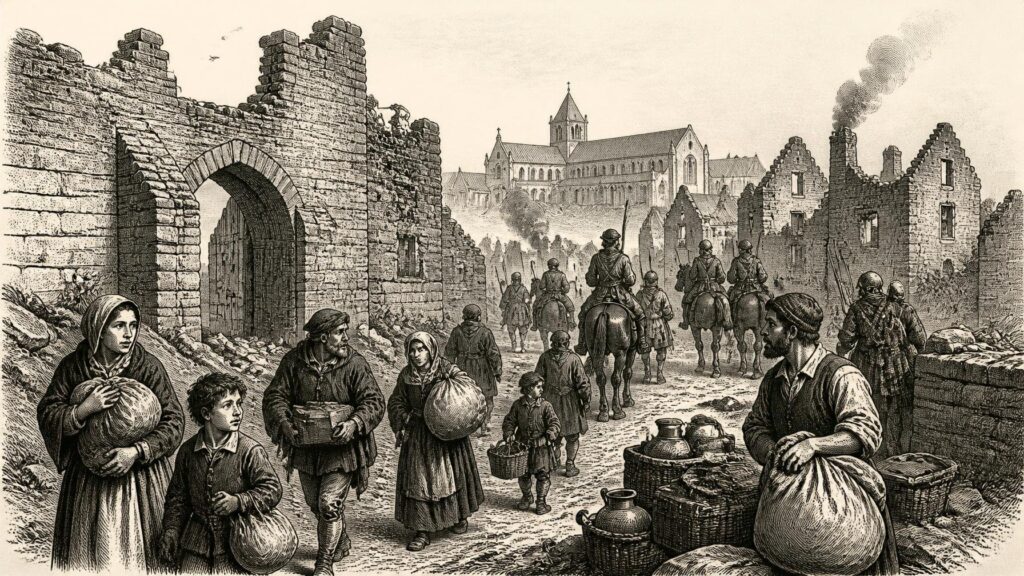
Athenry was among the gravest losses. The annals state that the rebels destroyed its walls, stone houses and castle, damaging the town so severely that repair was difficult for a long time. A contemporary town record also shows the seriousness of the danger: money was paid to George Bodkin for an undertaking to defend Athenry’s walls from the earl of Clanricarde’s sons and other rebels. It is prudent not to imagine every building reduced to ruins, but the event was unquestionably a devastating assault on a walled borough whose defences were central to its security, market life and standing.
The significance of the attack extended well beyond Athenry itself. Medieval and early modern towns were places where agricultural produce, hides, livestock and imported goods were exchanged, where artisans worked, and where royal administration could be made visible. Damaging gates and walls endangered inhabitants, but also disrupted trade, discouraged settlement and advertised that neither charter nor masonry guaranteed protection. The annals explicitly say that merchants suffered during the campaign. Galway city was threatened twice; the captain of soldiers stationed there was reportedly killed at the west gate.
There were limits to the alliance. The raiders passed into western Connacht against the wishes of the O’Flahertys and plundered Murrough O’Flaherty while using the route through Áth Tíre Oileáin. This illustrates a recurring feature of sixteenth-century conflict: coalitions formed quickly against a common enemy but did not erase competing territorial claims. Nor should the Mac an Iarlas’ rebellion be reduced to a simple ethnic contest between Irish and English. The Burkes were descendants of Anglo-Norman settlers, yet had long participated in Gaelic lordship, used Irish military networks and opposed an expanding Tudor administration. Their enemies and allies likewise crossed inherited cultural boundaries.
Peace Bought, Not Secured
By autumn the Dublin council had changed course. It released the earl of Clanricarde on terms intended to restore peace through paternal authority. The annals say that he returned home, reconciled his sons and that the hired soldiers were dismissed after receiving their wages. Other evidence places his release in August; the exact timing of the settlement should therefore not be pressed beyond late summer or autumn. The settlement ended the year’s concentrated campaign, not the underlying conflict. Government demands for restitution, disputes over succession and the brothers’ rivalry would continue to destabilise south Connacht.
The rebels also crossed the Shannon in September in an unsuccessful effort to support James fitz Maurice FitzGerald in Munster. There, the first Desmond rebellion was entering a decisive but not yet final phase. Sir John Perrot, president of Munster, besieged Castlemaine Castle in the summer with forces drawn from Munster, the larger towns and the crown’s Irish and English allies. The siege lasted three months. The annals attribute the castle’s fall to shortage of provisions rather than failure of defence; James fitz Maurice’s attempts to bring in Scottish relief therefore failed. He would not formally submit until February 1573, so it is misleading to say that the rebellion ended in 1572.
The Connacht and Munster crises were linked by personnel, military employment and fear of wider confederacy, but they had distinct causes. In Munster, FitzMaurice’s revolt had combined the politics of the Desmond lordship with an avowed defence of Roman Catholicism against the Reformation. In Connacht, the immediate trigger was Fitton’s intervention in the Clanricarde succession struggle and the reach of provincial government. Both conflicts nevertheless revealed the crown’s reliance on local magnates, garrisons and negotiated submissions—and the precariousness of each.
Church, Learning and Loss
Amid warfare, the year’s annal recorded deaths which reveal the texture of Irish society. Christopher Bodkin, archbishop of Tuam, died shortly before 15 August and was buried at St Nicholas’s, Galway. Bodkin had occupied a particularly ambiguous position during the religious changes of the Tudor age: recognised in both Catholic and Church of Ireland structures, he embodied the incomplete and contested character of reformation in the west. John Óg Ó Niallain, bishop of Kilfenora, also died and was buried in his cathedral town.
The annals also noted the drowning of John, son of Thomas, in the River Suck, and the death of Henry Ó Cráidhín, described as a wealthy merchant of Lower Connacht. Such entries are reminders that rivers, travel and commerce formed part of daily risk as well as regional life. More starkly, the earl of Thomond hanged Owen Roe MacWard, Maurice Ballach Ó Cléirigh and another man. The annalist identifies MacWard and Ó Cléirigh as learned in history and poetry and presents their deaths as a treacherous act that brought satire and condemnation upon the earl. Learned families were not detached observers: poets, historians and genealogists sustained reputations and claims to legitimacy, making their treatment politically charged.
Finally, the annals report a “great mortality of men and cattle” in 1572. They do not provide a cause, scale or local distribution. It would be unsafe to diagnose an epidemic or famine from that brief notice alone. Even so, in a year when armies burned settlements, took livestock and strained food supplies, the recorded mortality underlines the insecurity faced by households far removed from the decisions made at Galway, Dublin or Castlemaine.
One later-famous life also began in this unsettled year: modern reference works place the birth of Hugh Roe O’Donnell, future lord of Tyrconnell, in 1572, though no contemporary source supplies a secure day and month. For Ireland in the present tense of 1572, however, the more immediate legacy lay in broken walls, discharged mercenaries and settlements that rested on negotiation rather than peace.
Primary Sources
- Annals of the Four Masters, Part 8: Annals M1572
- CELT Project: Annals of the Four Masters
- Burke, Ulick
- Burke (de Burgh), John
- Burke (de Burgh), John (Seaan, Shane Mac Oliverus)
- Fitzwilliam, Sir William
- Bodkin (Bodekin, Bodikin), Christopher
- Fitzgerald, James fitz Maurice
- Devereux, Walter
- O'Donnell, Hugh [Aodh Ó'Dónaill; known as Red Hugh, Hugh Roe, Aodh Rua], lord of Tyrconnell (1572–1602), chieftain and rebel
- Athenry
- Athenry Gazetteer Final
- Athenry Walled Town
- The Story of Athenry (1950)
- Sixteenth Century
- Calendar of State Papers, Ireland, Tudor Period 1571–1575
- State Papers Ireland 1509–1782: government papers on Irish affairs
- Irish Manuscripts Commission Catalogue 2020–2022
- Colonel Thomas Smyth's Settlement in the Ardes, 1572
- Irish Historic Towns Atlas Volume I: Kildare, Carrickfergus, Bandon, Kells, Mullingar, Athlone