Ormond Peace1646 CE
In 1646, the Catholic Confederation reached its military zenith but became divided over peace with Charles I. Owen Roe O’Neill’s victory over Scottish Covenanters at Benburb, Preston’s Connacht operations, and the capture of Bunratty strengthened hopes of securing Catholic religious and political guarantees. The First Ormond Peace, agreed secretly with the royalist lord lieutenant, offered insufficient protections and provoked clerical, military and popular resistance. Papal nuncio Giovanni Battista Rinuccini led opposition, overthrowing the agreement and remodelling Confederate government. A failed advance on Dublin exposed rivalries, weak supply and divided command. Kilkenny’s Catholic print culture also articulated suffering, rights and legitimacy.
Dateline
In 1646, Ireland stood at a moment of striking Confederate strength and acute political division. Four years after the creation of the Catholic Confederation at Kilkenny, its leaders controlled much of the country, fielded provincial armies and conducted diplomacy with the king, the papacy and continental powers. Yet their achievements did not produce a settled government or a secure peace. Instead, military victories in Ulster, Connacht and Munster sharpened disagreement over what those victories were for: a limited accommodation with Charles I, or a war continued until Catholic worship, property and political security received firmer guarantees.
The year therefore cannot be reduced to a single battle. It joined the struggle for Ireland to the wider Wars of the Three Kingdoms, while making clear that Irish Catholic politics had aims and institutions of its own. The crisis centred on the First Ormond Peace, secretly concluded in spring, publicly announced in summer and destroyed by clerical, military and popular opposition in the autumn. Its collapse brought the papal nuncio, Giovanni Battista Rinuccini, briefly to the height of his influence. It also exposed divisions among the Confederates which victory could not remove.
A Peace Made in Secret
On 28 March, the Confederate Supreme Council concluded an agreement with James Butler, marquess of Ormond, Charles I’s lord lieutenant in Ireland. Ormond held Dublin for the king and was attempting to preserve royal authority in a kingdom divided among royalists, parliamentarians, Scottish Covenanters and Confederate Catholics. The proposed settlement was intended to bind the Confederates to the royal cause and permit Irish troops to assist Charles in Britain. For many members of the Supreme Council, especially those associated with Viscount Muskerry and the Old English Catholic landed interest, an agreement seemed the least dangerous option in a widening war.
But the treaty did not supply the secure religious settlement that many Confederates expected after 1641. Its provisions offered concessions and protections, yet central issues were deferred to royal favour and a future parliament. It did not guarantee the unrestricted public practice of Catholicism, settle possession of churches, or undo the constitutional and land questions which had fed Catholic mistrust of the Dublin administration. In Ulster particularly, this was inseparable from the legacy of plantation. A peace that preserved the existing framework without clear redress looked to many like a surrender of the war’s principal purposes.
The manner of negotiation aggravated the dispute. Rinuccini, archbishop of Fermo and papal nuncio to the Confederates since late 1645, had pressed for a stronger settlement and for continuing Catholic unity. The Supreme Council had indicated that it would wait for a possible papally mediated alternative, but nevertheless completed the Ormond agreement in March. News that Charles had distanced himself from earlier, more generous-looking dealings by his agent, the earl of Glamorgan, further undermined confidence in royal promises. The agreement remained politically fragile even before it was openly proclaimed.
Benburb’s Decisive Day
The most emphatic event of the year occurred on 5 June at Benburb in County Tyrone. There Owen Roe O’Neill’s Confederate Ulster army defeated the Scottish Covenanter force commanded by Robert Monro. O’Neill had returned from long service in the Spanish Netherlands with experience of continental warfare, but his army had previously suffered from weak supply, limited equipment and the insecurity of campaigning in a devastated province. Papal money and military stores distributed after Rinuccini’s arrival helped make the 1646 campaign possible, although they did not erase the logistical constraints under which O’Neill operated.
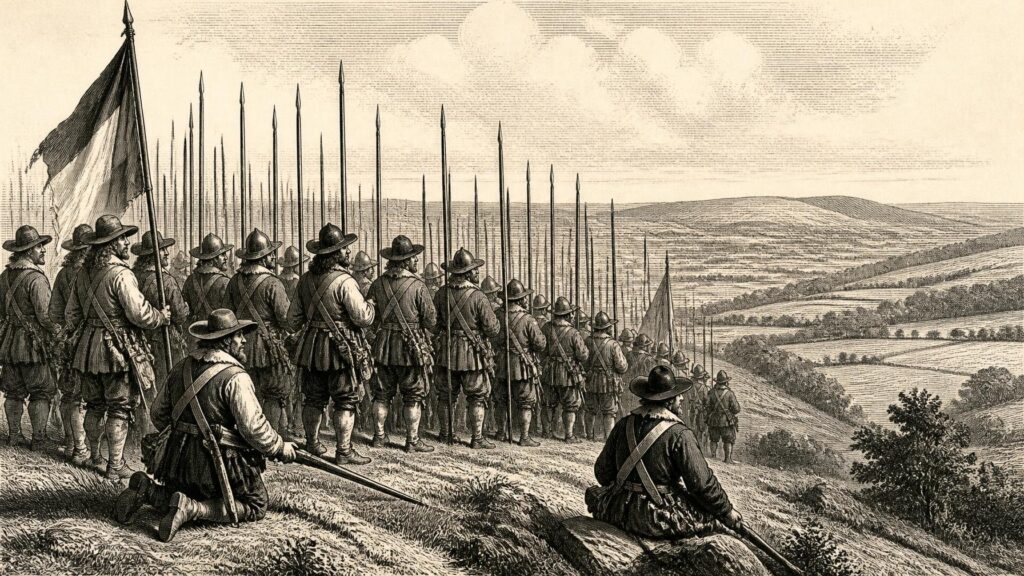
At Benburb, O’Neill prevented a converging enemy movement and chose ground which forced Monro’s men to attack uphill late in the day, with the sun against them. His infantry’s effective use of shortened pikes was remembered as a crucial feature of the fighting. The result was a severe defeat for the Covenanters and one of the most important Confederate battlefield successes of the entire war. Monro withdrew towards the surviving Scottish-held positions in east Ulster, while the victory demonstrated that an Irish Catholic army could defeat a formidable, professionalised opponent in open battle.
Its limits were as important as its drama. O’Neill did not possess the siege train or sustained resources required to overrun the fortified Scottish and settler enclaves of east Ulster. The Laggan army around Derry remained intact, and many troops dispersed after the campaign, as early modern soldiers commonly did when food, pay and plunder could not be reliably maintained. Benburb changed the balance of power; it did not settle Ulster. Still, it profoundly altered politics in Kilkenny. To Rinuccini and his supporters, success seemed evidence that continued war, pursued for explicitly Catholic ends, was both possible and providentially favoured.
Fighting Along the Shannon
Military pressure was not confined to the north. In Connacht, Thomas Preston’s Leinster army captured Roscommon town during its western campaign, though it did not achieve its larger objective of reaching and securing the port of Sligo. Preston, like O’Neill, had acquired military experience in continental service. He was also O’Neill’s long-standing rival. Their separate commands gave the Confederation formidable manpower on paper, but rivalry between provincial armies, commanders and political clients repeatedly reduced the strategic value of that strength.
In Munster and Clare, the siege of Bunratty revealed the importance of rivers, shipping and fortified houses. In March, a parliamentary expedition occupied Bunratty Castle, on the Shannon estuary below Limerick. The garrison could be supplied by sea, making the castle a dangerous parliamentary foothold close to Confederate-held territory and to a major port. Confederate forces under Muskerry besieged it through the summer. William Penn, serving with the parliamentary naval force, kept a detailed diary which records the practical centrality of ships, tides, provisions, artillery and communications.
The siege was costly for everyone within its reach. Troops had to be fed; surrounding country was exposed to raids and seizure; and the estuary became a military corridor rather than simply a route for local exchange. Rinuccini travelled to the camp near the end of June and supplied money for the besieging forces, an intervention that connected papal diplomacy directly to a local campaign. After the parliamentary commander, Colonel John MacAdam, was killed by a shot on 1 July, the defenders’ position worsened. The garrison capitulated on 14 July and was evacuated by sea to Cork, leaving its arms, ammunition and provisions behind.
Bunratty, Benburb and the Connacht gains made the summer of 1646 the high-water mark of Confederate military opportunity. Yet the victories also made compromise harder. The argument was no longer merely whether the Confederates could survive; it was whether they should accept a limited royal settlement just when their armies appeared capable of improving their position. War thus shaped political expectations as much as it determined frontiers.
Waterford, Kilkenny and the Nuncio
The First Ormond Peace was publicly proclaimed in Dublin on 30 July. Rinuccini answered by convening a synod of clergy at Waterford in early August. On 12 August the synod denounced the agreement. Its action was not simply the command of an Italian envoy imposed upon Irish Catholics: the large majority of clergy present shared the judgement that the treaty had failed religion. Supporters of the settlement could be represented as breaking the Confederate Oath of Association, while towns permitting its proclamation faced ecclesiastical pressure. On 1 September, Rinuccini issued excommunication against Confederates who persisted in supporting the peace.
Ormond attempted to sustain the agreement by travelling towards the Confederate heartland. He reached Kilkenny but could not consolidate support there; a proposed meeting at Cashel did not restore his position. As opposition gathered, he returned to Dublin on 14 September. Rinuccini then entered Kilkenny with armed backing. Leading advocates of the peace, including Muskerry and the Confederate secretary Richard Bellings, were imprisoned, and a new Supreme Council was appointed on 26 September. The treaty was, in practice, overthrown.
These events show both the reach and the weakness of Confederate institutions. The Confederation possessed a Supreme Council, a General Assembly, provincial armies, taxation and a diplomatic presence. But its authority depended on consent between clergy, gentry, townsmen and commanders rather than on an unquestioned monopoly of force. The Waterford synod could delegitimise a treaty, while armies could decide whether that judgement had effect. The conflict was not a simple division between Irish and English identities: Old English Catholics, Gaelic Irish leaders, clergy, royalists and town-based political interests crossed and re-crossed the lines of faction.
Dublin Unreached
The new leadership chose to turn its energy against Dublin, the royalist capital under Ormond. O’Neill and Preston moved towards it, but their co-operation was brittle. Their combined forces reached the outskirts in early November, yet the prospect of a sustained siege collapsed when an English parliamentary squadron entered Dublin Bay. Winter, supply difficulties and mutual distrust mattered as much as the arrival of outside help. O’Neill withdrew rather than commit his army to an operation for which neither unified command nor reliable resources existed. The campaign ended without the capture of the city that might have transformed the political map.
For ordinary people, such strategic reversals were lived through in smaller and harsher terms: disrupted tillage, uncertain markets, requisitions of grain and cattle, billeting, ruined communications and the danger of armed men moving through a district. The surviving records are richer in generals’ decisions than in the words of labourers, tenants or displaced families. Nevertheless, the repeated importance of cattle, provisions, shipping and local garrisons makes plain that warfare bore directly upon everyday subsistence. A victory at Benburb or Bunratty did not automatically bring security to the communities around it.
A Kilkenny Publication
Amid this crisis, Kilkenny also produced a notable work of print. Henry Burkhead’s A Tragedy of Cola’s Furie, or Lirenda’s Miserie was published there in 1646. Written in verse and shaped as a drama, it reimagined the violence that had begun in 1641 through transparent disguises: “Lirenda” stood for Ireland, while its Catholic defenders confronted cruel enemies. It is particularly significant as a rare literary work written from a Catholic Irish viewpoint during the wars. Whether it was performed is uncertain; its survival as a printed text is the firmer fact.
The publication matters because it places political argument beyond council chambers and battlefields. Kilkenny was not merely a wartime headquarters: it was a centre where printers, clerics, lawyers, envoys and soldiers circulated texts and arguments. Burkhead’s drama transformed recent trauma into a case about rights, suffering and legitimacy. In a year when the Ormond Peace divided the Confederates, print supplied another means of defining what Ireland’s conflict meant.
By the end of 1646, Confederate Ireland had won its greatest military successes only to discover that victory intensified the struggle over peace. Benburb had checked the Covenanter threat in Tyrone; Bunratty had removed a parliamentary foothold on the Shannon; the First Ormond Peace had been broken by a coalition of clergy and soldiers. But Dublin remained outside Confederate hands, the armies remained divided, and the political settlement had been deferred rather than achieved. The year left Ireland stronger in appearance, but less united in purpose.

Primary Sources
- Rinuccini, GianBattista
- O'Neill, Owen Roe (Ó Néill, Eoghan Rua)
- Preston, Thomas
- Butler, James
- Bellings (Bealing), Richard
- Burkhead, Henry
- The Confederation of Kilkenny
- The First Ormond Peace, 1646
- William Penn, Diary of an English Sea Captain, 1646
- Bunratty Castle
- A Chronology of Ireland
- List of Published Texts at CELT
- Commentarius Rinuccinianus de Sedis apostolicae legatione ad Foederatos Hiberniae catholicos per annos 1645-1649
- An aphorismical discovery of treasonable faction
- The Battle of Benburb, 1646
- Another Look at the Battle of Benburb, 5 June 1646
- The Embassy in Ireland of Monsignor G. B. Rinuccini, Archbishop of Fermo, in the Years 1645-1649
- History of the Irish Confederation and the War in Ireland, 1641-1649
- Ireland under the Stuarts and during the Interregnum
- A Tragedy of Cola's Furie, or, Lirenda's Miserie
- 'The Modell of its Sad Afflictions': Henry Burkhead's Tragedy of Cola's Furie
- Catholic Confederates and the Constitutional Relationship between Ireland and England, 1641-1649
- Peacemaking in Ireland and England, 1642-1646
- Ireland in Crisis: War, Politics and Religion, 1641-50