

Lifford’s Spanish Envoy1596 CE
In 1596, attempts to settle the Ulster conflict through pardons and limited autonomy failed as Hugh O’Neill and Hugh Roe O’Donnell linked territorial claims with Catholic liberty. Spanish envoy Alonso de Cobos met them at Lifford, prompting an appeal to Philip II for troops and a Habsburg ruler, and tying Irish resistance to European war. In Connacht, Norreys’s large expedition stalled beside the River Robe when provisions ran out, revealing the importance of supply and alliances. Succession disputes, raids, coercive administration and religious tensions widened disorder across Ireland. Changes in Connacht’s government and continued local rivalries failed to restore stability.
Dateline
In 1596, the war centred on Ulster did not yet look like the island-wide struggle it would become. It was, however, moving decisively in that direction. Hugh O’Neill, earl of Tyrone, and Hugh Roe O’Donnell of Tyrconnell had already made the English administration’s authority in the north and north-west precarious. During this year, negotiations which might have contained the conflict were overtaken by Spanish diplomacy, while O’Donnell’s intervention in Connacht displayed the reach of the northern alliance. The year also exposed how contested lordship, religion, food supply and local succession were bound together in late Tudor Ireland.
A Negotiated Peace That Did Not Hold
At the opening of 1596, the Dublin government still hoped to end the war by agreement. A cessation of arms was arranged in late January, and Crown representatives met O’Neill and O’Donnell in a wider effort to secure their submission. The terms under discussion were substantial. They contemplated pardons, a degree of local autonomy, and concessions which would have reduced intrusive royal administration in the northern lordships. Yet O’Neill and O’Donnell did not simply seek private forgiveness. Both connected settlement to claims over territory, followers and religion. O’Donnell demanded recognition of his interests in Sligo and north Connacht, and both leaders pressed for liberty of conscience for Catholics.
This was an important change in the language of the conflict. O’Neill had long operated in both Gaelic and English political worlds: he held an English earldom, had dealt with Dublin Castle, and had previously used royal service to strengthen his own position. But in 1596 he and his allies placed the free exercise of Catholic religion among their negotiating demands. That did not make every participant in the alliance a religious ideologue, nor did it erase dynastic and territorial motives. It did, though, give the confederacy a language capable of appealing beyond the immediate interests of Tyrone and Tyrconnell.
The English side was divided in method as well as weakened in the field. Sir William Russell, the lord deputy, and Sir John Norreys, general of the army, had an unhappy working relationship. Norreys was inclined to explore a settlement and, in May, was appointed with Sir Geoffrey Fenton to investigate and help pacify Connacht. Russell and other officials remained doubtful that negotiation could secure a durable peace. The practical difficulty was plain: the Crown could offer pardons, but its garrisons and officials could not easily impose terms over wide areas where local lordships commanded men, cattle, routes and intelligence.
Alonso Cobos at Lifford
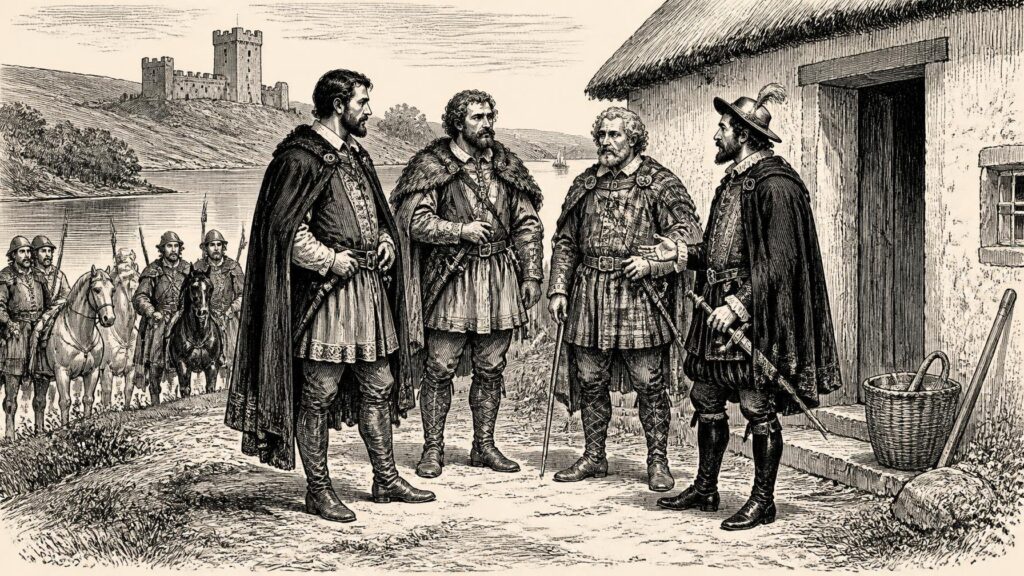
The fragile compromise was overturned in May by the arrival of Spanish agents. Captain Alonso de Cobos reached Tyrconnell and met O’Donnell at Lifford, the O’Donnell centre on the River Foyle. O’Neill then joined O’Donnell, accompanied by his brother Cormac MacBaron. Their talks with Cobos were conducted privately, with Hugh Boye MacDavitt—experienced in the wars of the Low Countries—acting as interpreter.
The consequences were immediate and far-reaching. O’Neill and O’Donnell abandoned the developing accommodation with the Crown and wrote jointly to Philip II of Spain. They sought an expeditionary force and proposed that a Habsburg prince should rule in Ireland. That proposal should not be mistaken for a settled constitutional programme shared by all Irish people. It was a wartime diplomatic initiative by two powerful northern lords seeking a counterweight to Elizabeth I’s government. But it demonstrated that the Irish conflict had become entwined with the wider Anglo-Spanish war and the Counter-Reformation politics of Europe.
Spanish promises were strategically valuable even before soldiers arrived. They offered hope of arms, money and professional support; they also gave O’Neill and O’Donnell a reason to prolong talks with the government rather than accept a settlement. Letters associated with O’Neill’s secretary, Henry Hovenden, reveal deliberate delay in negotiations after the Spanish intervention. There is an additional complication for modern readers: the confederates increasingly used the Gregorian calendar associated with Rome, whereas the English administration retained the old-style calendar. Dates in contemporary correspondence therefore require care. The difference itself carried political and confessional meaning.
Connacht and the River Robe
While diplomacy unfolded in the north, Connacht showed that the war was no longer an Ulster border crisis. The province had been unsettled by the collapse of the government’s earlier arrangements, by competition among local dynasties, and by resentment of Sir Richard Bingham’s hard rule. O’Donnell had already gained influence there through alliances and military pressure. In 1596 Norreys led a major Crown expedition westwards, joined by Ulick Burke, earl of Clanricarde, Donough O’Brien, earl of Thomond, and other loyal forces.
The Annals of the Four Masters, compiled later in the seventeenth century but drawing on Irish annalistic traditions, depicts this as an imposing muster. Its reported figure of 20,000 should not be treated as a secure modern count; what is secure is that the campaign was understood as an unusually large show of royal strength. The army assembled around Athlone, moved through Roscommon and Boyle, and reached the River Robe in Mayo. O’Donnell answered a request for help from Theobald Burke, Mac William Íochtar, by marching from the north-west and gathering Connacht allies, including Brian Óg O’Rourke, O’Conor Roe, O’Kelly, MacDermot, the MacDonaghs, O’Haras and O’Dowdas.
The opposing camps faced one another across the River Robe. No decisive battle followed. Instead, provisioning decided the outcome: Norreys’s force exhausted its food and withdrew, leaving garrisons in a chain of western and midland settlements, including Galway, Athenry, Cong, Ballinasloe, Roscommon, Tulsk and Boyle. This episode illustrates the material reality of war. Armies required grain, cattle, transport, pay and secure roads; a commander who could not feed his troops could not compel submission merely by assembling a large force. For civilians, the same campaigns meant requisitioning, raiding, displacement and the danger that crops and livestock would become military targets.
In the autumn, the government removed Bingham from power in Connacht after serious complaints against his administration. Sir Conyers Clifford became chief commissioner in December. The change acknowledged that coercion alone had aggravated disorder, but it did not restore the Crown’s position in north Connacht. O’Conor Sligo returned from England with English support, while O’Donnell retaliated against those who joined him by driving off cattle. Allegiance was neither fixed nor abstract: it was tested through kinship, local rivalries, protection and the immediate capacity to defend property.
Lordship Under Pressure
Succession disputes gave the wider conflict further openings. In East Bréifne, the death of Sir John Roe O’Reilly prompted O’Neill to support Philip O’Reilly’s claim to the senior Gaelic title. This challenged the Crown-backed composition that had divided authority and land among branches of the O’Reilly family. Philip openly adopted the name O’Reilly in July, proclaiming the return of tanistry; by early October he had been killed in an internal encounter involving O’Neill’s followers. The episode demonstrated both Tyrone’s growing influence beyond Ulster and the risks of attempting to rearrange local power through war.
In Munster, Donal MacCarthy Mór, first earl of Clancare, died late in the year. His death left an uncertain succession in a lordship spanning much of south Kerry and west Cork. Donal’s career embodied the overlap between Gaelic and English political forms: he was MacCarthy Mór and also an earl created under royal authority. His surviving Irish religious poems are a reminder that cultural production remained active amid political pressure. The annals also record the death of Theobald Butler of Cahir and Trian, praised for possessing a notably large collection of poetry among the Old English elite. Such notices reveal that patronage, manuscripts and learned culture mattered alongside military affairs.
Violence was not confined to frontier campaigns. Redmond Fitzgerald, lord of Tuath Bhrothaill, was executed at Cork for insurrection. In Leinster, Owny O’More ravaged Leix, attacking crops, corn and dwellings and killing the planter Alexander Cosby at Stradbally. Fiach MacHugh O’Byrne continued raiding in Leinster and Meath. These actions were connected to local dispossession, plantation and rivalry as much as to O’Neill’s strategy. Yet they widened the insecurity surrounding the Pale and showed how quickly northern resistance could encourage or shelter conflicts elsewhere.
Faith, Towns and Daily Consequences
Religion was increasingly visible in 1596, though religious practice varied sharply by region and social group. William Lyon, the Protestant archbishop of Cork, complained that congregations and communicants in the city had dwindled dramatically and that Catholic priests operated openly with support among merchants and aldermen. His testimony was partisan, but it points to a real difficulty for the established church: in port towns as well as Gaelic lordships, the Catholic renewal linked Ireland to continental seminaries, clerical networks and Iberian politics.
For most people, however, the year’s great questions were felt in ordinary pressures: whether cattle survived a raid, whether a market road was safe, whether a garrison demanded provisions, and whether a local lord could protect tenants and dependants. The contest was not simply between “Ireland” and “England”. Gaelic lords, Old English magnates, Crown officers, town elites, soldiers, clerics and farming communities pursued overlapping and conflicting interests. Still, 1596 marked a decisive enlargement of the struggle. At Lifford, Spanish diplomacy made continued resistance seem plausible; at the River Robe, supply and local alliances frustrated a royal campaign; and across Ireland, unsettled lordships and religious division ensured that peace would remain elusive.
Primary Sources
- Annals of the Four Masters: Annal M1596
- Annals of the Four Masters: Irish Text, Annal M1596
- O’Neill, Hugh | Dictionary of Irish Biography
- O’Donnell, ‘Red’ Hugh (Ó Domhnaill, Aodh Ruadh) | Dictionary of Irish Biography
- Norris (Norreys), Sir John | Dictionary of Irish Biography
- O’Reilly, Philip (Pilib Ó Raghallaigh) | Dictionary of Irish Biography
- MacCarthy Mór, Donal | Dictionary of Irish Biography
- Bingham (Byngham), Sir Richard | Dictionary of Irish Biography
- Clifford, Sir Conyers | Dictionary of Irish Biography
- MacCarthy Reagh, Florence (Finian, Finghín) | Dictionary of Irish Biography
- O’Neill, Sir Toirdhealbhach | Dictionary of Irish Biography
- Faith & Fatherland in Sixteenth-Century Ireland
- Calendars in Conflict
- Political Discourse and the Nine Years’ War in Late Elizabethan Ireland, c.1593–1603
- State Papers Ireland 1509–1782: Government Papers on Irish Affairs
- Calendar of the State Papers Relating to Ireland, 1596–1597
- Articles Agreed between Wallop and Gardiner and Tyrone and O’Donnell, January 1596
- Cotton MS Titus B XIII/2 | British Library Archives and Manuscripts Catalogue
- A Calendar of Manuscript Material Relating to Ireland, 1580–1602
- Hugh O’Neill & Faith and Fatherland
- Gregorian Calendar in Ireland
- Philip II’s Forgotten Armada