Kilmallock Sack1571 CE
In 1571, conflict and cultural change exposed the limits of Elizabethan government in Ireland. The sack of Kilmallock, whose dating requires careful comparison of sources, revealed Munster’s vulnerability during rebellion. A battered fortress and contested lordships reflected instability, including divisions across Connacht. Meanwhile, a Dublin publication in Irish type connected religious reform with language and print. Crown appointments, prospective colonial grants and reforming commissions expressed claims, but their implementation relied on alliances, supplies and local obedience. The year therefore resists a single national narrative, showing military coercion, regional rivalry and cultural initiatives unfolding within a fragmented and contested political landscape.
Dateline
In 1571, Ireland’s political fractures were made visible in a market town before dawn, in a battered Munster fortress, in disputed lordships across Connacht, and on a Dublin press producing a small book in Irish type. The year did not bring a single nationwide turning point. Rather, it exposed the limits of Elizabeth I’s government: it could appoint presidents, grant vast prospective colonies and commission religious reform, yet its authority beyond the Pale and selected towns depended on alliances, military supply, local knowledge and the uncertain obedience of magnates.
Dating a Town’s Disaster
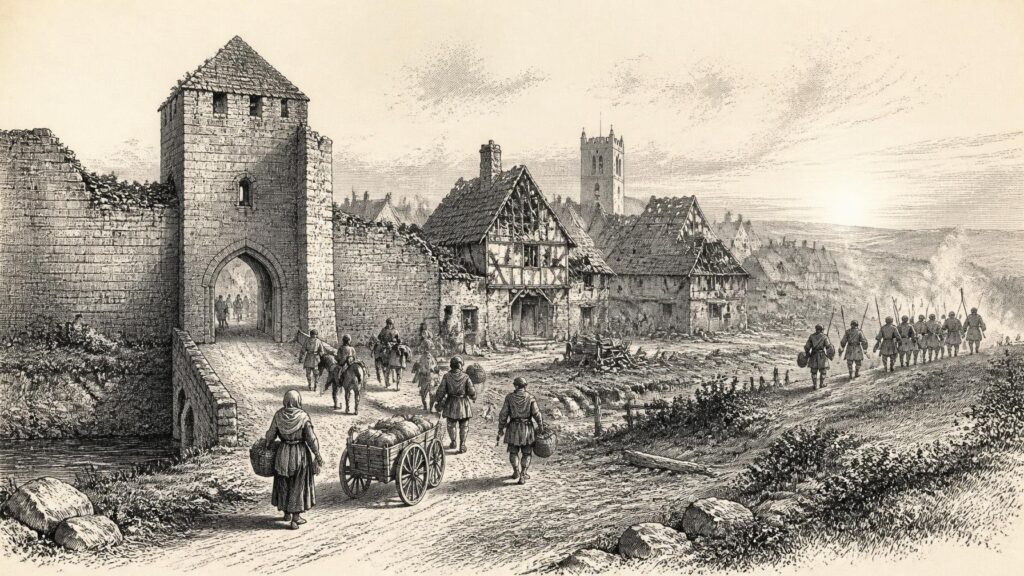
The sack of Kilmallock is the best-known Irish event assigned to 1571, but its dating requires care. The Annals of the Four Masters, compiled later from Irish materials, places James FitzMaurice Fitzgerald’s capture of the town under its annal for 1571. Other historical reconstructions distinguish attacks on Kilmallock in both 1570 and 1571, while a local conservation history gives 2 March 1571 for the later destruction. The safest conclusion is that a major assault, plunder and burning belong securely in the year, but that the exact day should not be treated as beyond dispute.
Kilmallock was no isolated village. Its walls, gates, religious houses and substantial urban dwellings marked it as one of north Munster’s important towns, positioned on routes between Limerick and Cork. It also served the crown’s allies and garrisons. That strategic role explains why FitzMaurice, the effective leader of resistance while the Earl of Desmond remained in English custody, targeted it. The annalist expressly interprets the attack as a blow against a place repeatedly used by English and Geraldine opponents, rather than as a raid undertaken simply for portable wealth.
The same account nevertheless dwells on wealth: gold, silver, valuables and household goods were divided among FitzMaurice’s followers, who included Mac Sweeny and Mac Sheehy fighting men. Its vivid image of residents roused before sunrise conveys the shock of a surprise assault, but it is literary as well as evidential; it should not be read as a precise inventory or a neutral civilian testimony. What can be stated firmly is that plunder and fire damaged a walled town whose commercial life and buildings mattered greatly to the government’s hold on Munster. Ordinary townspeople bore the immediate cost in lost property, disrupted work and the danger of flight.
Perrot’s Munster Presidency
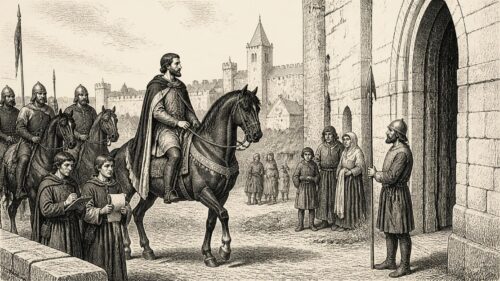
The crown answered through a stronger provincial command. Sir John Perrot landed at Waterford on 27 February 1571 and, after being sworn in during March, began operating as lord president of Munster. The office was intended to bring the province under more direct and continuous supervision than could be managed from Dublin. Perrot moved quickly to Kilmallock, where later accounts describe him lodging amid the damage and calling on inhabitants to return and repair the place. Rebuilding a town and restoring its walls were military measures as much as acts of recovery: Kilmallock was to become a usable base for crown forces again.
Perrot’s campaign also shows why office-holding did not equal control. In June and July he besieged Castlemaine, a Desmond stronghold commanding an important position in Kerry. He assembled Munster allies and used artillery, yet a shortage of powder, provisions and support forced the abandonment of the siege. The failure was significant. It demonstrated that the government’s garrisons and commanders could strike hard but still struggled to sustain operations in difficult country against a mobile enemy supported by local networks.
Later in the year, Perrot’s frustration produced the extraordinary proposal of a personal combat with FitzMaurice, with attendants on either side. No duel occurred. FitzMaurice’s reported reasoning was practical: his own death might ruin his party, whereas the queen could send another president if Perrot fell. The episode is less evidence of chivalric warfare than of a campaign at stalemate. It also illustrates how the First Desmond Rebellion combined dynastic rivalry, resistance to expanding crown administration, military employment and confessional tension. FitzMaurice was not yet defeated; his submission would come only in 1573.
Officials, Hostages and Connacht War
At the centre, government was unsettled. Sir Henry Sidney’s deputyship ended in March, and Sir William Fitzwilliam, returned from England in January, became lord justice that month. He was not appointed lord deputy until January 1572, a distinction that matters. Financial strain shadowed his administration: an audit of the preceding decade had revealed enormous crown expenditure in Ireland, overwhelmingly met from English subsidies. Ambitions for provincial reform therefore met a hard fiscal reality.
The death on 1 April of Sir Thomas Cusack, former lord chancellor and a three-time holder of viceregal office, closed the career of a major Pale official. His life had spanned the Tudor remaking of government and church, yet his will retained language and provisions associated with older religious practice. Cusack’s death is a reminder that official conformity did not automatically produce simple personal or family identities in sixteenth-century Ireland.
Connacht’s annals offer a different view of state-building. The Annals of Loch Cé record Sir Edward Fitton, president of Connacht, at Athlone, where Diarmaid O’Conchobhair Donn was seized despite a guarantee of safety. The prisoner escaped, according to the annal, after allies came to Athlone, and then hired 800 Scottish fighting men. These Albanachs helped turn a local political contest into a wider burden of exactions, cattle-taking and burnings across Magh Luirg and neighbouring territories.
Fitton answered with repeated expeditions. The annal records his capture of Baile an Tobair and Caisleán Riabhach, the demolition of the latter, a seven-week residence at Roscommon during which he took hostages, and another advance into Clanricarde. At Áth Sceitin he installed warders; at Carraig an Phoill, the defenders were killed and the site demolished. These entries are not a complete campaign journal, but they reveal the mechanics of power in 1571: fortified places seized or broken, hostages demanded, garrisons planted, and armies consuming the resources of districts through which they moved.
Irish Print and Divided Religion
Amid warfare and coercion, 1571 also produced a landmark in Irish-language culture. On 20 June, John Kearney’s Aibidil Gaoidheilge agus Caiticiosma, an alphabet and catechism translated from Latin and English into Irish, was printed in Dublin. It was the first book printed in the Irish language in Ireland, using type specially created for Irish. The colophon identifies Dublin, the financial backing of alderman John Ussher, and the date. At only fifty-four pages, the book was modest in scale, but its technical and cultural importance was immense.
The work was a Protestant instrument: Elizabeth’s government hoped that vernacular religious instruction might advance the reformed church among Irish speakers. Yet its existence also acknowledged a fundamental fact that official policy could not evade: Irish was the language through which much of the island lived, learned and worshipped. Kearney, treasurer of St Patrick’s Cathedral, drew on knowledge of Irish scribal practice in designing the type. The project therefore joined state-sponsored evangelisation to an indigenous written culture rather than replacing that culture outright.
Church government itself remained complicated. On 3 February Miler Magrath was translated from Clogher to the Church of Ireland archbishopric of Cashel and Emly. At the same time, he retained the Roman Catholic bishopric of Down and Connor, an arrangement that captures the ambiguity of the period more effectively than a simple Catholic–Protestant division. Ecclesiastical titles, revenues and loyalties could overlap in ways that served political survival as well as doctrine. The appointment did not signal a settled Protestant victory in Munster; the province was simultaneously being fought over by Perrot and FitzMaurice.
A Paper Colony in Ulster
In November, Elizabeth granted Sir Thomas Smith and his son a royal interest in the Ards peninsula and Clandeboye in east Ulster; surviving accounts conventionally date the letters patent to 16 November. The proposed undertaking envisaged English settlement, fortification and the acquisition of lands claimed by the crown in territory associated with the Clandeboye O’Neills. It was an important development in colonial thinking, combining private investment with royal authority and military expectations.
Nothing in 1571 permits the claim that Smith had successfully planted the district. The settlers would not arrive until the following year, and the enterprise would meet determined opposition. What belongs to this year is the grant itself: a paper assertion of title over a large inhabited region, made without the consent of those who claimed it by inheritance. In that sense, the patent foreshadowed the sharper conflicts over land, jurisdiction and settlement that would shape Ulster in the 1570s and beyond.
Succession and Survival
Irish annals also preserve quieter changes in local authority. Teige Mac Conmara died and was succeeded by his son John; John O’Shaughnessy was displaced by his senior paternal uncle, Dermot Reagh. Such notices show that lordship did not operate only through the queen’s officers or the great earls. Succession, seniority, kinship and control of named territories remained decisive in everyday political life. The annalists praise hospitality, protection of dependants and martial capacity because these were practical measures of a lord’s standing.
Thus 1571 was not merely a prelude to later rebellion or plantation. Kilmallock’s destruction, Castlemaine’s survival, Connacht’s hostage-taking, the Dublin catechism and the Ards grant each belonged to the same year, yet pointed in different directions. Violence disclosed the weakness of imposed authority; print attempted to communicate reform in Irish; and colonial patents imagined a reordered landscape. Ireland entered 1572 with none of these tensions resolved.

Primary Sources
- Annals of the Four Masters, Annal M1571
- Annals of the Four Masters, Irish Text, Annal M1571
- Annals of Loch Cé, Annal LC1571
- Annals of Loch Cé
- Fitzgerald, James fitz Maurice
- Perrot, Sir John
- Fitzwilliam, Sir William
- Cusack (Cusacke, Cusake), Thomas
- Magrath, Miler (Meiler)
- Kearney, John (Ó Cearnaigh, Seán)
- Smith, Sir Thomas
- The First Printed Book in Irish
- Aibidil gaoidheilge, [agus] caiticiosma
- Calendar of State Papers, Ireland, Tudor Period 1571–1575
- Calendar of State Papers, Ireland, Tudor Period 1568–1571
- Kilmallock Town Walls Conservation and Management Plan
- Kilmallock
- The Life and Times of Sir Peter Carew, Kt.
- The Hamilton Manuscripts
- A Letter Sent by I. B. Gentleman Unto His Very Frende Mayster R. C. Esquire
- Before the Hamilton & Montgomery Settlement of May 1606: Sir Thomas Smith’s Forgotten English Colony of 1572
- The Elizabethan Court Day by Day, 1571