Ladders at Sligo1501 CE
During 1501, Ireland’s political life remained intensely regional despite Gerald FitzGerald, eighth earl of Kildare, serving as lord deputy. In Oriel, rival Mac Mahon branches fought, displacing opponents and causing significant deaths, while Maguire forces suffered heavily at Slieve Beagh. Rival O’Conor kinsmen captured Sligo castle by ladders, killing leading combatants. Churchman John Maguire and poet Donnell O’Higgin were commemorated for learning and hospitality. Edmund Burke was seized returning from pilgrimage to Spain and held for ransom. Finally, Turlough O’Brien of Thomond burned parts of Limerick and the Maigue plain, demonstrating warfare’s continuing economic and human impact throughout the island.
Dateline
For Ireland, 1501 is best approached not as a year of one national event but as a sequence of sharply local struggles. The annals record fighting in Oriel, Slieve Beagh, Sligo and Thomond; deaths among ruling families; the capture and ransom of a returning pilgrim; and the passing of churchmen and learned men. Taken together, these notices reveal an island in which authority was intensely regional. The English crown’s lordship survived, and Gerald FitzGerald, eighth earl of Kildare, was serving as lord deputy, but its effective reach was uneven. Beyond the Pale and the larger Anglo-Irish lordships, political power rested with dynasties whose territories, alliances and rival branches could change through raids, hostage-taking, marriage, service and sudden violence. Kildare’s deputyship formed an important wider setting, but the events securely dated to 1501 are overwhelmingly those preserved in Irish annals.
War Within Oriel
The most sustained account concerns Oriel, the broad north-central region associated with the Mac Mahons and neighbouring powers. The Annals of Ulster and the Annals of the Four Masters agree that war broke out between the descendants of Aodh Ruaidh, or Hugh Roe, and those of Redmond Mac Mahon. This was not a simple contest between separate peoples. It was a feud within the political community described as Oriel itself, demonstrating the instability created when competing branches of a ruling kindred possessed followers, claims and armed resources of their own.
Rossa Mac Mahon carried cattle into Lucht Tighe, rendered in the Four Masters as Loughty, and drove Redmond’s descendants out of the district towards O’Neill protection. The wording matters. Cattle were not merely provisions or plunder: they were movable wealth, the basis of food, hospitality, tribute and compensation. To move herds in wartime was to sustain one’s own following while impoverishing and displacing an opponent. The annal’s account therefore offers a glimpse of the hardship behind concise reports of ‘war’: households had to move, pasture was contested, and a lord’s capacity to feed retainers was tested.
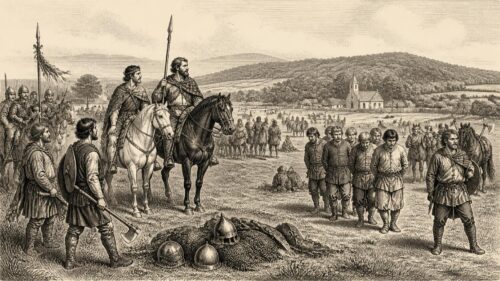
The opposing parties met at Ath an Choileir. Turlough, son of Conn O’Neill and described as the son of the earl’s daughter, supported Redmond’s descendants. His death there was presented by the Four Masters as especially grave: he was called the finest son of an Irish lord of his time. John Mac Donnell, identified as Mac Donnell Galloglagh, was also killed, along with many others. The latter designation points to the continuing importance of professional military households of Scottish-Gaelic origin and connection. Their presence in an Oriel conflict illustrates how warfare drew on networks extending beyond any one lordship, while loyalties could be purchased, inherited or politically cultivated.
The Slieve Beagh Slaughter
Another encounter made 1501 particularly destructive for families around Fermanagh and Monaghan. Thomas, son of Thomas Óg Maguire, was killed on Sliabh Beatha, now generally known as Slieve Beagh, by the sons of Brian, son of Redmond Mac Mahon. The Annals of Ulster calls the loss around him enormous and names the dead with unusual care: Maguire kinsmen, including Gilla Íosa, Thomas, Cormac, two men named Ruaidhrí, Edmund and Magnus, as well as Brian and Donnchadh Mac Manus. Its total is forty-seven killed in the incursion. Such lists were not casualty returns in the modern sense, but they preserve the names of men whose standing made their deaths politically consequential.
The killing was more than an episode of personal vengeance. The Maguires were the leading family in Fermanagh, and the Mac Mahons were central to Oriel. The battle exposed the permeability of lordly frontiers: a dynastic struggle in Oriel could draw in a Maguire force and bring violence across the upland zone between their spheres. It also helps explain why alliances mattered so much. In a polity where succession was not mechanically settled by eldest-son inheritance, collateral relatives could become rivals, and military reverses could alter the prospects of whole branches. The year’s deaths, including Niall son of Art O’Neill, whom the Annals of Ulster calls an eminent leader and dates to a month before Christmas, were therefore losses of political as well as familial importance.
A Castle Taken by Ladders
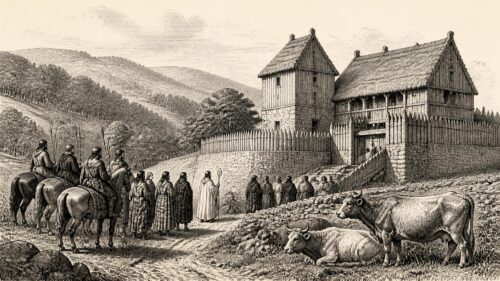
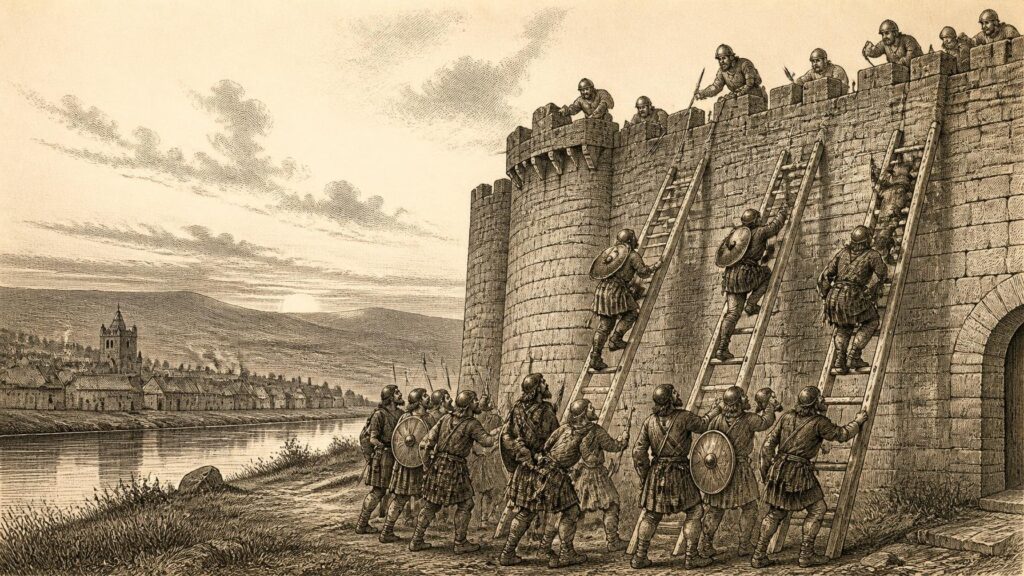
In north-west Connacht, the castle of Sligo was taken in 1501 by the sons of Ruaidhrí and of Felim, both sons of Turlough Carragh O’Conor. The annals’ memorable detail is that ladders were used from the top of the castle. It does not permit a full reconstruction of the assault, but it makes clear that the attackers gained entry by scaling the defences rather than by a recorded siege of artillery or starvation. Inside, Calvagh Caech, or ‘the Blind’, son of Donnell O’Conor, was slain. John, son of Ruaidhrí, also died at Calvagh’s hand in the same struggle.
The episode shows both the value and the vulnerability of a late medieval stronghold. A castle was a residence, storehouse, symbol of lordship and point from which a family could command a settlement and its approaches. Yet walls required loyal guards, supplies and constant vigilance. At Sligo, rival O’Conor kin used a practical expedient to settle a contest that the castle itself could not contain. The Annals of Ulster and Four Masters independently preserve the capture, strengthening confidence that it belongs to this year, while leaving the wider causes of the O’Conor dispute uncertain. It is sensible not to claim more than the evidence allows.
Church, Learning and Hospitality
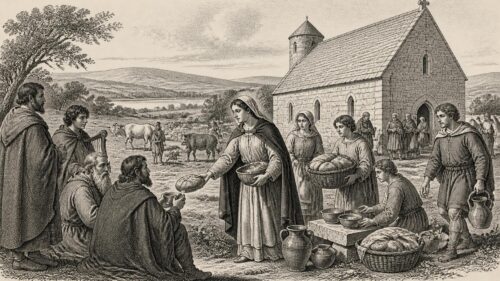
Amid these conflicts, the annals record institutions of care and learning. John, son of Rossa Maguire, died in the Ides of June. He had been canon-chorister at Clogher, parson and erenagh of Aghalurcher. An erenagh was a hereditary ecclesiastical office-holder responsible for church lands and local religious obligations; the combination of posts places John at the meeting point of clerical service, kinship and landed authority. He was praised as learned in both Latin and Irish and as the keeper of a house of general hospitality. That notice should not be read as a neutral biography, but it faithfully conveys the qualities his community thought worthy of commemoration: bilingual learning, ecclesiastical office and the ability to feed and receive those in need.
Hospitality was a political as well as religious virtue. A household able to provide food, lodging and protection displayed resources and secured loyalty. It mattered to churchmen, poets and lords alike. In this respect John Maguire’s obituary belongs beside the year’s cattle raids: both point to the centrality of provisioning. The contrast is stark. One entry remembers a household open to travellers and dependants; another records herds driven from a district in war. Food, livestock and shelter underpinned social status as surely as arms did. Scholarship on later medieval and sixteenth-century Irish households likewise emphasises hospitality as a core expectation of lordship.
Pilgrims, Ransom and Movement
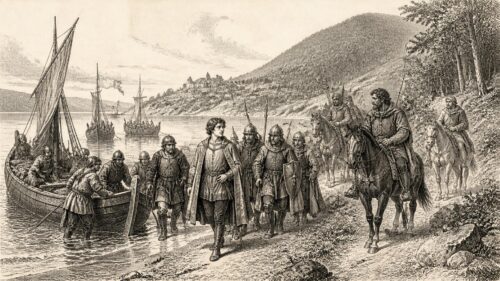
1501 also supplies evidence of Ireland’s connections beyond its shores. Edmund, son of Richard Burke, was seized by Mac William of Clanricarde while returning from the pilgrimage of St James in Spain. A large ransom was demanded, together with good hostages from his people and his own son. The report is blunt, but it discloses several realities. Pilgrimage could take Irish men across the Bay of Biscay and back; return did not guarantee safety at home; and elite captivity was governed by negotiation rather than simple imprisonment. Hostages made agreements enforceable because a lord’s kin and followers had a direct stake in payment.
Donnell O’Higgin, described as chief preceptor of the schools of Ireland in poetry, also died after returning from the pilgrimage of St James. His title evokes the learned families whose schools preserved and developed advanced Irish literary culture. Poetry, genealogy, history and legal learning were not marginal accomplishments: they helped articulate rank, entitlement and memory in lordly society. The deaths of O’Higgin and John Maguire therefore offer a necessary corrective to an annalistic year dominated by raids. Ireland in 1501 was a country of warriors and castles, but also of clerics, teachers, pilgrims, professional poets and households organised around hospitality.
Winter in Thomond
The final major notice falls in Munster. During the winter of 1501, Turlough O’Brien, lord of Thomond, burned County Limerick and Cois Máighe, the plain around the River Maigue. The source gives no precise day, route or casualty figure, so the event should not be embellished into a campaign whose details are unknown. Its timing is nevertheless revealing. Winter did not end political violence. Burning crops, settlements or stores during the coldest season could magnify suffering and damage an opponent’s ability to sustain people and animals until spring.
Across the island, then, 1501 was marked by the practical workings of lordship. Oriel’s rival branches fought over people and resources; Maguire and Mac Mahon forces met in a costly clash; an O’Conor castle changed hands at Sligo; pilgrims became captives or returned to die at home; and Thomond’s lord carried war into Limerick and the Maigue country. Dublin government under Kildare remained an important part of the political landscape, yet the year’s surviving record is a reminder that Ireland was not governed through one centre alone. Its history was made in lordly households, churches, schools, upland passes, cattle country, ports and contested castles.
Primary Sources
- Annals of the Four Masters
- Part 1 of Annals of the Four Masters
- The Annals of Ulster
- Part 124 of The Annals of Ulster
- Annals of Ulster otherwise Annala Senait, Annals of Senat
- Apparatus Criticus 41 for The Annals of Ulster
- FitzGerald, Gerald (Gearóid Mór)
- FitzGerald, Gerald (Gearóid Óg, Garrett McAlison)
- Darcy, Sir William
- Preston, Robert
- Food and Power in Sixteenth-Century Ireland: Studying Household Accounts from Dublin Castle
- The Rise and Fall of the Clann Éinrí Aimhréidh Uí Néill: Dynastic Feuding and Geopolitics in the Late Medieval Irish Sea World
- Gaelic Lordship and Tudor Conquest: Tír Eoghain, 1541–1603
- James IV, the O’Donnells of Tyrconnell and the Road to Flodden
- Gaelic Ireland: Land, Lordship and Settlement, c.1250–c.1650
- Tudor Fiants
- Upward Mobility in Later Medieval Meath
- Ireland in the Middle Ages
- Ireland’s Greatest Family: The FitzGeralds, Earls of Kildare
- Irish Historic Towns Atlas: Kildare