Raphoe’s Bleeding Crucifix1411 CE
Annals for 1411 portray Ireland as a patchwork of competing lordships, where succession disputes, captivity and violence shaped political life. In Munster, heirs and rivals among the Ó Briains, FitzGeralds, Mac Cárthaighs and Ó Súilleabháins were killed, expelled, blinded or displaced. Ó Conchobhair Fáilghe captured Meath’s sheriff for ransom, illustrating frontier insecurity, while Ó Domhnaill imprisoned Mulmhaire Mac Suibhne amid internal complaints. Annaghdown monastery burned, and church land officers, an historian and Thomond’s master poet died. The annals also report that Raphoe’s crucifix bled and healed illnesses, a medieval miracle claim reflecting devotion, pilgrimage and hopes for relief amid instability.

Dateline
The most striking Irish notice assigned to 1411 concerns an object rather than a battle or a ruler. The Annals of the Four Masters and the Annals of Loch Cé report that the Holy Crucifix at Raphoe, in present-day County Donegal, shed blood from its wounds, and that many illnesses were healed through it. This must be presented for what it is: a medieval annalistic report of a miracle, not evidence that can be tested as a physical occurrence. Yet the entry is historically important. It shows what contemporaries or later compilers considered memorable in a troubled year: divine favour, pilgrimage, healing and the authority of a sacred image could command attention alongside lordly expulsions, killings and ransom.
A Year Recorded Unevenly
Our view of 1411 is necessarily selective. The Irish annals preserve brief notices, chiefly of deaths, conflicts, ecclesiastical offices and exceptional religious happenings. They do not offer a complete calendar of events or an even survey of every region. The Annals of Loch Cé, centred in the learned world of Connacht and north-western Ireland, and the later Four Masters compilation overlap closely for this year, though they phrase some reports differently and preserve different details. Their agreement gives firmer footing to the broad outline, but their entries should not be inflated into more than they say.
That outline is of an island divided among numerous Gaelic and Gaelicised lordships, alongside the reduced but still consequential English lordship based on Dublin and the eastern counties. No single government controlled Ireland evenly. Authority was personal, territorial and negotiated: a lord’s standing depended on kinship, retainers, military capacity, alliances, fosterage, church connections and the ability to reward followers. The events placed in 1411 demonstrate that political life could turn swiftly on a family quarrel, an ambush, a captive official or the removal of a rival claimant.
Munster’s Fractured Lordships
Munster supplied several of the year’s sharpest notices. Donnchadh, son of Conchobhar Ó Briain and tánaiste, or designated heir, of Thomond, was killed by Barry More. The annals give no date, place or extended explanation. Even so, the description matters. He was not merely a member of a prominent family but an acknowledged successor within the Ó Briain lordship of Thomond. His death removed a figure whose position carried expectations of future rule and illustrates the vulnerability of succession in a political culture where several eligible kinsmen might contend for leadership.
Farther south and west, the balance of power in Desmond and among the Mac Cárthaigh and Ó Súilleabháin kindreds was also unstable. The Four Masters state that Thomas, son of John, Earl of Desmond, was banished from Ireland by James, son of Garrett. This is an exceptionally terse report of a major familial rupture within the FitzGerald earldom. Later genealogical and peerage traditions differ over the dating and legal consequences of Thomas’s displacement; for 1411, the responsible conclusion is the limited one supplied by the annal: an expulsion was attributed to James. It signals that the title and practical power of the earldom could be contested from within rather than operating as an uncomplicated extension of English royal authority.
The same year brought violence among neighbouring Gaelic dynasties. Ó Súilleabháin Mór was seized and blinded in treachery, while his son was killed, by Domhnall Dubh Ó Súilleabháin. Blinding was not random brutality alone. In medieval political culture, bodily integrity was closely bound to eligibility for lordship; maiming a rival could therefore be a direct means of excluding him from power. The annals also record the killing of Conchobhar, son of Gilla Mochuda Ó Súilleabháin, by his own kinsmen, and the expulsion of Mac Cárthaigh Mór by the Ó Súilleabháins. Tadhg, called Caech na Moicheirghe and described as heir to the lordship of Desmond, was treacherously killed by his kinsman Feidhlimidh Mac Cárthaigh. These were not isolated private crimes. They were blows within competing networks of authority, landholding and armed followings.
Such reports help explain why terms such as “Gaelic” and “English” can mislead when used as fixed opposing camps. The Fitzgerald earls, the Barrys and the Mac Cárthaighs all held power in Munster, but local politics were shaped at least as much by kin rivalry and regional interest as by ancestry. The year’s recorded victims include an Ó Briain heir, a Mac Cárthaigh heir and members of the Ó Súilleabháin kindred: succession was a persistent source of danger across political and cultural boundaries.
Captivity at the Meath Frontier
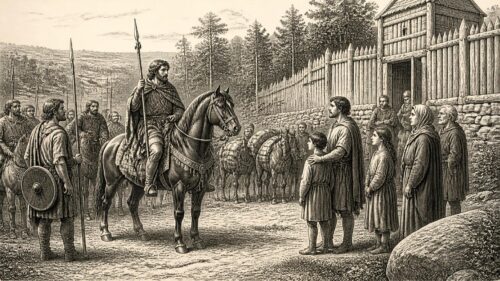
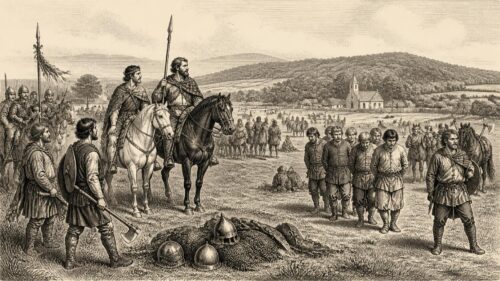
A concise notice from the midlands reveals the limits of government power beyond the core of the English lordship. The sheriff of Meath was captured by Ó Conchobhair Fáilghe, who exacted a great ransom. The sheriff was the king’s local officer in one of the principal counties of the lordship, while the Ó Conchobhair Fáilghe ruled the powerful Gaelic territory of Uí Fhailghe immediately to the west. His capture was therefore more than a profitable seizure of an individual: it exposed the insecurity of travel and administration along the frontier between Meath and Offaly.
The wording is careful. The annal does not say that Meath was conquered, nor that the sheriff’s authority disappeared. It records a prisoner and a ransom. But that was enough to demonstrate that royal office did not guarantee personal safety or uncontested reach. Ransom also points to the practical economy of conflict. Captives, livestock, horses, armour and access to fortified places could be converted into wealth, bargaining power and political recognition. Warfare was destructive, but it was also embedded in systems of extraction, compensation and negotiation.
Another entry concerns Mulmhaire Mac Suibhne, captured by Ó Domhnaill after accusations and complaints made by some of Mac Suibhne’s own people. The report offers no full account of the dispute, but it shows a lord acting upon internal grievance rather than simply confronting an external enemy. Across Ireland, senior rulers relied upon subordinate families, military households and mercenary connections; complaints within such relationships could become an opening for intervention. The Mac Suibhne name also evokes the enduring links between Irish lordships and the Gaelic world of western Scotland, through which fighting men, ships, marriage alliances and cultural connections moved.
Churches, Learned Offices and Loss
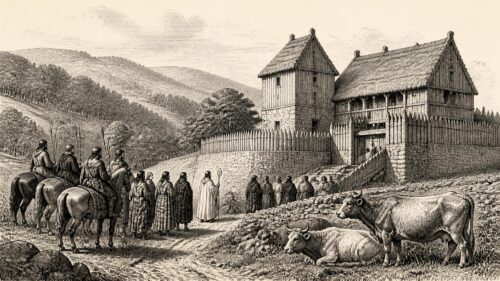
Religious institutions appear in 1411 as places of worship, economic resources and centres of learned life. The monastery of Eanach Dhúin, Annaghdown on Lough Corrib in County Galway, was burned. The annals do not identify the perpetrators, the cause or the scale of the damage. It would be irresponsible to supply a siege, accident or feud that the sources do not name. Still, the brief notice is a reminder that an ecclesiastical settlement was not outside secular conflict or misfortune. A monastic church required buildings, books, livestock, food stores, clergy and lay dependants; fire could disrupt worship and livelihoods alike.
Two deaths in the northern and western record disclose the local structure of church landholding. Conchobhar Ó Cathasaigh, erenagh of the lands of Muintir Chathasaigh at Devenish, and Johannes Mac Sgoloige, erenagh of his own lands at Ros Airthir, died. An erenagh was a hereditary church-land officer, normally drawn from a local learned or ecclesiastical family, who held responsibilities and revenues linked to a church territory. Their appearance beside kings and lords is significant. Religious life rested not only on bishops and monasteries but also on families managing land, dues and pastoral obligations over generations.
The year also took recognised custodians of learning. Domhnall Doidhiola Ó Beacháin was called an eminent historian, while Diarmaid, son of Gilla Íosa Mac Craith, was ollamh of Thomond in poetry. These titles were professional distinctions. Historians, poets, lawyers and genealogists preserved pedigrees, precedents, praise poetry, legal expertise and memories essential to a lord’s legitimacy. Their work was learned, often hereditary and sustained by patronage. The death of an ollamh was consequently both a personal loss and a loss to an institution of education and political culture. It also cautions against imagining fifteenth-century Ireland as culturally silent: the annals themselves were products of a literate tradition that valued named experts in history and verse.
Raphoe and Religious Hope
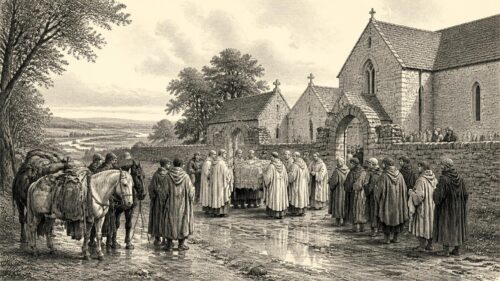
Against this background, the Raphoe crucifix notice acquires greater meaning. The annalists describe blood issuing from the image’s wounds and diseases being checked or healed. They do not give a day, name the sick, describe a pilgrimage route or quantify visitors. Those details must remain unknown. But the report suggests a devotional event of sufficient reputation to travel well beyond Raphoe’s immediate district and reach annalistic compilation in Connacht.
For people living with injury, epidemic disease, recurrent raiding and the insecurity of lordly politics, a sacred image associated with healing could offer consolation and attract offerings, visitors and prayer. That does not prove a particular outbreak in 1411; the reference to sickness is part of the miracle claim, not a medical register. What can safely be said is that the compilers considered healing an essential feature of the story. Religion was not a separate realm from daily life. It furnished explanations of misfortune, channels for charity and pilgrimage, and institutions through which communities organised land, memory and status.
Thus 1411 survives not as the year of one national event but as a cluster of local crises and acts of belief. An heir of Thomond was killed; a sheriff of Meath was ransomed; powerful families in Munster expelled, blinded and murdered rivals; Annaghdown’s monastery burned; church officers, a historian and a master poet died; and at Raphoe a crucifix was said to bleed and heal. Together, these notices reveal an Ireland of resilient institutions and intense regional politics, in which violence, lordship, learning and devotion were inseparable parts of the same historical landscape.
Primary Sources
- Annals of the Four Masters, Part 4: Annal M1411
- Annals of the Four Masters, Volume 4: Irish Text
- Annals of the Four Masters, Volume 4: English Translation and Editorial Header
- Annals of Loch Cé, Part 3: Annal LC1411
- Annals of Loch Cé
- The Annals of Ulster
- Annals of Ulster Otherwise Annala Senait, Annals of Senat
- TEI Header for The Annals of Ulster
- Text Searching in the CELT Database
- Book of the De Burgos
- MS A 13: Annals of the Four Masters
- Richard II and the Wider Gaelic World: A Reassessment
- Ireland 1400–1660
- Estimating the Survival of Texts and Manuscripts in the Gaelic Tradition
- Irish Religious Literature and the Professional Bardic Poet
- Gaelic Ireland: Land, Lordship and Settlement, c.1250–c.1650
- Geographical Loyalty? Counties, Palatinates, Boroughs and Ridings
- Divided Gaels: Gaelic Cultural Identities in Scotland and Ireland c.1200–c.1650
- Gásaitéar na hÉireann
- The Complete Peerage, Volume IV, Desmond Entry