Art Mac Murchadha’s Passing1417 CE
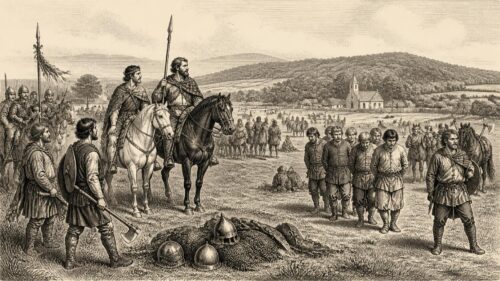
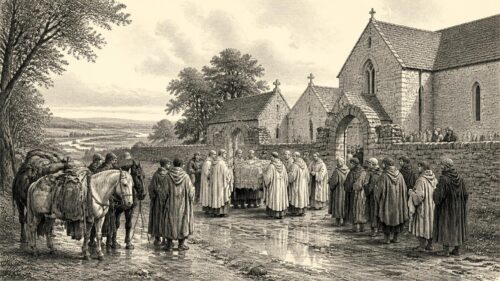
In 1417, the death of Art Mac Murchadha, king of Leinster, ended the career of a Gaelic ruler who had challenged English authority through warfare, negotiation and cross-community alliances. Annals disagree over the date and alleged poisoning, but emphasise his piety, hospitality and power; his son Donnchadh succeeded amid uncertainty after Diarmait Red-hand also died. Elsewhere, John Talbot’s cattle raid demonstrated uneven royal reach. Connacht saw Ruaidhrí Ó Dubhda’s succession, drownings, kin conflicts and hostage settlements. Burnings, killings and ecclesiastical involvement reveal pervasive local violence. Annalistic records also stress penitent deaths, kinship, burial and generosity, showing a fragmented Irish authority.
Dateline
In 1417, Ireland’s political map did not turn on a single capital or a single crown. Authority was dispersed among Gaelic kingships, Anglo-Irish lordships, ecclesiastical jurisdictions and the diminished institutions of the English lordship. Yet one death registered across the island as the passing of an exceptional regional power: Art Mac Murchadha Caomhánach, usually known as Art MacMurrough, king of Leinster. The annals place his death in this year, though they differ over details. Their disagreement is itself a useful warning: 1417 is firmly associated with Art’s death, but not with a securely known day, place or cause.
The Death of Leinster’s King
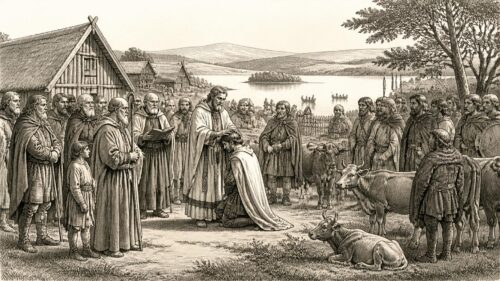
The Annals of Ulster and Annals of Loch Cé say that Art died in his own stronghold after receiving unction and performing penance. The later Annals of the Four Masters gives a fuller, admiring obituary: Art had defended Leinster against both “English and Irish”, had ruled for forty-two years, was celebrated for hospitality, knowledge and martial accomplishment, and had enriched churches and monasteries through alms and offerings. It adds that he died a week after Christmas and records a report that poison was administered at Ros Mhic Thriúin, New Ross, to Art and to Ó Deoráin, the brehon or judge of Leinster. That allegation cannot be treated as established fact. Modern scholarship notes both a version placing his death in December 1416 and another in January 1417. What can responsibly be said is that contemporary and near-contemporary annalistic traditions remembered his death under 1417, while the precise circumstances remained contested.
Art’s importance rested on more than battlefield success. Since the later fourteenth century he had built a broad Leinster following from the Blackstairs and Barrow valley towards the marches of Dublin and the south-east. He had challenged the ability of the English administration to move safely between its towns and lordships, extracted payments from settlements, and compelled English kings and governors to reckon with him. Richard II had twice come to Ireland with major expeditions partly to contain him. Neither campaign produced a lasting settlement. By 1417, Art’s career stood as proof that a Gaelic ruler could exercise substantial authority immediately beside the English lordship’s core territories.
That authority should not be imagined as an ethnic frontier separating two sealed communities. Art’s own marriage to Elizabeth le Veel linked him to an Anglo-Irish inheritance, while his eldest son Donnchadh was allied by marriage with the Butlers of Ormond. In the southern marches, Irish and English-speaking inhabitants traded, intermarried, made local agreements and sometimes served one another, even as raiding and war remained recurrent. Art’s long rule had therefore been shaped by negotiation as well as resistance: tribute, protection, hostage-taking, marriage and seasonal military pressure were all instruments of power.
A Difficult Succession
The same year brought an immediate blow to Art’s household. Diarmait Láimhdhearg, or Diarmait Red-hand, son of Art, also died in 1417. The annals do not explain the cause. Their juxtaposition of father and son conveys a sharp dynastic loss, but it does not allow a reconstruction of the family’s internal politics. The Annals of the Four Masters names Donnchadh, Art’s son, as successor. Later events show that this succession did not preserve Art’s former dominance intact. Donnchadh inherited prestige, followers and claims, but not necessarily his father’s personal authority or military skill.
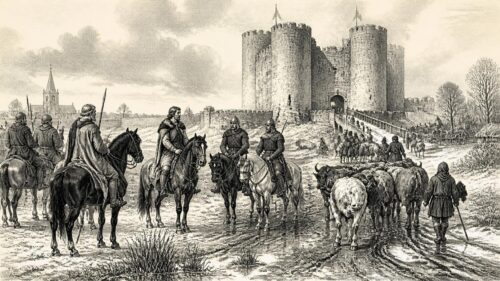
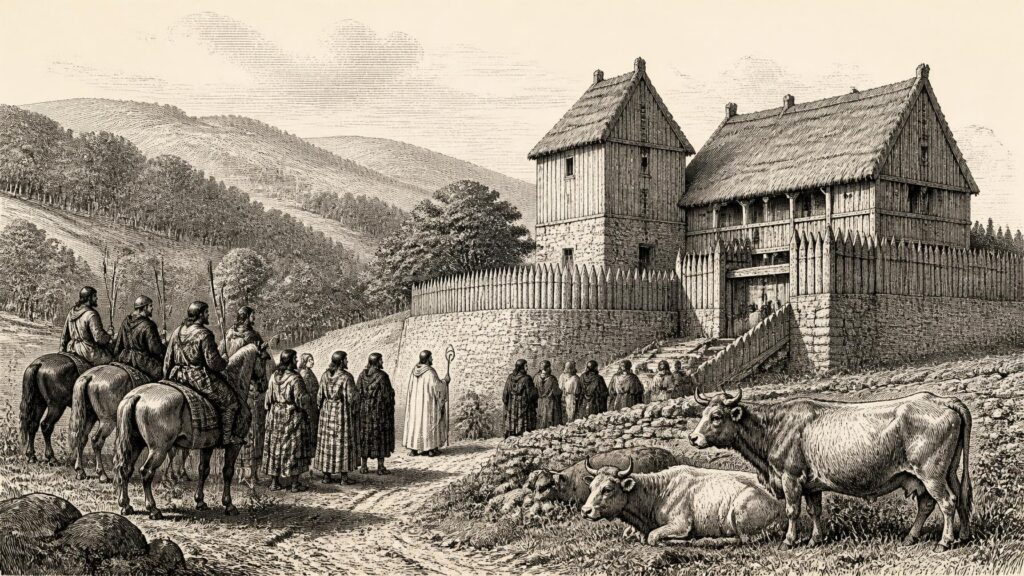
The timing was difficult. John Talbot, Lord Furnival, had been royal lieutenant in Ireland since 1414 and remained a formidable neighbour. Furnival had campaigned actively in the midlands and against Gaelic lordships, while his position placed him at the centre of Anglo-Irish political rivalries. In 1417 the annals record that Furnival took a great prey from the sons of Tomás Ó Fearghail. A “prey” meant seized livestock, a central form of wealth in the pastoral and mixed-farming economy, and its capture was both military action and economic coercion. The entry gives no route, numbers or outcome beyond the raid, but it shows the lord lieutenant operating beyond the narrowest bounds of the Pale.
Royal authority nevertheless remained uneven. The capture of cattle was a practical means of imposing pressure where castles, towns and courts could not ensure obedience. It also exposed the people who depended on herds: a lost herd affected food, dairying, rents, status and the ability to reward dependants. The violence of 1417 was not confined to formal campaigns between distant rulers; it reached households and local communities.
Deaths and Disaster in Connacht
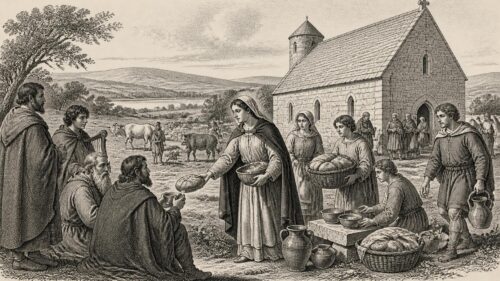
Connacht’s annals preserve an unusually vivid view of succession and loss. Ruaidhrí Ó Dubhda, king of Uí Fhiachrach or Tireragh in north-west Connacht, died in his own stronghold at the beginning of spring. The Annála Connacht praises him as a man who refused no plea for food or clothing, while other annals stress his prosperity, hospitality and penitential death. Such language was conventional in elite obituaries, but it was not empty decoration. A successful lord was expected to distribute food, clothing, gifts and protection. Generosity bound poets, clerics, warriors, tenants and allied kindreds to a ruling household. Ruaidhrí’s brother, Tadhg Riabhach, succeeded him, a clearly recorded transfer of local kingship.
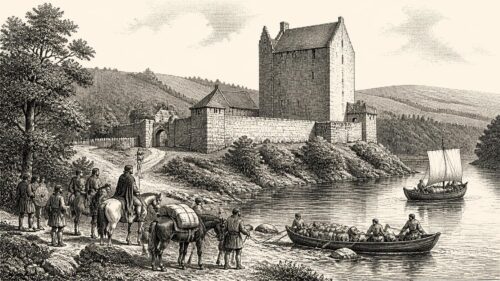
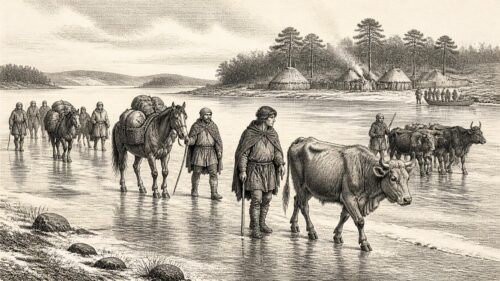
Off the western coast, the sea took a heavy toll. Two men named Ruaidhrí, one son of Murchadh Ó Flaithbheartaigh and the other son of Diarmait Dubh Ó Flaithbheartaigh, drowned in Cuan Umhaill, modern Clew Bay, along with sixteen other members of the Uí Fhlaithbheartaigh. The annal gives no explanation: it does not say whether they were travelling, fishing, trading or on military service. It would be wrong to supply one. But the incident underlines the maritime character of western lordship. Sea routes connected coastal Connacht, island communities, Ulster, Scotland and wider Atlantic networks; they could also be lethal, especially when a single mishap removed numerous members of a leading kindred.
Conflict within Connacht was equally close-grained. War broke out over the tanistry of Tireragh between Murchadh son of Cormac Mac Donnchada and Tomaltach Óg son of Tomaltach Mór Mac Donnchada; Matha son of Taichleach was killed in that struggle. Tanistry was not simple inheritance by eldest son. It concerned eligibility, kin-group support and the capacity to command. Elsewhere, the sons of Domhnall son of Muircheartach Ó Conchobair seized cattle from rival Ó Conchobair kinsmen as a pledge in a dispute concerning the lordship of Brian. Hostages were taken, then restitution made. This is a rare glimpse of a dispute being limited rather than ending in annihilation: livestock and hostages served as leverage, and a settlement followed.
Burning, Killing and Local Power
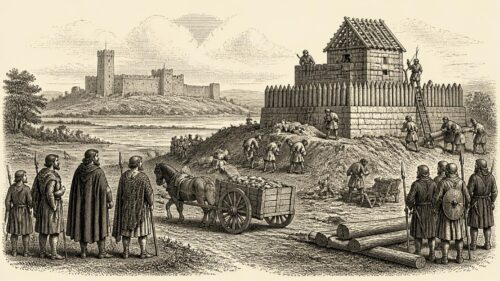
Several brief notices expose the variety of violence endured in 1417. Fore, the important monastic settlement in present-day County Westmeath, was burned by Ó Fearghail and Clann Seáin. The annal does not specify which buildings were destroyed, whether lives were lost, or why Fore was targeted. Its importance lay in its religious community, landed resources and strategic position, so an attack on it could damage both spiritual institutions and local wealth. Lissardowlin Castle, outside its bawn, was also burned. Again, the record is terse, but the distinction between castle and enclosing bawn evokes a defended seigneurial landscape in which residences, farmyards, stores and dependent households were vulnerable to fire.
In Munster, Tomás son of Mac Muiris of Kerry was killed by Séamus, son of the earl of Desmond, while Seán, son of Walter Burke’s son, was killed by men of the archbishop of Cashel. These notices do not describe large wars. Their value is precisely that they reveal competing armed followings around great lordly and ecclesiastical households. The archbishop’s men were not outside secular politics; church lordships possessed estates, tenants, clients and retainers, and could become participants in regional disputes.
A particularly human but still opaque entry concerns Piers Butler, a kinsman who might have become earl of Ormond. The annal reports that he was killed on Shrove Tuesday in the house of Donnchadh Óireach Mac Giolla Phádraig in Ossory, by Donnchadh’s blacksmith, while people were dancing. Piers was buried at Cúil. The notice resists easy explanation: it may preserve a killing arising from a personal quarrel, a political dispute or circumstances now lost. What survives is enough to show that elite life involved hospitality, feasting and sociability alongside sudden danger.
Religion, Memory and the Shape of the Year
Religion appears throughout the record of 1417, not as a separate sphere but as part of political and domestic life. Art Mac Murchadha and Ruaidhrí Ó Dubhda were remembered as dying after penance and sacramental preparation. Master Seán, parson of Daimhinis on Lough Erne, also died. Women’s deaths were marked by burial places and marital connections: Caitríona Ó Ruairc was buried at Roscommon, as was Ragnailt Ó Birn, whose successive marriages linked the Mac Diarmata, Burke and Mag Raghnaill worlds. Such notices show kinship operating across lordships and regions.
The surviving evidence for 1417 is annalistic: selective, elite-centred and often laconic. It does not provide harvest figures, prices, population totals or a continuous narrative of ordinary life. It does, however, record what contemporaries considered consequential: the death of rulers, the succession of a king, drowned kinsmen, cattle raids, burnings, religious preparation, hospitality and the killing of prominent people. Above all, Art Mac Murchadha’s passing closed an era in Leinster. The power he had assembled did not disappear overnight, but the loss of both Art and Diarmait Red-hand made 1417 a year in which a formidable political house entered a more uncertain future.
Primary Sources
- The Annals of Ulster
- Annala Uladh: Annals of Ulster otherwise Annala Senait, Annals of Senat
- Annals of Loch Cé, Part 3
- Annals of the Four Masters
- Annála Rioghachta Éireann: Annals of the Four Masters, Irish text, Part 5
- Annála Connacht, Part 185
- Annála Connacht
- MacMurrough Kavanagh (Mac Murchadha Caomhánach), Art Mór
- Talbot, John
- Butler, James
- Talbot, Richard
- In the Footsteps of a King
- One World: The Communities of the Southern Dublin Marches
- A Lancastrian Prince in Ireland
- Medieval Ireland/Éire sa Meanaoise
- The Genealogies, Tribes, and Customs of Hy-Fiachrach, Commonly Called O'Dowda's Country
- Genealogical Tables: Irish Families
- Ormond Deeds
- The Red Book of the Earls of Kildare
- The Metrical Dindshenchas
- Dictionary of National Biography: MacMurrogh, Art
- Irish Manuscripts Commission: Digital Resources