Desmond’s Execution1468 CE
In 1468, Thomas FitzGerald, earl of Desmond and former deputy of Ireland, was beheaded at Drogheda after arrest by John Tiptoft’s administration, provoking widespread condemnation and retaliatory raids. His execution exposed the fragility of crown authority beyond Dublin and the Pale. Tiptoft’s forces also burned Cavan and its Franciscan monastery. Elsewhere, disputed successions, raids, cattle seizures and warfare convulsed Connacht and Ulster, damaging crops and communities. Annals recorded deaths of lords, churchmen and the historian-poet Torna Ó Maolconaire, emphasising hospitality, learning and religious observance. The year revealed Ireland’s deeply fragmented political order, sustained by often unstable alliances, lordship and coercion.
Dateline
In 1468, an execution at Drogheda became the year’s defining Irish political shock. Thomas fitz James FitzGerald, earl of Desmond and former deputy of Ireland, was beheaded after appearing before the king’s administration. The killing reverberated far beyond the walled town on the Boyne. Irish annals written in different regions treated it not as an ordinary aristocratic fall, but as an outrage which exposed the precariousness of government in late medieval Ireland.
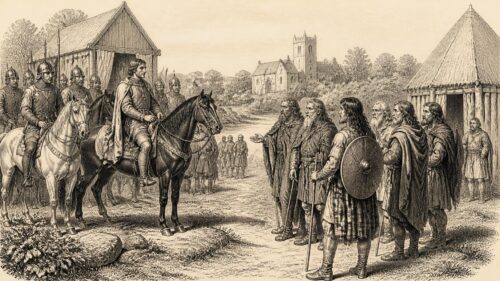
That response matters. Ireland was not governed as one unified political realm in practice. The English crown’s officials and law had their strongest footing in Dublin, the Pale and certain towns, while powerful Gaelic and Anglo-Irish lordships exercised authority elsewhere through kinship, clientship, military followings, lordly courts and control of land. The events recorded for 1468 show these worlds meeting repeatedly: at a parliament in Drogheda, in raids through Meath and Connacht, at Cavan’s friary, and in struggles for chiefly succession.
The Earl at Drogheda
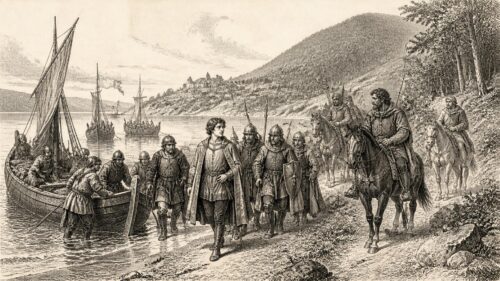
Thomas FitzGerald had been appointed deputy lieutenant in 1463 and was one of the foremost magnates in Ireland. Modern reference works usually number him the eighth earl of Desmond, although older accounts often call him the seventh. His position rested not only on extensive lordship in Munster but also on his ability to operate in the administration centred on Dublin. Yet complaints against his rule, tensions with interests in the Pale, and suspicion of his accommodation with Gaelic leaders had weakened him. John Tiptoft, earl of Worcester, arrived in Ireland as the crown’s new deputy in October 1467.
Tiptoft called parliament, first at Dublin and then at Drogheda. In the Drogheda session Desmond and Thomas FitzGerald, earl of Kildare, were arrested on charges of treason. The precise legal and political calculations behind the prosecution remain uncertain. It is therefore safer not to repeat later colourful explanations as fact. What can be firmly dated is Desmond’s execution on 15 February 1468. Kildare escaped execution and was subsequently pardoned, but Desmond was beheaded.
The annalists’ language makes clear how exceptional the act seemed to contemporaries. The Annals of Ulster say that there had not been a better “Foreign youth” in Ireland, using the conventional Gaelic term for a man of Anglo-Norman descent. Annála Connacht praised Desmond’s appearance, generosity, hospitality, suppression of theft and vice, and patronage of lay people, clerics and poets. The Annals of the Four Masters, compiled later from earlier material, similarly presents him as an exemplary lord, and says he went to Drogheda to meet the lord justice and the English of Meath before being treated treacherously. These are not neutral courtroom records: they are memorial judgements, shaped by political loyalties and ideals of lordship. Even so, their agreement on the scale of the reaction is striking.
Desmond’s body was carried south for burial at Tralee, in the burial place of his ancestors. His heir James was still under age. The immediate political cost was high. The Annála Connacht records that Gerald, described there as Desmond’s son, ravaged much of Meath and the counties of Leinster in vengeance. Modern biographical scholarship identifies the retaliating leader as Desmond’s brother Garret. The discrepancy is a useful reminder that annalistic notices can preserve the fact of an event while differing over personal detail. Either way, violence crossed the frontier of the Pale in direct response to the killing.
Government by Force and Fire
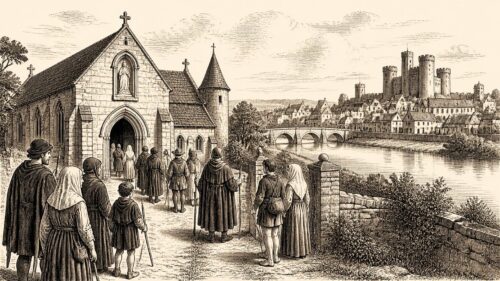
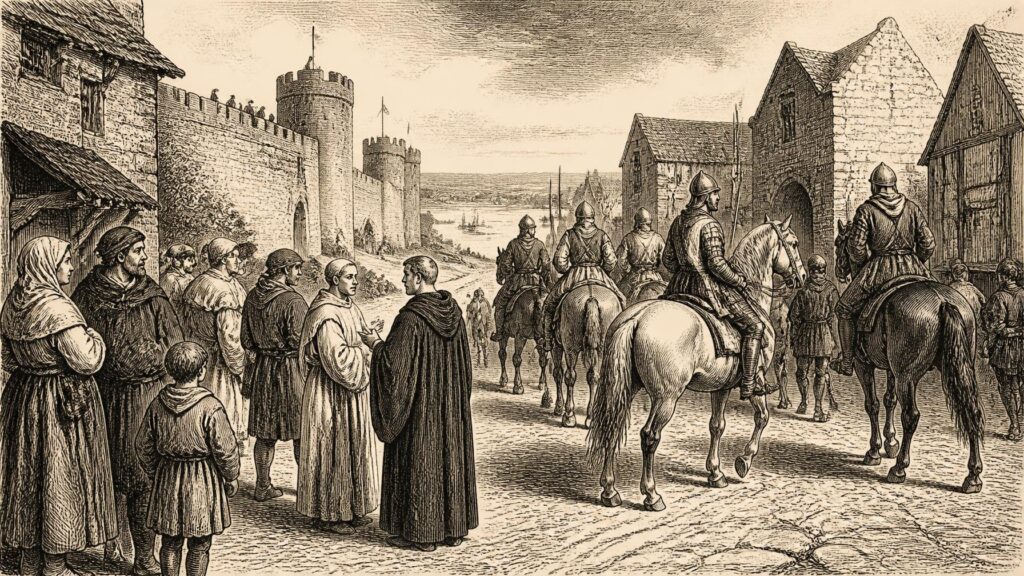
Tiptoft’s administration did not merely face a crisis in Munster and Meath. The Annals of Ulster records that the town of the O’Reillys and the monastery of Cavan were burned by “Foreigners” and by the “Saxon Earl” responsible for Desmond’s beheading. The wording connects the destruction explicitly to Tiptoft. Cavan was no isolated religious outpost: the town had developed around a Franciscan foundation traditionally associated with Giolla Íosa Ruadh O’Reilly around 1300. Burning its town and monastery was therefore an attack upon an O’Reilly centre where lordship, settlement, devotion and local exchange met.
The annals do not permit a detailed reconstruction of the damage, nor should one assume that every building was destroyed. They do show, however, that warfare was lived by townspeople, friars, dependants and travellers as well as by magnates. A burnt monastery meant disrupted worship and hospitality; a burnt town meant lost stores, insecure dwellings and a blow to the market and service functions gathered there. Such episodes demonstrate the limited reach of the Dublin government outside its core territories. A campaign intended to compel obedience could deepen the hostility on which resistance depended.
Successions and Spoils in Connacht
West and north-west Ireland saw no pause in local rivalry. Tigernán Ó Ruairc died in 1468, prompting a disputed succession among the Uí Briúin. Domhnall, son of Tadhg Ó Ruairc, was chosen with the support of Ó Domhnaill and allied friends, but a rival, Donnchadh Losc, was raised by another branch of the dynasty together with the men of Carbury and Clann Donnchadha. Succession was not automatic inheritance. It depended on kin groups, military capacity, external patrons and the ability to secure recognition.
Ó Domhnaill crossed the Erne with what the annalist called a countless host and devastated Lower Connacht, taking cattle and other movable wealth from Tireragh, Cúil Cnamha and Leyney Wood. Uilleag Burke, the Upper Mac William, and Ó Conchobair Donn came with mixed Gaelic and English forces to aid Lower Connacht. They burned Ó Ruairc’s residence but achieved no decisive engagement. The consequence, recorded with unusual clarity, was that crops in Tireragh, Cairbre and Luigne were poor and unproductive. This connects high politics to ordinary subsistence. Armies required food; raiding removed stock and labour; fields damaged or left unattended could leave communities facing a lean year.
Other notices reveal the same economy of conflict. Castles changed hands at Collooney and Bundrowes. Richard Burke sought hostages in Moylurg, while rival leaders drove off large preys of cattle. Feidlimid Finn maintained an army for a week from his own provisions before fighting broke out around a captured herd. Cattle were food, wealth, tribute and a means of sustaining armed followers. Annalistic figures for forces and booty should not be treated as modern statistics, but the repeated attention to preys, provisions and hostages shows what military power demanded in practice.
Ulster’s Local Wars
In Ulster, Conn son of Aodh Buí Ó Néill inflicted a major defeat at Benn Uama on the Galls of Lecale. The fuller Connacht annal says that the son of Robert Savage, lord of Lecale, and Aonghus Mac Domhnaill were killed, while Muirchertach Ruadh Ó Néill, lord of Clandeboye, was captured. The outcome demonstrates that political labels did not map neatly onto opposed national camps. Gaelic Ó Néills, a Mac Domhnaill, the Anglo-Irish Savages of Lecale and other followers could be drawn into the same contest through local alliances and enmities.
Further west, the Maguires of Fermanagh continued their own violent competition. Donnchadh Maguire attacked Philip Maguire’s people and carried off preys; in the pursuit, the account says that Philip and his son were killed, while Donnchadh returned in triumph. August brought further killing among the Clann Gafraidh, and another Maguire kinsman was slain. These short notices disclose neither a national war nor a settled peace, but the recurring pressures of lordship: contested authority, retaliatory raiding and the vulnerability of smaller kindreds caught in larger feuds.
Death, Learning and Religious Memory
Alongside warfare, 1468 brought deaths that illuminate the social world valued by the annalists. Cathal Óg Mag Raghnaill, chief of Muintir Eolais, died during Lent after receiving the rites of unction and penance. The chronicler praised his generosity to poets, strangers, poor people and those in need. His son Tadhg succeeded him, while another claimant was proclaimed by a rival branch. The notice joins religious preparation for death to political succession and to hospitality, a fundamental measure of a ruler’s standing.
Torna Ó Maolconaire, ollamh of Síol Muireadaigh in history and poetry, also died, after St Patrick’s Day, at Lis Fhearbain. He was buried at Elphin under the protection of Patrick and Francis, and Urard Ó Maolconaire succeeded to his office. An ollamh was not simply a poet in the modern sense. The office represented a learned hereditary profession responsible for history, genealogy, praise-poetry and the preservation of political memory. Torna’s death, and the immediate naming of a successor, shows the continuity of learned institutions amid military disruption.
Religion was similarly embedded in public life rather than separated from it. The year’s sources mention the death of the bishop of Elphin, a January death within the Mac Suibhne family, Lenten rites, Franciscan burial, and the burning of Cavan’s Franciscan monastery. They reveal a landscape in which churches and religious houses were sanctuaries, burial places, patrons of learning and centres of lordly commemoration, but were also exposed to the violence of political competition.
A Fractured Year
Desmond’s execution is the clearest dated event of 1468, but it should not eclipse the year’s wider evidence. Across Ireland, rulers died and successors were contested; raiding armies carried away cattle and damaged harvests; a friary town was burned; a battle in Ulster captured a lord; and a master of history and poetry was buried. The records are concentrated on elites because elites generated the actions annalists considered memorable. Yet their notices repeatedly point beyond them: to crops, stores, hospitality, monastic communities, poets, dependants and the many unnamed people described simply as gentle and common.
For contemporaries, Drogheda was not merely the place where a magnate died. It was a warning that crown government could turn suddenly against one of its greatest Irish partners. The reprisals, the destruction at Cavan and the persistent conflicts of Connacht and Ulster suggest why coercion offered no simple answer. In 1468, the island’s political order was held together not by a single authority, but by fragile bargains whose collapse could be felt from a parliamentary town on the Boyne to fields, monasteries and lordly households across Ireland.
Source References
Hover over a number to see the source. Select it to open the source.

- [1] The Annals of Ulster, Year U1468
- [2] Annála Connacht, Annal 1468
- [3] Annals of the Kingdom of Ireland: Annals of the Four Masters, Volume 4
- [4] Annals of Loch Cé, Annal LC1468
- [5] A Fragment of Irish Annals, Text
- [6] A Fragment of Irish Annals, Document Details
- [7] FitzGerald, Thomas fitz James
- [8] Tiptoft, John
- [9] FitzGerald, Thomas ‘fitz Maurice’
- [10] Ó Maolchonaire, Muiris
- [11] Conry, Florence
- [12] The Execution of the Earl of Desmond, 1468
- [13] Erasing a Monarch: An Act of Defiance and Rebellion
- [14] Cavan Town (Co. Cavan)
- [15] Cavan Franciscan Friary
- [16] Official Guide to Cavan
- [17] Exploring the Irish Annals
- [18] Annals of the Kingdom of Ireland: Table of Contents
- [19] The Execution of the Earl of Desmond
- [20] The Last Kings of Ireland: Material Expressions
Primary Sources
- The Annals of Ulster, Year U1468
- Annála Connacht, Annal 1468
- Annals of the Kingdom of Ireland: Annals of the Four Masters, Volume 4
- Annals of Loch Cé, Annal LC1468
- A Fragment of Irish Annals, Text
- A Fragment of Irish Annals, Document Details
- FitzGerald, Thomas fitz James
- Tiptoft, John
- FitzGerald, Thomas ‘fitz Maurice’
- Ó Maolchonaire, Muiris
- Conry, Florence
- The Execution of the Earl of Desmond, 1468
- Erasing a Monarch: An Act of Defiance and Rebellion
- Cavan Town (Co. Cavan)
- Cavan Franciscan Friary
- Official Guide to Cavan
- Exploring the Irish Annals
- Annals of the Kingdom of Ireland: Table of Contents
- The Execution of the Earl of Desmond
- The Last Kings of Ireland: Material Expressions