Furnival’s Prisoner at Trim1447 CE
In 1447, Ireland’s divided political worlds were linked by conflict, administration, religion and epidemic disease. Domnall Ballach Maguire was killed amid Fermanagh succession rivalry, while Hugh Maguire and Breifne constable Cormac Mac Cába also died. At Trim, Lord Lieutenant John Talbot imprisoned Feidhlimidh Ua Raghallaigh, who later died of plague and was buried in the Franciscan friary. Talbot’s parliament regulated trade, officials, coinage and English dress. Plague caused heavy mortality across several provinces, affecting clergy, lords, lawyers and scholars. Meanwhile, Thomas Óg Maguire rebuilt Aghalurcher church, and an Ó Mórdha lord founded a Franciscan burial house in Laoighis for descendants.

Dateline
In 1447, Ireland’s most revealing events joined together places that were politically and culturally very different: Trim, where the English administration attempted to legislate for its shrinking lordship; Breifne and Fermanagh, where Gaelic dynasties defended contested successions; and churches and religious houses where patrons invested in stone, burial and learning. The year was also marked by a severe epidemic. The surviving annals provide unusually sharp glimpses of individual loss, but they do not permit a complete national narrative. What they do show is a country of several political worlds, connected by travel, diplomacy, religious institutions and danger.
A Killing Beyond Lough Erne
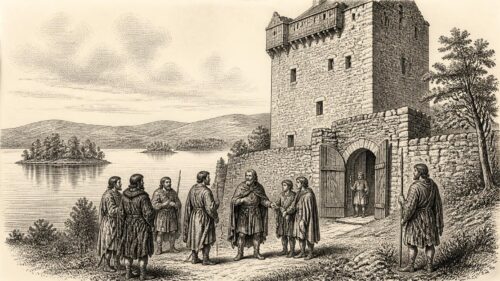
The most precisely dated Irish event of the year occurred in the Maguire lordship of Fermanagh. On 10 February, Domnall Ballach Mag Uidhir was killed by arrows while travelling east from Breifne Uí Raghallaigh, the O’Reilly territory, towards the residence of Éinrí Ó Néill. The Annals of Ulster give a fuller account than most sources of the period. Domnall had only a small party with him, including descendants of David Maguire, and was travelling through Barr na Cúile after crossing from the lough. His enemies caught him there: Donn Maguire, sons of Art Maguire, and followers of Mac Oirghiallaigh and Ua Daimín. He lay on the plain overnight and was buried next day at Lisgoole.
This was not a border clash between neat territorial blocs. Domnall was, the annals say, in conflict with Thomas Óg Maguire, lord of Fermanagh, and with Philip, the tánaiste, or acknowledged heir-apparent. His intended destination in the Ó Néill sphere suggests an attempt to seek support beyond his own lordship, whether refuge, alliance or armed backing; the sources do not say which. The killing demonstrates the lethal stakes of dynastic rivalry, but also the practical geography of late medieval power. Leading men moved by boat and road across the Erne–Breifne–Ulster zone, drawing on kinship and clientage that did not stop at a modern county boundary.
The violence did not end with Domnall’s death. Hugh, son of Thomas Óg Maguire, died during the same year of what the Annals of Ulster call a glandular illness. Cormac Mac Cába, constable of Breifne, also died, and his brother Henry was chosen as constable by both the Uí Raghallaigh and Clann Cába. Such notices matter because offices were not merely honorific. A constable was a military and administrative figure within a lordship, while the selection of Henry by two related political groupings indicates the negotiated character of authority.
Trim and the Limits of Lordship
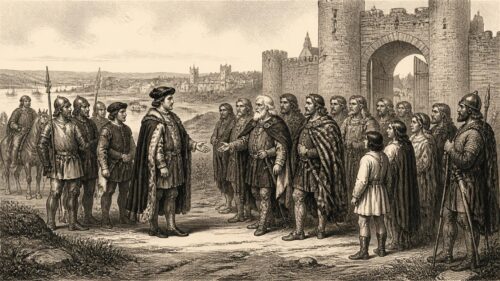
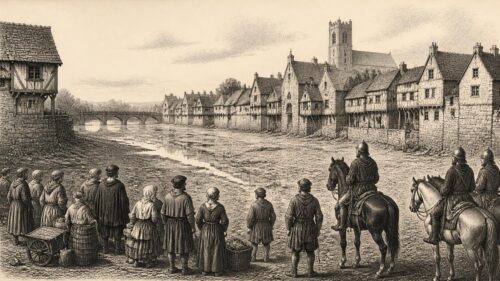
At Trim, the English lordship confronted Breifne in a very different fashion. Feidhlimidh Ua Raghallaigh, son of John and grandson of Philip, travelled to the town to meet Lord Furnival and was seized. The annals describe him as a man suited to rule Breifne because of his prowess and hospitality. Their wording is hostile to his captor, but the central fact is clear: a prominent Gaelic claimant entered an important administrative centre and was imprisoned there.
Lord Furnival was John Talbot, earl of Shrewsbury and newly created earl of Waterford, who was serving as Henry VI’s lord lieutenant in Ireland. The Gaelic chroniclers call him the king of England’s deputy; official records show Talbot exercising the higher office of lieutenant. This difference in terminology should not obscure the political reality. Talbot’s authority was strongest in the towns, castles and settled districts of the lordship, but his government sought influence far beyond them through agreements, demands for submission, hostages and selective coercion.
Feidhlimidh’s imprisonment had a grim outcome. A major plague reached Trim, and he died there after receiving unction and penance. The Annals of Ulster date his death only as three weeks before All Saints’ Day and record his burial in the friary at Trim. The episode makes tangible the risks of political travel and custody. It also complicates any simple contrast between an English town and a Gaelic countryside: Trim’s Franciscan house became the burial place of a Breifne lordling who had died in the lieutenant’s hands.
Talbot held a parliament at Trim in January. Its legislation was directed to the English polity rather than to the island as a whole. Measures addressed the collection of customs, the movement and security of royal officers, coinage, and the outward marks by which settlers were expected to distinguish themselves from Irish neighbours. One statute required Englishmen not to wear their upper-lip hair in the Irish fashion. This was not a harmless rule of dress. It attempted to turn appearance into a test of political allegiance, revealing official anxiety about cultural contact and the limited reach of government. Another measure against illicit exactions on merchandise and provisions points to the importance of roads, markets and trade routes even within the constrained area governed from Dublin.
Plague Across the Provinces
The epidemic was the year’s widest recorded calamity. The Annals of the Four Masters state that a great plague raged in summer and autumn, killing people in Meath, Leinster and Munster. Named victims included the prior of Ballyboggan, the prior of Connala, the baron of Calatrum, and Garrett Mac Walronta. The annal adds that some said seven hundred priests died. That figure should be treated as a contemporary report, not a securely counted total: medieval annals often preserve the scale of fear and bereavement more reliably than modern-style statistics.
No source from 1447 identifies the disease in terms that allow a confident modern diagnosis. The word translated as plague could cover more than one epidemic illness, and the separate notice of Hugh Maguire’s glandular sickness should not automatically be equated with it. Yet the chronology and geographical spread leave no doubt that communities experienced an exceptional mortality crisis. Clerics appear prominently because monasteries, parish churches and learned households generated records; their losses nevertheless imply disruption to pastoral care, prayers for the dead, education and the hospitality expected of religious institutions.
The plague reached political society as well as cloisters. Feidhlimidh Ua Raghallaigh died in detention; William Ó Deoráin, chief brehon of Leinster, and his wife also died; and the annals note the deaths of other lords and scholars. Mortality could alter succession calculations, weaken household followings and interrupt legal or ecclesiastical service. But the evidence does not justify claims that 1447 transformed all Ireland at once. Its effects must be understood locally, through the deaths and absences that the sources happen to preserve.
Building for Saints and Souls
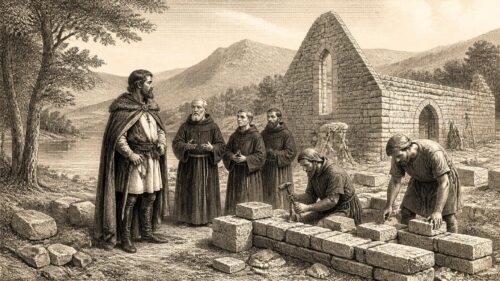
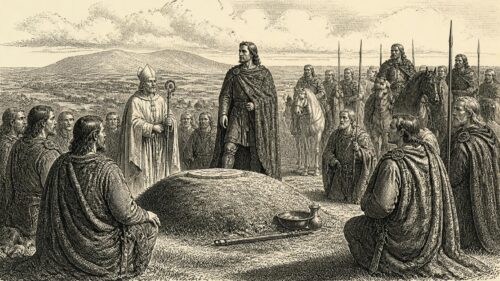
Against that background, Thomas Óg Maguire’s work at Achadh Urchair, or Aghalurcher, stands out. During 1447 he had the church roofed and its eastern gable rebuilt in honour of God, St Tighernach and St Ronan, and, as the annals candidly put it, for the good of his own soul. The site lies near Upper Lough Erne and was a major Maguire burial place. Its surviving medieval fabric confirms that this was no token gift. Official heritage interpretation describes the new feature as a ‘French roof’, perhaps a ribbed vault; the exact form remains uncertain, but the intervention was substantial.
The project reveals how lordship and devotion reinforced one another. A ruler who faced lethal kin-conflict could invest in a church associated with his family’s dead, invoke revered local saints, employ skilled masons and make a visible claim to piety. Religious patronage did not stand apart from politics. It provided a durable setting for commemoration, prayer and dynastic prestige, even when immediate succession was unsettled.
In Leinster, the Annals of the Four Masters also record the foundation of a house in Laoighis, in the diocese of Leighlin, by an Ó Mórdha lord in honour of St Francis, chosen as a burial place for himself and his descendants. The annal’s place-name is imprecise by later standards. It is generally identified with the Conventual Franciscan friary at Stradbally, but that identification is a later scholarly conclusion rather than an explicit statement in the 1447 entry. The secure point is the founder’s purpose: a Gaelic lord established or endowed a Franciscan house as both a religious work and a dynastic mausoleum.
Hospitality, Law and Learned Households
Death notices from 1447 also illuminate the social institutions that supported ordinary travel and elite culture. Matthew Ó Rodacháin, coarb of Fenagh, died; the annals praise him as a source of hospitality and wealth for the churches of Ireland. The coarb was successor to a saintly foundation, combining ecclesiastical standing with rights and responsibilities attached to a church community. Another annal calls the coarb of Fenagh keeper of a general guest-house. Hospitality was not simply private generosity: in a society of long journeys, retinues and visiting clerics, it was a recognised social obligation and a source of reputation.
Several deaths register the resilience and vulnerability of learned professions. Gilla na Naomh Mac Aodhagáin, described as Ireland’s foremost master of judgement and fénechas, or native law, died. Eógan Ó Breisléin, chief brehon of Fermanagh and arch-erenagh of Airech Maoláin, also died. These men belonged to traditions in which legal expertise, landholding, ecclesiastical office and hereditary learning could overlap. Their obituaries show that Gaelic Ireland’s political order relied not only on warriors and lords but on professional jurists able to interpret law and on church officers who managed institutional resources.
In Connacht, the Annals of Connacht record the death of Sadhbh, daughter of William Mac Branáin and widow of Máelín Ó Maolconaire. Later tradition identifies her as a banollamh, a woman professor-poet in the learned Ó Maolconaire family of Síol Muireadaigh. The title and succession associated with her should be treated as broader learned tradition, while her death itself belongs securely to 1447. Together with the notices of brehons and churchmen, it reminds us that an epidemic year also removed custodians of poetry, genealogy, law and memory.
A Year of Connected Fragility
Thus 1447 was not defined by one island-wide battle or a single ruler’s triumph. It was a year in which a Maguire rival was killed on a north-western journey, an O’Reilly claimant died a prisoner at Trim, and disease crossed regional and social boundaries. Yet it was also a year of construction, legislation, hospitality and scholarship. The rebuilt church at Aghalurcher and the Franciscan foundation in Laoighis express confidence in prayer, commemoration and continuity. The annals’ funeral notices, by contrast, preserve how precarious that continuity could be.
Primary Sources
- The Annals of Ulster, Year U1447
- Annals of the Four Masters, Part 8, Annal M1447
- Annals of the Four Masters, Part 8, Irish text, Annal M1447
- Annála Connacht
- The Annals of Ulster: Edition and Bibliography
- Annals of the Four Masters: Project and Edition Information
- Talbot, John
- Patent Roll 25 Henry VI (1446–1447), Item 16
- A Seventeenth Century Copy of Letters Patent Creating John Talbot, Earl of Shrewsbury, Earl of Waterford and Lord Steward of Ireland, 17 July 1446
- English Lordship of Ireland and the Irish Sea World: Re-assessing the Origins of the Kildare Ascendancy, c.1390–c.1513
- Irish Lords and English Rulers
- Aghalurcher Church
- Stradbally (Co. Laois)
- Trim Castle and the Evolution of Lordship in Meath
- Statute Law Revision Act 2007, Schedule 2
- Query Concerning O'Reilly's Money Against the Use of Which an Act of Parliament Was Passed in 1447
- Annals of the Kingdom of Ireland, by the Four Masters
- Calendar of Ormond Deeds, Volume III, 1413–1509
- Irish Exchequer Payments, 1326–1446
- Achadh Lurchair/Aghalurcher in the Placenames Database of Ireland