Eóghan’s Stone at Tullaghoge1432 CE
In 1432, Domhnall Bog Ó Néill was killed in Ó Catháin territory, enabling his rival Eóghan, son of Niall Óg, to be inaugurated king of Tír Eóghain at Tullaghoge with clerical and learned support. Eóghan’s alliance with Sligo provoked conflict with Niall Garbh Ó Domhnaill of Tír Conaill, bringing armed diplomacy, Erne crossings, prolonged campaigning, burned settlements and crops. Raids exposed Armagh’s vulnerability, while bishops and learned families remained centres of hospitality, law and memory. Elsewhere, Ormond attacked Éile and Mac Murchadha challenged English power in Leinster. The year revealed fragmented authority, shifting alliances, and legitimacy unable to secure peace.
Dateline
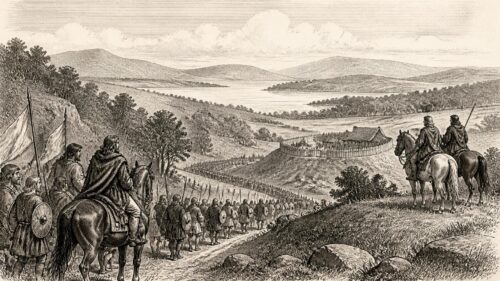
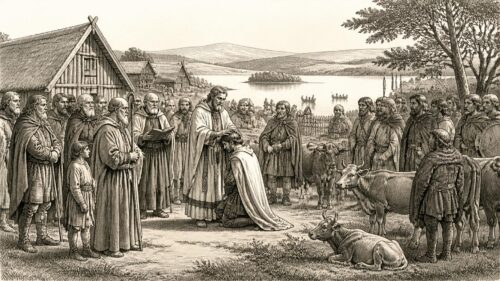
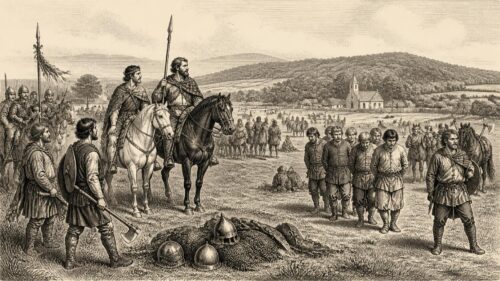
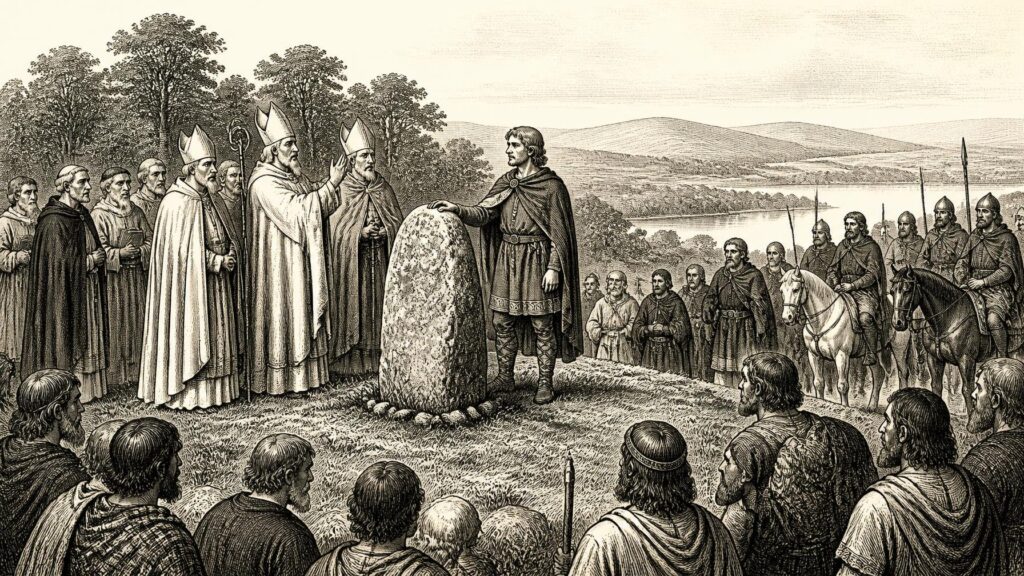
In 1432, the most consequential change in Ireland occurred not in Dublin but at Tullaghoge, the ceremonial centre of Tír Eóghain in modern County Tyrone. Domhnall Bog Ó Néill, a long-contested ruler of Tír Eóghain, was killed in the country of the Ó Catháin. His rival and kinsman Eóghan, son of Niall Óg, was then inaugurated on the Leac na Ríogh, the kings’ stone at Tullaghoge. The annals present this as a unanimous act, carried out with the assent of bishops and learned men. It was both a dynastic succession and a carefully staged public declaration that Eóghan’s branch now held the leading place in northern Irish politics.
A Death and an Inauguration
The killing of Domhnall Bog was itself a reminder that lordship could be won or lost abruptly. The Annals of Ulster state that he entered Ó Catháin territory and that Domhnall and Aibhne, sons of Diarmait Ó Catháin, seized the house in which he was staying. Domhnall Bog and several companions were killed. The annalist places the event between Christmas and Epiphany, though the chronicle’s annual headings should not be treated as modern day-by-day dating. What is securely associated with 1432 is the succession that followed: Eóghan Ó Néill was made king of Tír Eóghain and went to Tullaghoge for inauguration.
The ritual mattered. A ruler’s authority depended upon armed followers, kinship and the ability to reward allies, but inauguration gave political change a sacred and territorial form. The attendance of bishops and ollamna – learned masters associated with law, history and poetry – indicates that kingship was not merely a private family possession. It was validated before clerical and intellectual authority. Eóghan had long been a formidable figure in Ulster, yet the removal of Domhnall Bog allowed him to convert influence into recognised leadership. The ceremony at Tullaghoge made a claim to continuity with earlier kings of Tír Eóghain while signalling a new balance of power.
The Erne Conference
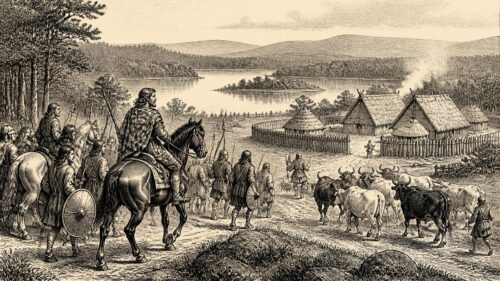
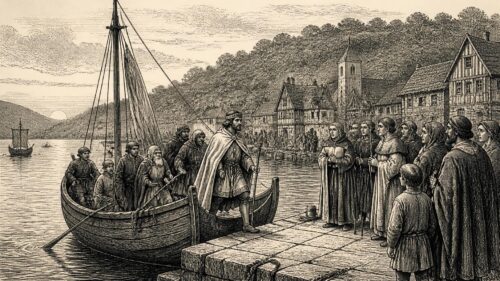
That balance was immediately tested by Niall Garbh Ó Domhnaill, king of Tír Conaill. Eóghan sought an alliance with the sons of Domhnall, son of Muircheartach Ó Conchobhair of Sligo. A conference was arranged at Cáol Uisce, or Narrow Water, on the Erne. The gathering demonstrates that diplomacy was active and practical: alliances were made in person, with mounted retinues, hostages, escorts and control of crossing-points all carrying political weight.
Yet the conference almost became a battle. Niall Garbh positioned men to prevent the meeting, and when Eóghan and his Maguire allies reached the narrow water, Ó Domhnaill’s followers exchanged arrows with them. The men of Fermanagh nevertheless landed, but suffered a reverse at Míodhbhóilg; many were wounded or killed. Despite this clash, the Ó Conchobhair party reached Eóghan and gave him their hands in a formal pledge of friendship. The episode captures the character of late-medieval Irish politics: negotiation and violence were not opposites. A settlement might be pursued through an armed confrontation, and a meeting ostensibly for peace could require boats, cavalry and battle-ready escorts.
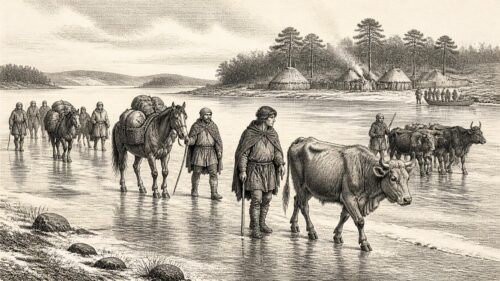
The Sligo alliance gave Eóghan a western partner against Tír Conaill, while the reaction of Ó Domhnaill confirmed how threatening that partnership appeared. Eóghan’s son Énrí travelled to Sligo to secure support. Niall Garbh, aided by Tadhg Ó Ruairc and members of the Maguire kindred, watched the routes by which Énrí and the men of Cairbre might return. Thomas Óg Maguire brought a fleet to Cáol Uisce and carried them safely to his own residence. Water transport on the Erne was therefore not incidental: it shaped movement, protection and the survival of alliances across the north-west.
War Without Settlement
Open war between Eóghan Ó Néill and Niall Garbh Ó Domhnaill followed. Eóghan, the Maguires and the Clann Aodha Buidhe Ó Néills led a major hosting into Cenél Moen, on the approaches to Tír Conaill. The annals say that the opposing forces remained face to face from the feast of the Holy Cross until Lammas. Rather than inventing modern dates for this seasonal description, it is safer to note its meaning: the confrontation endured through a substantial part of the farming year.
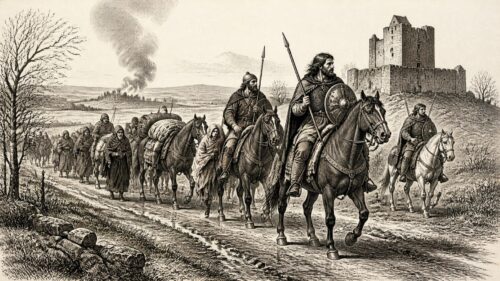
The cost fell heavily on local communities. There were killings and woundings in repeated skirmishes; the settlements of Ó Domhnaill and of Neachtan Ó Domhnaill were burned; and cornfields were put to the torch. Burning grain was a direct assault on subsistence, not simply an emblem of victory. It reduced food available for households, dependants and livestock, and compelled communities to reckon with hunger after the army had departed. Neither side made peace. Their withdrawal without a cessation left a dangerous frontier in which future raids, rather than a negotiated settlement, remained likely.
Other northern conflicts show that no single division neatly separated ‘Gaelic’ and ‘English’ interests. Maghnus Mac Mathghamhna raided English-settled districts repeatedly, and the annals record a grim display of enemy heads at his residence of Baile na Lurgan. In a separate dispute, Brian Mac Mathghamhna broke with Eóghan and with his own kinsmen, taking his cattle and dependants to the English side. An English force then marched with him into Airgíalla, burning Dartraighe Coininse and advancing to the plain of Armagh. Alliances followed immediate rivalries, protection and opportunity as much as broad ethnic labels.
Armagh Under Pressure
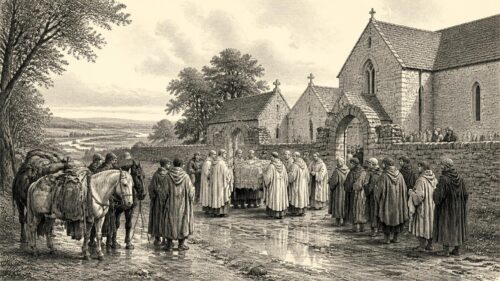
The raid on Armagh was especially revealing. The attacking force removed provisions from churches and burned them on the town green. Clergy and students then made substantial payments to prevent the burning of the churches themselves. Armagh was at once a major ecclesiastical centre, a place of learning and a settlement whose accumulated food stores and movable wealth made it vulnerable in war. The episode should not be read as proof that religion had lost authority. Rather, it shows that church institutions possessed resources worth seizing and could negotiate collectively for protection in a landscape where military power was fragmented.
The death of Art Mac Cathmhaoil, bishop of Clogher, adds a quieter but important perspective. Both major annalistic accounts praise his piety and hospitality; the Annals of Ulster say that he maintained a guest-house for the poor, bardic companies and pilgrims. Such notices are formulaic in part, but they point to a real social expectation. A bishop’s household was not solely an administrative office. It could function as a centre of almsgiving, lodging, patronage and movement, serving travellers as well as local people. In a year marked by raiding and the destruction of food, this ideal of organised hospitality had particular resonance.
Learning and Lordship
1432 also brought losses to the learned families who preserved law, genealogy, poetry and historical memory. Matthew Glas Ó Duibhgeannáin of Kilronan, described as an ollam in history, died. Gregory, son of John Ó Maol Chonaire, died while being educated in the household of the Mac Aodhagáin of Ormond; he was remembered as a prospective master of history. These were hereditary scholarly lineages, but their training involved travel and residence in other learned households. Their work connected regions that warfare often divided, and their expertise helped define pedigrees, rights, precedents and reputations.
The death on 16 January of Tadhg Riabhach Ó Dubhda, lord of Uí Fhiachrach, is recorded in similarly political language. He was praised for restoring hereditary property to its rightful holders, whether lay or ecclesiastical, and for respecting poets and learned men. An annalistic obituary is not an impartial audit of government, but it reveals an ideal of lordship: protection of inherited rights, fair dealing with churches, and patronage for those who could articulate a dynasty’s history. In 1432, power was exercised through fighting men, but it was also judged through law, generosity and cultural authority.
Conflicts Beyond Ulster
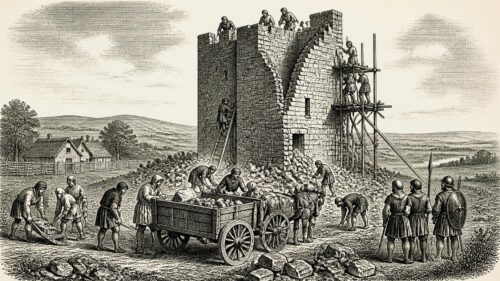
Elsewhere, James Butler, fourth earl of Ormond, had returned from England and moved to repair his position in the midlands. War broke out between him and Maolruanaidh Ó Cearbhaill of Éile. The annals report that Ormond entered Éile with a great army, ravaged the territory and demolished two Ó Cearbhaill castles. The names of the castles are not supplied by the contemporary record and should not be guessed. Their destruction nevertheless shows that fortifications were political assets: damaging them limited a lord’s ability to defend dependants, control routes and project power.
In Leinster, Donnchadh Mac Murchadha, lord of Leinster, ravaged English territory. An English counter-attack failed; Walter Tobin was captured and others were killed, wounded or taken prisoner. This was not a peripheral disturbance. It demonstrates the continuing weakness of English authority beyond its more secure towns and lordships, and the capacity of the Mac Murchadha dynasty to impose costs on neighbouring colonial communities. Ireland in 1432 was not governed by a single effective political system. Its rulers operated through overlapping territories, shifting alliances and local military strength.
The year therefore stands out for a change of leadership, rather than for a final settlement. At Tullaghoge, Eóghan Ó Néill secured the kingship of Tír Eóghain with ceremony and support. Across Ulster, however, war with Tír Conaill intensified; Armagh’s churches and students had to buy protection; and the countryside bore the burden of burned crops and mobile armies. In Éile and Leinster, rival powers likewise contested castles, land and tribute. The stone at Tullaghoge offered the image of legitimate succession. The events that followed showed how difficult that legitimacy would be to turn into peace.
Primary Sources
- The Annals of Ulster: Year U1432
- Annals of the Four Masters: Annal M1432
- Annals of the Four Masters: Irish Text, M1432
- O'Neill (Ó Néill), Eóghan
- O'Donnell (Ó Domhnaill), Niall Garbh
- O'Neill (Ó Néill), Aodh Buidhe
- O'Connor (Ó Conchobhair), Domhnall
- O'Carroll (Ó Cearbhaill), Maolruanaidh
- Butler, James
- MacMurrough (Mac Murchadha), Domhnall Riabhach
- O'Donnell (Ó Domhnaill), Neachtan
- O'Neill (Ó Néill), Brian Ballach
- The Genealogies, Tribes, and Customs of Hy-Fiachrach, Commonly Called O'Dowda's Country
- The Genealogies, Tribes, and Customs of Hy-Fiachrach, Commonly Called O'Dowda's Country
- Annals of Loch Cé
- Annals of Loch Cé: English Translation, Volume I
- Annals of Loch Cé: Irish Text
- Exploring the Irish Annals
- The Annals of Clonmacnoise
- The English Lordship of Ireland and the Irish Sea World: Re-assessing the Late Medieval Irish Sea Region
- Richard II and the Wider Gaelic World: A Reassessment
- Siting of Castles in the Midlands of Ireland