Kinsale’s Pilgrim Lord1428 CE
In 1428, Irish annals recorded no single national crisis but interconnected regional events. Aedh Mag Uidhir, a Fermanagh lord returning from pilgrimage to Compostela, died at Kinsale on 11 August and was buried at Cork, illustrating maritime, religious and political links. His death coincided with Maguire dynastic violence, including seizure of his sons’ castle and the killing of Aedh Óg. In Leinster, Donnchadh Mac Murchadha Caomhánach’s ransom, return and cooperation with English authority reflected negotiated power. Deaths of ecclesiastical and local rulers, notably a Mac Conmara chief, reveal hereditary offices, patronage, protection and peace as foundations of Ireland’s diverse lordships.
Dateline
The Irish record for 1428 is unusually revealing because its notices range from a death in a Munster harbour to upheaval within a Fermanagh lordship, the release of a Leinster ruler, and the passing of local chiefs and church office-holders. They do not describe a single island-wide crisis. Instead, they show an Ireland governed through many overlapping jurisdictions: Gaelic lordships, Anglo-Irish towns and liberties, hereditary ecclesiastical communities, and powerful kin-groups whose internal disputes could alter the balance of an entire region.
Some cautions are essential. The fullest surviving accounts are annalistic compilations, and their year headings do not always correspond perfectly with modern chronological reconstruction. The Annals of Ulster, Annals of Loch Cé and Annals of the Four Masters nevertheless agree on the central episode of the year: the death at Kinsale of Aedh, or Hugh, son of Pilib Mag Uidhir. Where their wording differs, it is safer to preserve that uncertainty than to manufacture a precision the evidence does not supply.
A Pilgrim at Kinsale
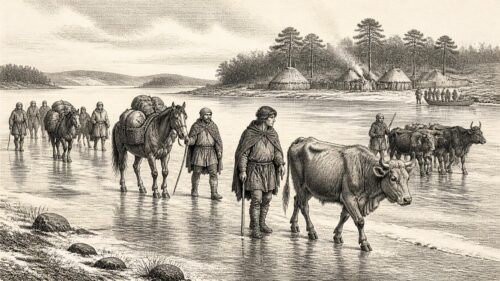
Aedh mac Pilib Mag Uidhir had undertaken a pilgrimage to the shrine of St James at Compostela in north-western Iberia. Such a journey placed an Irish lord within a much wider Christian world. It required sea travel, money, companions, contacts at ports, and sufficient security at home for a leading man to leave his territory. The annals praise Aedh above all for énech – generosity, hospitality and public reputation – a quality central to aristocratic authority in Gaelic Ireland. A lord’s household was expected to feed followers, travellers, churchmen and dependants; generosity could be a political resource as much as a private virtue.
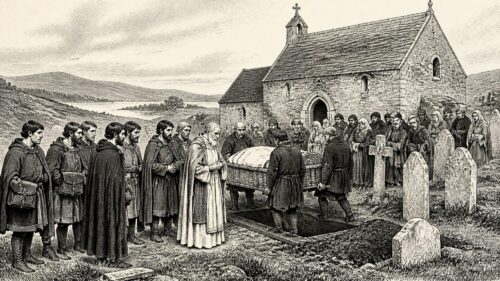
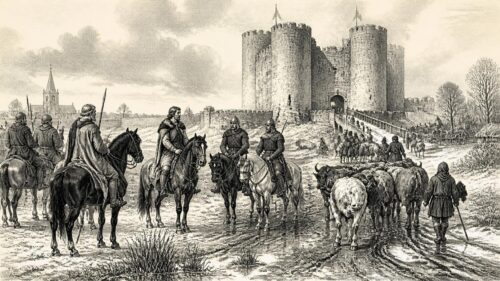
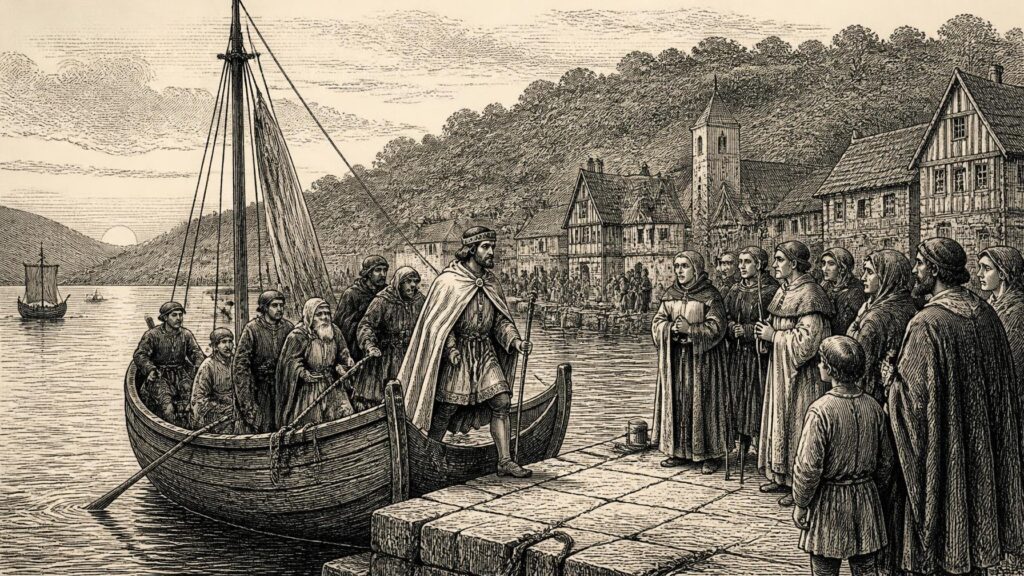
The account is poignant. Aedh reached Ireland after completing the pilgrimage but died at Kinsale on the first night after landing. The Annals of Ulster date his death to 11 August, expressed in the contemporary Roman fashion as the third Ides of August. Thomas Óg Mag Uidhir, travelling with him, brought the body from Kinsale to Cork for burial. The notice makes Kinsale more than a distant southern place-name in a Fermanagh story. It was a harbour at which a traveller returning from Iberia could make landfall, while Cork provided the ecclesiastical setting for burial.
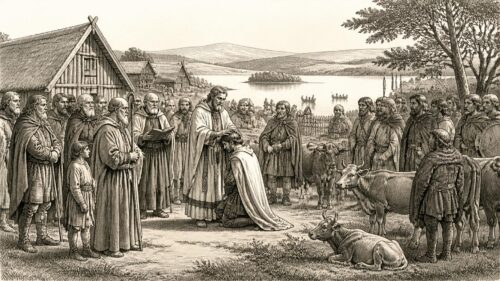
The annalists describe his end as coming after penance and the cleansing of sins. That language should not be reduced to a conventional obituary formula. Pilgrimage was an act of devotion, but for a lord it could also affirm standing before relatives, rivals and clergy. Aedh’s return through Kinsale, followed by a burial in Cork rather than in his northern homeland, demonstrates both the hazards of travel and the practical networks linking the Atlantic coast, Munster towns and the Gaelic north.
Fermanagh’s Family Conflict
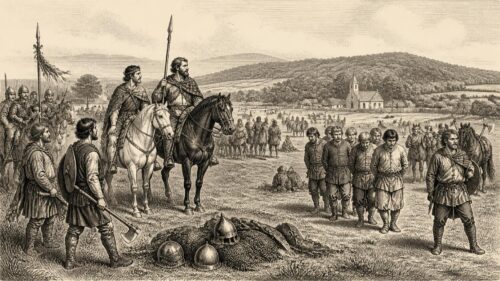
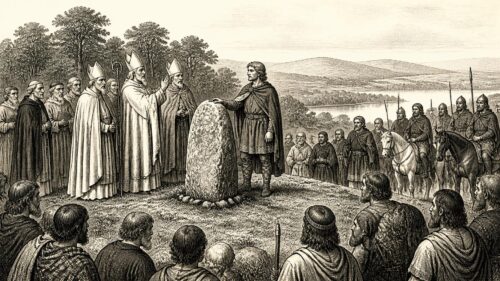
Aedh’s absence mattered in Fir Manach. He belonged to the wider Mag Uidhir ruling kindred, among whom leadership was neither automatic nor free from challenge. Modern reconstruction of the dynasty identifies him as a cousin and rival of Tomás Mór Mag Uidhir, the established king of Fir Manach. The Annals of the Four Masters place under 1428 the seizure of the castle held by Aedh’s sons by Mag Uidhir and his sons; the defeated branch was expelled and its people plundered. The Annals of Loch Cé and Annals of Ulster independently record another violent episode: Aedh Óg Mag Uidhir was killed by the sons of Donnchadh Ballach Mag Samradhain, with the Ulster annalist locating the killing in the house of Mac Gilla-Fhinnein.
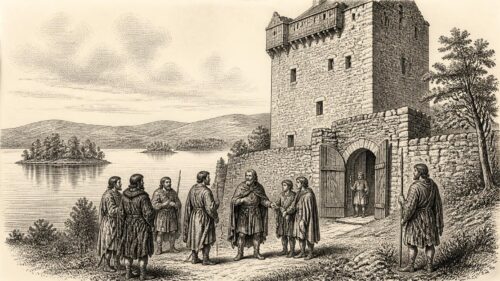
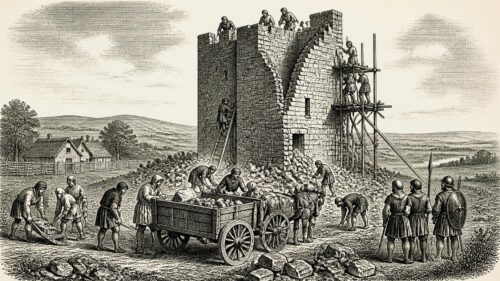
The sources do not permit a neat reconstruction of every participant’s motives or of the order of every blow. They do, however, show that Aedh’s death was embedded in a struggle over land, fortification, dependants and dynastic standing. A castle in this setting was not merely a building: it was a defensible residence, a symbol of lordship and a place from which dues and military service could be demanded. Plundering a rival’s people attacked the material basis of his authority, including cattle, food stores and the households that sustained his following.
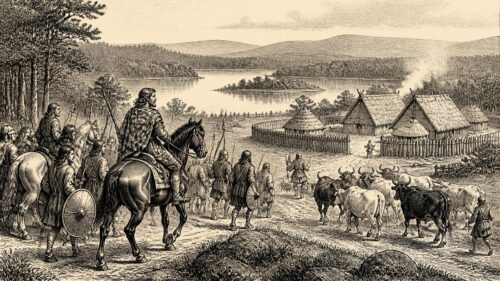
Fir Manach was therefore not an isolated lake-country beyond national affairs. Its lords dealt with neighbouring Breifne, Tyrone and Tyrconnell, and their disputes could draw in other kindreds. Yet 1428 should not be portrayed as the beginning or end of the Maguire conflict. The rivalry had deeper roots and continued after the year. What can responsibly be said is that the pilgrimage, death, killing and seizure recorded in 1428 marked a sharp reversal for one Maguire faction and strengthened the position of its opponents.
Ransom and Accommodation in Leinster
The Annals of the Four Masters also assign to 1428 the ransom of Donnchadh Mac Murchadha Caomhánach, or Donough MacMurrough Kavanagh, lord of Leinster. It says that he had been imprisoned in England for nine years and was ransomed by his own province, to the advantage of the Irish. The phrase conveys the political value placed on restoring a recognised dynastic lord, but the exact chronology requires care. A modern biographical study places Donnchadh’s return to Ireland in 1427, when the English administration sought to use him against the activities of his brother Gerald. It further places him on an English campaign against the O’Byrnes in 1428.
Rather than treating these accounts as simply contradictory, they reveal the awkwardness of power in Leinster. Donnchadh’s release, return, ransom and renewed political activity may have been remembered through different stages of a process rather than a single uncomplicated event. In 1428 he was not yet securely restored as undisputed MacMurrough overlord. His position depended on dealings with the Dublin government, on family rivalry, and on relationships with neighbouring powers including the Butler earls of Ormond. The year thus belongs to a period in which the English lordship could still intervene in Leinster, but could not straightforwardly dictate its political settlement.
That limited reach is important. English royal government remained concentrated around Dublin and the towns and lordships tied to it. Beyond those areas, authority was negotiated through military expeditions, hostages, payments, marriages and bargains with Gaelic rulers. Donnchadh’s presence on an English operation against the O’Byrnes illustrates alliance rather than simple submission. A Gaelic lord could cooperate when it served his immediate interest without abandoning his family’s wider claims.
Deaths, Offices and Local Order
Several other deaths recorded in 1428 give the year a quieter but valuable social dimension. Robert, the coarb or successor of St Caillín, died. The title points to the continuing importance of hereditary ecclesiastical office. Caillín was the patron saint of Fenagh in what is now County Leitrim, and a coarb was not merely a cleric in the modern parish sense. He stood within a community whose religious prestige, lands, rents, manuscripts and local connections had accumulated around a saint’s foundation over centuries. Robert’s death therefore meant a succession within an institution that linked devotion, learning and property.
In Thomond, the chief of Clann Chuiléin, a Mac Conmara described as the son of Cú Mac Conmara, also died. The Annals of Ulster credits him with bringing prosperity and peace to his people, suppressing raiding and what it calls harmful agreements. Annalistic praise must not be accepted as a neutral administrative report, but its vocabulary is revealing. Peace was not imagined as the absence of armed men; it was an achievement of lordship, maintained by restraining theft, enforcing obligations and protecting those who lived under a chief’s authority.
The Mac Conmaras were among the major families of east Clare, in a landscape shaped by O’Brien kingship, castles, churches and Franciscan foundations. Quin Friary, associated with MacNamara patronage, had already developed within the ruins of a former Anglo-Norman castle. In and around Ennis, religious houses provided places of worship, burial, hospitality, education and manuscript work. The death of a chief in 1428 therefore concerned more than succession within one household: it affected patronage, protection and the management of local society.
The annals also record the death of Cormac Ó Birn, chief of Tír Briúin, and that of Diarmait Ó Catháin, lord of Cianachta and the Creeve in north Ulster. These brief notices should not be inflated into evidence of a general political transformation. Their value lies in showing the density of local lordship. Ireland was not divided simply between an English east and a Gaelic west or north. It contained numerous territories whose rulers defended inherited rights, cultivated reputations for hospitality and warfare, and navigated relations with stronger neighbours.
A Year of Connections
1428 is best remembered through Aedh Mag Uidhir’s final voyage: a Fermanagh lord returning from Compostela, landing at Kinsale, dying on 11 August and being carried to Cork for burial. Yet his story is not an isolated curiosity. It joins the year’s other evidence: a contested Maguire inheritance, a Leinster lord emerging from captivity, the death of a peace-making Mac Conmara chief, and succession in the religious community of St Caillín. Together these events show an Ireland whose regions were politically distinct but connected by ships, ports, pilgrim roads, kinship, church institutions and conflict.
For most people, the year’s great matters were experienced indirectly. A lord’s death could change who demanded food-rents or service; a raid could take livestock and unsettle a district; a pilgrimage could draw wealth and manpower away from home; a monastery or friary could offer learning, worship and hospitality. The surviving annals chiefly name elites, but the repeated ideals of generosity, peace, protection and penitence make sense only because they concerned the wider communities over whom those elites claimed authority.
Primary Sources
- Annals of the Four Masters, Part 6
- The Annals of Ulster, Volume 3 English Translation
- Annals of Ulster Otherwise Annala Senait, Annals of Senat
- Annals of Loch Cé A.D. 1014–1590, Part 4
- Annals of Loch Cé A.D. 1014–1590
- Annála Connacht
- Annals of Inisfallen
- MacMurrough Kavanagh (Mac Murchadha Caomhánach), Art Mór
- Maguire (Mág Uidhir), Pilib (Philip)
- Maguire (Mág Uidhir), Tomás Óg
- Caillín
- The Book of Fenagh
- Quin Franciscan Friary
- Ennis Friary
- The Library & Scriptorium
- Historic Stroll in Old Kinsale
- English Lordship of Ireland and the Irish Sea World: Re-assessing the Origins of the Kildare Ascendancy, c.1390–c.1513
- Exploring the Irish Annals
- Annals of the Kingdom of Ireland: Table of Contents
- The Annals of Ulster