Moylurg’s Summer Settlement1393 CE
In 1393, Moylurg experienced a succession crisis after Aedh Mac Diarmata died and his son Cathal drowned. Maelruanaid Mac Diarmata gained the kingship with Tomaltach Mac Donnchada’s support, defeated Aedh’s sons near Loch Gara, and imprisoned rivals who later escaped. By summer, territorial division and captive exchanges produced a negotiated peace. Elsewhere, deaths among regional lords, clerics, scholars and craftsmen reflected interconnected political and cultural networks. Ferghal Mag Samradain’s death highlighted patronage of learned people. Ó Conchobair Fhailghe founded a Franciscan house at Cill Achaidh, while Richard Northalis became chancellor, pursuing concealed royal debts, revealing diverse local authority across Ireland.

Dateline
The year 1393 is best seen through a cluster of closely recorded events in the Irish midlands and Connacht, rather than as a single island-wide turning point. Three annalistic traditions—the Annals of Ulster, Annála Connacht and the Annals of Loch Cé—preserve unusually overlapping accounts of a succession crisis in Moylurg, a Mac Diarmata lordship around Loch Cé and Loch Gara. Their agreement gives the episode exceptional definition. Elsewhere, notices of deaths, a Franciscan foundation in Uí Fhailghe and a new royal chancellor reveal the many scales on which political, religious and cultural life worked in late-medieval Ireland.
A Sudden Crisis in Moylurg
The year opened with the death of Aedh mac Conchobair Mac Diarmata, king of Moylurg. The annalists remembered him warmly: Annála Connacht called him a man “full of every good quality”, while the Annals of the Four Masters associated his death with penitence and hospitality. Such praise was conventional, but it still signals the importance of a ruler whose household stood at the centre of a substantial Connacht lordship.
Bereavement quickly became a political emergency. Cathal, Aedh’s son, drowned soon afterwards. The sources agree on the loss but differ slightly in their geographical wording: the Annals of Ulster place the drowning at Inis Daighre in Loch Cé, whereas Annála Connacht names Loch Dorri. The safest conclusion is that the death occurred in the lake country of Mac Diarmata power, not that every detail of the later annalistic wording can be reconciled. Whatever the precise site, the disappearance of both lord and son removed the most obvious line of succession.
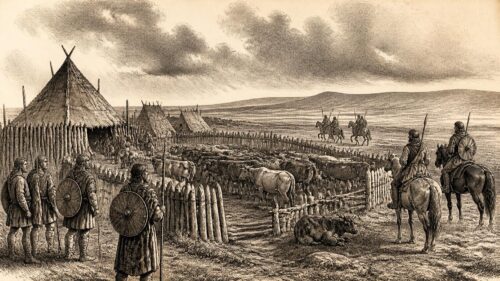
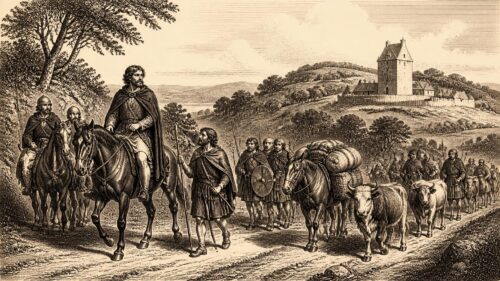
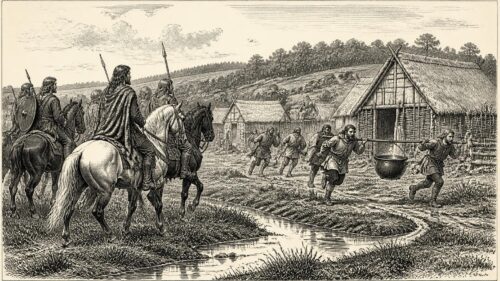
Maelruanaid Mac Diarmata was then made king of Moylurg through the support of Tomaltach Mac Donnchada. This was not a quiet inheritance. The sons of the dead Aedh attacked the new ruler at a place named as Cloonagunnane by Annála Connacht, in the callow or low-lying pastureland of Loch Gara. The annals describe a battle, rather than a mere raid. Maelruanaid’s opponents were defeated; Domnall Dubh Mac Diarmata was killed; and Conchobur Mac Diarmata, together with his brother Ruaidhrí, was captured. Ferghal, son of Donnchadh Riabhach, was also taken.
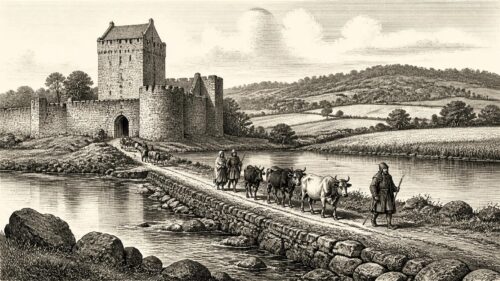
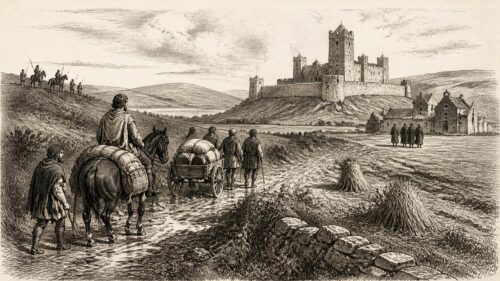
The Annals of Ulster add a vivid sequel: prisoners were put into the castle of Baile-in-tobair, but escaped in the same year. That detail demonstrates both the practical value and the limits of fortified power. A castle was a place for detaining politically valuable captives, yet custody depended on retainers, provisions, local allegiance and the ability to prevent escape. The conflict was therefore more than a family quarrel. It was a contest over lordship, clients, land, captives and the right to command the Mac Diarmata following.
Land, Captives and Peace
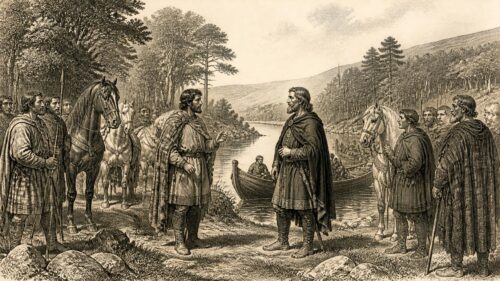
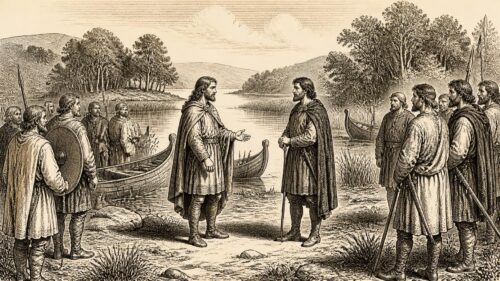
By the summer, the people of Moylurg had made peace. The formula is unusually revealing: it concerned the division of territory and the exchange or release of captives. This was a negotiated settlement, not simply the cessation of fighting. Land was the foundation of a lord’s income and authority, supplying food rents, military service and hospitality; deciding its allocation was therefore deciding the political order. Captives and hostages were likewise part of that order. They provided security for agreements, bound kindreds to bargains and could be exchanged when a settlement was reached.
It would be mistaken to describe the agreement as a modern peace treaty, or to suppose that it ended rivalry permanently. The annals do not say either. But the summer settlement shows that political violence in Gaelic Ireland could be followed by structured accommodation. The same networks that mobilised fighting men could also produce divisions of land, exchanges of prisoners and recognisable terms of reconciliation. Moylurg’s crisis offers a sharply dated example of this process.
It also helps explain why local lordships mattered so much. Ireland in 1393 was not politically uniform. The English crown claimed the lordship of Ireland, while its effective institutions were concentrated in towns, shires and lordships under colonial influence. Beyond and alongside them stood powerful Gaelic and Gaelicised lordships, each shaped by kinship, clientship, ecclesiastical connections and military capacity. Moylurg was not peripheral to its inhabitants: control of its lake shores, pasturelands, routes and dependants was the essential political question of the year.
Losses Among Lords and Learned Men
The year’s obituary notices map a wider world of regional dynasties and learned households. Brian Ó Cellaigh, described as eligible for the kingship of Uí Maine, died in the spring. His death did not necessarily bring an immediate succession change, but it removed a man recognised as a potential ruler within a major east-Connacht polity. Seaan mac Sefraid Ó Raigillig, bishop of Bréifne, also died. His passing mattered in both religious and political terms, since bishops were prominent figures in lordly society, custodians of church property and participants in negotiation.
One death was dated more closely. Matthew Ua hEogain, chaplain of Inis Cáin, died on 11 October, according to the Annals of Ulster. This is a rare fixed day amid notices usually assigned only to a year or season. Other entries should not be given a precision their sources do not possess: Muiris Cam Mac Eochagáin died in November, while Brian mac Uilliam Óg Mac Eochagáin died on 2 October. Several members of the Ó Cellaigh family were also recorded among the dead. The clustering of notices tells us that the annalists cared about succession and kinship, but it does not by itself prove famine, epidemic or a general mortality crisis in 1393.
Ferghal Mag Samradain, chief of Tullyhaw, died between Easter and May Day. The annals call him a general patron of Ireland’s learned retinues and companies, praised by poets and satirists alike. The phrase points to a social world in which trained poets, historians, lawyers and other learned specialists depended on elite patronage, while also preserving and judging the reputations of patrons. Praise poetry was not an ornamental extra to lordship: it articulated ancestry, status, claims to rule and obligations of generosity. Satire, by contrast, could damage a lord’s standing. Ferghal’s death was thus recorded as a loss to a wider intellectual community, not merely to his own kindred.
The death of Aedh Mac Aedha, described as a famous wright, offers a smaller but valuable glimpse of skilled work. Medieval annals more often name kings, clerics and warriors than craftspeople. His inclusion suggests a reputation extending beyond an ordinary local occupation. It does not allow us to reconstruct his workshop or particular commissions, but it reminds us that building, timberwork and technical skill were recognised elements of social distinction.
A Franciscan House at Cill Achaidh
A major religious development belongs firmly to 1393. The Annals of Loch Cé and the Annals of the Four Masters record that a monastery at Cill Achaidh, in the diocese of Kildare, was built for the Brothers of Saint Francis by Ó Conchobair Fhailghe. Cill Achaidh is associated with Killeigh in present-day County Offaly. The annals do not provide a day or month, nor a description of the buildings, community or endowment. It is therefore safer to call this a recorded foundation or establishment than to imagine a completed stone complex appearing at once.
The patronage was politically meaningful. The reigning Ó Conchobair Fhailghe lord was Murchadh, whose dynasty was rebuilding its influence in Uí Fhailghe, on the contested western edge of the English lordship’s Leinster heartland. Supporting Franciscans joined devotion to reputation, commemoration and local authority. Mendicant friars preached, heard confession, buried benefactors and moved through networks broader than any one lordship. A new house could therefore connect a Gaelic ruling family to a religious order with roots across Ireland and Europe.
Government in the Lordship
In the crown’s administration, 29 May 1393 brought the appointment of Richard Northalis, bishop of Ossory, as chancellor of Ireland. Northalis was a Carmelite and an experienced royal servant. His appointment came with a mandate to investigate old debts concealed by royal officials, a pointed indication that revenue, record-keeping and accountability troubled the government of the lordship. The chancellor’s seal, writs and financial inquiries belonged to a very different political language from the hostage settlements of Moylurg, but both were methods of making authority effective.
Northalis’s appointment should not be confused with Richard II’s personal intervention in Ireland. The king did not arrive until 2 October 1394, almost sixteen months later. In 1393, royal rule was still being exercised through officials, councils, magnates, courts and local negotiations. The contrast is instructive: while a royal bishop-chancellor sought to recover hidden debts in the English administration, the Mac Diarmata settlement showed land and captives being reordered in Connacht, and Ó Conchobair Fhailghe endowed a Franciscan community in the midlands.
These events do not amount to one national story, and that is precisely their historical value. In 1393 Ireland was connected by church, learning, lordship and the crown’s legal claims, yet its politics were intensely local. A lake-country succession struggle, the patronage of poets, the death of a skilled wright, a friary foundation and a chancery appointment together reveal a society in which authority was continually inherited, contested, negotiated, recorded and remembered.
Primary Sources
- Annála Connacht, Annal 1393
- The Annals of Ulster, Year U1393
- Annals of Loch Cé, Annal LC1393
- Annals of the Four Masters, Annal M1393
- CELT Project: The Annals of Ulster
- CELT Project: Annals of the Four Masters
- CELT Project: Annála Connacht
- CELT Project: Annals of Loch Cé
- Northalis, Richard, Dictionary of Irish Biography
- O'Connor Faly (Ó Conchobair Failge), Muircheartach Óg, Dictionary of Irish Biography
- Close Roll 17 Richard II (1393–1394), Item 84, Virtual Treasury of Ireland
- Irish Lords and English Rulers, History Ireland
- In the Footsteps of a King, History Ireland
- Thomas Holand – Richard II’s King of Ireland?, History Ireland
- Richard II and the Wider Gaelic World: A Reassessment, Journal of British Studies
- Ireland and the English Crown, 1171–1541, Irish Historical Studies
- Bardic Poetry, The Cambridge History of Irish Poetry
- Mendicant Orders and Vernacular Irish Learning in the Late Medieval Period, Irish Historical Studies
- Irish Script on Screen: MS A 13, Annals of the Four Masters
- Exploring the Irish Annals, University of Galway
- Killeigh History
- The Origin and History of Irish Names of Places, Volume III