Galway’s Bell and Keys1389 CE
On 10 May 1389, Galway’s bell summoned burgesses and townspeople to surrender the keys of its gates to William Burke, lord of Upper Connacht, excluding royal ministers. Following a 1388 oath of fealty and grants of revenues, the action reflected local insecurity and accommodation, while retention of customs suggested caution. Galway’s choice occurred amid Connacht’s shifting wars, raids, captures, killings and pragmatic settlements, where control of resources shaped power. Annals record contested successions and deaths across Ireland. With government weakened after Robert de Vere’s fall and only later reorganised under John Stanley, authority remained fragmented among towns, lords and communities.
Dateline
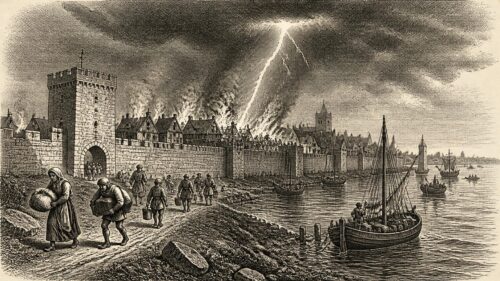
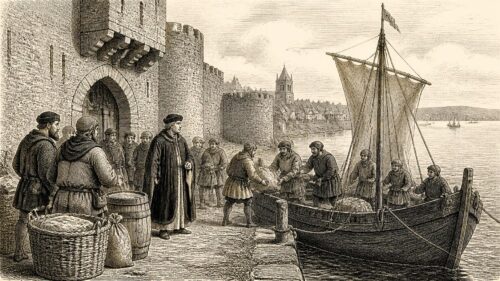
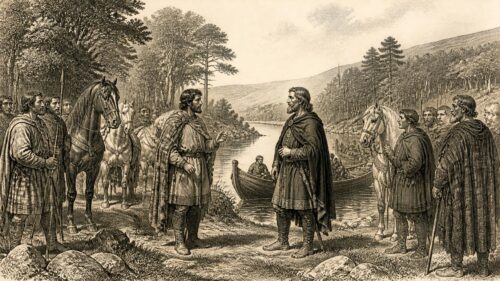
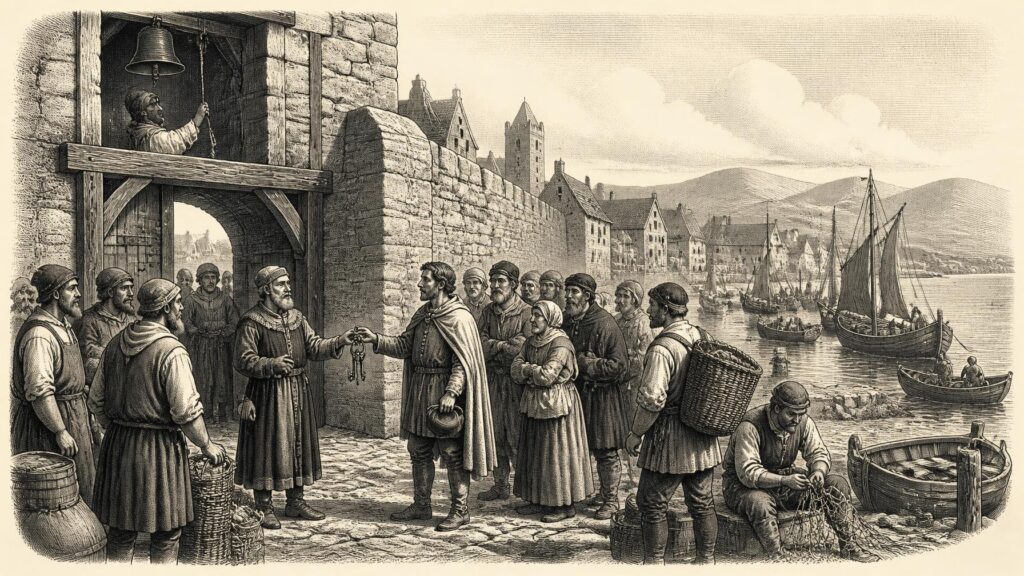
On Monday, 10 May 1389, according to a later court record, the common bell of Galway was rung and the town’s burgesses and wider community delivered the keys of every gate to William Burke, lord of Upper Connacht. The gesture was not merely ceremonial. The keys were handed over, the record alleged, so that the king’s ministers could not enter the town. Galway had already, on 5 November 1388, sworn fealty to Burke and assigned him the profits of its fish-weirs, mills, rents and services, apart from the customs duty known as the coket. The May action therefore belongs firmly to 1389: a walled port on Ireland’s western seaboard publicly shifting its immediate allegiance in a time of fractured authority.
The evidence needs careful handling. The account survives through proceedings later taken against Henry Blake of Galway, and it describes the events in the accusatory language of royal justice: “sedition”, felony and resistance to the king. Nor should its formula that the “whole community” assented be read as a modern vote count. Yet the record is unusually revealing. It distinguishes burgesses from the broader community and places the town bell at the centre of collective action. Whether or not every inhabitant agreed, a substantial civic mobilisation seems hard to deny. In 1389, Galway’s people were not simply passive subjects caught between lords; they appear as political actors deciding whom their gates, revenues and loyalty would serve.
A Port Chooses Its Lord
Galway’s predicament had deep roots, but the decision of May 1389 was an immediate response to a dangerous regional world. The town lay within the inheritance claimed by Roger Mortimer, earl of March and Ulster, who was still a minor. During his minority, the Crown held the lordship’s revenues and rights in custody. William Burke, however, was a powerful local lord of the Clanricard Burkes. The Burkes were descendants of the Anglo-Norman de Burgh connection, but their Connacht lordships had long operated within Gaelic political society as well as the English lordship.
The town’s transfer of fealty to Burke was thus directed against both royal administration and Mortimer’s seigneurial claim. It was more serious than paying for protection. The delivery of fish-weirs and mills mattered because these were productive assets: weirs secured valuable fisheries, while mills turned grain into saleable flour and rendered dues to lordship. Rents and services likewise formed the ordinary income of urban rule. Galway withheld the coket, the customs charge on merchandise, a detail that may suggest caution rather than a wholly clean break with the Crown. The town’s leaders and inhabitants may have been attempting to accommodate a force they could not ignore while avoiding the most explicit possible rupture with royal fiscal authority.
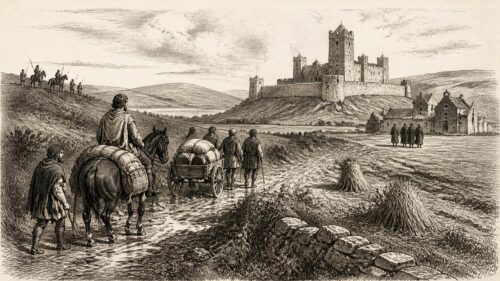
Galway was an important place to make such a choice. It had served as one of Ireland’s staple ports in 1375–77, designated for the regulated export of merchandise, and it retained connections by sea and through royal administration despite the weakness of English power west of the Shannon. But its position also exposed it. The town depended on defensible walls, maritime access, local food supply and the willingness of surrounding lords to permit movement through the countryside. A later royal charter described Galway as surrounded by Irish enemies and English rebels, a formulation from the 1390s but one that captures the insecurity already visible in 1389. Trade and ordinary travel required protection by land and water.
Connacht’s Contested Landscape
The immediate background was a Connacht divided by rival lordships. After the death of Ruaidhrí Ó Conchobhair, king of Connacht, in 1384, competing Ó Conchobhair branches struggled for predominance. The Annals of Loch Cé had described a general war spreading through Connacht in 1388. This broader conflict should not be mistaken for a single war with a single front: it was a shifting pattern of alliances, raids, hostage-taking and local settlements. Galway’s decision to recognise William Burke belongs responsibly within that unsettled setting, though the surviving evidence does not tell us precisely what threat or negotiation prompted the gathering on 10 May.
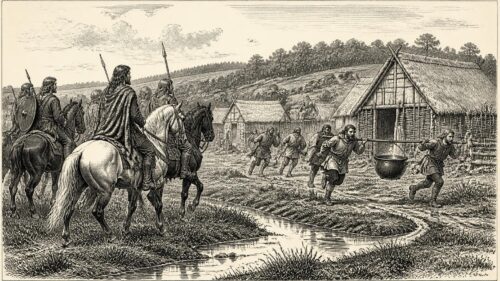
Elsewhere in Connacht and its borderlands, 1389 brought evidence both of conflict and of deliberate peacemaking. Eóghan Ó Ruairc and the sons of Cathal Óg Ó Conchobhair went to Caisleán an Uabhair, where they fought the cavalry of Muintir Héilí. The annals report the deaths of a son of Ó hÉilí and of Maghnus Ó hÉilí, followed by the plundering of Muintir Héilí and the killing of Muirchertach Ó hÉilí. Yet this was not an unbroken campaign. Ó Ruairc, Domhnall son of Muirchertach Ó Conchobhair, and Clann Donnchadha subsequently made peace.
A separate settlement followed between Clann Donnchadha and Mac Diarmada. Its terms were material and personal: Conchobhar Mac Donnchadha and Murchadh son of Cormac were released. Another annalistic version adds that Cathal Mac Diarmada, captured by Mac Donnchadha, had suffered a broken leg and was freed in exchange for another prisoner. Such details show how peace worked in practice. It did not necessarily arise from reconciliation or lasting political unity. It restored captives, repaired immediate balances of power and allowed antagonists to pause without surrendering their wider claims.
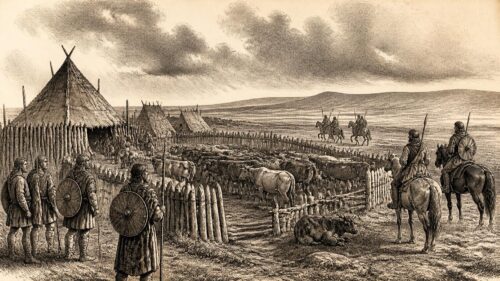
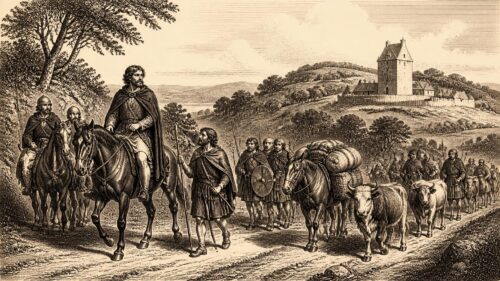
For farming households, tenants and dependants, these struggles could carry severe consequences even where the annals record no battle nearby. Military followings needed food, horses, lodging, intelligence and payment. Control of a mill, a fishery, a road or a gate had direct economic meaning. The sources for 1389 do not provide a nationwide account of harvests, prices, weather or population, so none should be invented. They do, however, preserve a political economy in which the command of labour, provisions, transport routes and revenue-bearing property was inseparable from lordship.
Captivity, Treachery and Succession
The year’s annals repeatedly use the language of treachery, indicating how dangerous personal politics could be. Maghnus Ó Ruairc was taken prisoner by Cormac Ó Fearghail “by deceit”. Niall Óg Ó Néill was taken prisoner by the English or “Foreigners”, as the annalists termed the English of Ireland. Henry Ó Néill raided Muintir Duirnín at Monach-Maighe-Héine, while Domhnall son of Muirchertach plundered Tír Chonaill. Brian, son of Domhnall Óg Ó Ruairc, was killed by Clann Muirchertaigh. These entries do not add up to an island-wide campaign; rather, they reveal overlapping theatres of competition from Breifne towards Ulster and Donegal.
Several deaths altered local leadership. Maurice Mael Ó Conchobhair Fáilghe was killed by a single arrow-shot at the church of Cluain Dá Thorc, by one of the Uí Cheallaigh of Lé. The site was a church, but its sanctity did not guarantee safety: ecclesiastical places were woven into settlement, travel and political life. In Corcomroe, Mael Sechlainn Cam Ó Lochlainn was killed treacherously by his own brother. The Annals of Ulster date this killing to the Sunday before Michaelmas, 26 September 1389. In Fermanagh, Gilla-Ísu Mag Uidhir, chief of Muintir Peodacháin, died on 10 December. Such notices matter because lordship rested on kinship, clientship and reputation; the death or seizure of one leading man could invite renegotiation among relatives and rivals.
Religion appears in the record less as a separate sphere than as part of the social fabric. Nehemias Ó hEógain, vicar of Inis Caoin on Lough Erne, died on 29 January, while the vicar of Inis Cain is also noticed in the Four Masters. Annalists marked deaths of clerics, lords and warriors in the same compressed chronological form. Their work itself was a cultural institution: learned writers preserved genealogical identities, territorial titles and moral judgements about killings, piety, hospitality and treachery. The precision of some feast-day dating sits beside the uncertainty of local geography and motive, a reminder that medieval historical memory was both careful and selective.
A Weak Centre, Strong Local Powers
Galway’s revolt unfolded while the English lordship’s central government was unsettled. Robert de Vere, Richard II’s favourite and duke of Ireland, had been forfeited in February 1388 after his fall in English politics. The exceptional grant that had made him marquess of Dublin and duke of Ireland had therefore collapsed without providing stable government in Ireland. In 1389 Richard II was beginning to reassert personal rule in England, but this did not immediately create security in Connacht or elsewhere.
Later that year, on 31 July, Sir John Stanley entered an indenture to serve for three years as justiciar of Ireland; his appointment was issued on 1 August, and the principal Dublin offices were again filled around him. This administrative reconstruction was important, but it came after Galway’s May handover of its keys. The sequence helps explain the town’s calculation. Royal government existed in documents, seals and offices, but its ability to protect a western town depended on local allies, money and armed capacity. Those were precisely the resources that regional lords could more readily command.
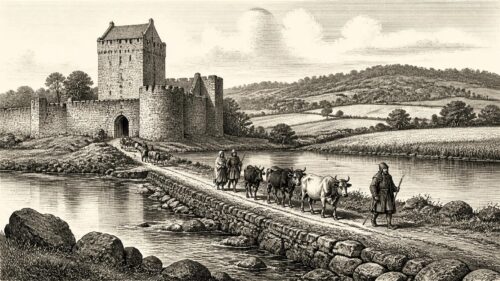
Ireland in 1389 was therefore not moving uniformly towards either royal recovery or Gaelic independence. Galway’s bell and keys, Connacht’s settlements, the imprisonment of magnates and the killing of local rulers point instead to a patchwork of authority. Lords made and broke agreements; towns weighed their allegiances; churches and castles stood within contested landscapes; and ordinary livelihoods depended on the outcome. The clearest event of the year, Galway’s delivery of its gates to William Burke, captures that wider condition: power was exercised not only from Dublin or Westminster, but at a town bell, a mill, a fish-weir and a locked gate on the Atlantic edge of Connacht.
Primary Sources
- Annals of Loch Cé A.D. 1014–1590
- The Annals of Ulster, Volume 3 English Translation
- Annals of the Four Masters, Volume 4 English Translation
- Annals of Ulster: Irish Text
- Annals of the Four Masters: Irish Text
- Urban Rebels in Medieval Connacht: The Revolt of Galway, 1388–9
- Richard II
- The ‘Calculus of Faction’ and Richard II’s Duchy of Ireland, c.1382–9
- From Boom to Bust: The Lordship of Ireland and the European ‘Commercial Revolution’
- Researchers Use Parish Incomes to Map 14th Century Ireland in Unprecedented Detail
- The Medieval Irish Plea Rolls: An Introduction
- Gaelic Society and Economy
- Gaelic Lordships in Ulster in the Later Middle Ages
- Seaborne Trade and the Commercialisation of Fifteenth- and Sixteenth-Century Gaelic Ulster
- Lordship in Medieval Ireland
- Gaelic Lordly Settlement in 13th- and 14th-Century Ireland
- Patent Roll 18 Richard II (1394–1395), Item 83
- Patent Roll 19 Richard II (1395–1396), Item 9
- Calendar of the Close Rolls Preserved in the Public Record Office: Richard II, 1385–1389
- The Annals of the Four Masters